Few tools earn their keep like a 4.5-inch angle grinder. It slices through a rusted bolt, grinds a weld flat, cuts rebar to length, and strips old paint, all from one compact body you can hold in one hand. The trick is matching the right amount of power to the work.




What separates grinders comes down to motor power, the switch and safety features, and comfort in the hand over a long job. The five picks below range from a budget starter to a variable-speed professional tool, so there is a fit for a weekend DIYer removing rust, a fabricator cutting metal all day, and a homeowner tackling the occasional repair.
| Grinder | Standout feature | Price tier | Link |
|---|---|---|---|
| DEWALT DWE402 | Strong 11-amp motor, paddle switch | Premium | |
| AVID POWER | Value kit with wheels included | Budget | |
| SKIL 9295 | Lowest price, metal gear housing | Budget | |
| Bosch GWS8-45 | Slim-grip pro tool, service-minder brushes | Mid-range | |
| Makita 9564CV | Variable speed, clutch, soft start | Premium | |
How to choose a 4.5-inch angle grinder
The specs on the box translate directly into how the tool handles metal and how long it lasts.
Motor power (amps)
Amperage is the headline power number, and more amps mean the grinder holds its speed under load instead of bogging down in a heavy cut. Budget tools run around 6 to 7.5 amps, fine for light-to-medium DIY, while pro-grade grinders climb to 11 amps or beyond for faster material removal. The DEWALT’s 11 amps and the Makita’s 13 amps power through demanding cutting and grinding, while the 6-amp SKIL suits occasional lighter jobs.
The switch: paddle or slide
The on-off switch shapes both safety and feel. A paddle switch, on the DEWALT, must be held down to run and releases instantly when you let go, a genuine safety benefit if you lose grip. A slide or lock-on switch, common on many others, lets you run continuously without holding, which some prefer for long grinding sessions. Choose based on whether you value the dead-man safety of a paddle or the convenience of a lock-on.
Safety features that matter
Grinders throw sparks and spin fast, so protection counts. Look for a tool-free adjustable guard to deflect sparks, a spindle lock for quick disc changes, and, on higher-end tools, a clutch that lets the disc slip if it binds to protect the motor and your wrist. The Makita’s SJS clutch and soft start reduce kickback and startup jolt, while service-minder or auto-off brushes, on the Bosch and DEWALT, shut the tool down before worn brushes cause damage.
Wheel changes and compatibility
You will swap discs often, so easy changes save real time. A spindle lock plus a tool-free or quick-change wheel release lets you switch from a cutting wheel to a grinding or flap disc fast. All of these use the standard 5/8-inch 11 spindle thread that fits the wide range of 4.5-inch wheels sold everywhere, so consumables are cheap and easy to find.
Comfort, size, and control
An angle grinder is a two-handed tool under load, so a slim body and a multi-position side handle that suits left or right-handed use reduce fatigue and improve control. The Bosch and DEWALT emphasize slim grips, and adjustable side handles across these picks let you brace the tool at the best angle for the cut. A lighter tool, like the Makita’s manageable weight, is easier to maneuver during long jobs.
Variable speed and extras
Most grinders run at a single speed near 11,000 rpm, which is ideal for cutting and grinding metal. Variable speed, found on the Makita, lets you slow the tool for polishing, wire wheels, or working softer materials without throwing them. Bundled accessories, like the cutting and grinding wheels and flap disc in the AVID POWER kit, get you working immediately without a separate trip for consumables.
DEWALT DWE402
The DEWALT DWE402 is the best-seller here and a well-rounded workhorse. Its 11-amp motor spinning at 11,000 rpm delivers a strong power-to-weight ratio for fast material removal, and a paddle switch adds a dead-man safety that stops the tool the instant you release it. A dust ejection system pushes damaging debris out of the motor for longer life, oversized brushes double brush life over the previous model, and auto-off brushes shut the tool down before wear causes damage. A one-touch guard rotates 360 degrees, and a quick-change wheel release and protected spindle lock make disc swaps fast. For a dependable everyday grinder, it is the confident pick.
Pros:
- Strong 11-amp motor for fast cutting and grinding
- Paddle switch for dead-man safety
- Dust ejection and long-life brushes
- Tool-free guard and quick wheel changes
Cons:
- Paddle switch must be held, no lock-on
- Priced above budget models
Best for: most users wanting a powerful, durable, safety-minded everyday grinder.
AVID POWER Angle Grinder Kit
The AVID POWER kit is the value pick that gets you cutting on day one. Its 7.5-amp motor reaches up to 12,000 rpm, plenty for home DIY and light-to-medium tasks like sharpening blades, cutting rebar and pipe, and removing rust and paint, and it handles masonry with diamond discs too. The standout is the bundle: two metal cutting wheels, two grinding wheels, a flap disc, an auxiliary handle, an adjustable guard, and a wrench, so you are ready to work without extra purchases. A standard arbor and integrated spindle lock make disc changes quick, and a tool-free guard plus a two-position side handle suit both left and right-handed users. For a first grinder, the all-in value is strong.
Pros:
- Includes cutting, grinding, and flap wheels
- Capable 7.5-amp, 12,000 rpm motor
- Tool-free guard and spindle lock
- Two-position handle for either hand
Cons:
- Not built for continuous heavy-duty use
- No paddle-switch dead-man safety
Best for: DIYers who want a ready-to-use grinder and wheels for little money.
SKIL 9295
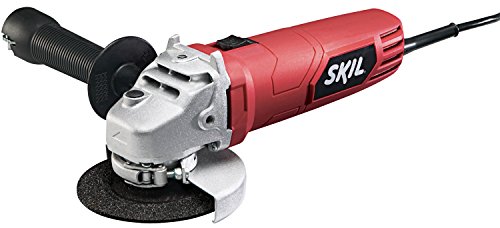
The SKIL 9295 is the lowest-priced way into a capable grinder, and it does the basics well. A 6-amp motor spins at 11,000 rpm, enough for occasional cutting, grinding, and rust removal around the house, and a heavy-duty metal gear housing adds ruggedness and durability beyond what the price suggests. A tool-less guard adjusts quickly for different jobs, a compact grip gives comfortable control, and a vibration-reducing handle with onboard wrench storage means the wrench is always where you need it. It is not built for all-day fabrication, but for a homeowner’s toolbox it delivers reliable performance for very little. As a starter grinder, it is hard to beat on price.
Pros:
- Lowest price in the group
- Durable metal gear housing
- Tool-less guard adjustment
- Vibration-reducing handle with wrench storage
Cons:
- 6-amp motor is best for lighter jobs
- Fewer premium safety features
Best for: homeowners who need an occasional grinder at the lowest cost.
Bosch GWS8-45
The Bosch GWS8-45 is the comfortable professional’s choice at a sensible price. A 7.5-amp motor delivers 11,000 no-load rpm with steady power, and a slim-grip body provides outstanding comfort for extended use, which matters when you are grinding for an hour. Durable carbon brushes extend tool life, and service-minder brushes stop the grinder when maintenance is due, so you never burn out the motor by accident. Directed airflow diverts dust away from vital components for durability, a burst-protection guard adjusts quickly for safety, and a large spindle lock plus a two-position side handle make disc changes and control easy. For a refined, reliable daily driver, it delivers.
Pros:
- Comfortable slim-grip body for long use
- Service-minder brushes protect the motor
- Directed airflow keeps dust off components
- Large spindle lock for easy disc changes
Cons:
- 7.5 amps trails the highest-power tools
- No included accessory wheels
Best for: users who value comfort and durability for regular grinding work.
Makita 9564CV
The Makita 9564CV is the premium, feature-rich tool for demanding work. A powerful 13-amp motor delivers strong output with variable speed from 2,800 to 10,500 rpm, so you can slow it down for polishing or wire-wheeling and open it up for heavy cutting. Constant speed control automatically feeds more power under load to hold rpm, while a soft start suppresses the startup jolt for smoother, safer beginnings and longer gear life. The standout is the SJS mechanical clutch, which lets the drive shaft slip if the wheel suddenly stops, protecting the motor, the gears, and your wrist from kickback. For serious fabrication and control, it is the top tier here.
Pros:
- Powerful 13-amp motor with variable speed
- SJS clutch protects against kickback
- Constant speed control holds rpm under load
- Soft start for smooth, safer starts
Cons:
- Highest price in the group
- More tool than occasional users need
Best for: fabricators and heavy users who want variable speed and clutch protection.
The verdict
Best overall: the DEWALT DWE402 takes the top spot as the proven best-seller. Its strong 11-amp motor, paddle-switch safety, dust ejection, and quick wheel changes make it the balanced choice for the widest range of users.
Best value: the AVID POWER kit includes the wheels to start cutting immediately, and the SKIL 9295 is the cheapest capable option.
Best premium: the Makita 9564CV adds variable speed and clutch protection for demanding work, while the Bosch GWS8-45 is the comfortable everyday professional.
Frequently asked questions
How many amps do I need?
For occasional light DIY, 6 to 7.5 amps is enough. For frequent cutting, grinding welds, or all-day work, 11 amps or more, like the DEWALT or Makita, holds speed under load and finishes faster. Match the power to how hard and how often you will use it.
Is a paddle switch or a slide switch better?
A paddle switch, on the DEWALT, is a safety feature that stops the tool the moment you let go, which is reassuring if you lose grip. A slide or lock-on switch lets you run continuously without holding it, which some prefer for long grinding. It comes down to safety versus convenience.
Can these cut metal and grind, or just one?
Both, by swapping the wheel. A thin cutting wheel slices metal, bolts, and rebar, while a thicker grinding wheel smooths welds and edges, and a flap disc finishes surfaces. All of these use standard 4.5-inch wheels, and the AVID POWER kit includes a starter set.
What safety gear should I use?
Always wear eye protection and gloves, and add a face shield and hearing protection for heavy cutting, since grinders throw sparks and are loud. Keep the guard in place to deflect sparks, secure your workpiece, and let the tool reach full speed before it touches the metal.
What does a clutch do on a grinder?
A clutch, like the Makita’s SJS system, lets the drive shaft slip if the wheel suddenly binds or stops, which reduces dangerous kickback and protects the motor and gears. It is a valuable safety and durability feature for heavier, more frequent work.
Corded or cordless for a 4.5-inch grinder?
These are all corded, which is the right call for sustained cutting and grinding: a cord delivers constant full power with no battery to drain mid-cut, and corded tools cost less for the performance. Cordless grinders add convenience for quick jobs away from an outlet, but for shop work and long sessions, corded power like these models is hard to beat, and you never have to stop to swap or recharge a battery in the middle of a job.
This article may contain affiliate links; see our Affiliate Disclosure.