A flat iron asks you to section your hair, clamp it, and drag the plates down a hundred small pieces while the clock runs. A straightening brush asks you to brush your hair. That is the whole pitch, and on a weekday morning it is a persuasive one.


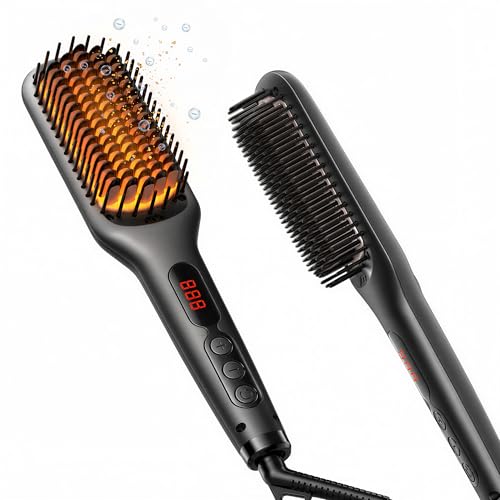


What separates a good straightening brush is heat that stays even across the whole plate, bristles that actually grab hair rather than slide past it, and enough temperature control to suit fine hair and thick curls without cooking either. It suits anyone chasing smooth and sleek rather than glass-flat, whether that is a five-minute weekday fix or a second-day refresh.
At a glance
| Product | Standout feature | Price tier | Link |
|---|---|---|---|
| TYMO Ring | 3D brush teeth, heats in 20 seconds, full travel kit | Mid-range | |
| TYMO Ionic Plus | Twice the bristle density, 16 temperatures, T-sensor | Premium | |
| MEGAWISE Pro Ceramic Ionic | Cheapest here; 20-second heat-up, auto-off, long cord | Budget | |
| TYMO FLIPRO 2-in-1 | Flat iron plates plus comb teeth; straightens and curls | Premium | |
| L'ANGE Le Vite | LCD interface, precise temperature up to 450 degrees | Mid-range | |
How to choose a hair straightening brush
Know what a brush does and does not do
A straightening brush smooths. It removes frizz, drops volume, and leaves hair sleek with body still in it, which is closer to a blowout than to a flat iron finish. What it will not reliably give you is the pin-straight, glassy look, because bristles cannot compress a strand between two plates the way an iron does. For most people that is a feature: brushed-out hair looks less flat and less styled. If you want a mirror finish on tightly coiled hair, an iron is still the tool, and a hybrid design is the closest compromise.
Temperature range matters more than the top number
Every brush here advertises its heat. The number that matters is the lowest one. Fine, bleached, or fragile hair wants a low setting, and a brush that starts hot has nothing safe to offer it. Thick, coarse, or curly hair needs the top of the range to do anything at all in one pass. Five settings covers most people; sixteen settings is for someone matching heat precisely to their hair. A digital display removes the guesswork of counting clicks.
The rule that saves hair: use the lowest setting that works in one slow pass. Two passes at low heat do less damage than one at maximum, and going over the same section repeatedly is what actually causes breakage.
Bristle design is where these differ most
Bristles do two jobs: hold the strand against the heated surface, and keep the heat off your scalp. Denser bristles grab more hair per pass, which helps on thin hair that slips through gaps and on thick hair that needs real tension. Three-dimensional teeth, where bristles sit at varying heights, reach hair a flat row of bristles skims past. Ceramic and tourmaline coatings let the brush glide without snagging. Anti-scald tips on the bristle ends are the difference between styling confidently near the roots and flinching.
Ions, ceramic, and what the marketing means
Negative ion generators are standard in this category. The claim is frizz and static reduction with more shine, and the mechanism is uncontroversial enough: ions help lay down the cuticle and reduce static charge. Take the ion counts as marketing rather than a comparable spec. Ceramic matters more, because it heats evenly and holds temperature, and even heat is what avoids the hot spots that scorch one section while another goes untouched.
Heat-up time, auto-off, and voltage
Twenty seconds to temperature is now normal, and it changes how a tool fits into a morning. Auto shut-off after a period of inactivity is a safety feature worth insisting on, since a heated brush left face-down is a genuine hazard. Dual voltage matters only if you travel abroad, but it costs nothing and every brush here has it. A swivel cord stops the cable from wrapping as you work around the back of your head, which sounds trivial until you have fought one.
Dry hair only
This is worth stating plainly, because it is the most common mistake. These brushes are for dry hair. Applying high heat to wet hair boils water inside the strand and causes real damage, and MEGAWISE explicitly warns against it. Wet-to-dry tools exist and are a different product. Dry the hair first, then style.
TYMO Ring Hair Straightener Brush
The best seller of this group, and the most balanced tool here. It works as a comb and a flat iron at once, producing a straight finish with a blowout look in a single pass rather than the flattened result an iron gives. The 3D brush teeth are the reason: bristles at varying heights catch hair a flat row would miss, and TYMO claims twice the straightening effect of a traditional hot comb. PTC heating spreads temperature evenly across the surface, which is what keeps damage down, and five settings cover fine through thick hair. It reaches temperature in twenty seconds, shuts off after thirty minutes idle, and has an anti-scald exterior. The box includes a detangling brush, two clips, a heatproof glove, and a travel bag.
- Pros: Comb and flat iron in one for a straight blowout finish in a single pass; 3D brush teeth reach more hair per stroke; PTC heating for even temperature and less heat damage; five settings across hair types; twenty-second heat-up; auto shut-off after thirty minutes; anti-scald exterior; dual voltage plus a complete travel kit.
- Cons: Five settings is less granular than the premium models; no digital display, so temperature is set by clicks; standard bristle density is a limitation on very thick or tightly curled hair.
Best for: Most people, most mornings, and anyone who wants a smooth blowout look rather than a flat one.
TYMO Ionic Plus Straightening Brush
This is the brush for hair at the extremes. Bristles are twice as dense as standard, which fixes the two opposite problems: fine hair that slides through gaps without being gripped, and thick curly hair that needs serious tension to straighten. More hair per pass also means fewer passes, which is both faster and gentler. Sixteen temperature settings and T-sensor technology, monitoring heat by the millisecond and adjusting continuously, make this the most precise heat control here. Tourmaline ceramic bristles glide without snagging or breakage, and 10M+ ions handle frizz and shine. The buttons sit at the end of the handle so they cannot be pressed accidentally while styling at an awkward angle, and the whole thing is built anti-scald.
- Pros: Twice the bristle density, effective on both thin hair and thick curly hair; 16 temperature settings, the finest control here; T-sensor adjusts heat by the millisecond to avoid overheating; tourmaline ceramic bristles resist snagging and breakage; keeps body rather than flattening hair; ergonomic anti-scald design with buttons placed out of the way; dual voltage.
- Cons: The most expensive brush in this comparison; sixteen settings is more than most people will ever use; denser bristles need a slower, more deliberate stroke to work.
Best for: Thick, curly, or very fine hair, where standard bristle density gives disappointing results.
MEGAWISE Pro Ceramic Ionic Hair Straightener Brush
The budget entry, at well under half the price of the premium brushes, and it does not feel stripped out. Negative ion technology handles frizz and static, and the advertised result is smooth, neat, shiny hair rather than anything more ambitious. Heating elements are built for quick heat-up and consistent temperature across the surface, which is the specification that matters most, since uneven hot spots are what ruins cheap heated tools. Multiple settings cover fine, normal, and thick hair. It is compact and light for travel, has anti-scald outer teeth and an insulated structure protecting scalp and hands, and runs a 74.8-inch cord that reaches whichever socket is awkwardly placed. Auto-off and universal dual voltage come as standard, and the power cord rotates.
- Pros: Cheapest brush here by a wide margin; even heat distribution with no hot spots; negative ion technology for frizz and static; multiple settings across hair types; anti-scald outer teeth and insulated build; 20-second heating; auto-off; unusually long, rotatable cord; genuinely light for travel.
- Cons: Settings are not specified as precisely as the premium options; no digital display; standard bristle density, so very thick or coiled hair will need more passes; explicit warning against use on wet hair.
Best for: A first straightening brush, a travel spare, or normal hair that does not need fine heat control.
TYMO FLIPRO 2-in-1 Flat Iron Straightener Brush
The hybrid, and the answer to the brush’s main weakness. It carries ceramic flat iron plates and comb teeth in one body, so it flattens roots properly for a genuinely sleek finish while still straightening twice the hair per pass with one-handed ease. Because it has plates, it also curls and waves, which no plain brush can do. The plates are coated with argan oil and keratin, the comb teeth carry a keratin coating with T-sensor technology, and TYMO claims three times less heat damage and twice the smoothness against a conventional iron. Five precision settings run from 265 to 410 degrees with a smart LED display, ion technology targets frizz, and a 360-degree swivel cord plus universal voltage make it a real travel tool.
- Pros: Flat iron plates plus comb teeth, so it flattens roots and delivers a sleeker finish than a plain brush; straightens, curls, and waves from one tool; oil and keratin coatings with T-sensor for reduced heat damage; LED display with five precise settings; strong ion technology for frizz and moisture; heat-proof comb design; swivel cord and dual voltage.
- Cons: Priced near the top of the group; the marketing swings between calling it two-in-one and five-in-one, which muddies what you are buying; hybrids ask more technique than a plain brush; more tool than someone who only wants quick smoothing needs.
Best for: Anyone who wants a flat iron finish, plus curls, without owning two tools.
L'ANGE Le Vite Straightening Brush
The salon-brand option, and the simplest to operate well. An LCD digital interface sets a precise temperature up to 450 degrees, so you are choosing a number rather than guessing at a click, and that is the fastest way to find the setting your hair likes and stay there. It heats quickly and evenly, and the pitch is one slow-to-moderate pass from root to tip on dry hair, which is the correct technique for any brush in this category. Double negative ion technology traps moisture and seals the cuticle, aimed at hair that stays smooth rather than merely looking smooth for an hour. L’ANGE states it works across straight, curly, wavy, and tightly coiled hair, and backs it with a money-back promise.
- Pros: LCD digital interface for exact temperature selection; heats quickly and evenly; double negative ion technology to trap moisture and seal the cuticle; rated for all hair types including tightly coiled; ceramic; dual voltage; money-back promise; mid-range price for a salon brand.
- Cons: A 450-degree ceiling is more heat than most hair should ever see; no auto shut-off mentioned, unlike the others here; no travel kit or accessories; standard size only.
Best for: Anyone who wants to dial an exact temperature and leave it there.
Verdict
Best Overall: TYMO Ring. The best seller of this group, and the easiest to recommend. It heats in twenty seconds, the 3D teeth grab more hair than a flat bristle row, PTC heating keeps the surface even, and five settings cover the range most people need. It gives a smooth blowout finish rather than a flat one, shuts itself off, and arrives with a glove, clips, a detangling brush, and a bag. Nothing here does the common job better.
Best Value: MEGAWISE Pro Ceramic Ionic. The cheapest brush in the comparison still brings even heat, ion technology, anti-scald teeth, auto-off, dual voltage, and a 20-second heat-up. For normal hair, or as a travel spare, it covers the fundamentals for a fraction of the premium price.
Best Premium: TYMO Ionic Plus. Double-density bristles and sixteen T-sensor-controlled temperatures make it the pick for hair that other brushes disappoint: too fine to grip, or too thick and curly to straighten in one pass. It costs the most and earns it in exactly those cases.
If you want a genuine flat iron finish and curls from one tool, the TYMO FLIPRO is the hybrid worth the extra technique.
Frequently asked questions
Can these be used on wet hair?
No. Every brush here is a dry-hair tool, and MEGAWISE says so explicitly. High heat on wet hair turns the water inside each strand to steam and damages it from within. Dry your hair first, even roughly, then style. Tools designed to go from wet to dry are a separate category built differently.
Is a straightening brush less damaging than a flat iron?
Usually, for two reasons rather than magic. A brush covers more hair per pass, so there are fewer passes over any section, and it does not clamp the strand between two hot plates. Several models here claim substantially reduced heat damage on that basis. It still applies real heat, so a heat protectant and the lowest workable setting remain the sensible approach.
Will it work on curly or coiled hair?
Yes, with the right expectations and the right brush. A straightening brush relaxes curls into a smooth, sleek shape rather than producing a glassy flat finish. Denser bristles and a high top temperature matter far more on coiled hair, which is where the Ionic Plus and the FLIPRO pull ahead. Tightly coiled hair may still want a flat iron for a truly straight result.
How long does the result last?
Typically until the next wash, and less in humidity, which is where the ion technology earns its place by reducing frizz and static. A finishing product or serum helps hold it. Many people find a straightening brush most useful on second-day hair, refreshing a style in a couple of minutes rather than starting over.
Do I still need a flat iron?
Only for a mirror finish, sharp ends, or tight curl patterns you want completely straight. For everyday smoothing, frizz control, and a blowout look, a brush is faster and easier, and it is the tool most people reach for once they own both. The hybrid designs exist precisely to blur that line.
This article may contain affiliate links; see our Affiliate Disclosure.