Ten minutes of skipping will do to your lungs what half an hour on a treadmill does, using a piece of equipment that fits in a coat pocket and costs less than a protein shake. The catch is that the wrong rope, at the wrong length, will whip your ankles until you quit.



Jump ropes split into three types that train different things: fast thin cables for speed and footwork, heavier ropes that load the shoulders and arms, and cordless designs that let you skip in a room with a normal ceiling. What separates a good rope from a frustrating one is the bearings, the cable, and whether you can set the length properly. The picks below suit a beginner in a garage, a boxer’s warm-up, a small flat with low ceilings, or a daily cardio habit.
At a glance
| Product | Standout features | Price tier | Link |
|---|---|---|---|
| Loocio Speed Jump Rope | Best seller; ball bearings; PVC-coated steel; foam handles | Budget | |
| SPORTBIT Adjustable Jump Rope | Lowest price; cut to size with scissors; 118 in; washable handles | Budget | |
| YOTTOY Cordless Jump Rope | Cordless and corded in one; digital counter; low-ceiling friendly | Budget | |
| Redify Weighted Jump Rope | 1 lb total; two ropes included; aluminum handles; double bearings | Premium | |
| Elite Jumps 6mm PVC Rope | Thick 6mm cord; non-kinking; unbreakable handles; indoor or outdoor | Premium | |
How to choose a jump rope
Speed, weighted, or cordless: three different workouts
Start here, because these are not competing versions of one product. A speed rope uses a thin PVC-coated steel cable that moves faster than you can, which is what you want for double-unders, footwork, and pure cardio; the Loocio, SPORTBIT, and Redify’s lighter model all work this way. A weighted rope, like the Redify at a pound in total, slows the turn down and loads your shoulders, forearms, and grip, which is why boxers use them and why they build strength that a speed rope does not. A cordless rope, like the YOTTOY, swings a weighted ball on a short stub instead of a full cable, so it works in a room with a low ceiling and it cannot whip your ankles. Beginners often learn faster on a slightly heavier rope, because you can feel where it is.
The cable is the rope
Cable construction decides speed, durability, and where you can use it. PVC-coated steel wire, on the Loocio, is the standard: fast, thin, and durable, but the coating is what stands between the steel and the concrete, so rough ground eats it. A thick 6mm PVC cord, on the Elite Jumps rope, has an inner string core and is built to survive both smooth indoor floors and rough outdoor surfaces, with enough thickness that beginners can feel it spinning, and it does not kink. Braided cotton, on the Redify, is the heaviest option and the gentlest on the floor and on you. Redify actually ships both a 9mm braided cotton rope and a 9mm solid PVC rope, so you switch between them, which roughly doubles the working life of the set.
Bearings are why a rope feels good or awful
Almost every pick here advertises ball bearings, and it is not marketing. Bearings let the cable spin freely while the handle stays still in your hand. Without them the cable twists against the handle, snags, and eventually knots mid-set. The Redify weighted rope uses a double ball bearing arrangement, which it needs because a heavier rope loads the pivot harder, and SPORTBIT’s handles spin a full 360 degrees. If a rope has no bearings at all, it will tangle, and no other feature makes up for that.
Length, and the mistake everyone makes
A rope that is too long is the reason most people conclude they cannot skip. The standard check is to stand on the middle of the cable: the handles should reach roughly your armpits. Longer than that and the rope slaps the floor and slows; much shorter and it clips your head. Every rope here adjusts, but the mechanisms differ and it matters. SPORTBIT’s 118 inch cable is simply cut to length with kitchen scissors, which is permanent and precise. Redify uses a built-in lock that moves and adjusts quickly, and the LIFEEZY design uses a screw-free self-locking system. Adjustable-and-reversible suits a shared household; cut-to-fit suits a rope that is yours alone.
Handles: where the sweat goes
Handles decide whether a long session is pleasant. Foam-covered ergonomic handles, on the Loocio, are soft, non-slip, and wick moisture, which is the comfortable budget answer. SPORTBIT uses 4.8 inch sweat-resistant handles sized for adult hands and washable, a genuinely practical detail. YOTTOY uses non-slip silicone, non-toxic and odorless. The Redify goes furthest with aluminum handles and silicone grips, with raised oval detailing for friction so the handle does not slide out when your hands are wet, which is exactly what a heavier rope demands. Handle length matters more than it sounds: short handles are twitchy and hard to control at speed.
Loocio Speed Jump Rope
The best seller of this group by a wide margin, and it is a lesson in doing the basics right for pocket money. The cable is steel wire coated in strong PVC, which survives long sessions and resists the cracking that kills bare plastic ropes. High-quality ball bearings let it spin fast and tangle-free, which is the whole difference between a rope you use and a rope you fight. The handles are ergonomic and covered in soft sponge, non-slip and moisture-wicking, so your grip holds when your hands are wet. The length adjusts to suit adults, kids, beginners, or experienced jumpers, and the whole thing rolls into a pocket. There is nothing here that is not also on ropes costing three times as much.
Pros:
- Best-selling jump rope in this comparison by a clear margin
- PVC-coated steel cable resists cracking and wear
- Ball bearings give fast, tangle-free rotation
- Soft foam ergonomic handles, non-slip and moisture-wicking
- Adjustable length suits adults and kids
- Budget price and pocket-sized
Cons:
- Thin coated cable wears fast on concrete
- No weight for strength work
- Foam handles absorb sweat over time
Best for: most people: a first rope, a gym bag rope, or daily cardio without a decision to agonize over.
SPORTBIT Adjustable Jump Rope
The cheapest rope here, and the one with the most sensible take on sizing. It arrives at 118 inches and you cut it to your height with kitchen scissors, which sounds crude and is actually the most precise adjustment method there is: no coiled tail flapping from the handle, no lock slipping mid-set. The cable is flexible and built not to tear or break, the handles spin a full 360 degrees for a smooth turn, and the 4.8 inch ergonomic handles are sized for adult hands, non-slip, sweat-resistant, and washable. It is aimed at cardio, boxing, endurance, and agility work equally. The obvious caveat: once you cut it, it is your length forever, so measure carefully and do not share it with someone much taller.
Pros:
- Lowest price in this comparison
- Cut-to-fit sizing with ordinary scissors: precise, no leftover tail
- Handles spin a full 360 degrees
- 4.8 in handles sized for adult hands
- Sweat-resistant, washable, non-slip grips
- Flexible cable built not to tear or break
Cons:
- Cutting is permanent; poor choice for a shared rope
- No weighted option for strength work
- Thin cable is not built for rough outdoor surfaces
Best for: one person who wants a rope set exactly to their height, for the least money.
YOTTOY Cordless Jump Rope
The problem-solver. If your ceiling is normal height, your downstairs neighbor is not, and your ankles have taken enough punishment, a cordless rope removes all three objections at once. A weighted ball on a short stub replicates the feel and the effort without needing an arc of clear air, and the ball’s external thread doubles as a massage ball. It is a two-in-one design: a real adjustable steel-and-PVC cable is included, so the same handles work as a conventional speed rope outdoors, on 360 degree ball bearings. The digital display is the other draw, showing a timer, weight, calorie estimate, and count, which turns a vague ten minutes into a number you can beat. The handles are ergonomic non-slip silicone, non-toxic and odorless.
Pros:
- Cordless mode works with low ceilings and in small rooms
- Two-in-one: a full corded cable is included
- Digital display tracks time, count, weight, and calories
- Weighted ball doubles as a massage ball
- 360 degree ball bearings; adjustable PVC-coated steel cable
- Silicone non-slip handles; budget price
Cons:
- Cordless mode cannot fully replicate real rope timing
- Calorie estimates are indicative, not measured
- Listing describes the screen inconsistently
Best for: flats and hotel rooms with low ceilings, beginners protecting their shins, and anyone who trains better with a number on a screen.
Redify Weighted Jump Rope
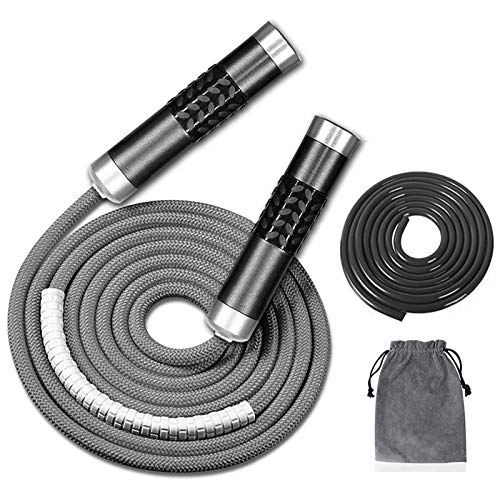
This is the one that turns skipping into strength work. The whole rope weighs about a pound, enough that your shoulders, forearms, and grip are working rather than just your calves, which is why weighted ropes are a fixture in boxing and MMA training. It is really two ropes in one box: a 9mm braided cotton rope, 0.46 pounds and ten feet long, built in a three-dimensional spiral braid with a wear-resistant silicone protective tube, plus a 9mm solid PVC rope. Switching between them roughly doubles the set’s life and gives you two different feels. Upgraded double ball bearings keep a heavy rope turning smoothly, and the aluminum handles with silicone grips, raised in small ovals for friction, stop it launching out of sweaty hands. A built-in lock adjusts length quickly.
Pros:
- 1 lb total weight loads shoulders, forearms, and grip
- Two ropes included: braided cotton and solid PVC
- Upgraded double ball bearings for smooth heavy rotation
- Aluminum handles with textured silicone grips
- Built-in lock adjusts length quickly
- Silicone protective tube extends rope life
Cons:
- Most expensive pick here
- Too slow for fast double-unders
- A pound is tiring quickly if you are new to skipping
Best for: boxing and MMA conditioning, and anyone who wants their skipping to build upper-body endurance too.
Elite Jumps 6mm PVC Jump Rope
The rope from the company that makes ropes for competitive jumpers, and it shows in the details that matter rather than the ones that market well. The cord is a thick 6mm PVC with an inner string core, which does two useful things: it survives rough outdoor surfaces as well as smooth indoor floors, and it is heavy enough that beginners can actually feel where the rope is in the arc, which is how people learn timing. That thickness also adds resistance, so a session works you harder than a wire cable at the same pace. The handles are described as unbreakable and the cord as non-kinking, which is the failure mode of every cheap PVC rope: a permanent bend that ruins the turn. Elite makes freestyle, weighted, and competition ropes, and this is the fitness one.
Pros:
- Thick 6mm PVC cord with an inner string core
- Rated for both smooth indoor floors and rough outdoor surfaces
- Non-kinking cord holds its shape
- Unbreakable handles
- Added resistance from the thicker cord
- Easy for beginners to feel the rope spinning
Cons:
- Premium price for a non-weighted rope
- Slower than a thin steel speed cable
- Thicker cord stings more than a wire if you catch yourself
Best for: outdoor skipping on rough ground, and beginners learning timing who want one rope that lasts.
The verdict
Best Overall: Loocio Speed Jump Rope. The best seller here by a distance, and deservedly so. Ball bearings for a tangle-free spin, a PVC-coated steel cable that lasts, comfortable non-slip foam handles, and adjustable length, for a price that makes it a non-decision. For cardio, footwork, and general fitness, it does what ropes costing several times more do.
Best Value: SPORTBIT Adjustable Jump Rope. Cheaper still, with 360 degree spinning handles, washable sweat-resistant grips, and cut-to-fit sizing that gives you a better-tuned rope than most adjustable locks manage. Just remember the cut is permanent.
Best Premium: Redify Weighted Jump Rope. A pound of rope, two cables in the box, double bearings, and aluminum handles. It is a different training tool rather than a nicer version of the same one, and if you want skipping to build your shoulders and grip, nothing else here does it.
Two situational picks worth naming. If your ceiling is low or your shins have suffered enough, the YOTTOY skips cordless and counts your reps. And if you jump outdoors on concrete, the Elite Jumps 6mm cord is built for the surface that shreds thin cables.
Frequently asked questions
How long should my jump rope be?
Stand on the middle of the cable with one foot and pull the handles up: they should reach roughly your armpits. Too long is the usual error, and it makes the rope drag on the floor and slow down, which feels like you cannot skip when actually the rope cannot. Every rope here adjusts, whether by a lock, or by cutting it to length as the SPORTBIT does.
Should a beginner start with a speed rope or a weighted one?
Something with a bit of heft is usually easier to learn on, because you can feel where the rope is in its arc and time your jump to it. A thin steel speed cable moves too fast to feel and punishes mistiming. A thicker cord like the Elite Jumps 6mm, or a light weighted rope, teaches rhythm faster. Move to a speed cable once the timing is automatic.
Do cordless jump ropes actually work?
For cardio, largely yes. The weighted ball reproduces the arm motion and the effort, and it removes the two things that stop people skipping indoors: ceiling height and the rope hitting your ankles. What it cannot fully reproduce is the timing discipline of a real rope, since nothing passes under your feet. The YOTTOY hedges sensibly by including a real cable too.
Why do jump ropes need ball bearings?
So the cable can spin while the handle stays still in your hand. Without bearings, the cable winds up against the handle, drags, and knots mid-set. It is the single feature that most affects how a rope feels. Heavier ropes need more of it, which is why the Redify weighted rope uses a double bearing arrangement.
Can I use a jump rope on concrete?
You can, but it shortens the rope’s life considerably. Thin PVC-coated steel cables abrade quickly on concrete and asphalt, and once the coating goes, the steel frays. If outdoors is your only option, choose a thick cord built for it, such as the Elite Jumps 6mm, which is rated for rough surfaces. A mat or a wooden floor is kinder to the rope and to your joints.
This article may contain affiliate links; see our Affiliate Disclosure.