Someone starts frying onions, and three rooms away a purifier spins up on its own, throws an orange ring, and quietly works the smell down until the light goes blue again. Nobody touched a button. That is the entire argument for putting a radio inside an air purifier.


The filter does the cleaning; the smart part decides when to run it hard and when to leave you alone. What separates a good one is the quality of its sensor, whether auto mode reacts sensibly, and whether the app is a real control panel or a novelty you open twice. Room size, as always, sets the floor.
At a glance
| Product | Standout feature | Price tier | Link |
|---|---|---|---|
| LEVOIT Core 300S-P | Auto mode on PM2.5, Alexa and Google, quiet as 22dB | Mid-range | |
| LEVOIT Core 200S-P | Compact 360-degree intake, voice control, in-app filter life | Budget | |
| LEVOIT Vital 100S-P | Pet Mode, washable pre-filter, precise schedules | Mid-range | |
| BLUEAIR Blue Pure 511i Max | HEPASilent dual filtration, as quiet as 19dB | Mid-range | |
| LEVOIT Core 400S-P | Laser dust sensor, live PM2.5 display, largest coverage | Premium | |
How to choose a smart air purifier
Check the model letter before anything else
This category has a trap worth naming. Manufacturers sell near-identical purifiers in smart and non-smart versions, and the difference can be one letter buried in a model number. The bodies look the same, the filters are often shared, and the listings read almost identically, because the cleaning hardware genuinely is the same. Only one of them has WiFi. If app control is what you are paying for, confirm the listing says WiFi, app, or voice control explicitly rather than trusting the shape of the box.
CADR and room size, not marketing coverage
Coverage claims can be quoted in two very different ways. A purifier rated for a large area at one air change per hour is not doing much for allergies; the number worth finding is the smaller room size at roughly four to five air changes per hour, which is the standard for people reacting to dust, dander, or pollen. Both figures appear in these listings, and the gap between them is wide. The Core 400S-P covers up to 1,733 sq ft once per hour; the Core 200S-P refreshes a 140 sq ft room 4.8 times per hour. Those describe very different jobs.
The AHAM VERIFIDE seal is worth caring about. It means the CADR figures were independently tested to a set standard rather than calculated in-house, so numbers between certified models can be compared directly. Four of the five purifiers here carry it.
The sensor is what makes auto mode work
Auto mode is only as good as what it can detect. Most sensors here watch PM2.5, the fine particulates that come from smoke, cooking, and traffic, and adjust the fan as readings change. A laser dust sensor is the better implementation, updating a live particle count rather than guessing. What none of these sense is gas: VOCs from paint or cleaning products are handled by the carbon filter but generally will not trigger the fan on their own. If someone in the home reacts to odors rather than particles, plan on scheduling or manual control.
Noise, and the modes that hide it
A purifier in a bedroom lives or dies on noise. The quiet ratings here are genuinely low, from 19dB up to about 27dB, but every one of those numbers describes the slowest speed. On high, all of them are audible. Sleep modes matter for the second reason too: they kill the display lights. An air quality ring is useful in a kitchen and infuriating at 2am, so the ability to dim or disable it is not cosmetic.
Filters are the real running cost
The purifier is the cheap part. Filters are consumables, typically replaced every several months depending on use, and every brand here pushes its own. Genuine filters do fit better and, on the branded systems, carry more carbon than off-brand copies, though the warnings about damage are firmly in the maker’s interest. Two practical features cut the cost: a washable pre-filter, which catches hair and large debris so the expensive filter lasts longer, and in-app filter life tracking, so you replace on condition rather than guesswork. Some lines also sell task-specific filters, for smoke, pet allergies, or toxins, on the same body.
What the app should actually do
A good app does four things: report current air quality, set schedules with real start and end times, check filter life remotely, and connect to a voice assistant. Scheduling is the underrated one. Running a purifier hard while the house is empty and dropping it to sleep speed overnight is quieter and cheaper than leaving it on auto forever, and it takes two minutes to set up once.
LEVOIT Core 300S-P
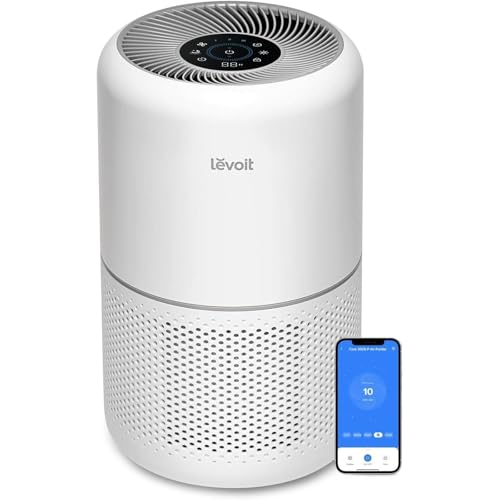
The best seller of this group, and the most complete small-room package. It is AHAM VERIFIDE with published CADR ratings of 141 CFM for smoke, 156 for dust, and 175 for pollen, so the performance claims are independently checked rather than asserted. Auto mode watches PM2.5 and moves the fan and the color of the indicator ring as the air changes, which is the behavior that makes a purifier feel worth owning. The VeSync app handles remote settings, air quality, and schedules; Alexa and Google Assistant handle the rest. It runs as quietly as 22dB, and Sleep Mode turns the display off entirely. The carbon filter is specified with more carbon than off-brand equivalents, aimed at kitchen odors, smoke, and VOCs.
- Pros: AHAM VERIFIDE with transparent CADR figures across smoke, dust, and pollen; genuine auto mode driven by PM2.5 sensing; app plus Alexa and Google control; schedules and remote air quality checks; as quiet as 22dB with a lights-off Sleep Mode; high-carbon filter for odors and VOCs.
- Cons: Costs more than the smaller Core 200S-P without a large jump in coverage; tied to genuine Levoit filters for best results; no washable pre-filter.
Best for: A main bedroom or living room where the purifier should manage itself and stay silent at night.
LEVOIT Core 200S-P
The small, cheap, sensible one. It is built around a 360-degree air intake in a compact body, refreshing a 140 sq ft room 4.8 times per hour, which is the meaningful figure for anyone whose nose runs in a dusty bedroom. Three stages do the work: a nylon pre-filter for large particles, activated carbon for odors and fumes, and a main filter removing 99.97% of dust, pollen, and dander between 0.1 and 0.3 microns. Smart and voice control come as standard, and filter life is tracked in the app rather than left to memory. At 27dB on its lowest speed it is quiet, and a Display Off button kills the lights.
- Pros: Least expensive purifier here; AHAM VERIFIDE; 4.8 air changes per hour in a 140 sq ft room, a genuinely useful rate for allergies; 360-degree intake works in a corner; smart and voice control; in-app filter life monitoring; 27dB with a dedicated display-off button; light enough to move between rooms.
- Cons: The smallest coverage in this comparison, so wrong for open plans; no air quality display or laser sensor; no washable pre-filter; a nursery or office is closer to its limit than a lounge.
Best for: Bedrooms, dorms, nurseries, and offices, or a second unit for a room that already has one elsewhere.
LEVOIT Vital 100S-P
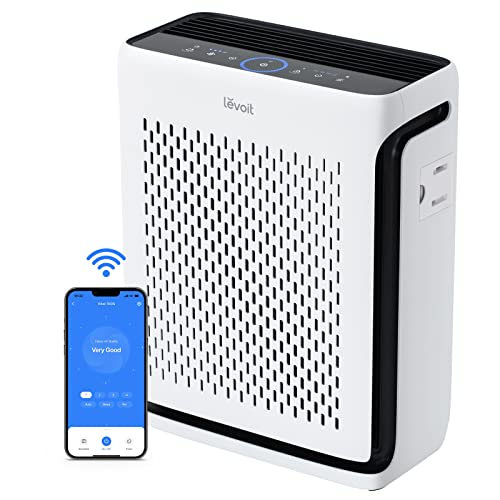
The pick for homes with animals. A wide U-shaped inlet is shaped to take in airborne fur and large particles instead of letting them drift past, and Pet Mode is a proper mode rather than a badge. The washable pre-filter is the quiet money-saver of this group: rinse it under a tap and the three-stage system keeps working, while the expensive main filter lasts longer. It purifies a 222 sq ft room 4.8 times an hour, or up to 1,073 sq ft once an hour, and captures 99.97% of particles from 0.1 to 0.3 microns. Scheduling is the most precise here, with start and end times bound to a chosen speed or mode, and the VeSync app covers timers, filter life, and third-party voice assistants. Sleep Mode uses light detection to dim itself automatically, dropping to 25dB.
- Pros: Washable pre-filter cuts long-term filter costs; Pet Mode and a wide U-shaped inlet built for fur; precise schedules tied to speeds and modes; automatic display dimming via light detection; 25dB in Sleep Mode; AHAM VERIFIDE; full VeSync app and voice assistant support; solid mid-size coverage.
- Cons: Priced above the Core 300S-P without a live air quality display; 1,073 sq ft is a once-per-hour figure, not an allergy rate; the pre-filter must actually be rinsed to pay off.
Best for: Pet owners, and anyone who wants to spend less on replacement filters over time.
BLUEAIR Blue Pure 511i Max
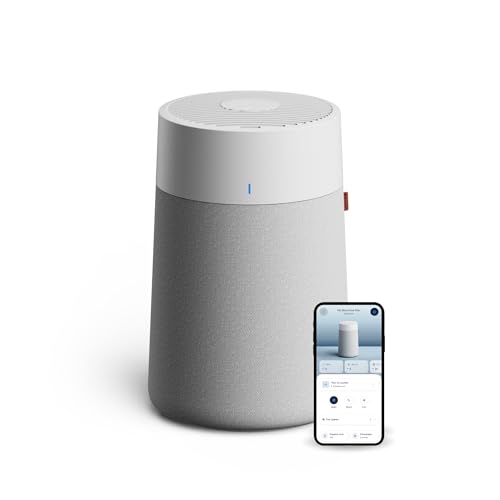
The quietest machine here and the only non-Levoit in the group. Blueair’s HEPASilent approach pairs mechanical and electrostatic filtration, which lets it move air with less fan noise for the same cleaning, and the payoff is a rating as low as 19dB. It clears a 237 sq ft space in about twelve and a half minutes and covers up to 1,138 sq ft in an hour, capturing 99.97% of airborne particles down to 0.1 microns, including dust, pollen, dander, mold particles, and smoke. Built-in sensors drive the fan automatically when pollution rises, and the Blueair app handles monitoring, settings, and filter reminders. The 360-degree intake and compact Scandinavian shape suit rooms where a purifier has to look like furniture.
- Pros: Quietest here at 19dB, meaningfully below the rest; HEPASilent dual filtration captures down to 0.1 microns; fast cleaning in small rooms; automatic fan response to sensor readings; app monitoring, control, and filter replacement reminders; 360-degree intake in a compact, attractive body.
- Cons: No AHAM VERIFIDE seal quoted, so figures are harder to compare directly against the certified models; no voice assistant support mentioned; electrostatic filtration is a different approach that some buyers prefer to avoid; a separate app if the rest of the house is Levoit.
Best for: Light sleepers and nurseries, where noise is the deciding specification.
LEVOIT Core 400S-P
The big one, and the only purifier here with a laser dust sensor. That sensor scans continuously and drives a live PM2.5 number on the display, so auto mode is reacting to a measured particle count rather than a rough signal, and you can watch it climb when someone starts cooking. AHAM VERIFIDE CADR ratings are the highest in this group at 231 CFM smoke, 240 dust, and 259 pollen, enough to clean up to 1,733 sq ft in an hour and to make open-plan spaces realistic. The three-stage filter captures 99.97% of particles from 0.1 to 0.3 microns, and the carbon stage is aimed squarely at kitchen VOCs. Auto mode adjusts speed and updates the display as conditions change.
- Pros: Laser dust sensor with a continuously updating PM2.5 display; by far the strongest CADR figures here, all AHAM VERIFIDE; covers up to 1,733 sq ft, suiting open floor plans and basements; three-stage filtration to 99.97% at 0.1 to 0.3 microns; carbon stage targeted at kitchen odors and VOCs; full smart WiFi, app, and auto mode.
- Cons: The most expensive option by a clear margin; physically the largest, so it takes real floor space; larger filters cost more to replace; overkill for a single bedroom.
Best for: Open-plan living areas, basements, and anyone who wants to see the air quality number rather than trust a color.
Verdict
Best Overall: LEVOIT Core 300S-P. The clear best seller of this group, and it earns it. Independently verified CADR figures, an auto mode that genuinely reacts to PM2.5, app and voice control, schedules, and a 22dB sleep mode that goes dark as well as quiet. It is the model that covers the common case, a bedroom or living room, without asking you to think about it again.
Best Value: LEVOIT Core 200S-P. The cheapest way into real app and voice control, and it still clears a small room nearly five times an hour, which is the rate that matters for allergies. For a nursery, office, or dorm it does the same job as its bigger siblings in a smaller space, and it is easy to justify two of them.
Best Premium: LEVOIT Core 400S-P. The laser sensor and live PM2.5 readout make its auto mode the most trustworthy here, and the CADR figures back the coverage claim for open-plan rooms. If one purifier has to handle a kitchen, lounge, and stairwell together, this is the only pick in the group sized for it.
If noise decides everything, the Blueair Blue Pure 511i Max is quieter than anything else here at 19dB, and the Vital 100S-P is the one to pick if pet fur and filter costs are the running problem.
Frequently asked questions
Do I need the WiFi version at all?
Only if you will use it. The filtration is identical on the non-smart twins, so a purifier that lives in one room and runs on one speed gains nothing from a radio. Smart control pays off in three cases: auto mode reacting to a sensor instead of you, schedules that match the fan to the day, and checking filter life without walking over. If none of those appeal, buy the cheaper non-smart model and spend the difference on filters.
Should it run all the time?
Air only stays clean while the fan is moving, so a purifier switched off is doing nothing, and particles return within hours. Continuous running on auto or a low speed is the normal approach, which is why quiet operation and modest power draw matter more than peak output. Scheduling a higher speed during cooking or cleaning, then dropping to sleep speed overnight, is the practical compromise.
How often do filters need replacing?
Every several months for most homes, sooner with pets, smoke, or heavy dust. Rather than guessing, use the in-app filter tracking these models provide. A washable pre-filter, as on the Vital 100S-P, extends the main filter’s life by catching hair and large debris first, which is the single easiest way to cut the cost.
Will a purifier help with cooking smells and VOCs?
Partly. The activated carbon stage absorbs odors, smoke, and VOCs, and the models here with more carbon do better at it. The limit is the sensor: these detect particulates, not gases, so auto mode may not spin up for a smell alone. Extractor fans and open windows remain the first line; the purifier handles what is left behind.
Is one purifier enough for a house?
Generally not. These are room devices, and air does not move freely between closed doors. Two right-sized units, one where you sleep and one where you live, beat one oversized unit in a hallway.
This article may contain affiliate links; see our Affiliate Disclosure.