The back bedroom sits ten degrees colder than the rest of the house, and cranking the central thermostat to fix it just bakes the living room. An electric baseboard heater solves the cold room and only the cold room: a strip of finned metal along one wall, wired to its own dial, running when that space needs heat and staying dark the rest of the day.



Baseboard heat is one of the few home upgrades that stays simple: no ducts, no refrigerant, no outdoor unit, nothing needing a service contract. What separates a good unit from a frustrating one is whether it hardwires or plugs in, whether the wattage matches the room, and where the thermostat sits. Get those right and the heater disappears into the wall for twenty years.
At a glance
| Product | Standout features | Price tier | Link |
|---|---|---|---|
| Cadet F Series 24 in. (2F350W) | Best seller; 350/262 W at 240/208 V; universal wiring; lifetime warranty | Budget | |
| Cadet 30 in. 500 W (120 V) | Runs on a standard 120 V circuit; 4.17 A draw; compact 30 in. footprint | Budget | |
| Comfort Zone CZ600 | No wiring needed; 1500 W, two heat settings, dial thermostat; tip-over switch | Budget | |
| Stelpro Brava (AB0501W) | One-piece no-end-cap cabinet; engineered against ticking noise; 5-year warranty, lifetime element | Premium | |
| Comfort Zone CZ650B | Digital thermostat with temperature display; 1500 W, two heat settings; dent-proof end panels | Mid-range | |
How to choose an electric baseboard heater
Hardwired or plug-in: the fork that decides everything else
Almost every other decision follows from this one. A hardwired baseboard heater has no cord. It connects to a dedicated circuit inside the wall, sits permanently against the baseboard, and is controlled by a thermostat on the wall or built into one end. The Cadet and Stelpro units here are all hardwired, and all of them need an electrician unless you genuinely know your way around a panel.
A plug-in unit borrows the baseboard shape but not the installation. The Comfort Zone models are long, low, fan-free convection heaters with a cord and a tip-over switch. They warm a room the same way, but you can carry one elsewhere and undo the whole decision by unplugging it. That flexibility has a ceiling: a plug-in heater is capped at what a standard outlet delivers, and it ties one up permanently. If you own the place and the cold room is a fixed problem, hardwire it. If you rent, or the cold room moves with the season, plug in.
Sizing by wattage, not by hope
The rule of thumb that has held up for decades is roughly 10 watts per square foot of floor area, for a room with average insulation and an eight-foot ceiling. A 100-square-foot office wants about 1000 watts. A 150-square-foot bedroom wants about 1500. Push that up for big single-pane windows, three exterior walls, a floor over a garage, or high ceilings.
This is where the small units get misunderstood. The 350-watt Cadet is not a failed room heater; it is a supplement, sized for a bathroom, a hallway, or a corner that runs cold while the rest of the house is fine. Buying 350 watts for a full bedroom will disappoint you. Buying 1500 watts for a small bathroom will cycle constantly and feel drafty.
Wattage translates straight into heat: the 350-watt Cadet is rated at 1195 BTU, which is simply watts multiplied by 3.412. Every electric heater obeys the same arithmetic, and all of them turn essentially all the electricity into heat, so no element here is more efficient than another.
120 volts or 240 volts
Hardwired baseboard heaters come in both. A 240-volt unit draws half the current of a 120-volt unit at the same wattage, which means thinner wire and more heaters per circuit – that is why most whole-room installations are 240 volts, and why the Cadet F Series is offered at 240/208 volts. The catch is that 240 volts needs a double-pole breaker and a dedicated run, so if your room has no such circuit you are paying for wiring as well as the heater. A 120-volt unit like the 500-watt Cadet or the Stelpro Brava can often tie into wiring that already exists, which makes smaller 120-volt models the practical choice for one retrofitted room.
Where the thermostat lives
Most hardwired baseboard heaters ship without a thermostat, and this surprises people. The Cadet 72-inch listing says it plainly: requires a thermostat. Stelpro sells the Brava the same way, with a wall thermostat or a built-in end kit as separate purchases.
A wall thermostat reads the room at chest height, away from the heater’s own rising warmth, and holds temperature more steadily. A built-in thermostat at the end of the unit is cheaper and needs no extra wiring, but it sits in the heater’s own warm air and tends to shut off early, letting the far side of the room drift cool. Plug-in models sidestep this, with the control already on board.
Length, clearance, and the furniture problem
Length is not decoration. A longer heater at the same wattage spreads a cooler element over more surface, which feels gentler and runs quieter. It also has to go somewhere: baseboard heaters want an unobstructed run of wall, ideally under a window where cold air falls, with air entering at the bottom and leaving at the top. A sofa pushed against one blocks the convection loop and puts fabric against a hot surface at the same time. Measure the free wall before choosing a length, and keep curtains clear of the top outlet.
Cadet F Series 24 in. Electric Baseboard Heater (2F350W)
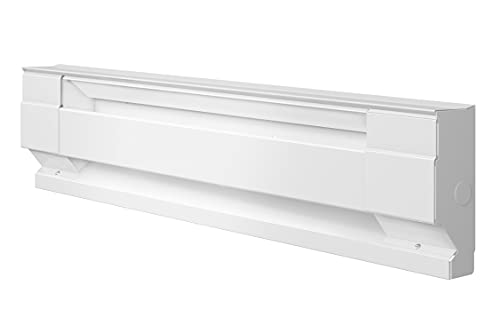
The F Series is the plain white workhorse that turns up in more hallways and back bedrooms than any other baseboard heater, and this 24-inch, 350-watt version is the volume seller of the group. There is nothing clever about it, which is the point: steel, a finned element, universal wiring with pre-punched knockouts so it lands on either end, and a limited lifetime warranty behind it. It runs at 240/208 volts, putting out 350 or 262 watts depending on the supply – 1195 BTU at full tilt. Cadet builds the same series in longer lengths, so if this one is too small the fix is the same heater, just more of it.
- Pros: The proven best seller in the category; universal wiring and pre-punched knockouts keep the electrician’s visit short; limited lifetime warranty; convection design with no fan and nothing to fail.
- Cons: Hardwired, so no weekend fitting unless you are qualified; needs a 240-volt supply and a thermostat, neither included; at 350 watts it supplements a small space rather than heating a bedroom.
Best for: a small, specific cold spot – bathroom, entry, or compact office – where a 240-volt circuit already exists or is going in anyway.
Cadet 30 in. 500 W Baseboard Heater (120 V)
This is the unit that fits the awkward retrofit. It is 30 inches long, rated 500 watts, and – the part that matters – it runs on 120 volts, drawing 4.17 amps. That is an ordinary household circuit rather than a double-pole breaker and a new dedicated run – the difference between a modest install and a real electrical project. It is UL listed, white, and shaped to sit against a baseboard like any other. Five hundred watts covers roughly 50 square feet, so think small: a bathroom, a landing, a walk-in closet that never warms up.
- Pros: 120-volt operation opens up rooms where a 240-volt circuit would be an expensive addition; low 4.17 A draw sits easily on an existing circuit; short 30-inch run fits walls that longer units cannot; UL listed.
- Cons: Still hardwired despite the friendly voltage; 500 watts is a supplement, not a bedroom’s whole heat source; thermostat is a separate purchase; the listing carries less documentation than the F Series.
Best for: a small room that needs permanent, out-of-the-way heat and has no 240-volt circuit within reach.
Comfort Zone CZ600 Electric Baseboard Space Heater
The CZ600 is the answer for anyone who wants baseboard warmth without an electrician. It borrows the long, low silhouette and the fan-free convection principle, then adds a cord. At 1500 watts with two heat settings and an adjustable dial thermostat, it is sized for a medium room – around 150 square feet – which makes it the first unit here that can take a bedroom on by itself. Being portable, it carries the safety kit portables need: a tip-over switch, an overheat sensor, and a body designed to stay cool enough to touch.
- Pros: No wiring and no permanence – it works the day it arrives; 1500 W genuinely heats a medium room; two heat settings plus an adjustable thermostat; full safety set; silent, with no fan noise.
- Cons: Occupies an outlet and leaves a cord along the floor; 1500 W shares badly with a kettle or a second heater; a dial thermostat is less precise than a digital one; portables do not have the twenty-year life of a hardwired unit.
Best for: renters, and anyone who wants a cold bedroom fixed this week rather than after a callout.
Stelpro Brava 500 W / 120 V Baseboard Heater (AB0501W)
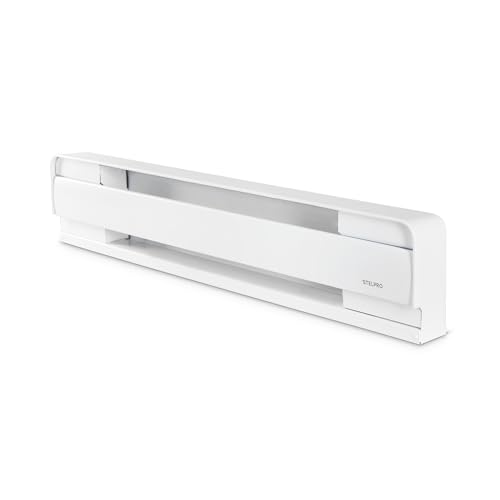
The Brava is what you buy when the heater has to look like it belongs. Stelpro builds it as a one-piece cabinet with rounded corners and no end caps, so there is no seam line and no plastic trim to yellow – it reads as trim rather than equipment. Under the skin it is 500 watts at 120 volts across roughly 28 inches, warming about 50 square feet silently, with no moving parts. The detail worth paying for is the engineering against expansion noise: baseboard heaters are notorious for ticking and pinging as the element heats and cools, and Stelpro designs the cabinet specifically to eliminate it. In a bedroom, that is not a luxury. The warranty runs five years, with a lifetime warranty on the element.
- Pros: Cleanest-looking unit here by a distance, with a seamless no-end-cap cabinet; engineered against the ticking baseboard heaters are known for; 120 V keeps the wiring simple; full-length thermal protection with auto reset; 5-year warranty and a lifetime element warranty.
- Cons: Must be hardwired – the listing is explicit that this is not a plug-in; no thermostat included, and the built-in kits cost extra on top; 500 W suits about 50 square feet, so a bedroom needs a longer model; the priciest unit here.
Best for: a bedroom or living space where quiet running and a clean look justify spending more than the plain white box costs.
Comfort Zone CZ650B Baseboard Heater with Digital Thermostat
The CZ650B is the CZ600 with the one upgrade that changes how a heater feels to live with: a digital thermostat and a clear temperature display instead of an unmarked dial. With a dial you hunt for the setting by trial and error, and re-hunt every time someone nudges it. With a number on a screen you set 68 and walk away. Everything else carries over: 1500 watts of silent convection, two heat settings, dent-proof end panels, and the full safety set.
- Pros: Digital thermostat with a temperature display takes the guesswork out of setting it; 1500 W with two heat settings covers a medium room; completely silent convection; full safety set – tip-over switch, overheat protection, stay-cool body; still just plugs in.
- Cons: Costs more than the dial version for what is one feature; same 1500 W outlet load and same cord across the floor; no timer on this model; portable construction rather than a lifetime fixture.
Best for: a daily-use bedroom or home office where you want to set an actual temperature and stop thinking about it.
The verdict
Best overall: Cadet F Series 24 in. (2F350W). It is the best seller of this group by a wide margin, and the reason is not marketing. It is a plain, serviceable, lifetime-warranted convection heater with universal wiring, from the brand whose parts your electrician already stocks. Size it plainly – 350 watts is a supplement – and step up to a longer unit in the same series for a bigger room.
Best value: Comfort Zone CZ600. It delivers the most heat of anything here, 1500 watts, at the bottom of the price range, and needs nothing but an outlet. Add an electrician and a thermostat to any hardwired unit on this list and the gap widens further.
Best premium: Stelpro Brava (AB0501W). The seamless one-piece cabinet, the deliberate engineering against ticking, and the lifetime element warranty are what the extra money buys. In a room where you sleep or work, silence and a clean line are worth it.
FAQ
Do electric baseboard heaters need their own circuit?
Hardwired units generally do. A 240-volt heater needs a dedicated double-pole circuit sized to its load, which is the main reason installation costs what it does. Smaller 120-volt units draw less – the 500-watt Cadet pulls 4.17 amps – and can sometimes join a lightly loaded existing circuit, but that call belongs to an electrician who can see your panel. Plug-in models need no new circuit, though a 1500-watt heater uses most of a standard 15-amp outlet’s capacity.
How many watts do I need for my room?
Start at 10 watts per square foot: 1000 watts for 100 square feet, 1500 for 150. Add to that for large or single-pane windows, more than one exterior wall, a floor over an unheated garage, or high ceilings. Undersizing means the heater runs constantly and never quite wins; oversizing means short, uneven cycles.
Why does my baseboard heater tick and ping?
Metal expands as the element heats and contracts as it cools, and the cabinet moves against its mounting. It is normal and harmless, but loud enough to wake light sleepers. Units designed against it – the Stelpro Brava calls this out directly – are noticeably better, and a heater fastened squarely to a solid surface, without being pinched at the ends, ticks less than one that is not.
Does the thermostat come with the heater?
Usually not, on hardwired models. Cadet’s larger F Series listings state that a thermostat is required, and Stelpro offers wall thermostats and built-in end kits separately. Budget for one. Plug-in models have the control built in.
Are baseboard heaters expensive to run?
Every electric resistance heater converts essentially all its electricity to heat, so no model here is more efficient than another at making warmth – the difference is how much of it you waste. That is the whole argument for zone heating: warming one 150-square-foot room costs far less than lifting the entire house a few degrees to fix one cold corner. A thermostat that holds a setpoint, and a heater sized to the room, is where the savings live.
This article may contain affiliate links; see our Affiliate Disclosure.