Nobody at the gate is going to weigh your dog. They are going to look at the space under the seat in front of you, and if the carrier does not fit there, the dog does not fly. That one measurement decides more about air travel with a pet than any label on the box.


A flight carrier has two jobs that pull against each other: give the dog room to stand up and turn around, and squash into a rigid box beneath an airline seat. The soft-sided bags below are built for the cabin, where a bit of give is the whole point. The hard kennel is built for the hold, where give is exactly what you do not want. Which one you need is settled by the dog’s size, not by preference.
At a glance
| Product | Standout features | Price tier | Link |
|---|---|---|---|
| Henkelion Soft-Sided Pet Carrier | 15x9x9 in, up to 15 lb, four-side mesh, folds flat, dual loop handles | Budget | |
| Vceoa Soft-Sided Pet Carrier | 17.5x11x11 in, up to 16 lb, rigid base insert, washable fleece bed | Budget | |
| Amazon Basics Soft-Sided Mesh Pet Carrier | 20x12x12 in, up to 22 lb, front and top entry, washable fleece pad | Mid-range | |
| Petmate Vari Dog Kennel, 36-Inch | Hard shell for the hold, zip-tie holes, four-side vents, 50–70 lb dogs | Premium | |
| Sherpa Original Deluxe Travel Pet Carrier | Spring wire frame compresses to fit, Assured On Board program, up to 16 lb | Mid-range | |
How to choose a carrier that actually gets on the plane
“Airline approved” is a claim, not a certification
Start here, because it saves the most grief. No government agency certifies pet carriers. The TSA screens passengers and bags; it does not run an approval scheme for dog bags, so a “TSA approved” line on a listing is marketing language. Airlines set their own maximum under-seat dimensions, those limits differ between airlines, and they differ between aircraft within the same airline. A bag that flies happily on one route can be refused on the next. Look up the published limit for the carrier and the aircraft on your booking, then buy to that number. Handle every “airline approved” badge as a hint that the bag is roughly the right shape, not as a promise.
Measure the dog, not the scale
Weight limits get the headlines, and nearly every listing here quietly begs you to ignore them. Measure two things: length from the neck to the base of the tail, and height from the floor to the top of the shoulder. A compact 14 lb terrier and a leggy 14 lb whippet cross need different bags. The dog has to stand without ducking and turn around without folding in half, so buy for the dimension that fits worst, not the weight that fits.
Soft for the cabin, hard for the hold
Under-seat space is an awkward, uneven cave, often with a metal box on one side. Soft carriers work there because they yield: nylon panels flex, and the good ones let the back end compress a few inches to slide in. Hard plastic kennels cannot yield, which is exactly why the hold requires them. If your dog is too big for the cabin, you are shopping for a rigid shell with holes for zip ties and ventilation on all four sides, not a nicer bag.
Top entry beats front entry at the airport
In a calm living room, a front door is fine. In a terminal, with a dog that has decided the bag is a trap, lowering them in from above is far easier than pushing them in from the front. Most carriers here offer both. Check the zippers too: locking zippers or an anti-escape clip stop a determined nose from opening the bag at exactly the wrong moment.
Straps that do a second job
The small details separate a good travel bag from a good vet bag. A luggage pass-through sleeve lets the carrier ride on your rolling case, which matters when you have a boarding pass in one hand. A shoulder strap frees both hands. A seatbelt loop turns the same bag into a safe car seat for the drive to the airport and the ride at the other end.
Bedding, spills, and the flight after the flight
Assume an accident. A removable, machine-washable pad and a waterproof or wipe-clean base turn a bad hour into a laundry cycle. A rigid base insert is worth looking for as well: without one, the floor of a soft bag sags into a hammock and the dog spends the flight bracing instead of resting.
Book the spot before you buy the bag
Airlines cap how many animals travel in the cabin on a given flight, and the spot has to be reserved, usually by phone and usually for a fee. Sort that first. The perfect carrier is no use on a flight that is already full of dogs.
Henkelion Soft-Sided Pet Carrier
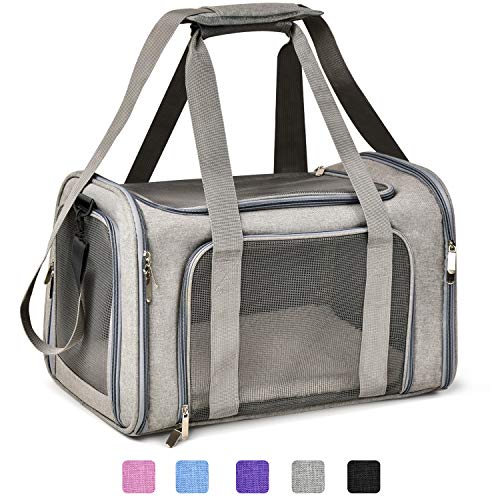
This is the runaway best seller of the group, and it earns that on simple arithmetic: it is the cheapest way to get a proper soft-sided carrier that covers the basics without fuss. The interior suits pets up to about 15 lb within 15 by 9 by 9 inches, which puts it at the small end of the range here, so it is a bag for genuinely little dogs. Lightweight polyester keeps the empty weight down, mesh on four sides means air and a clear view of your dog, and the whole thing folds flat when the trip is over. Two connecting loop handles double as a seatbelt or luggage strap, and the padded shoulder strap handles the walk through the terminal. Henkelion notes a maximum of 18 by 11 by 11 inches for carry-on use, which is a reminder that the airline, not the bag, has the final word.
Pros:
- Cheapest route to a competent flight carrier
- Mesh on all four sides for airflow and visibility
- Connecting loop handles work as a seatbelt or luggage strap
- Padded, adjustable shoulder strap
- Folds flat and stores easily between trips
Cons:
- Smallest interior here, so only for very small dogs
- No rigid base insert mentioned, so the floor can sag
Best for: a small dog and an occasional flight, where the budget matters as much as the bag.
Vceoa Soft-Sided Pet Carrier
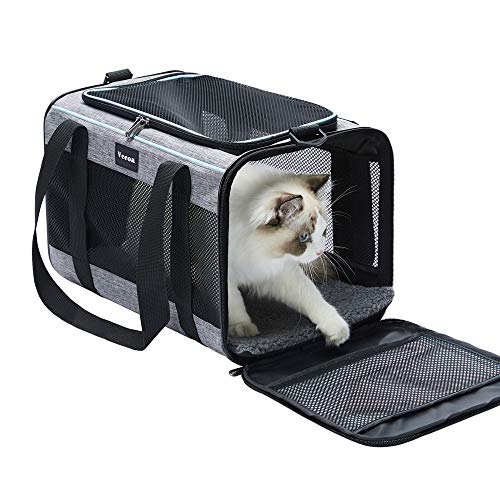
Almost as popular as the Henkelion and noticeably roomier, this one measures 17.5 by 11 by 11 inches and takes pets up to about 16 lb. The detail that matters is the removable base insert, which gives the dog a solid, flat surface instead of a sagging fabric floor. That single piece of board is the difference between a dog who settles and a dog who spends two hours shifting their feet. On top of that sits a removable fleece bed you can hand wash. Entry is from the top and the side with locking zippers, mesh windows handle ventilation, and the back strap slides over a suitcase handle. Vceoa is refreshingly blunt in the listing: every airline has its own rules, so call before you fly.
Pros:
- Removable base insert creates a firm floor
- Washable fleece bed included
- Top and side entry with locking zippers
- Strap works as a seatbelt or a luggage pass-through
- Roomier than the smallest bags at a similar price
Cons:
- At 17.5 inches long it exceeds some airlines’ under-seat limits
- Fleece bed is hand wash rather than machine wash
Best for: a dog who needs a little more floor than the smallest carriers give, on airlines with generous under-seat space.
Amazon Basics Soft-Sided Mesh Pet Travel Carrier
The largest soft carrier in the lineup, and the only one rated to 22 pounds. At 20 by 12 by 12 inches it is a real option for a dog at the top end of what any cabin will take, though that length is also the reason to check your airline first, since it sits above several published under-seat limits. What you get for the extra size is a genuinely comfortable box: mesh ventilation panels, front and top zippered openings, connecting top handles, an adjustable shoulder strap, and a fleece pad that goes in the washing machine rather than the sink. Amazon Basics states it conforms to under-seat dimensions of most airlines, and repeats the same advice as everyone else, which is to measure the dog from neck to tail base and floor to shoulder before you order.
Pros:
- Highest weight rating here at 22 lb
- Machine washable fleece pad
- Front and top openings for easy loading
- Connecting top handles plus adjustable shoulder strap
- Plenty of mesh for airflow and visibility
Cons:
- 20 inches long exceeds some airlines’ under-seat limits
- No spring frame, so it compresses less willingly than the Sherpa
Best for: a bigger small dog, on a route where you have confirmed the under-seat space allows it.
Petmate Vari Dog Kennel, 36-Inch
If your dog weighs 50 to 70 pounds, no amount of shopping will get them under a seat, and this is the category you are actually in. The Vari is a hard plastic shell built to most airline cargo specifications: four-sided ventilation, a sturdy wire door, and tamper-proof holes for zip ties, which airlines require so the door cannot be nosed open in transit. The 36-inch size gives an interior of roughly 32.5 by 22.2 by 26 inches, enough for a large dog to stand, turn, and lie down, which is the standard the airline will hold you to. A stay-dry moat channels fluids away from the dog, and the shell wipes clean. It is bulky and it is the priciest item here, but for a big dog it is not really an optional purchase.
Pros:
- Meets most airline cargo specifications
- Zip-tie holes for the secure door airlines require
- Ventilation on all four sides
- Roomy enough for a large dog to stand and turn
- Stay-dry moat and wipe-clean shell
Cons:
- Far too large for the cabin, hold travel only
- Bulky to store and to move through an airport
Best for: a large dog traveling in the hold, where a rigid, zip-tie-secured crate is the requirement rather than the upgrade.
Sherpa Original Deluxe Travel Pet Carrier
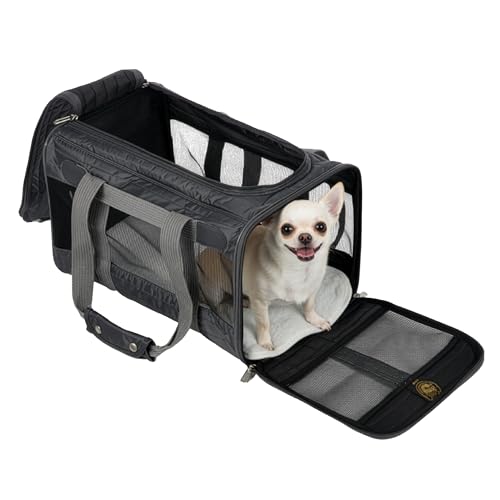
The Sherpa answers the exact problem this whole article circles: bags are rigid and under-seat spaces are not. Its patented spring wire frame lets the rear end be pushed down several inches, so a carrier that looks too tall on paper flattens into the gap and springs back afterwards. Sherpa also runs a Assured On Board program, which is a rare thing to offer in a category built on vague promises. The medium is 17 by 11 by 10.5 inches and fits pets up to 16 pounds. Everything else is well judged: mesh panels, escape-proof locking zippers, top and side entry, a waterproof interior base, a washable liner, a large storage pocket, a padded top handle, a detachable strap on metal D-rings, and a luggage strap that doubles as a seatbelt pass-through.
Pros:
- Spring wire frame compresses to clear tight under-seat spaces
- Assured On Board program backs the fit
- Escape-proof locking zippers, top and side entry
- Waterproof interior base plus washable liner
- Luggage strap doubles as a car seatbelt pass-through
Cons:
- Costs more than the plain soft bags
- 16 lb limit rules out larger dogs
Best for: frequent flyers who want the fit question settled before they reach the gate.
Verdict
Best overall: Henkelion Soft-Sided Pet Carrier. It outsells everything else here by a distance, and for a small dog it is hard to argue with. Four-sided mesh, a padded strap, loop handles that work as a seatbelt, and a fold-flat body, for less than the cost of the pet fee itself.
Best value: Vceoa Soft-Sided Pet Carrier. Nearly the same money as the Henkelion, more room inside, and a removable base insert that gives the dog a firm floor instead of a sagging one. That is a real upgrade for a barely different price.
Best premium: Petmate Vari Dog Kennel. Not a luxury, a requirement. For a 50 to 70 lb dog flying in the hold, the four-sided ventilation, the zip-tie holes, and the room to stand and turn are what the airline is checking for.
Best for regular flyers: Sherpa Original Deluxe. The compressible spring frame and the Assured On Board program buy you the one thing the cheap bags cannot: confidence at the gate.
FAQ
Is there such a thing as a TSA approved dog carrier?
No. The TSA screens passengers and their belongings, and it does not certify pet carriers. The phrase appears on listings because it sells bags. The rules that decide whether your dog boards are the airline’s under-seat dimensions, which vary by carrier and even by aircraft type on the same airline.
What size carrier fits under an airline seat?
There is no single answer, which is the real and slightly annoying truth. Published under-seat limits commonly sit somewhere around 17 to 18 inches long and 11 inches high for soft bags, but you have to check the number for your specific booking. Soft carriers with a flexible or spring frame have an advantage, since they can be squashed into a space that a rigid box of the same size would not enter.
Can a large dog fly in the cabin?
Generally not. Cabin travel is limited to dogs that fit in a carrier under the seat, which in practice means small dogs, roughly in the 15 to 22 lb range depending on the airline and the shape of the dog. Larger dogs travel in the hold in a rigid kennel that meets the airline’s cargo specification, with a secured door and ventilation on all four sides.
Should I let my dog out of the carrier during the flight?
No. Airlines require the pet to stay in the carrier, under the seat, for the whole flight. That is also why the interior matters so much: a firm base, enough height to stand, and enough length to turn around are what make several hours in a bag tolerable.
How do I get a nervous dog used to the carrier?
Open it at home weeks ahead and leave it out as furniture, with the familiar bedding inside and snacks appearing in it at random. Several of these bags are designed to double as a soft indoor den for exactly that reason. A dog who already naps in the bag takes boarding day as a longer version of a normal nap, rather than an ambush.
This article may contain affiliate links; see our Affiliate Disclosure.