The hardest thing about working from a small home is not the work. It is that the room has to stop being an office at six o’clock, and yesterday’s paperwork is still sitting where dinner goes.



A secretary desk solves that by folding the work away behind a door or a drop-front, with the storage stacked upward instead of outward. The pieces below take five different routes to the same end: an armoire that shuts on the whole mess, a desk that folds flat to the wall, an arched hutch with charging built in, a slim classic in walnut, and a solid hardwood roll top. What suits a studio apartment, a spare-bedroom corner, or a desk that has to live in the dining room are three different answers.
At a glance
| Product | Standout features | Price tier | Link |
|---|---|---|---|
| Sauder Craft & Sewing Armoire Best Overall |
Doors close on everything; fold-out table; six adjustable shelves; six-outlet power strip built in | Premium | |
| HOMCOM Foldable Wall-Mounted Desk Best Value |
Only 7.7 inches deep closed; 110 lb desktop rating; chalkboard front; six upper compartments | Budget | |
| ZKIODV Arched Writing Desk with Hutch | Two AC outlets, two USB and a USB-C port; three-color LED; two fluted drawers; side shelves | Mid-range | |
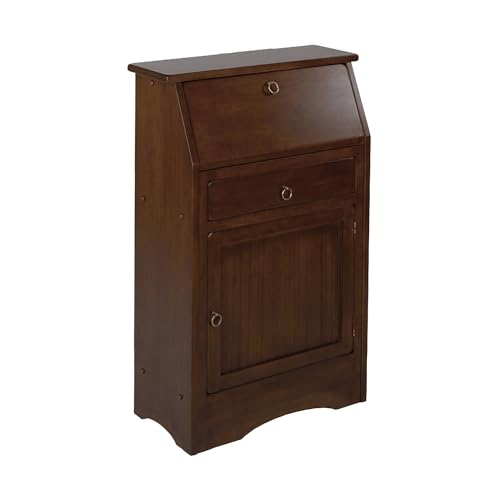
| Winsome Regalia Secretary Desk | Just 11.42 inches deep; drawer, cabinet and shelf; antique walnut finish | Mid-range | |
| Maykoosh Carved Wood Roll Top Desk Best Premium |
Solid hardwood; roll top closes over the work; three drawers; carved antique finish | Premium | |
How to choose a secretary desk for a small room
Decide first whether it has to close
This is the fork in the road, and everything else follows from it. A true secretary or an armoire desk hides the work: shut the doors or drop the front and the laptop, the cables and the half-finished paperwork disappear behind a clean face. That is worth a great deal in a room that has another job in the evening. The cost is that you work in a smaller opening, and you have to clear the surface enough to close it.
An open hutch desk, like the arched ZKIODV, never hides anything. In exchange you get a full-size worktop, better light, and no ritual of packing up. If the desk sits in a spare room or a corner nobody looks at, the open hutch is usually the better buy. If it stands in a living room or a studio, the door earns its keep every single day.
Measure the depth, not the width
In a small room the number that hurts is depth, because it eats walking space. The spread here is dramatic. The HOMCOM folds down to 7.7 inches against the wall, which is shallower than most bookshelves. The Winsome Regalia is 11.42 inches deep, slim enough to line a hallway. The Sauder armoire is 21.81 inches deep and the HOMCOM is 20 inches when open, which is a normal desk depth and a normal obstacle.
Height is where the storage hides. The ZKIODV and the armoire-style pieces run to five or six feet tall, stacking shelves in the vertical space no one else is using. In a rental with low ceilings, or under a sloped roof, check that headroom before the width.
Power at the desk, not across the floor
Built-in power has quietly become the thing that separates these. The Sauder has a six-outlet power strip on the center shelf, which is why it works for a sewing machine or a monitor and a laptop brick at once. The ZKIODV builds in two AC outlets, two USB ports and a USB-C port, so a phone and a laptop charge without a wall adapter in sight.
The traditional pieces, the Winsome and the Maykoosh, have none of this. You will be running an extension lead to them, and in a room where the desk sits away from a socket, that cable is what ruins the look you paid for.
What a fold-down surface will actually hold
A drop-front is a shelf on hinges, and it has a limit. HOMCOM rates its desktop to 110 pounds and backs it with 0.6-inch MDF panels and a support structure running top to bottom, which is enough for two monitors or a sewing machine. That is a real number, and it is worth looking for, because a fold-down surface with no published rating is a fold-down surface nobody wanted to publish a rating for.
Wall-mounted designs add a second question: what is behind the plaster. A desk that hangs off the wall has to be anchored into studs, not just drywall plugs, and that is not optional at 110 pounds of load. The freestanding pieces sidestep this entirely, which is the quiet argument for an armoire in a rental.
Engineered wood or hardwood
Most of this category is MDF or particleboard with a finish, and that is not an insult; it is flat, stable, cheap and it holds a laminate well. HOMCOM builds its panels from P2-grade MDF, which is the standard for indoor furniture. It will do a decade of light duty if it never gets soaked.
The Maykoosh is the exception, built from hardwood with a carved antique finish, and it feels and ages differently. It also weighs 44 pounds and costs accordingly. If the desk is a piece of furniture you expect to keep and refinish rather than replace, that is the one that rewards the money. If it is a workstation for a few years in a flat you will move out of, it is not.
Sauder Craft & Sewing Armoire
Sauder sells this as a craft and sewing armoire, and it is the best seller of this group by a distance. Read past the name, because as a small home office it is close to ideal: doors that shut on the entire operation, a fold-out table for the work, six adjustable shelves to tune the interior to whatever you actually own, and a six-outlet power strip on the center shelf so the machine, the laptop and the lamp all live inside the cabinet. At just under 35 inches wide and 61.58 inches tall, it puts a full workstation into the footprint of a wardrobe, and Sauder is explicit that it is meant for a craft room, a home office or a living room.
Pros
- Doors close on the work; the room goes back to being a room
- Six-outlet power strip built into the center shelf
- Six adjustable shelves rather than fixed ones
- Fold-out table gives real working area from a 21.81-inch deep cabinet
- Best-selling piece here, and finished in a clean Glacier White
Cons
- The most expensive option in this group
- Sold for crafting, so the interior is laid out for supplies rather than files
- You have to tidy the surface before the doors will shut
Best for: a workspace in a living room or studio that has to vanish completely at the end of the day.
HOMCOM Foldable Wall-Mounted Convertible Desk
This is the answer when there is no floor to give. Closed, it is 7.7 inches deep and reads as a display cabinet with a chalkboard front; open, it is a 110-pound-rated desktop with six upper compartments and three lower shelves behind it. The bottom shelf adjusts across three levels, which matters more than it sounds when you are fitting box files rather than paperbacks. The chalkboard is not a gimmick either, since it takes the to-do list that would otherwise be a pile of sticky notes on a surface you need to clear.
Pros
- 7.7 inches deep when folded, the shallowest here by far
- 110 lb desktop rating on 0.6-inch MDF with full-height support
- Nine storage positions: six upper compartments, three lower shelves
- Three-level adjustable bottom shelf
- Anti-tipping design; lowest price in the group
Cons
- Wall-mounted, so it must be anchored into studs
- Not freestanding, which is awkward in some rentals
- Opens to 20 inches deep, so it still needs clearance in use
Best for: a hallway, a dorm room or a studio where the desk has to disappear flat against the wall.
ZKIODV Arched Writing Desk with Hutch
The ZKIODV is the one that admits the desk is going to be visible and decides to look good instead. The arched hutch is genuinely handsome, and underneath the styling it is well specified: two fluted drawers on smooth glides, adjustable hutch shelves, integrated side shelves that add storage without adding footprint, and a charging station with two outlets, two USB ports and a USB-C port. Three LED color temperatures cover a bright work setting and a warmer one for evening. At 35.4 inches wide and 70.8 inches tall it goes up rather than out, which is the whole point in a bedroom corner.
Pros
- Charging built in: two AC outlets, two USB, one USB-C
- Three-color LED lighting, from focused white to warm
- Adjustable hutch shelves plus side shelves for extra storage
- Two drawers on smooth glides hide the clutter
- Tall and narrow, so it uses vertical space
Cons
- Nothing closes, so the work stays on display
- At 70.8 inches tall it needs headroom and an anti-tip anchor
- Sells in much smaller numbers than the top two here
Best for: a bedroom or study corner where the desk should look like furniture and charge your devices.
Winsome Regalia Secretary Desk
The Regalia is the classic reading of the brief, and the slimmest thing here: 11.42 inches deep, 25.12 inches wide, in an antique walnut finish, with a drawer, a cabinet and a shelf. It is a piece of furniture that happens to be a desk, and it will sit in a hallway or against the end of a room without announcing itself as an office at all. The trade-off is fair and obvious. There is no hutch tower, no built-in power, and the working surface is modest. What it does, it has been doing in the same shape for a very long time.
Pros
- Only 11.42 inches deep, so it fits where nothing else will
- Drawer, cabinet and shelf in a very small footprint
- Antique walnut finish suits a living space, not just an office
- Freestanding, no wall anchoring needed to place it
- Long-established design, widely sold
Cons
- No built-in outlets or USB
- Least storage of the group; no tall hutch
- At 38.58 inches tall it stores nothing in the vertical space above
Best for: a hallway or living room where the desk must be slim and read as furniture.
Maykoosh Carved Wood Roll Top Desk
The roll top is the original version of this idea: pull the tambour down and the work is gone, drawers and all. Maykoosh builds this one from hardwood rather than the engineered panels the rest of the category runs on, with carved detail and an antique white finish, three drawers, and a 42-inch height that keeps it compact. At 44 pounds it has the heft to match. This is the piece to buy if you want something that will still be worth refinishing in twenty years rather than replacing in five.
Pros
- Solid hardwood, not MDF or particleboard
- Roll top closes over the work surface and the clutter
- Three drawers; carved detail and antique finish
- Compact at 42 inches tall, suits traditional rooms
- The one piece here built to be kept and refinished
Cons
- Listed dimensions differ between the product name and the spec table, so measure your space against both before ordering
- No built-in power, USB or lighting
- Assembly required, and it is the heaviest piece here
Best for: someone buying furniture first and a workstation second, in a traditional room.
The verdict
Best Overall: Sauder Craft & Sewing Armoire. It outsells everything else here by a wide margin, and the specification says why: doors that close, a fold-out work surface, six adjustable shelves and a six-outlet power strip inside the cabinet. Ignore the crafting name. It is the most complete small-space office in this group.
Best Value: HOMCOM Foldable Wall-Mounted Desk. The lowest price here, the second-best seller, and the only one that gets down to 7.7 inches deep. A published 110-pound desktop rating and nine storage positions is a lot of desk for the money, provided you have a wall and studs to put it on.
Best Premium: Maykoosh Carved Wood Roll Top Desk. The only solid hardwood piece in the comparison, and the only one with a true roll top. You give up built-in power and gain a desk that ages instead of wearing out.
Common questions
What actually makes a desk a secretary desk?
Traditionally, a hinged front that folds down into a writing surface, with drawers or shelves behind it, so the whole desk closes. The term has loosened a long way. Retailers now use it for armoire desks, roll tops, and plain writing desks with a hutch on top. If closing it up matters to you, check for a drop-front, doors or a tambour rather than trusting the name.
Will a hutch desk fit under a low ceiling or a sloped roof?
Measure before you order. Several of these run to around 70 inches tall, so a sloped attic ceiling or a low basement can rule them out. The shorter pieces, like the 42-inch roll top and the 38.58-inch Winsome, fit almost anywhere, at the cost of the vertical storage a tall hutch gives you.
Do I need to bolt it to the wall?
For anything tall and shallow, yes, and especially with children or pets in the house. Tall furniture with a surface that folds out in front of it is exactly the shape that tips. Wall-mounted desks must go into studs rather than drywall plugs; a 110-pound rating means nothing if the fixings are in plasterboard alone.
Is a fold-down desk sturdy enough for two monitors?
It depends on the rating and the support behind it. HOMCOM publishes 110 pounds with 0.6-inch panels and a top-to-bottom support structure, which comfortably covers two monitors, or a printer, or a sewing machine. Where no rating is published, assume it is meant for a laptop and paper, and load it accordingly.
Is engineered wood a bad buy?
No. MDF and particleboard are flat, stable and hold a laminate finish well, and P2-grade MDF is the normal material for indoor furniture at this price. It is weak against water and it will not survive many disassemblies, so it suits a desk that stays put. Hardwood is the choice when you expect to move it, refinish it, and keep it.
This article may contain affiliate links; see our Affiliate Disclosure.