There is a version of this article that lists ten cheap propane heaters and calls them all tent heaters. This is not that article, because the makers of most of them say plainly, in their own listings, never use indoors. Propane heat inside a tent or a van is genuinely useful and genuinely dangerous, and the line between those two runs through one feature that costs money.



Read the picks below with one distinction in mind. Two of them are radiant heaters with a low-oxygen shut-off, built and certified for enclosed spaces. Three of them are open-flame tank-top heaters whose own instructions restrict them to well-ventilated outdoor use: a patio, a deer blind, an awning, a fishing spot. Both kinds are useful. Only one kind belongs inside anything with walls.
At a glance
| Product | Standout feature | Price tier | Link |
|---|---|---|---|
| Mr. Heater MH9BX | 4,000 to 9,000 BTU, low-oxygen and tip-over shut-off, 225 sq ft | Premium | |
| Mr. Heater Little Buddy | 3,800 BTU, 95 sq ft, one-button ignition, tiny footprint | Mid-range | |
| MOZODAWN 2-in-1 Heater and Stove | 13,000 BTU, cooks as well as heats, tip-over and flame-out cut-offs | Mid-range | |
| Gasfargo Outdoor Propane Heater | 6,200 BTU, USB lighter, cylinder stand, no electricity needed | Budget | |
| INTCOLL Dual Fuel Heater | Runs propane or iso-butane, self-ignition, anti-tip folding base | Budget | |
How to choose a portable propane heater
The oxygen depletion sensor is the whole decision
Burning propane consumes oxygen and produces carbon monoxide, a gas you cannot smell, see, or notice yourself succumbing to. In open air this does not matter, because the atmosphere is effectively infinite. In a tent, a van, or an ice shack, it very much does. A low-oxygen safety system, often called an ODS, is a pilot mechanism that senses the oxygen level dropping and shuts off the gas before the air becomes dangerous. It is the difference between a heater certified for enclosed spaces and one that is not, and it is most of the reason the Mr. Heater units cost three times what a tank-top radiant heater costs. If you plan to run a heater in any space with walls, this feature is not a nice extra. It is the product.
What the listings actually say, and why you should read them
The budget heaters here are clear about their limits, and they deserve credit for it. Gasfargo’s own listing states the heater must be used outdoors in a well-ventilated area only, and never indoors or in an enclosed space. The AeriePrecium and similar tank-top units carry the same instruction. These are not badly made; they are open-flame radiant heaters designed for outdoor use, and used that way they work well and cost very little. The problem is only that they are widely searched for as tent heaters. Take the maker at their word.
Size the output to the space
BTU per hour is heat output. Around 9,000 BTU covers roughly 225 square feet, which is a large tent, a small van, or a decent shelter. About 3,800 BTU covers around 95 square feet, which suits a two or three-person tent, a truck cab, or an ice shack. Bigger is not better here: an oversized heater in a small enclosed space burns more oxygen and forces you to cycle it on and off. Radiant heaters warm objects and people directly rather than heating the air, so you feel them immediately and they work even in a drafty space.
Fuel, and how long it lasts
Most of these run on the one-pound disposable cylinders sold everywhere, and some connect to a larger refillable tank by hose, which is dramatically cheaper for long trips and van use. Run time depends on the setting: the MH9BX is quoted at 5.6 hours at its minimum output on one supply, which is a night if you are careful and rather less if you run it high. Bring more fuel than you think. One heater here, the INTCOLL, also runs iso-butane canisters, which matters if you already carry them for a backpacking stove. Note the reverse warning on the AeriePrecium-style units: propane only, no iso-butane.
Stability, and the things that go wrong
A tipped heater is the other failure mode, and the good ones cut the gas the moment it happens. The Mr. Heater units shut off if tipped, if the pilot goes out, or if oxygen drops. The MOZODAWN has a tip-over switch and a gas cut-off when the flame goes out. The cheap tank-tops rely on a wide or folding base and a wire guard, which is protection against burns rather than against tipping. One more practical note on the MH9BX: above about 7,000 feet of altitude it may shut itself off, which is worth knowing before a mountain trip.
Mr. Heater MH9BX
The most popular heater in this group by a wide margin, and the one that defined the category. It runs 4,000 or 9,000 BTU of radiant heat over roughly 225 square feet, burns cleanly at close to full efficiency, and carries the three safety cut-offs that matter: it shuts off if tipped over, if the pilot light goes out, or if it detects low oxygen levels. That last one is the reason to buy it. This particular version carries Massachusetts and Canada approval, which is worth checking against where you live and camp. Practical touches abound: a fold-down handle, a swivel-out regulator so the hose goes where you need it, and 5.6 hours of run time at minimum output. The propane tank is not included, and unauthorized accessories are expressly prohibited and will void the warranty, which is not boilerplate on a gas appliance.
Pros
- Low-oxygen, pilot-out, and tip-over shut-offs, all three
- Two output levels covering up to about 225 square feet
- Clean-burning at close to full efficiency, no electricity needed
- Fold-down handle and swivel regulator make it genuinely portable
- Massachusetts and Canada approved
Cons
- Roughly three times the price of a tank-top radiant heater
- May shut off above about 7,000 feet of altitude
- Tank not included, and only approved accessories may be used
Best for: larger tents, vans, and shelters, and anyone who wants the safety system rather than the lowest price.
Mr. Heater Little Buddy
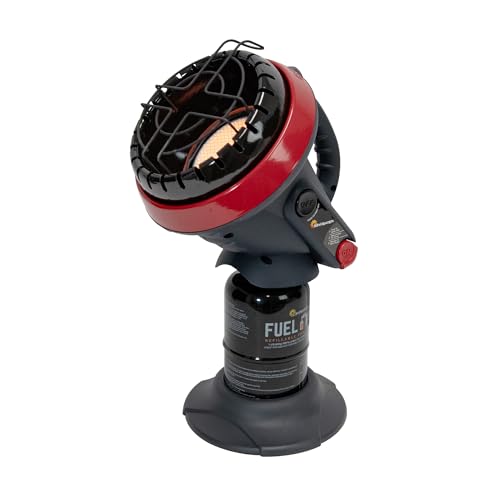
The small sibling, and the better choice more often than people expect. It puts out 3,800 BTU per hour and heats up to 95 square feet, which sounds modest until you measure your tent and realize 95 square feet is most of it. Matching output to a small space is the right instinct with any combustion heater. It stands on an eight-inch round base that takes up almost no floor, which matters when floor is the thing you are short of, and it starts on one button rather than a lighter and a knob. There is no second output setting and no fan; it is a single-purpose radiant heater that does one job simply.
Pros
- Output matched to a small tent rather than oversized for it
- Eight-inch round stand uses almost no floor space
- One-button ignition, no lighter needed
- Cheaper than the MH9BX
Cons
- 3,800 BTU will not warm a large tent or a van
- Single output level, so control is on and off
Best for: two and three-person tents, truck cabs, and ice shacks where the MH9BX would be too much heater.
MOZODAWN 2-in-1 Propane Heater and Stove
Two pieces of kit in one bag, which is a real argument when you are packing a car. It heats and it cooks, putting out up to 13,000 BTU with 360-degree radiant heat, the highest figure here. The build shows some thought: a stainless steel threaded interface that resists rust, an adjustable control, and a five-foot hose connector included so it reaches a tank rather than perching on one. Safety runs to a triple arrangement, with a tip-over switch and an automatic gas cut-off once the flame goes out. What it does not have is a low-oxygen sensor, so like the other open-flame units here it belongs outside: at the picnic table, under an awning, beside the tent rather than in it.
Pros
- Heats and cooks, replacing two items in the car
- Highest output here at 13,000 BTU, with 360-degree radiant heat
- Tip-over switch plus automatic cut-off if the flame goes out
- Five-foot hose included, so it runs off a proper tank
- Rust-resistant stainless steel gas interface
Cons
- No oxygen depletion sensor; outdoor use only
- Tank not included
Best for: car campers who want one gas appliance for cooking dinner and warming the camp chairs afterwards.
Gasfargo Portable Outdoor Propane Heater
The straightforward budget option, and refreshingly real about itself. Its own listing leads with the warning: outdoors and well-ventilated only, never indoors or enclosed, away from anything flammable. Taken on those terms it is good value. A single tank-top radiant burner produces 6,200 BTU, enough to make a patio, a fishing spot, or a hunting blind comfortable, and it needs no electricity at all. It assembles and packs down quickly, lights through an ignition hole on the side with the USB lighter included, and stands on a cylinder stand that holds the tank steady rather than letting it wobble. The exterior face guard is there to stop you burning yourself on it.
Pros
- Cheapest way to get real radiant heat outdoors
- 6,200 BTU, no electricity, nothing to charge
- USB lighter and cylinder stand included
- Assembles and packs down in moments
- Face guard reduces the chance of contact burns
Cons
- Outdoor use only; the maker is explicit about this
- No oxygen sensor and no tip-over cut-off
- Propane tank not included
Best for: patios, awnings, deer blinds, and fishing, where the air is open and the price is the point.
INTCOLL Dual Fuel Camping Heater
The one that solves a packing problem. It runs on one-pound propane cylinders or on iso-butane canisters, with the connector included, which means if you already carry iso-butane for a backpacking stove the heater burns the same fuel and you carry one kind of gas instead of two. Most heaters in this class are propane only and say so sternly. It is the lightest and most compact pick here, built for someone counting grams, and it comes in a hardshell case that protects it in a pack. One-click self-ignition means no matches, and a sturdy foldable base resists tipping on uneven ground. A twelve-month warranty backs it.
Pros
- Dual fuel: propane or iso-butane, connector included
- Lightest and most packable option here
- Hardshell carry case protects it in a pack
- One-click self-ignition and a foldable anti-tip base
- Cheapest pick of the group, with a twelve-month warranty
Cons
- No oxygen depletion sensor; for open-air use
- Small output; this warms you, not a space
Best for: backpackers and anyone already carrying iso-butane who wants warmth at a camp table without a second fuel type.
The verdict
Best Overall: Mr. Heater MH9BX. Comfortably the best-selling heater here, and the only pick in this group with a low-oxygen shut-off alongside tip-over and pilot-out protection. If the words tent or van are anywhere in your plan, this is the answer, and the extra money is buying the one feature that cannot be improvised.
Best Value: INTCOLL Dual Fuel Camping Heater. The cheapest here, the lightest, and the only one that will burn the iso-butane already in your pack. For open-air warmth it does the job for very little, provided you keep it outside.
Best Premium: MOZODAWN 2-in-1 Propane Heater and Stove. The most capable outdoor unit: the highest output, a stove as well as a heater, a real hose, and both a tip-over switch and a flame-out cut-off. For car camping it replaces two things you would otherwise pack.
And if your tent is small, take the Little Buddy over the MH9BX. Matching output to the space is the right call with any combustion heater.
Frequently asked questions
Can I run a propane heater inside a tent?
Only one that is certified for enclosed spaces and has a low-oxygen shut-off, and even then with ventilation and a battery carbon monoxide alarm. Of the picks here, the Mr. Heater units are built for that; the tank-top radiant heaters are not, and their own instructions say never to use them indoors or in an enclosed space. Believe the instructions. Carbon monoxide gives no warning of any kind.
Do I need a carbon monoxide alarm?
If you are running any combustion heater in any enclosed space, yes, without exception. A cheap battery alarm costs a fraction of the heater and is the only thing in the vehicle that can tell you the air is going wrong. The heater’s oxygen sensor and the alarm are two independent protections, and you want both.
How long does a one-pound propane cylinder last?
It depends entirely on the setting. The MH9BX is quoted at 5.6 hours at its minimum output; run it on high and you will get a good deal less. Small tank-top heaters at 6,000 BTU or so land in a similar range. For a long trip or van use, a hose to a larger refillable tank is far cheaper and means you are not carrying a bag of disposables.
Radiant or forced-air for camping?
Radiant, for everything in this article. Radiant heaters warm people and objects directly rather than warming the air, so you feel them at once, they work in a drafty tent where warm air would just leave, and they need no electricity or fan. Forced-air propane heaters are for workshops and construction sites, not campsites.
What about altitude?
Combustion heaters get less reliable as the air thins, and the makers say so. Mr. Heater notes that the MH9BX may shut off above roughly 7,000 feet above sea level. That is the safety system behaving correctly rather than a fault, but if your camping is at altitude it is worth knowing before you rely on it.
This article may contain affiliate links; see our Affiliate Disclosure.