Set a budget of 300 for a gaming desk and the search will hand you back nothing that costs even a third of it. The most expensive desk here lands under 85. That is genuinely good news, and it changes the question completely: you are not choosing what to spend, you are choosing what to check. The answer is two numbers, and seven of these ten listings publish neither of them.




At a glance
| Desk | Size and the numbers it publishes | Price tier | Link |
|---|---|---|---|
| DUMOS 50 inch | 50in L-shape. Best seller. No load figure | Budget | |
| DUMOS 47 inch | 47in. Calls its power hub a power strip | Budget | |
| GTPLAYER 55 inch | Biggest here. The only warranty on the page | Budget | |
| X-cosrack 33.5 inch | Smallest. 180lb frame, 1.5m cord | Mid-range | |
| Korfile 40 inch | 220lb legs. Two combine into a U | Mid-range | |
| TIQLAB 40 inch | 220lb. The only FSC-certified wood here | Mid-range | |
| MOTPK 43 inch | The only desk here publishing its depth | Premium | |
How to choose
Depth is the number that decides everything
Every desk here is sold by one measurement, its width, and width is not what fails you. A 27 inch monitor on its stand eats most of a foot before your keyboard gets a look in, and if the desk is shallow the screen ends up in your face with nowhere to put your hands. Exactly one listing on this page publishes a depth: 17.7 inches. Everyone else names a width and leaves the rest to the photograph. Measure the space between your monitor and your chest, then ask before you order.
Load capacity is a number or it is nothing
Rock-solid, unshakable, excellent load-bearing. Those are the phrases most of these listings use instead of a figure, and they mean nothing at all. Three desks here publish a real number: two at 220 pounds and one at 180. Now weigh what is going on it. A tower is 30 to 50 pounds, two monitors are another 25, and then you lean on it. 180 pounds is not much headroom. If a desk will not state its capacity, that silence is the specification.
Carbon fiber is a sticker
Four desks in this search advertise carbon fiber, and none of them are made of it. Korfile says it outright and deserves credit for it: MDF with a carbon fiber textured finish. That is the truth about all of them. It is a laminate pattern printed on particle board, and it is a perfectly good scratch-resistant surface, but it is a look and not a material. The whole category is MDF underneath. One listing here claims FSC-certified wood instead, and that is the only material claim on this page worth anything.
The power outlets are a power strip screwed to a desk
Which is fine, and one brand is plain enough to use the words: built-in power strip, two AC outlets, a USB and a Type-C. Everyone else says charging station or power hub, which sounds like engineering and is not. The detail that actually matters is the cord, and only two listings mention it: 1.5 meters. That means the desk has to live within five feet of a wall socket, or you are running an extension lead to the extension lead you just bought.
Reversible is the feature to insist on
Almost every L-shaped desk here can be built with the short arm on either side, and it costs nothing. It matters because a corner desk that faces the wrong way is furniture you cannot use, and rooms change. Korfile goes further and notes that two of its desks combine into a U, which is a real answer if the setup grows. Check for the word reversible before anything else on an L-shape, because the alternative is committing your room layout to a decision you make while unpacking.
Count what the storage actually holds
Shelves, drawers, hutches and pegboards are how these desks distinguish themselves and the counts are wildly different: three tiers here, four drawers and a pegboard there, a single fabric drawer somewhere else. A CPU stand matters most of all if you own a tower, because the alternative is the carpet, and carpet feeds a computer dust. Two desks here put the tower on a reversible metal shelf. Work out what you are storing before a light strip decides it for you.
DUMOS 50 inch
The best seller in this search and among the cheapest, and it wins by ignoring the gimmicks: no lights, no sockets, just 50 inches of L-shaped surface, which is the second largest here. The CPU stand mounts on either side and gets your tower off the floor and out of the dust. A reinforced metal frame with an X-brace underneath, and a waterproof top, which on a desk that will meet a drink eventually is a better feature than a light strip. DUMOS claims tools-free assembly with numbered parts.
Pros:
- The best-selling desk in this search
- 50 inches of surface; among the cheapest here
- Reversible CPU stand keeps the tower off the carpet
- Waterproof top and an X-braced metal frame
Cons:
- No load capacity published
- No depth published
- No lights or sockets, if you wanted them
Best for: the most desk for the least money, gimmicks skipped.
DUMOS 47 inch
The same idea with the electronics added, and the listing is refreshingly plain about what they are: a built-in power strip carrying two AC outlets, a USB and a Type-C, on a 4.92 foot cord. Calling it a power strip rather than a charging hub is the plain description and nobody else here manages it. The monitor riser carries RGB strips with a remote for seven colors, brightness, speed and modes, clipped down so they stay put. Multi-tier shelves and a drawer, in 47 or 53 inches, black or white.
Pros:
- Calls its power hub what it is: a power strip
- Publishes its cord length, at nearly five feet
- Two AC outlets plus USB and Type-C on the desktop
- Drawer and multi-tier shelves; two sizes, two colors
Cons:
- No load capacity published
- No depth published
- Remote-controlled lights, not app-controlled
Best for: sockets on the desktop, described plainly.
GTPLAYER 55 inch
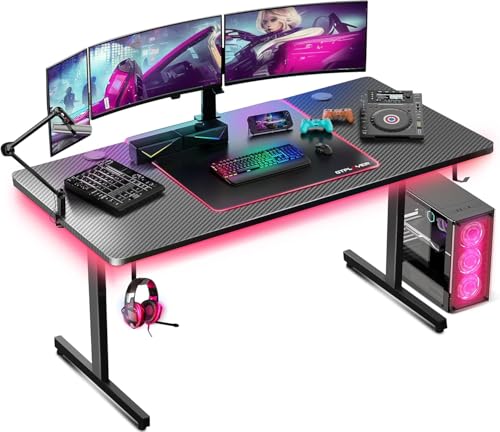
The largest desk on this page at 55 inches, in a T-shape rather than an L, so it wants a wall rather than a corner. It has a mouse pad built into the surface, which removes one thing to buy and one thing to slide around, plus a headphone hook and integrated LEDs. The genuinely notable feature is at the bottom of the listing: a one year warranty, and it is the only warranty offered anywhere in this search. Everything else it says about strength is adjectives with no numbers behind them.
Pros:
- The biggest desk here at 55 inches
- The only one offering a warranty; one year
- Mouse pad built into the surface
- T-shape suits a wall rather than a corner
Cons:
- No load capacity, depth or frame material published
- Its strength claims are entirely adjectives
- T-shape wastes a corner if that is what you have
Best for: width against a wall, with someone standing behind it.
X-cosrack 33.5 inch
The smallest desk here by a distance and the most thoroughly specified, which is an odd pairing. It publishes an X-braced steel frame at 180 pounds, a 1.5 meter cord, two AC outlets with USB and Type-C, and lighting detailed to a degree nobody else attempts: 20 static colors, 22 dynamic modes, five brightness levels and ten speeds. There is a monitor stand, a fabric drawer, a reversible CPU stand and side hooks, all inside 33.5 inches. It is the worst seller on the page.
Pros:
- Publishes its load capacity and cord length
- Six real features in the smallest footprint here
- Reversible CPU stand plus a fabric drawer
- Anti-tip adjustable feet for uneven floors
Cons:
- 180 pounds is the lowest capacity published here
- 33.5 inches is very tight for two monitors
- The worst-selling desk in this search
Best for: a genuinely small room, with the numbers stated.
Korfile 40 inch
The second best seller here and the most useful listing in the search. It publishes a leg capacity of 220 pounds, states plainly that the carbon fiber is a textured finish on MDF rather than pretending otherwise, and tells you assembly takes about 60 minutes, which nobody else will. Two of these combine into a U-shape if the setup grows. Three AC sockets and two USB ports, app-controlled RGB, double Z-shaped legs with adjustable pads, and a monitor stand that takes two 24 inch screens.
Pros:
- Publishes a 220 pound leg capacity
- Real that carbon fiber is a finish on MDF
- Two desks combine into a U-shape
- Three AC sockets, two USB, app-controlled lighting
Cons:
- No depth published
- 40 inches is modest for a dual-monitor setup
- MDF core, however good the finish
Best for: knowing what you are buying, and room to grow into a U.
TIQLAB 40 inch
The only desk in this search that is not made of MDF, or says it is not: FSC-certified wood on a metal frame with an X-brace, and a published static load of 220 pounds. That is two real material facts on a page of adjectives, and the certification means the timber is traceable to a managed forest. Two tiers of open shelving under the desk, two AC outlets with a USB and a Type-C, and a reversible short arm. It ships with a purpose-made L-shaped allen key.
Pros:
- The only FSC-certified wood on this page
- Publishes a 220 pound static load
- Two AC outlets plus USB and Type-C
- Reversible design; X-frame against wobble
Cons:
- No depth published
- 40 inches; among the smaller desks here
- No lighting, if that was the point
Best for: real wood and a real load figure.
MOTPK 43 inch
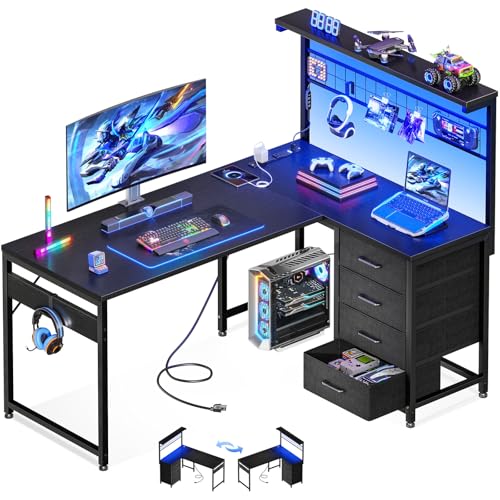
The most expensive desk here, which still means very little, and the only one that tells you how deep it is: 17.7 inches deep by 43 wide by 29.8 high. That single number is worth more than every light mode on this page, because depth is what decides whether a monitor and a keyboard can coexist. It is also the best-stocked desk here: four drawers, a grid pegboard, a shelf, a hutch that mounts either side, a headphone hook, three outlets, two USB ports and two LED strips with a memory function.
Pros:
- The only desk publishing depth, width and height
- Four drawers, a pegboard, a shelf and a hutch
- Three outlets and two USB ports
- Reversible hutch; lighting with a memory function
Cons:
- 17.7 inches deep is shallow for a large monitor
- No load capacity published
- The most expensive desk here, and one of the smaller
Best for: storage, and knowing the desk fits before it arrives.
The verdict
Nothing in this search costs a third of the budget in the search term, so spend the attention instead. Two numbers matter and hardly anyone prints them: how much weight the desk holds, and how deep it is. Everything else, the lights and the carbon fiber and the charging hubs, is a strip of MDF and a power strip.
Best overall: Korfile 40 inch. The second best seller here and the only listing that is fair on all three fronts: it publishes a 220 pound leg capacity, it admits the carbon fiber is a printed finish on MDF rather than a material, and it tells you assembly takes about an hour. Three sockets, two USB ports, app-controlled lighting, adjustable pads for a bad floor, and two of them make a U if the setup grows.
Best value: DUMOS 50 inch. The best-selling desk in this search, among the cheapest, and the second largest surface on the page. It skips the lights and the sockets entirely and spends the money on the desk: 50 inches of L-shape, a reinforced metal frame with an X-brace, a waterproof top, and a CPU stand that mounts either side to keep your tower out of the carpet dust.
Best premium: MOTPK 43 inch. The dearest desk here and the only one that publishes its depth, which is the number that actually decides whether your monitor and your keyboard can share the surface. At 17.7 inches it is shallow, and you know that before you order rather than after. Four drawers, a pegboard, a reversible hutch, three outlets and two USB ports.
FAQ
Do I need to spend 300 on a gaming desk?
No. Nothing in this search reaches even a third of that. The most expensive desk here is under 85 and the best seller is barely half that. Spend the attention on the load capacity and the depth instead.
Are these desks actually carbon fiber?
No. It is a textured laminate printed on MDF, and Korfile says so plainly on its own listing. It makes a decent scratch-resistant surface. It is a look, not a material, and every desk here is particle board underneath except the one claiming FSC-certified wood.
How much weight will they hold?
Only three of these will say: two at 220 pounds and one at 180. A tower is 30 to 50 pounds and two monitors another 25 before you lean on it. Everything else offers adjectives, and that silence is your answer.
Why does depth matter more than width?
Because a 27 inch monitor on a stand takes most of a foot before your keyboard arrives, and a shallow desk puts the screen in your face. One listing here publishes a depth, at 17.7 inches. Everyone else gives you a width and a photograph.
Are the built-in power outlets useful?
They are a power strip fixed to the desk, and one brand uses those exact words. It saves reaching behind furniture. The catch is the cord: the two that publish it are 1.5 meters, so the desk lives within five feet of a socket.
This article may contain affiliate links; see our Affiliate Disclosure.