Two of the magnetic sun shades in this search include a purchasing checklist, and the last item on both is the same: heat may weaken the magnet’s holding strength. Read that where it sits. This is a product for hot, sunny days, and its own sellers are telling you that the hotter it gets, the worse it holds on. They are being fair. It is still the strangest disclosure on the page.






At a glance
| Product | UV claim | Price tier | Link |
|---|---|---|---|
| COOCTECH Mesh | 99.98%. One figure for both bands. Cheapest here | Budget | |
| Munchkin Brica | “Helps block”. No number, and a heat alert | Budget | |
| Kinder Fluff | 99.79% UVA and 99.95% UVB. Two figures, certified | Budget | |
| Sfee Roller | “Blocks harmful UV rays”. No figure | Budget | |
| TuckVisor | 100%. It is opaque, and it is tiny | Mid-range | |
| XCBYT Curtains | 99%. Opens with a four-point magnet warning | Premium | |
| ZATOOTO Curtains | 97% in one bullet, 99% in the next | Premium | |
How to choose
One number for UVA and UVB is a marketing number
UVA and UVB are different wavelengths, and no material filters both identically. So a real lab report produces two figures. Exactly one listing here has two: 99.79 percent of UVA and 99.95 percent of UVB, described as lab tested and certified. Everything else quotes a single percentage covering both bands, or a round 99, or nothing at all. The tell is not the size of the number. It is whether the number split when it met the physics.
The claims ladder runs from nothing to everything
Line them up and the range is remarkable for one product category. One shade says only that it helps block ultraviolet, with no figure. One says 97 percent in its first bullet and 99 percent in its second. Several say 99. One says 99.98. One says 100. That is a spread from an unquantified hedge to a total, describing what is basically the same problem: a piece of fabric or film between the sun and the back seat.
The only shade claiming 100 percent is the one you cannot see through
And it is the smallest thing here, at under eighteen inches long and seven inches at its widest, tucking into the gap between the window and the trim. That is the trade made visible. Total blocking means opaque, opaque means no visibility, and no visibility means it can only cover a sliver. Every shade that lets you see out is admitting light through, which is why its figure has a decimal point instead of a full stop.
Check your window frame with a fridge magnet before you buy
Four magnetic products here, and all four warn you they may not fit your car. One says steel frames only, and that magnets weaken badly through plastic or rubber, and that frameless windows are out entirely. Another opens its listing, before any feature, with four instructions: confirm the frame takes magnets, test with a fridge magnet, make sure the magnetic area is bigger than the rubber seal, and note that heat weakens the hold. Aluminum, carbon fiber and plastic frames are all named as failures. Modern cars are full of them.
And note what the fourth point on that checklist says
Two of these listings state that high temperatures reduce the magnet’s holding strength. The shade exists for hot days. Its grip is weakest in exactly the conditions you bought it for, and both sellers put that in writing rather than let you discover it in a car park in August. Take it as a real constraint on the design, not a footnote: if your frame is marginal on a cool day, it will not be better on a hot one.
The sellers disagree about front windows
One opaque magnetic shade says, in capitals, that it is for rear side windows only and asks you not to use it on front windows because it blocks the driver’s view. Two other opaque magnetic sets in this same search ship a shaped piece for the front side window, one of them a triangle cut to size. They cannot all be right about the same idea. Rules on obstructing a driver’s view vary by where you live, so check yours, and notice that the people selling these do not agree with each other.
Your window is not a rectangle, and the shade is
The most accurate sizing note here belongs to a magnetic shade that says it plainly: because its sunshade is rectangular and car windows vary in size and shape, you should confirm your window’s shape before expecting full coverage. Another says slight variations are unavoidable in a universal product. Sizes across this page run from twelve inches to over thirty, none of them matching, and every one is a rectangle being sold for a window with a curve in it.
COOCTECH Mesh
The cheapest shade in this search and the largest mesh panel on the page at 25 by 15 inches, on a steel wire frame with four suction cups and a storage bag. It is a see-through mesh, so it does not block your view, and it is sized for SUVs, minivans and large sedans rather than just hatchbacks. It claims 99.98 percent of harmful rays, which is a single figure covering both ultraviolet bands and carries no mention of a test. Good product, unverifiable headline.
Pros:
- The lowest price here, and the biggest mesh panel
- Steel wire frame; removable and reinstallable
- Four suction cups and a storage bag included
- Mesh keeps your view clear through the window
Cons:
- One figure for both UV bands, and no test named
- Suction cups need clean glass and re-pressing
- Mesh means it shades rather than blacks out
Best for: the largest see-through panel for the least money.
Munchkin Brica
The one product here with an idea nobody else had: a white hot indicator that changes color when the car gets too hot, so the shade itself tells you something is wrong. On a shade sold for a rear seat with a baby in it, that is a genuinely thoughtful piece of design and it costs nothing to use. Two shades at 15 by 19 inches in a safe-view mesh, with a choice of clips or suction cups and a one-push retract. Its ultraviolet claim is the weakest wording on the page: helps block, with no figure at all.
Pros:
- Heat indicator turns white when the car gets too hot
- Clips or suction cups; two ways to mount it
- One-push retraction; rolls away in a second
- Safe-view mesh keeps visibility good
Cons:
- “Helps block” with no percentage anywhere
- Its own bullet says suction needs reapplying as temperature swings
- 15 by 19 inches; small against the big panels here
Best for: a rear seat with a child in it, and a warning built in.
Kinder Fluff
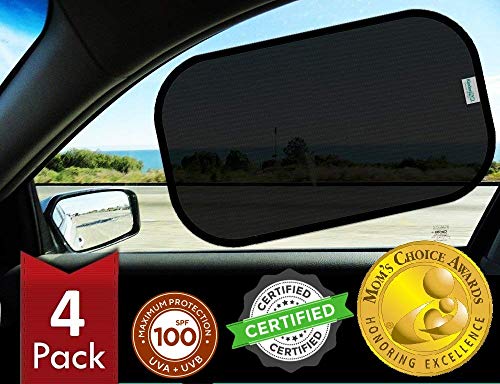
The only listing here with a lab behind it, and it shows in the shape of the claim: 99.79 percent of UVA and 99.95 percent of UVB, two different numbers, because they are two different wavelengths and nothing blocks them identically. It is also the only pack that refuses the visibility trade-off and gives you both sides of it: four shades, two transparent and two semi-transparent, with instructions to use the clear ones where seeing out matters and the darker ones where shade matters. Static cling, no suction cups, no residue, works on tinted glass.
Pros:
- Two certified figures, split by UV band, lab tested
- Four shades: two transparent, two semi-transparent
- Static cling; no suction cups, no adhesive, no residue
- UPF 50+; works on tinted windows; folds into a pouch
Cons:
- Must be removed before opening the window
- Cling needs clean glass; dust makes it fall
- 20 by 12 inches; overlap needed on big windows
Best for: a number you can check, and the choice of two.
Sfee Roller
A self-retracting roller shade at 15.7 by 17.7 inches in a higher-density mesh, with six rubber suction cups and adjustable clips as a second option, so you can raise or lower the height to suit the window. A quick-retract button rolls it away in one motion. The listing is also unusually practical about the failure everyone hits: if the suction cups arrive deformed from shipping, dunk them in hot water and dry them before use. That is the kind of note that comes from actually reading returns.
Pros:
- Roller height adjusts to fit different windows
- Six suction cups plus clips; two mounting options
- One-button retract; folds away instantly
- Tells you how to fix deformed suction cups
Cons:
- No UV percentage given anywhere
- Depends on suction cups, which need clean glass
- Mesh only; no blackout option
Best for: adjusting the height to an awkward window.
TuckVisor
Not a window shade at all, but a visor extender, and it belongs on this page because it is the real end of the trade. It is a semi-rigid opaque strip, 17.75 inches long and 7.25 at its widest, that tucks into the gap between the window and the trim to kill the band of sun your visor misses. It claims to block 100 percent, which is true and unremarkable for an opaque material, and it is the only product here that earns that figure precisely because you cannot see through it. Patented and made in the USA.
Pros:
- Genuinely opaque, so 100 percent is a real claim
- Tucks in; no suction cups, magnets or cling
- Kills the gap your sun visor does not reach
- Stores between the seat and console; patented
Cons:
- Tiny; it is a strip, not a window cover
- Must come out before the window goes down
- Solves a different problem to everything else here
Best for: the strip of glare your visor cannot cover.
XCBYT Curtains
Four full blackout curtains covering all four side windows, with a shaped triangular front piece and rectangular rears, twelve magnets in the front panel and fourteen in the rear with the top eight upgraded. It is the most complete privacy solution here, meant for camping, naps and changing, and it is backed by a twelve-month warranty. It is also the listing that opens with a four-point warning before a single feature: check the frame takes magnets, test with a fridge magnet, confirm the magnetic area beats the rubber seal, and know that heat weakens the hold.
Pros:
- All four side windows covered in one pack
- Shaped front triangle; not just rectangles
- Full blackout for camping, naps or changing
- Twelve-month warranty; publishes every dimension
Cons:
- Iron frames only; not plastic, aluminum or carbon fiber
- Its own note says heat weakens the magnets
- Ships a front-window piece another seller here warns against
Best for: blacking out the whole car, if your frames are steel.
ZATOOTO Curtains
The best idea among the blackout curtains: a silver reflective layer on one side and a black absorbing layer on the other, so you turn the silver out in summer to push heat away and the black out in winter to draw it in. That is a genuinely clever reversible design at 31 by 19 inches. The numbers are where it wobbles. Its first bullet says up to 97 percent of ultraviolet, its second says 99 percent of light, and its magnet count appears as twelve, then fourteen front and fourteen rear, then twelve and fourteen, across two bullets.
Pros:
- Reversible: silver reflects in summer, black absorbs in winter
- 31 by 19 inches covers a whole window
- Four panels; blackout privacy for camping or naps
- Publishes the fridge-magnet test before you buy
Cons:
- 97 percent in one bullet, 99 percent in the next
- Magnet count given three different ways
- Not for carbon fiber, aluminum or plastic frames
Best for: a car used in both seasons, if the frames cooperate.
The verdict
Two things settle this page. Ultraviolet comes in two bands and only one listing here published two numbers, which is what happens when a claim meets a laboratory. And four magnetic shades all warn that your car may not be magnetic, two of them adding that heat loosens their grip, which is a hard thing to say about a sun shade.
Best overall: Kinder Fluff. The only certified figures in the search, and they are two figures rather than one, because UVA and UVB do not block alike and a real test says so. It is also the only pack that handles the visibility trade-off as a choice instead of a compromise: two transparent shades for the windows where you need to see, two semi-transparent for the ones where you want shade. Static cling means no suction cups, no residue, and it works on tinted glass.
Best value: COOCTECH Mesh. The cheapest shade here and the largest see-through panel, at 25 by 15 inches on a steel wire frame, sized for SUVs and minivans rather than only small cars. Four suction cups and a bag are included, and the mesh keeps your view clear. Its 99.98 percent claim is a single number covering both ultraviolet bands with no test named, so buy it for the size and the price and take the headline as decoration.
Best premium: XCBYT Curtains. Four blackout panels covering every side window, with a shaped triangular front rather than another rectangle, and a twelve-month warranty behind it. Nothing else here turns a car into a dark room this completely. Before you buy, do what its own first bullet asks and hold a fridge magnet to your window frame, because iron frames are required and plastic, aluminum and carbon fiber are all out.
FAQ
Why do UV claims here run from 97 to 100 percent?
Because most of them are not measurements. UVA and UVB are different wavelengths and no material blocks both identically, so a real test yields two figures. One listing here publishes two, certified. The rest give one number for both bands, or none.
Will magnetic shades fit my car?
Test first. All four magnetic products here warn you: iron or steel frames only, and one asks you to hold a fridge magnet to the frame before buying. Plastic, aluminum, carbon fiber and frameless windows are named as failures, and modern cars are full of them.
Does heat affect a magnetic shade?
Its sellers say yes. Two listings here end their purchasing checklist with the note that high temperatures reduce the magnet’s holding strength, which is worth weighing on a product bought specifically for hot days.
Can I use these on front side windows?
The sellers disagree. One opaque shade says in capitals it is for rear windows only and asks you not to block the driver’s view. Two other opaque sets ship a front-window piece. Rules vary by where you live, so check yours.
Mesh or blackout?
Depends on the window. Mesh shades let you see out and admit some light. Blackout curtains give privacy and darkness and you cannot see through them. One pack here gives you both transparencies and tells you to use each where it suits.
This article may contain affiliate links; see our Affiliate Disclosure.