Three listings here mention their pulley ratio and seven do not, which matters more than any of them let on: a 2:1 pulley means you feel half the stack. One machine explains that a 1:1 ratio offers more resistance and suits heavy lat pulldowns. The other seven publish a weight and let you assume it is the weight you will lift.


At a glance
| Product | Is the weight included, and what does it say? | Price tier | Link |
|---|---|---|---|
| Fitvids 122.5 lb | Yes. And its bullet claims a 3,775 pound user | Budget | |
| 160LB Station | Yes, 160 lbs. And it names every exercise | Budget | |
| ROBORE 160LB | Yes. Says 160 lbs, then says 12 plates of 14 | Budget | |
| Mikolo Home Gym | Yes. Title says 150 lbs, bullet says 152 | Mid-range | |
| Roygym Power Cage | No. A frame in 18.3 sq ft. You buy the iron | Mid-range | |
| Major Fitness Drone2 | No stack. But it explains the 1:1 ratio | Premium | |
| Mikolo Smith Machine | Two stacks of 132. The only ratio explanation here | Premium | |
How to choose
The pulley ratio decides what the stack actually weighs
Run a cable over a pulley system at 2:1 and you feel half the stack while getting twice the cable travel. At 1:1 you feel all of it over half the distance. Neither is better, they are different tools, and one listing here explains exactly that: a 1:1 ratio offers more resistance and suits slower, strength-focused work like heavy lat pulldowns. Seven listings publish a stack weight and never mention the ratio, which leaves the most important number on the page unanswered.
Half these gyms do not include any weight
The other split nobody announces. Five products here are selectorized machines with a stack built in, so the number in the title is the iron in the box. Five are power racks or Smith machines, and their accessory lists give it away: weight storage pins, spring clamps, a bar. Pins hold plates you do not have yet. One frame here costs a mid-range price and needs a full set of Olympic plates before you can use it, which is easily another several hundred pounds of iron to buy and carry.
Check the arithmetic on the stack
One machine advertises a 160 pound stack and then explains it as 12 plates at 14 pounds each. Twelve fourteens is 168. Another says 150 pounds in its title and 152 in its bullets. These are small discrepancies and they are on the single specification the product is sold on, which tells you how carefully the rest of the listing was checked.
One listing describes a 3,775 pound user
The same bullet manages three numbers: 1.5 inch steel tubing, cables tested to 1,000 pounds, and support for up to 3,775 pounds of user weight. Its own heading says 1,000 pounds capacity. A person cannot weigh 3,775 pounds and a cable rated at 1,000 could not hold them if they did. It is a decent budget machine and that sentence is nonsense, and both things can be true.
Footprint in square feet, not inches
You are putting this in a garage or a spare room, so the question is whether it fits. One listing gives you the answer directly at 18.3 square feet. Two others publish dimensions you can multiply out, at roughly 22 and 26 square feet of floor. The rest give you nothing, which on an object this size is the most useful thing they could have said and did not. Measure your space, then shop.
Two stacks means two people, and it is a real feature
Two machines here run independent weight stacks on each side, and both make the same argument: one person does squats while the other does crossovers, nobody waits, and each side sets its own weight. For a couple training together at different strengths that solves the actual problem with a single-stack gym, which is that it is a queue. It also doubles the price, which is the real trade.
Count the exercises they are willing to name
Some listings give you a number and some give you a list. One claims 90-plus exercises and then names eleven stations. One claims over 100 and names none. One says it covers 80 percent of muscle groups, which invites the obvious question about the other 20. The listings worth trusting write out chest press, pec fly, preacher curl, lat pulldown, seated row and the rest, because a named exercise is a station that exists.
Fitvids 122.5 lb
The cheapest complete gym here, and one of only three that tells you how much floor it needs: 42 by 76 by 80 inches, which works out around 22 square feet. It runs 15 steel shaft pulleys on nylon-coated aircraft cable, includes a detachable rod, sponge handles, calf blocks and ankle straps, and its 122.5 pound vinyl stack is clear about being the entry level. It also says it covers 80 percent of muscle groups, and claims support for a 3,775 pound user in a bullet headed 1,000 pounds capacity.
Pros:
- Publishes its full dimensions; about 22 sq ft of floor
- 15 steel shaft pulleys on nylon-coated aircraft cable
- Detachable rod, handles, calf blocks and ankle straps included
- The lowest price for a gym with the weight in it
Cons:
- Claims support for a 3,775 pound user
- 122.5 lbs; the lightest stack here
- Ships in five boxes; assemble only when all arrive
Best for: starting out, in a measured amount of space.
160LB Station
It names its exercises rather than counting them, and the list is the specification: chest press, pec fly, preacher curl, wide and close-grip lat pulldown, seated low row, leg extension, cable lateral raise, triceps pressdown, cable curls and seated cable ab crunch. Every one of those is a station that exists. The 160 pound selectorized stack is the biggest at the budget end and changes with a pin, high, mid and low pulley positions cover most cable work, and the preacher curl pad comes off.
Pros:
- Names ten exercises rather than claiming a number
- 160 lb stack; the largest at this price
- High, mid and low pulley positions
- Adjustable seat and removable preacher curl pad
Cons:
- No pulley ratio published
- No dimensions or footprint given
- Ships in multiple boxes
Best for: the most weight for the least money, listed plainly.
ROBORE 160LB
The gas-assisted telescoping seat is the good idea here, because a fixed seat on a multi-gym is what makes a machine fit one person in the house and nobody else. Sixteen named exercises across chest, back, arms, abs and legs, a 12-cable pulley system for quick changes, and the listing claims 30 years of manufacturing behind it. Its stack maths does not close: it says 160 pounds and then says 12 plates at 14 pounds each, which comes to 168.
Pros:
- Gas-assisted telescoping seat fits different bodies
- Sixteen exercises named individually
- 12-cable pulley system; quick resistance changes
- Publishes its plate count and plate weight
Cons:
- 12 plates at 14 lbs is 168, not the 160 advertised
- No pulley ratio and no dimensions
- Ships in four separate packages
Best for: a household of different heights.
Mikolo Home Gym
The most complete stack machine here: eleven named stations covering pec fly, lat pulldown, low row, chest press, leg extension, leg press, preacher curl, core, calf, seated row and mid row, on 14-gauge steel with the stack shielded behind a steel sheet. High, mid and low pulleys, a professional bearing on the cable bar to spare your wrists, removable preacher pad and leg press attachment, and a movement guide in the box. Its title says a 150 pound stack and its bullet says 152.
Pros:
- Eleven stations named, not a vague exercise count
- 14-gauge steel with the stack shielded
- Bearing on the cable bar reduces wrist strain
- Removable preacher pad and leg press; movement guide included
Cons:
- Title says 150 lbs; the bullet says 152
- No pulley ratio published
- No dimensions or footprint given
Best for: a full gym with the weight already in it.
Roygym Power Cage
The only listing here that gives you a footprint in the unit you think in: 18.3 square feet, which is the smallest on this page and the number that decides whether it goes in the garage. It is a genuine rack, with a Smith bar on linear bearings across nine height positions, dual 1:1 pulleys with 20 positions, and an accessory list that runs to eighteen items including a landmine, battle rope anchor and dip bars. Read that list carefully, though: it includes five weight storage pins and no weights.
Pros:
- 18.3 sq ft; the only footprint stated in square feet
- Dual 1:1 pulleys with 20 positions
- Eighteen accessories listed by name and quantity
- Warns that its three boxes may arrive on different days
Cons:
- No weight stack and no plates; you buy all the iron
- Its storage pins hold plates you do not own yet
- One-year cover only
Best for: a small garage, if you already own plates.
Major Fitness Drone2
It explains the thing the rest of this page hides. Its cable system is 1:1, and the listing tells you why that matters: a 1:1 ratio offers more resistance and suits slower, strength-focused exercises like heavy lat pulldowns, seated rows and leg presses. That is the clearest sentence in this search. Around it sits a power cage, cable crossover, pull-up station and squat rack on 2 by 2 inch steel to 2,000 pounds, with dip handles, a T-bar, tricep rope, ankle straps, belt and lat bar included, and lifetime support.
Pros:
- Explains its 1:1 ratio and what it is good for
- 2 by 2 inch steel uprights rated to 2,000 lbs
- Nine accessories named, including belt and wrist wraps
- Lifetime after-sales support; takes most market accessories
Cons:
- No weight stack and no plates included
- Publishes no dimensions or footprint
- You supply a barbell’s worth of iron on top of the price
Best for: a rack that tells you how its cables behave.
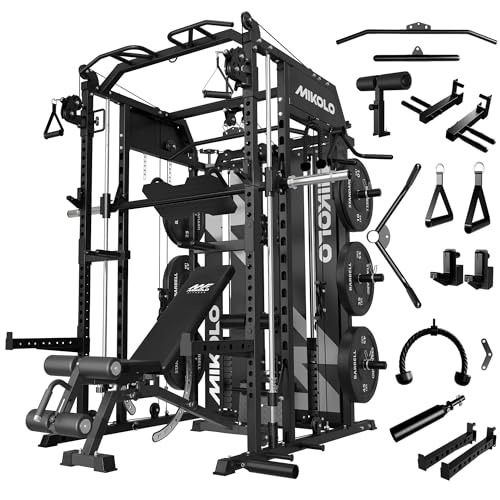
Mikolo Smith Machine
The only listing in this search that works through its pulley arrangement in public: a 2:1 ratio on the functional trainer, combining the output of two stacks to give 264 pounds for lat pulldown and low row, with 132 pounds per side so two people train at once without touching each other’s pin. It consolidates ten stations into one power rack footprint at 87 by 56 by 68 inches on 2 inch steel rated to 2,200 pounds, with a 15 degree elevated cable pivot and no carabiner swapping between movements.
Pros:
- The only listing explaining its pulley ratio and totals
- Dual 132 lb stacks; two people train independently
- Ten stations in one footprint; publishes its dimensions
- No carabiner changes between lat pulldown and row
Cons:
- By far the highest price here
- 87 inches tall; check your ceiling before ordering
- About 26 sq ft of floor once you work it out
Best for: two people, and a listing that shows its working.
The verdict
Two questions sort this page and neither is the number in the title. Does the weight come with it, because half these are frames whose accessory lists quietly include storage pins for plates you do not own. And what is the pulley ratio, because at 2:1 you feel half the stack, and seven listings never say.
Best overall: Mikolo Home Gym. It is a complete gym with the iron in the box, and it names eleven stations rather than claiming a number: pec fly, lat pulldown, low row, chest press, leg extension, leg press, preacher curl, core, calf, seated row and mid row. The stack is shielded behind steel, the frame is 14-gauge, and a proper bearing on the cable bar spares your wrists on pulldowns. Its title and bullet disagree by two pounds, which is the worst thing about it.
Best value: 160LB Station. The biggest stack at the budget end at 160 pounds, and a listing that writes out every exercise instead of totting them up: chest press, pec fly, preacher curl, both lat pulldown grips, seated low row, leg extension, cable lateral raise, triceps pressdown, cable curls, ab crunch. A named exercise is a station that exists. High, mid and low pulleys, an adjustable seat, and a preacher pad that comes off.
Best premium: Mikolo Smith Machine. It is the only product here that opens up its own pulley arrangement, telling you it runs 2:1 on the functional trainer and combines two stacks for 264 pounds on the pulldown. That is the number every other listing leaves you to guess. Dual 132 pound stacks mean two people train at once at their own weights, and ten stations fit inside one rack footprint that it actually publishes.
FAQ
What does the pulley ratio change?
What you feel. At 2:1 you lift half the stack over twice the cable travel; at 1:1 you feel every pound. One listing here explains that 1:1 gives more resistance and suits heavy pulldowns. Seven never mention it, which leaves their stack weight ambiguous.
Do these include the weights?
Half do. Five are selectorized machines with a stack built in. Five are racks, and their accessory lists give it away with weight storage pins and spring clamps, which hold plates you have to buy separately.
How much space do I need?
More than most listings will say. One gives 18.3 square feet directly. Two publish dimensions you can multiply out to about 22 and 26 square feet. The rest publish nothing, on an object the size of a wardrobe.
Is a bigger stack better?
Only if the arithmetic holds and the ratio is 1:1. One machine here advertises 160 pounds and describes 12 plates of 14, which is 168. Another says 150 in the title and 152 in the bullets.
Are dual stacks worth it?
If two of you train. Two machines here run independent stacks per side, so one person squats while the other does crossovers and neither touches the other’s pin. It solves the queue, and it roughly doubles the price.
This article may contain affiliate links; see our Affiliate Disclosure.