The band is set up in a friend’s living room, the take is magic, and you have one shot to capture vocals, guitar, and a room mic all at once, cleanly separated. A portable multitrack recorder makes that possible anywhere, recording several inputs to their own tracks so you can mix later instead of praying a single stereo take turns out. The recorders below are built for exactly that job, and one is the best-selling multitrack of the group.



A quick clarification worth making: a multitrack recorder is not the same as a voice recorder or a stereo handheld. To capture a band you need several inputs recorded to separate tracks at once, with real microphone preamps and, ideally, phantom power for condenser mics. Every recorder here does that. These picks suit a songwriter layering demos in a bedroom, a band tracking live rehearsals, or a mobile creator capturing an ensemble on location. Below is the quick comparison, then a guide to choosing the right one.
| Recorder | Standout features | Price | Link |
|---|---|---|---|
| Zoom R12 MultiTrak | 8-track, 2 XLR/TRS combo with phantom, touchscreen, effects, USB interface | Premium | |
| Zoom H4n Pro | 4-track, X/Y mics, 2 XLR/TRS combo, up to 24-bit/96kHz, USB interface | Mid-range | |
| Zoom R4 MultiTrak | 4-track, 32-bit float, 2 XLR/TS combo, built-in mic, pocketable | Budget | |
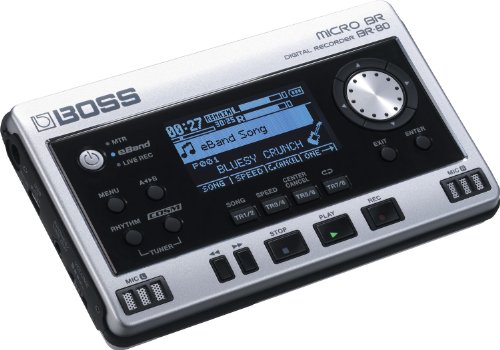
| Roland BR-80 | 8 playback tracks, eBand and Live modes, COSM effects, built-in stereo mic | Premium | |
| Boss BR-600 | 8 playback tracks, 64 V-Tracks, built-in drum machine, stereo mic, battery | Mid-range | |
How to choose a portable multitrack recorder
The specs that matter are the ones that decide what you can capture at once and how good it sounds. Here is what to weigh.
Simultaneous tracks versus playback tracks
Two numbers get quoted, and they are not the same. Simultaneous recording tracks is how many separate sources you can capture at once, which is what matters for a live band; playback tracks is how many you can layer and play back after. The Zoom R12 records eight tracks at once, the H4n and R4 record four, and the Roland and Boss offer eight playback tracks but fewer simultaneous inputs. For capturing a full band live, prioritize simultaneous inputs; for layering demos one part at a time, playback tracks matter more.
Inputs and phantom power
Real XLR inputs with combo jacks accept professional microphones and quarter-inch instrument or line sources, and phantom power lets you run studio condenser mics that need it. The R12 and H4n provide two XLR/TRS combo inputs with phantom, ideal for a pair of good mics or a mic-and-instrument setup. If you plan to use condensers or dynamic stage mics rather than only the built-in mics, XLR inputs with phantom power are essential.
Built-in microphones and sound quality
Every recorder here has built-in mics, but their quality and pattern vary. The H4n’s X/Y condenser pair captures a focused, phase-coherent stereo image up to very high levels, great for a room or an acoustic ensemble, while the R4 and the Roland and Boss include convenient built-ins for quick ideas. Sample rate and bit depth set the ceiling on fidelity: 24-bit at 44.1 or 96kHz is plenty, and 32-bit float on the R4 is the standout, since it records with so much headroom that you effectively cannot clip a take.
32-bit float and gain
This is the modern game-changer worth understanding. Traditional recording requires setting input gain correctly, and a surprise loud moment can clip and ruin a take. A 32-bit float recorder like the Zoom R4 captures such a wide range that you no longer set gain by hand; you fix the level afterward with no distortion and no noise penalty. For unpredictable live sources, a drummer who suddenly hits harder or a singer who belts a chorus, that safety net is invaluable.
Effects, mixing, and doubling as an interface
Onboard tools save you a laptop. Look for per-track EQ, compression, reverb and delay, and a proper mixer so you can shape a rough mix on the device, plus amp models and drum machines if you write with guitar or need a rhythm bed. Most of these also work as a USB audio interface, so the same box records to an SD card in the field and feeds your computer for podcasting or streaming at home. That dual role makes a multitrack recorder far more useful than a single-purpose tool.
Power, storage, and portability
On-location work lives and dies by batteries. AA or USB power lets you record where there is no outlet, and long runtime matters for full sessions. Storage is usually an SD or microSD card, so check the supported capacity and bring a fast, roomy card. Finally, weigh size against inputs: a pocketable four-track goes everywhere, while an eight-track with faders is bigger but gives hands-on control. Match the form factor to how and where you actually record.
Zoom R12 MultiTrak
The best-selling multitrack here is a complete mobile studio in a compact, battery-powered body. The R12 delivers eight-track recording at 24-bit/44.1kHz with two XLR/quarter-inch combo inputs and phantom power, plus onboard mixing and intuitive touchscreen editing, so you can produce full songs or demos with no computer at all. It doubles as a USB-C audio interface and control surface with transport controls and faders, and it is loaded with creative tools: 150 drum loops, an onboard FM synth, send effects like reverb and delay, and per-track EQ and compression. Power it from four AA batteries, USB-C, or the included adapter for long sessions anywhere, and this bundle adds cables and accessories. It is the premium pick, but for the most capable all-in-one, it leads.
Pros
- Best-selling multitrack, eight simultaneous tracks
- Two XLR combo inputs with phantom power
- Touchscreen editing, onboard mixing and effects
- Works as a USB interface and control surface
Cons
- Highest price in the group
- Larger than a pocket four-track
Best for: musicians who want a full mobile studio to track and mix a band without a computer.
Zoom H4n Pro
The H4n Pro is a modern classic that blends a superb built-in stereo pair with real multitrack inputs. Four-track simultaneous recording combines the excellent onboard X/Y condenser mics, which capture up to a very high 140 dB SPL, with two XLR/TRS combo inputs and high-fidelity preamps, so you can record a room and two close mics together. It handles up to 24-bit/96kHz in broadcast-compliant WAV, includes effects like compression, low-cut, and reverb, and mounts to a stand, tripod, or camera for audio-for-video. Battery life reaches several hours, and it doubles as a USB audio interface. For location recording of music, ensembles, and interviews where great built-in mics plus XLR flexibility matter, it is a dependable mid-range workhorse.
Pros
- Excellent X/Y mics plus two XLR combo inputs
- Four-track capture up to 24-bit/96kHz
- Handles very high sound pressure levels
- Mounts to stands and cameras, USB interface
Cons
- No 32-bit float, so gain must be set
- Four tracks, not eight
Best for: location recordists who want top built-in mics with XLR flexibility.
Zoom R4 MultiTrak
The R4 is the value champion and the most future-proof recorder here thanks to 32-bit float. That format means gain-free recording: you cannot clip a take, so a surprise loud passage from a band is captured cleanly and fixed later. It offers four-track recording with a bounce function for virtually unlimited layering, two XLR/TS combo inputs plus a built-in mic, and four faders for hands-on volume control. A color LCD keeps navigation easy, it packs 50 built-in effects including guitar and bass amp models, and it runs on four AA batteries for pocket-sized field use. It also serves as a USB audio interface for a phone or PC. For a songwriter or small ensemble who wants the clip-proof safety of 32-bit float at the lowest price, it is an easy recommendation.
Pros
- Lowest price with clip-proof 32-bit float
- Four tracks plus bounce for layering
- Two XLR combo inputs and a built-in mic
- 50 effects and amp models, pocketable
Cons
- Four simultaneous tracks, not eight
- No phantom power for condenser mics
Best for: value seekers and songwriters who want gain-free, clip-proof recording.
Roland BR-80
The BR-80 is the ultra-portable all-rounder, packing a full workflow into a pocketable body. Three modes cover different needs: MTR multitrack recording with eight playback tracks and 64 V-Tracks for takes, a Live Recorder mode using the high-quality built-in stereo condenser mics for instant band capture, and an eBand mode with a huge library of backing and rhythm patterns for practice and play-along. World-class COSM amp and effects modeling shapes guitar and vocal tones, it records to SD or SDHC cards, and it doubles as a USB audio interface with bundled recording software. For a guitarist or singer-songwriter who wants sketching, practice tools, and multitrack in one tiny device, it is a versatile premium option.
Pros
- Three modes: multitrack, live capture, and play-along
- Built-in stereo condenser mics for quick band capture
- COSM amp and effects modeling
- Very compact, USB interface with software
Cons
- Fewer simultaneous XLR inputs than the Zooms
- Premium price for its size
Best for: guitarists and singer-songwriters who want practice tools and multitrack in a pocket.
Boss BR-600
The BR-600 is the songwriting workstation of the group, built to turn ideas into arranged demos without extra gear. It offers eight simultaneous playback tracks and 64 V-Tracks so you can record multiple takes and keep the best, a powerful guitar and effects processor with vocal effects and a pitch corrector, and a built-in drum machine with velocity-sensitive pads to lay down a rhythm bed. Built-in stereo mics and battery power let you record anywhere, and it stores to a CompactFlash card. Its onboard rhythm and effects make it especially handy for solo writers building full-sounding demos one part at a time. For an arranger who wants drums, effects, and multitrack layering in one battery-powered box, it remains a capable mid-range choice.
Pros
- Eight playback tracks with 64 V-Tracks
- Built-in drum machine and effects processor
- Vocal effects and pitch correction
- Built-in mics and battery power
Cons
- Older CompactFlash storage
- Fewer simultaneous inputs for full-band tracking
Best for: solo songwriters building arranged demos one layer at a time.
The verdict
Best Overall: the Zoom R12 MultiTrak. As the best-selling multitrack here, it captures eight tracks at once with two phantom-powered XLR inputs, mixes and adds effects on a touchscreen, and doubles as an interface, making it the most complete tool for tracking a band on location.
Best Value: the Zoom R4 MultiTrak. It brings clip-proof 32-bit float, four-track recording, XLR inputs, and 50 effects at the lowest price, which is a lot of future-proof capability for the money.
Best Premium: the Roland BR-80. Its three modes, quality built-in condenser mics, and COSM modeling pack multitrack recording, live capture, and practice tools into a genuinely pocketable device, ideal for a mobile songwriter.
FAQ
What makes a recorder multitrack rather than a voice recorder? A multitrack recorder captures multiple separate sources at the same time, each to its own track, using real mic preamps and often phantom power. A voice recorder or stereo handheld mixes everything into one or two tracks, which is fine for a lecture but useless for mixing a band later.
How many tracks do I need to record a band? Count the sources you want separated at once. Two XLR inputs plus built-in mics, as on the R12 and H4n, cover a couple of close mics and a room. To capture a full drum kit plus several instruments simultaneously, you need the highest simultaneous-input count, which points to the eight-track R12.
What is 32-bit float and do I need it? It is a recording format with so much headroom that you no longer set input gain and cannot clip a take. The Zoom R4 offers it, which is a real advantage for unpredictable live sources. It is a convenience and safety feature rather than a strict requirement.
Can I use these with studio condenser microphones? Yes, if the recorder supplies phantom power on its XLR inputs, which the R12 and H4n do. Condenser mics need that power to work. If a recorder lacks phantom power, stick to dynamic mics or the built-in mics.
Do they work as a computer audio interface? All of these double as a USB audio interface, so the same device records to a card in the field and connects to a computer or phone for podcasting, streaming, or mixing at home. That dual role is a big part of their value.
Can I record without mains power? Yes. Every recorder here runs on batteries, usually AA cells or USB power, so you can capture a session anywhere. Carry spare batteries and a roomy, fast memory card for long location work.
This article may contain affiliate links; see our Affiliate Disclosure.