A dead outlet, a light that will not come on, a car that will not start: half the mystery of home electrical trouble disappears the moment you can actually measure what is happening. A multimeter turns guesswork into a number, telling you whether a wire is live, a fuse is blown, or a battery is flat. For a modest outlay it is the single most useful diagnostic tool a homeowner can own.


A great home multimeter is safe first, then easy to read, and covers the handful of measurements a household actually needs: voltage, continuity, resistance, and battery health. The picks split between simple, cheap meters, trusted-brand tools with better safety, and feature-rich models that add auto-ranging and more functions. The five below suit a first-time homeowner, a confident DIYer, and a car owner chasing an electrical gremlin.
At a glance
| Product | Standout feature | Price tier | Link |
|---|---|---|---|
| AstroAI 2000-Count Multimeter | Simple, cheap, covers core home tests | Budget | |
| Klein Tools MM325 | Trusted brand, lead-alert LEDs, drop-rated | Mid-range | |
| AstroAI TRMS 6000-Count | Auto-ranging, True RMS, more functions | Mid-range | |
| Klein Tools Electrical Test Kit | Meter plus voltage and outlet testers | Mid-range | |
| FNIRSI DMT-99 | Rechargeable, high count, waveform view | Premium | |
How to choose a multimeter for home use
You do not need a lab-grade instrument to fix a house. You need one that is safe for household voltages, easy to read, and covers the everyday tests. Here is what matters, and what does not.
Safety and CAT ratings
This is the one area not to skimp on, because you will point the leads at live household power. Look for a meter with an appropriate CAT safety rating, CAT III at 600 volts is a sensible minimum for household mains, and for fused overload protection so a wrong-setting mistake trips the fuse instead of the meter. Quality test leads with finger guards and a sturdy, drop-resistant body add real-world safety. Always treat a circuit as live until your meter proves otherwise, and switch off power at the breaker for anything beyond simple voltage checks.
Auto-ranging or manual
Ranging is how the meter picks the scale for a reading. An auto-ranging meter figures it out for you, which is far friendlier for a beginner who does not want to guess whether an outlet is on the 200 or 600-volt range. A manual-ranging meter is cheaper and gives an experienced user faster, more deliberate control. If this is your first meter, auto-ranging removes a step and a common source of confusion.
True RMS and accuracy
True RMS, or TRMS, describes how accurately a meter reads AC. Older averaging meters can misread the distorted waveforms that modern electronics, dimmers, and variable-speed motors produce, while a True RMS meter stays accurate on them. The count number, 2000, 6000, or 9999, is the resolution: a higher count shows more digits and finer detail. For basic home checks a simple meter is plenty; if you work on electronics or newer appliances, True RMS is worth having.
The functions you will actually use
Most home jobs use just a few modes: AC voltage to check outlets and fixtures, continuity with an audible buzzer to find breaks in wires and blown fuses, resistance, and DC voltage to test batteries, including a car’s. Extra functions like temperature, capacitance, and frequency are useful for HVAC and electronics but not essential for wiring. A non-contact voltage feature, or a companion tester, is genuinely handy for confirming a wire is dead before you touch it.
Readability, power, and extras
Little things make a meter pleasant to use: a backlit display for dim closets and crawlspaces, a data-hold button to freeze a reading in an awkward spot, a kickstand or magnetic hanger for hands-free work, and lead holders so the probes do not wander. Power is worth a thought too; most meters run on replaceable batteries, while some newer models recharge over USB-C, which spares you buying cells. Choose the conveniences that match where and how you will work.
Meter, kit, or companion testers
A multimeter is the versatile core, but two simple companions make home electrical work faster and safer. A non-contact voltage tester glows or beeps near a live wire without touching it, so you can confirm power is off before you open a box. A plug-in receptacle tester reads an outlet in seconds and flags common wiring faults like a missing ground or a reversed hot and neutral, which a meter can find but not as quickly. Some kits bundle all three, and if outlet and wiring safety is your main concern, that combination is often more useful day to day than a single meter loaded with advanced functions you rarely touch.
AstroAI 2000-Count Multimeter
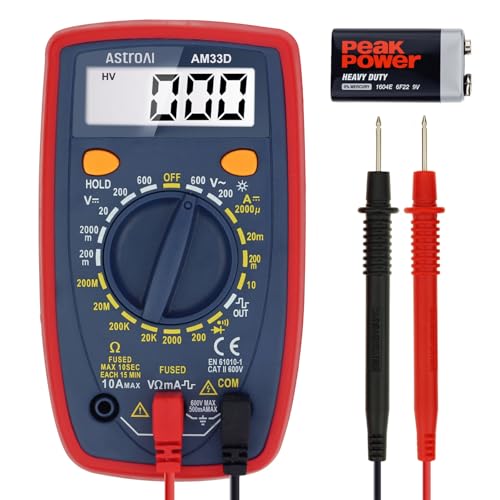
The best-selling pick is a cheap, simple meter that covers exactly what most households need. It measures AC and DC voltage, DC current, resistance, continuity, and diodes, which handles checking outlets and fixtures, testing batteries and vehicle circuits, and finding breaks in wiring. A backlit screen reads clearly in dim spaces, a continuity buzzer beeps when a circuit is complete, and double-fuse overload protection plus a silicone cover guard against mistakes. Data hold and auto shutoff round it out, and batteries and leads are in the box. For a first meter that does the common jobs without fuss, it is the effortless, low-cost choice.
Pros:
- Very affordable and beginner-friendly
- Covers voltage, continuity, resistance, and batteries
- Backlit screen and continuity buzzer
- Double-fuse protection and protective cover
Cons:
- Manual-ranging, not auto
- Basic 2000-count resolution, no True RMS
Best for: first-time homeowners doing simple voltage and continuity checks.
Klein Tools MM325
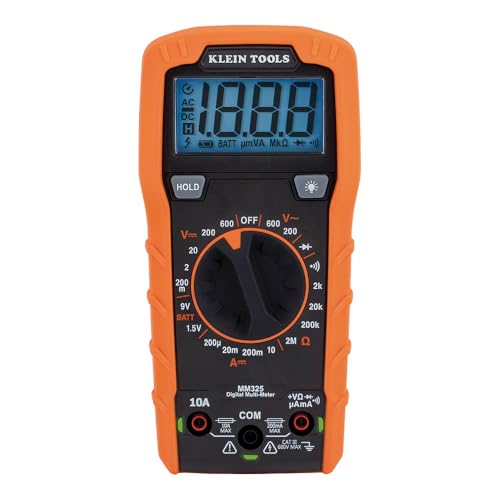
Klein is a name electricians trust, and the MM325 brings that pedigree to the home at a fair price. It measures AC and DC voltage up to 600 volts, DC current, and resistance, with continuity, diode, and battery tests, and its standout is safety: lead-alert LEDs light up to confirm your probes are in the right jacks, reducing a common and dangerous mistake. It is built to survive a two-meter drop, ships with CAT III and CAT IV rated leads, and includes a kickstand and lead holders for hands-free work. For a homeowner who wants a rugged, safety-focused meter from a respected brand, it is the confident pick.
Pros:
- Trusted electrician brand, solid safety focus
- Lead-alert LEDs confirm correct probe placement
- Drop-rated with CAT III and CAT IV leads
- Kickstand and lead holders included
Cons:
- Manual-ranging design
- Fewer bonus functions than feature-rich meters
Best for: those who want a rugged, safety-first meter from a trusted name.
AstroAI TRMS 6000-Count
Step up from the basic model and this AstroAI adds the features that make troubleshooting easier and more accurate. It is auto-ranging, so it picks the scale for you, and True RMS, so it reads modern AC loads correctly. On top of voltage, current, resistance, continuity, and diodes, it measures capacitance, frequency, duty cycle, and temperature, covering electronics and appliance work a basic meter cannot. Double ceramic fuses guard against overload, and a large backlit screen, data hold, and kickstand keep it easy to use. For a homeowner who wants room to grow without spending big, it is the value sweet spot.
Pros:
- Auto-ranging and True RMS accuracy
- Adds temperature, capacitance, and frequency
- Higher 6000-count resolution
- Ceramic-fuse protection, large backlit screen
Cons:
- More features than a basic user may need
- Runs on replaceable batteries
Best for: DIYers who want auto-ranging and extra functions for the money.
Klein Tools Electrical Test Kit
For diagnosing house wiring, this Klein kit is the most complete answer, because it pairs a multimeter with two tools built for exactly that. The included non-contact voltage tester glows and beeps near live wires so you can confirm power is off before touching anything, and the receptacle tester plugs into an outlet and instantly flags common faults like an open ground, open neutral, or reversed hot and neutral. The multimeter itself measures voltage, current, resistance, and continuity. Together they take you from finding a bad outlet to confirming it is safe to work on. For home electrical safety and wiring checks, the three-tool kit is hard to beat.
Pros:
- Three tools for complete home diagnosis
- Non-contact tester confirms power is off
- Outlet tester flags common wiring faults
- Trusted Klein build
Cons:
- Meter is basic rather than feature-packed
- More items to store than a single meter
Best for: homeowners focused on outlet and wiring safety checks.
FNIRSI DMT-99
The FNIRSI is the tech-forward premium pick, packing features usually found on pricier meters. It offers a high 9999-count resolution with True RMS, an auto-identify mode that detects voltage, resistance, and continuity for you, and a color screen that plots readings as a live waveform, so you can see fluctuations a plain number hides. A monitoring mode can log data and alarm on thresholds to catch intermittent faults hands-free, and it covers current, NCV, frequency, and diodes. Best of all, a built-in lithium battery recharges over USB-C, ending the hunt for spare cells. For a homeowner who enjoys the best gadget for the job, it is a lot of meter.
Pros:
- High 9999-count resolution and True RMS
- Color waveform view and monitoring alarms
- Auto-identify mode simplifies testing
- USB-C rechargeable, no disposable batteries
Cons:
- More capability than basic home tasks require
- Learning curve for the advanced modes
Best for: enthusiasts who want advanced features and rechargeable power.
The verdict
Best Overall: the AstroAI 2000-Count is the pick for most homes. It is cheap, simple, and covers the checks a household actually needs, from testing an outlet to finding a blown fuse or a dead battery, which is exactly why it is the most popular here. For the majority of DIY jobs, it is all you need.
Best Value: the AstroAI TRMS 6000-Count adds auto-ranging, True RMS accuracy, and extra functions for a modest step up, giving you room to grow into electronics and appliance work without overspending.
Best Premium: the FNIRSI DMT-99 packs a high-resolution True RMS meter, a waveform display, monitoring alarms, and USB-C recharging into one gadget-lover’s tool. If safety and trusted-brand build lead your list, the Klein MM325 is the rugged choice, and the Klein test kit is the best answer for outlet and wiring diagnosis.
Frequently asked questions
What can I safely check at home with a multimeter? You can confirm whether an outlet is live, test batteries, check continuity in wires and fuses, and measure resistance. For anything involving opening a panel or working on live mains, turn off power at the breaker first, verify it is dead with the meter or a non-contact tester, and call a licensed electrician for work beyond your comfort or your local code.
Do I need auto-ranging or manual? If this is your first meter, auto-ranging is easier because it selects the scale for you, so you are not guessing whether a reading falls in one range or another. Manual-ranging is cheaper and gives experienced users faster control. Either works for home use; auto-ranging just removes a step for beginners.
What is True RMS and do I need it? True RMS is a method for reading AC accurately, including the distorted waveforms from modern electronics, dimmers, and variable-speed motors that can fool older averaging meters. For basic outlet and battery checks a simple meter is fine, but if you work on electronics or newer appliances, True RMS gives more reliable readings.
Why does the CAT safety rating matter? The CAT rating tells you the electrical environment a meter is built to survive safely. For household mains, a CAT III 600-volt rating or better, paired with fused overload protection and quality leads, guards against a dangerous fault if something goes wrong. It is the specification not to compromise on when buying.
Can a multimeter test my car battery? Yes. Set it to DC voltage and measure across the battery terminals; a healthy resting car battery reads around the high 12-volt range, and the number should climb when the engine runs and the alternator charges. A multimeter is a handy first step in diagnosing a car that will not start.
This article may contain affiliate links; see our Affiliate Disclosure.