A slow leak behind the water heater does not announce itself; you find it weeks later as a warped floor and a musty smell. A smart leak detector catches that first drip and pings your phone while the puddle is still the size of a coin.
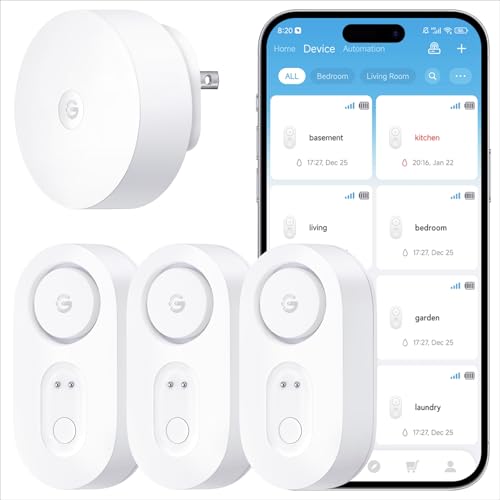


The best detectors alert you instantly, wherever you are, through the app, a text, an email, or a loud on-device siren, and they keep working for years on a single battery. This lineup spans simple single sensors, long-range hub systems, and a smart valve that shuts the water off automatically. Whether you are protecting a first apartment, a finished basement, or a whole house full of appliances, matching the alert method and coverage to your home is what turns a small drip into a non-event.
| Product | Standout | Price | Link |
|---|---|---|---|
| GoveeLife Smart Water Leak Detector | 1804 ft range, 5-year battery | Mid-range | |
| YoLink Water Leak Starter Kit | Hub plus four sensors, LoRa | Mid-range | |
| Moen Flo Smart Water Shutoff | Auto-shutoff valve for the main | Premium | |
| X-Sense Wi-Fi Water Leak Detector | Six probes, 110 dB alarm | Budget | |
| SwitchBot Wi-Fi Water Leak Detector | No hub needed, budget | Budget | |
How to choose a smart water leak detector
Focus on how it alerts you, how far it reaches, and whether you want it to also stop the water.
How the sensor alerts you
The whole point is a warning you cannot miss. Look for a combination of remote alerts, app push, plus SMS text or email, so you are covered even away from home, and a loud local siren, often 100 to 110 decibels, so anyone in the house hears it too. Some sensors connect straight to your WiFi, while others report through a hub or base station that then reaches the internet. More alert channels mean fewer ways for a leak to slip by unnoticed.
Coverage and range
Where you can place sensors depends on how they communicate. Long-range radio systems using Sub-1G or LoRa technology reach distant basements, garages and sump pits through several walls, far beyond typical WiFi. WiFi-direct sensors are simplest but limited to your router’s reach. Wherever they connect, put sensors at the likeliest failure points: under sinks, behind the toilet, by the water heater, washing machine, dishwasher and any sump, since those are where leaks start.
Detection sensitivity
A good sensor triggers on the thinnest film of water, with the best detecting depths as small as half a millimeter, so you are warned at the first seep rather than after a flood. Multiple probes, top and bottom, catch water whether it pools underneath or rises around the unit. An extended probe cable is handy for reaching into a tight cabinet or monitoring a water level in a tank or sump from a more convenient spot.
Battery life and waterproofing
These sit ignored for years, so battery life matters: expect anywhere from two to five years on a charge, with a low-battery warning so you are not caught out. A high waterproof rating, IP66 or IP67, lets a sensor survive the very humidity and splashing it is meant to detect, and shrug off an accidental submersion. A rust-proof, sealed body means the detector still works after the leak it caught, ready for the next one.
Just alert, or automatic shut-off
There are two levels of protection. A detector warns you and leaves the response to you, which is enough if you are usually home or have someone nearby. A smart shut-off valve, like the Moen Flo, mounts on your main line, learns your normal water use, and automatically turns the water off when it spots an abnormality, protecting the house even when no one is around. Some sensor ecosystems can also trigger a separate shut-off valve when a leak is found.
Ecosystem and smart home
If you already run a smart home, check compatibility with your platform and whether a single hub supports enough sensors to cover the whole house. Systems that integrate with voice assistants or other devices can, for example, cut power to an appliance or flash a light on a leak. Being able to share alerts with family means someone can act even if your own phone is on silent, which is exactly when a leak tends to happen.
GoveeLife Smart Water Leak Detector
The GoveeLife is the best seller, and it covers the essentials thoroughly. Advanced Sub-1G long-range wireless keeps a strong signal up to a claimed 1804 feet, even through several dense walls, so a basement or garage sensor still reaches the gateway. It alerts through app push, SMS text and email, all free, and its on-device siren adjusts across four volume levels up to a loud 105 decibels for anyone at home. An IP67 rating handles spills and humidity, an upgraded battery lasts up to five years, and a one-tap in-app silence quiets the alarm while you investigate. A find-device beep even helps you locate a misplaced sensor. It does need the GoveeLife gateway, but as a well-rounded system it is the easy pick.
Pros:
- Long 1804 ft range through walls
- Free app, SMS and email alerts
- Loud, adjustable 105 dB siren
- Up to five-year battery life
- IP67 waterproof
Cons:
- Requires the GoveeLife 2.4GHz gateway
- Alerts only, no automatic shut-off
Best for: Most homes wanting reliable multi-channel alerts and long range without extra fuss.
YoLink Water Leak Starter Kit
The YoLink starter kit pairs a hub with four leak sensors for immediate whole-home coverage at toilets, sinks, the water heater, laundry, the dishwasher and sump areas. Its long-range LoRa radio reaches where WiFi struggles, up to a quarter mile in open air, and you get app, email and text alerts with sensors you can name by location. A standout is that it keeps working without internet: with device-to-device control, a sensor can directly trigger a YoLink siren or shut-off valve during an outage. The sensors themselves are silent by design, so you add a speaker hub or siren if you want an audible alarm. As part of a platform that scales to hundreds of devices, it suits anyone building out a smart home.
Pros:
- Hub plus four sensors for whole-home coverage
- Long-range LoRa beats WiFi range
- Works even without internet
- Scales to hundreds of devices
- Name sensors by location in the app
Cons:
- Sensors are silent unless you add a siren
- Hub-based setup is more involved
Best for: Whole-home coverage and smart-home builders who want long range and offline protection.
Moen Flo Smart Water Shutoff
The Moen Flo is the premium, do-it-all option because it does more than detect: it acts. Installed on your main water line, it learns your home’s normal usage and automatically shuts the water off when it spots an abnormality like a running toilet or a hidden leak, stopping damage even when no one is home. It sends app, phone-call and email alerts, its FloSense technology tunes protection to your habits and flags water waste, and it works with major smart-home platforms. Professional installation is recommended since it plumbs into the main. It is the biggest investment here by far, but for whole-house protection that actually turns off the water, nothing else compares.
Pros:
- Automatically shuts off the water on a leak
- Learns your home’s usage patterns
- App, phone-call and email alerts
- Flags leaks and water waste
- Works with major smart-home platforms
Cons:
- Most expensive by a wide margin
- Needs professional installation on the main line
Best for: Homeowners who want automatic whole-house shut-off, not just an alert.
X-Sense Wi-Fi Water Leak Detector
The X-Sense is a sharp-value WiFi detector with strong sensitivity and a loud alarm. It reports through the X-Sense app via an included base station, sending a push alert the moment water is found, and both the sensor and base station sound together at up to 110 decibels so no one misses it, day or night. Six probes, two on top and four on the bottom, catch water from any direction and detect a depth as small as 0.015 inches for a genuinely early warning. An IP66 rating suits humid spots by the dishwasher, water heater or washing machine, and you can share the device so family members get alerts too. For a well-priced sensor that is both sensitive and loud, it is a smart choice.
Pros:
- Six probes catch water from any direction
- Detects a very shallow 0.015 inch of water
- Loud 110 dB combined alarm
- Share alerts with family
- IP66 waterproof for humid areas
Cons:
- 2.4GHz WiFi only
- Alerts only, no automatic shut-off
Best for: Budget-conscious buyers who want high sensitivity and a very loud alarm.
SwitchBot Wi-Fi Water Leak Detector
The SwitchBot is the budget standout, and it needs no separate hub: connect it straight to WiFi and it sends real-time app and email alerts on any drip, leak or flood. Four probes on top and bottom detect water as shallow as half a millimeter, and a bundled one-meter extended probe lets it monitor a water level in a bathtub, fish tank or sump, or tuck into a narrow spot like behind a fridge. A built-in 100 decibel alarm covers audible warning, an IP67 sealed shell handles wet environments, and the battery lasts up to two years. As part of the SwitchBot ecosystem it can even trigger a smart plug to cut power to an appliance on a leak. For the lowest price here, it is remarkably capable.
Pros:
- No hub needed, connects directly to WiFi
- Detects water as shallow as half a millimeter
- Extended probe for water-level monitoring
- Loud 100 dB alarm and IP67 shell
- Lowest price here
Cons:
- Two-year battery is shorter than some rivals
- Range limited to your WiFi
Best for: Renters and budget buyers who want a capable, hub-free sensor that is easy to set up.
The verdict
Choose based on how much of your home you are protecting and whether you want it to stop the water or just warn you.
Best Overall: GoveeLife Smart Water Leak Detector. The best seller combines long range, free app, SMS and email alerts, a loud siren and a five-year battery, covering most homes with no fuss.
Best Value: SwitchBot Wi-Fi Water Leak Detector. The hub-free SwitchBot detects the faintest water, alarms loudly and adds an extended probe, all for the lowest price here.
Best Premium: Moen Flo Smart Water Shutoff. The Moen Flo does not just warn you, it shuts the water off automatically at the main, the strongest whole-house protection available.
Frequently asked questions
How do smart leak detectors alert me?
They combine remote alerts, app push plus text or email, with a loud on-device siren of 100 to 110 decibels. That way you are warned whether you are home or away, and no single failure lets a leak slip by.
Do I need a hub?
Some do and some do not. WiFi-direct sensors like the SwitchBot connect straight to your router, while long-range systems like GoveeLife and YoLink use a hub or gateway that extends coverage well beyond WiFi range.
Where should I place sensors?
Put them where leaks start: under sinks, behind toilets, and beside the water heater, washing machine, dishwasher and any sump pump. Those appliances and fittings are the most common sources of household water damage.
Can a detector turn off the water?
A basic detector only alerts you. For automatic shut-off you need a smart valve like the Moen Flo on your main line, or an ecosystem such as YoLink that can trigger a separate shut-off valve when a leak is found.
How long do the batteries last?
Expect two to five years depending on the model, with the GoveeLife rated up to five and the SwitchBot up to two. All provide a low-battery warning so you can swap or recharge before they die.
Are they waterproof?
Yes, and they should be, since they sit in damp spots. Look for an IP66 or IP67 rating, which lets a sensor survive humidity, splashes and even a brief submersion and keep working afterward.
This article may contain affiliate links; see our Affiliate Disclosure.