It is dark, the car is dead, and your phone is at four percent. That is the exact moment a jump starter with a built-in power bank stops being a gadget and starts being the most sensible thing in the trunk. One brick the size of a paperback starts the engine, refills the phone, throws a beam of light on the engine bay, and on some models pumps up the tire that started the whole mess.



These combos split into two shapes: pocketable lithium packs that focus on starting the car and charging a phone, and chunkier all-in-one units that add a tire inflator and a small toolkit’s worth of extras. This guide compares strong picks across both, so a commuter who wants something in the glovebox, a road-tripper covering long empty stretches, and anyone with an older battery that needs the occasional nudge can each find the right one.
At a glance
| Product | Standout feature | Price tier | Link |
|---|---|---|---|
| NOCO Boost GB40 | Best-seller, UltraSafe spark-proof, 2.5 lb, IP65 | Mid-range | |
| GOOLOO A3 | 7-in-1 with 150 PSI tire inflator, 45 min run | Budget | |
| WOLFBOX Jump Starter | 65W USB-C charging, 160 PSI, 400-lumen light | Premium | |
| JOLTEKON Jump Starter | 8-in-1, 500-lumen light with red warning strobe | Mid-range | |
| Povasee A30 | Just 2.2 lb, 74 Wh power bank, QC3.0 output | Budget | |
How to choose a jump starter and power bank combo
Peak amps: read this before you compare numbers
Peak amp figures are the headline spec and the least trustworthy one, because there is no shared standard for measuring them. That is why you will see a well-regarded unit rated at 1000 amps sitting beside a budget pack claiming 8000, and it does not mean the latter is eight times stronger. A far more useful number is the engine size the maker says it will start, which is a concrete, testable claim: something rated for 6.0L gas and 3.0L diesel covers essentially every family car and most trucks. Match that to your vehicle, take peak amps as marketing, and favor brands whose claims look conservative rather than fantastic.
Safety features are not optional
You are connecting a high-current lithium pack to a car battery, often in the dark and possibly flustered. Spark-proof technology and reverse polarity protection mean that clamping the wrong terminal produces a warning rather than a bang, and every pick here has both. Smart clamps that stay dead until correctly connected are the same idea taken further. Beyond that, look for the wider protection list, which typically covers short circuit, over-current, overcharge, and overheat, and for flame-retardant housings. This is the one category where paying a little more for a brand that takes safety seriously is straightforwardly worth it.
The power bank half of the equation
Since this is a combo, capacity matters. Look for watt-hours or milliamp-hours rather than vague claims: something in the range of 60 to 100 Wh will refill a phone several times over, which is the difference between calling for help and watching your screen die. Check the outputs too, as a USB-C port with fast charging refills a modern phone far quicker than an old 5-volt USB-A, and some units offer 45 to 65 watts, enough to charge a tablet or even a laptop. The same port usually recharges the jump starter itself, and a high input wattage means it refills in about ninety minutes rather than overnight.
Do you actually want the air compressor
The all-in-one units with built-in tire inflators are genuinely useful, since a slow puncture is far more common than a dead battery, and topping up cold tires in a driveway beats queuing at a gas station. Look for around 150 PSI with an auto shut-off that stops at your target pressure, plus a readable screen. The trade-offs are fair ones: these units are bigger, heavier, and the compressors get hot, so every maker here warns against running them continuously. If you want something that lives in a glovebox and never gets thought about, skip the compressor. If the car does road trips, it earns its space.
Cold, standby, and keeping it ready
A jump starter’s whole job is working on the worst morning of the year, so check the operating temperature range, which typically spans well below freezing to around 140 degrees F. Lithium packs lose punch in the cold, which is exactly when batteries fail, so a unit rated to work at low temperatures matters more than an extra thousand claimed amps. Standby time is the other half: good packs hold charge for up to two years, but every maker still advises topping it up every two or three months to protect the cells and promise it works. A dead jump starter is just a paperweight, so set a reminder.
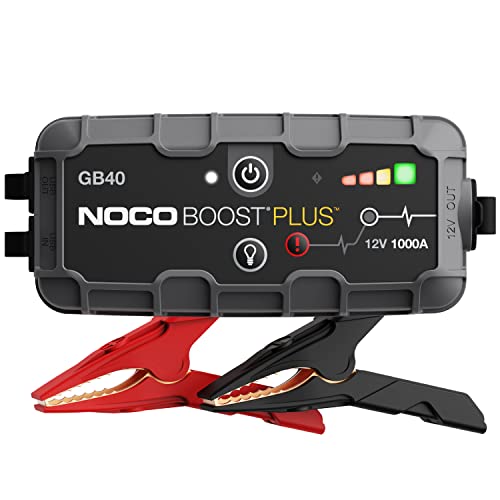
NOCO Boost GB40
The best-selling jump starter here is also the most trusted, and its rating tells you why: NOCO quotes a sober 1000 amps and 20 starts per charge for engines up to 6.0L gas and 3.0L diesel, which covers almost any car and most trucks without inflating the number for the box. UltraSafe technology brings patented spark-proof and reverse polarity protection, so connecting it wrong produces nothing rather than drama. The integrated power bank handles emergency phone and tablet charging, and it recharges in three hours. A 100-lumen LED with seven modes including SOS and strobe covers roadside repairs. At just 2.5 pounds it genuinely fits a glovebox, and the IP65 rubberized housing shrugs off water, dust, and being thrown around. There is no air compressor, which is the trade for the size.
Pros
- Best-seller with fair, conservative ratings
- UltraSafe spark-proof and reverse polarity protection
- Compact 2.5 lb, genuinely glovebox-sized
- Rugged IP65 water and dust resistant housing
Cons
- No air compressor
- 100-lumen light is dimmer than rivals
Best for: most drivers who want a compact, trustworthy pack that starts the car and charges a phone.
GOOLOO A3 Jump Starter with Air Compressor
The value pick crams a genuinely useful toolkit into one budget unit. It is a 7-in-1: jump starter for engines up to 9.0L gas and 6.5L diesel, tire inflator, power bank, LED flashlight, bike pump, ball pump, and digital pressure gauge. A BOOST button forces a start when battery voltage is extremely low. The compressor is the star, offering 150 PSI and 35 liters per minute across five inflation modes with five nozzles, enough to take a car tire from 30 to 36 PSI in about a minute, with a smart LED screen, tire pressure detection, and auto shut-off, plus 45 minutes of continuous cordless inflation. A battery management system provides ten protections including reverse connection and overheating, it survives from -4 degrees F to 140 degrees F, and it is rated for over 1000 charge cycles with an 18-month warranty.
Pros
- 7-in-1 with a genuinely capable 150 PSI compressor
- Budget price for the feature count
- Auto shut-off inflation with a clear LED screen
- Ten protections and 1000+ charge cycles
Cons
- Bulkier than a pocket jump pack
- Compressor needs cooling between long runs
Best for: road-trippers who want a tire inflator and jump starter in one affordable unit.
WOLFBOX Jump Starter with Air Compressor
The premium all-in-one leans on speed. A 65W USB-C port means it refills itself in about an hour and a half and charges a laptop or tablet properly, not just a phone, and its 16,000 mAh capacity is a real power bank rather than a token one. The 59.2Wh battery delivers a 3000-amp peak for engines up to 8L gas or 6L diesel, even from a completely dead battery. Its compressor is the quickest here at 45 liters per minute and 160 PSI, inflating a pickup tire from 30 to 36 PSI in two and a half minutes and a sedan tire in forty seconds. The 400-lumen light is three to five times brighter than typical, with distress, strobe, and high beam modes, and it works down to -4 degrees F with ten protections. Note there is no charging adapter in the box.
Pros
- 65W USB-C charges laptops and refills in ~90 minutes
- Fastest 160 PSI, 45 L/min compressor here
- Bright 400-lumen light with multiple modes
- Real 16,000 mAh power bank capacity
Cons
- Most expensive option in this group
- Charging adapter not included
Best for: people who want the fastest charging and inflation and will pay for it.
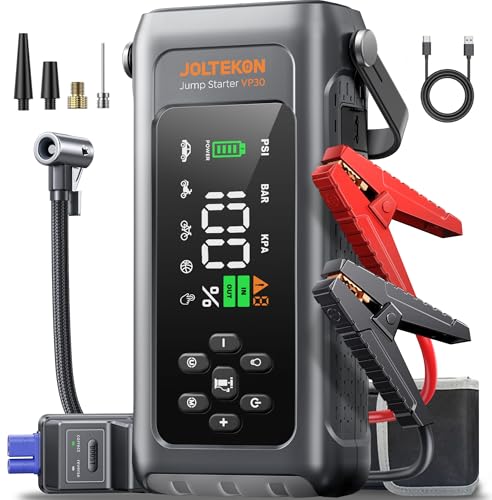
JOLTEKON Jump Starter with Air Compressor
This 8-in-1 is the one to pick if roadside visibility worries you. Its 500-lumen wide light runs four modes, and the standout is a red strobe that works as a warning triangle when you are stopped on a shoulder, alongside SOS, white flashlight, and white strobe. The jump starter handles engines up to 9L gas and 8L diesel with a force start function for completely drained batteries, works from roughly -4 degrees F to 140 degrees F, and holds standby charge for about 24 months across 1000+ recharge cycles. A 19-cylinder motor drives 150 PSI inflation with five modes, auto memory, automatic shut-off, four nozzles, three units, and a detachable hose. A 3.3-inch smart display stays readable in sunlight and reports true remaining capacity, and it carries ten protections with V0 fireproof cells in a shell built for rain, dust, and drops.
Pros
- 500-lumen light with a red warning-triangle strobe
- Force start for completely drained batteries
- Large sunlight-readable 3.3-inch display
- Ten protections and V0 fireproof cells
Cons
- Maker advises 50% charge minimum before starting
- Bulkier than compact packs
Best for: drivers who want maximum roadside visibility alongside starting and inflation.
Povasee A30 Jump Starter
If size and price rule, the A30 is remarkable. It weighs 2.2 pounds and measures about the size of a pack of paper, so it disappears into a bag or door pocket, yet it starts engines up to 10L gas or 8L diesel and offers around 60 quick starts per charge, with an RST button to force a restart when voltage drops below 9V. As a power bank it is a proper 74Wh with two USB outputs so you can charge two devices at once, and QC3.0 fast charging refills a phone noticeably quicker than a standard port. A 400-lumen LED runs flashlight, strobe, and SOS modes. Ten protection systems cover reverse polarity, short circuit, overcharge, and spark resistance, and the smart clamps stay dead until correctly connected. It works from -22 degrees F to 140 degrees F, the widest range here, and includes a protective case and two-year warranty.
Pros
- Very light 2.2 lb and pocketable size
- Widest cold-weather range at -22 degrees F
- 74Wh power bank with dual outputs and QC3.0
- Budget price with a two-year warranty
Cons
- No air compressor
- Peak amp claim is far higher than conservative brands
Best for: anyone wanting the lightest, cheapest pack that still charges phones fast.
The verdict
Best Overall: the NOCO Boost GB40. As the runaway best-seller it earns trust the right way, with conservative accurate ratings, patented spark-proof and reverse polarity protection, a rugged IP65 body, and a size that actually fits a glovebox. For most drivers it is the one to own.
Best Value: the GOOLOO A3. A capable 150 PSI compressor, power bank, flashlight, and pressure gauge in one budget 7-in-1 with ten protections covers far more roadside problems than a jump pack alone.
Best Premium: the WOLFBOX Jump Starter. The 65W USB-C port that refills it in about ninety minutes and charges a laptop, the fastest 160 PSI compressor here, and a bright 400-lumen light make it the most capable all-in-one.
Frequently asked questions
How many peak amps do I need? Peak amps are not measured to a common standard, so a 1000-amp pack from a careful brand can outperform a budget one claiming several times more. Ignore the headline and match the engine size the maker states, which is a concrete claim.
Can I use one on a completely dead battery? Usually yes. Most packs here include a boost, force start, or RST button that overrides the safety cutout when battery voltage is too low to detect. Follow the manual, and do not attempt more than about three consecutive starts without pausing.
How often should I recharge it? Every two to three months, even if unused. These packs hold standby charge for up to two years, but topping up protects the cells and, more importantly, ensures it works on the morning you actually need it.
Will it work in freezing weather? That is when you need it most, and lithium packs do lose output in the cold. The models here are rated to work from about -4 degrees F, with one going down to -22 degrees F, so check the low-temperature rating if you live somewhere genuinely cold.
Is the air compressor version worth the extra bulk? If your car does road trips, likely yes, since slow punctures and low winter pressures are more common than dead batteries. If you want something small that lives in the glovebox and is forgotten, a compact pack without a compressor is the better fit.
This article may contain affiliate links; see our Affiliate Disclosure.