Dragging an upright through eight rooms means fighting the hose, catching the cord on every doorframe, and bending double to reach under the beds. Strap the motor to your back instead and the whole job changes: both hands free, a wand that reaches the ceiling and the baseboard without you kneeling, and no canister to yank around corners. Cleaning crews switched to backpacks for a reason, and the same logic works in a big house.


Backpack vacuums are built around one idea: carry the weight on your hips and shoulders so your arms only steer the wand. That makes them fast across large floor plans, stairs, and awkward spaces like ledges and ceiling vents. This guide compares three strong corded models, so someone cleaning a large home, a landlord turning over units, or a small cleaning business can each find a machine that suits their back and their square footage.
At a glance
| Product | Standout feature | Price tier | Link |
|---|---|---|---|
| Hoover Commercial Shoulder Vac Pro | Chiropractor-designed harness, quiet 66 dBA | Premium | |
| Atrix Ergo Backpack Canister | 1,400W motor, 106 CFM, huge accessory bundle | Mid-range | |
| Shop-Vac Commercial Backpack | Waist belt holds six tools, dual-surface nozzle | Budget | |
How to choose a backpack vacuum
Why a backpack wins in a big space
The advantage is mostly about wasted motion. An upright forces you to push a heavy head, stop at every threshold, and swap tools to reach anything off the floor. With the motor on your back, you walk the room in a straight line and sweep the wand, which cuts cleaning time noticeably across a large floor plan. Stairs are the clearest win: no lifting a canister step by step, no balancing an upright on a tread. The same setup reaches ceiling corners, ledges, vents, and under furniture without a single knee bend, so the machine that seems like commercial overkill is often the one that makes a big house genuinely manageable.
Harness fit is the whole comfort story
A backpack vacuum you resent wearing gets left in the closet, so the harness matters more than any spec. Look for wide, padded shoulder straps that spread the load rather than digging in, and a waist strap that transfers most of the weight to your hips, which is where your body carries weight best. Padding across the back keeps the motor housing off your spine and lets air move so you do not overheat. Weight itself is worth checking, since these machines commonly land in the high teens of pounds, but a well-balanced 19-pound unit with a proper hip belt feels lighter than a badly hung 15-pound one. If you clean for hours, prioritize the harness over everything else.
Suction, airflow, and what actually lifts dirt
Two numbers describe cleaning power and they are not the same. Motor wattage indicates raw power, while airflow, measured in cubic feet per minute, describes how much air the machine actually moves, and airflow is what carries debris up the hose. Figures around 85 to 106 CFM are typical and capable in this class. Because backpack vacuums are dry canisters without a motorized brush roll, they excel on hard floors, low-pile carpet, stairs, and above-floor work, and they are less suited to deep-pile carpet where an agitating brush does the real lifting. Match that to your floors before buying.
Filtration and bags
What comes out of the machine matters as much as what goes in, especially with the exhaust sitting on your back. Multi-stage systems layer a collection bag, a cloth filter bag, a pre-motor filter, and a HEPA or HEPA-media exhaust filter, catching progressively finer particles along the airflow path. That keeps dust, pollen, and dander from being blown back into a room you just cleaned, which is the whole point if anyone in the house has allergies. Bagged designs are cleaner to empty than bagless bins, though they mean buying bags, so factor in the running cost and check the capacity if you clean large areas between changes.
Cord, noise, and tools
These are corded machines, and that is deliberate: constant suction with no battery to fade halfway through the house. A long cord is what makes that practical, so look for extra length and plan on an extension cord for really big spaces. Noise deserves attention if you clean around family or clients, with the quieter models sitting in the 60s of decibels versus the low 80s, a difference you feel over an hour. Finally, look at the tools: a crevice tool, dust brush, and dual-surface floor nozzle cover most jobs, extension wands save your back, and a belt or clip that holds attachments while you work saves constant trips back to the bag.
Above-floor work is the hidden advantage
Floors are only part of what a house needs, and this is where a backpack quietly justifies itself. With the motor already on your shoulders and a wand in hand, you can run the brush along crown molding, over door frames, across ceiling fan blades, into ceiling vents, and down behind radiators without fetching a ladder-and-canister combination or swapping machines. Stairs stop being the worst job in the house, since nothing needs balancing on a tread while you work. The same goes for cars, closet shelves, and the tops of cabinets. If your cleaning routine involves much more than open floor, the reach is often worth more than any suction figure.
Running costs and upkeep
Plan for the consumables before you buy, because bagged machines need bags and filters. Check what the bag costs and how much it holds, since a larger capacity means fewer changes across a big property, and note whether the pre-motor filter is washable, which saves replacing it. A cloth shake-out bag inside the paper bag adds a layer you simply empty rather than bin. Beyond that, upkeep is light: empty before the bag is stuffed, since a packed bag chokes airflow and the machine feels like it lost suction when the filter is simply clogged, rinse washable filters and dry them fully before refitting, and check the hose for blockages if performance dips.
Hoover Commercial Shoulder Vac Pro
The best-selling model here leads on the thing that decides whether you keep using a backpack vacuum: how it sits on your body. Hoover’s harness is chiropractor-designed to cut strain and spread the load, which is what makes extended cleaning sessions tolerable rather than punishing. It is genuinely lightweight for the class and easy to maneuver, with an extra-long cord that lets you cover more ground before hunting for another outlet. Filtration runs through a hypercone filter made with HEPA media that traps dirt, dust, and pollen with no loss of suction as it fills, and a cleaning accessory pack handles detail work. It is also the quietest option here at 66 dBA, low enough to clean around other people without shouting over it, and it handles both carpet and hard floors.
Pros
- Chiropractor-designed harness reduces strain
- Quietest here at 66 dBA
- HEPA media filtration with no suction loss
- Lightweight with an extra-long cord
Cons
- Highest price of the three
- Fewer bundled attachments than the Atrix
Best for: anyone cleaning large areas for long stretches who wants the most comfortable, quietest carry.
Atrix Ergo Backpack Canister Vacuum
If you want the most machine and the deepest toolkit in one box, the Atrix bundle is hard to argue with. Its 1,400-watt motor is the strongest here and moves 106 CFM of airflow, the highest figure in this group, which is what actually pulls debris up the hose. The Premium Bundle earns its name: a 6-foot hose, furniture nozzle, oval dust brush, crevice tool, three blower nozzles, turbo and floor brushes, a 22 to 37 inch extension wand, a blower adapter, hose and filter plugs, and ten filters, so nothing needs buying on day one. It even converts to a blower. Four levels of filtration include an 8-quart HEPA bag, a cloth shake-out bag, a HEPA pre-motor filter, and an exhaust filter. The low-profile ergonomic design with a waist strap keeps it manageable through offices, warehouses, stairs, and homes.
Pros
- Strongest 1,400W motor and 106 CFM airflow
- Four-stage filtration with an 8-quart HEPA bag
- Enormous accessory bundle plus ten filters
- Low-profile ergonomic fit with waist strap
Cons
- Louder than the Hoover
- Big accessory kit needs somewhere to live
Best for: professionals and thorough home cleaners who want maximum suction and every tool included.
Shop-Vac Commercial Backpack Vacuum
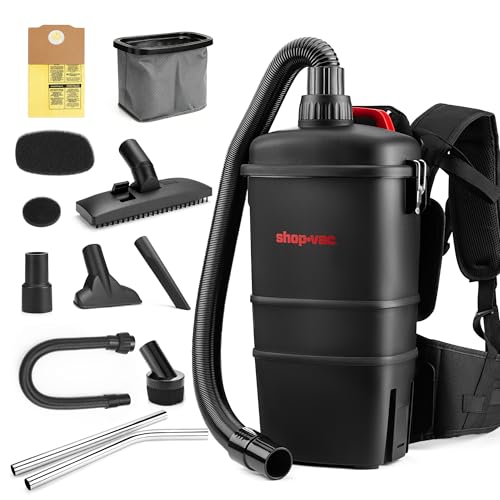
The value pick is built like a work tool and priced like one. A 1000-watt, 4.5 peak horsepower motor pushes 85 CFM through a 1.5-gallon capacity in a rugged 19-pound body made for schools, offices, theaters, and busy homes. Comfort is taken seriously for the money: a 6.5 inch wide shoulder harness spreads the load, adjustable shoulder and waist straps balance it, and soft back padding keeps it off your spine, while a 6-foot retractable hose and two metal wands totaling four feet mean almost no bending. The smartest touch is the integrated waist belt that holds up to six attachments, so the crevice tool and brushes travel with you. Filtration layers a dust bag, cloth filter bag, washable foam pre-motor filter, and HEPA exhaust filter, and a dual-surface nozzle switches between hard floors and low-pile carpet with one button.
Pros
- Lowest price with rugged commercial build
- Waist belt carries six attachments as you clean
- Wide harness with adjustable waist strap and back padding
- Dual-surface nozzle switches floors with one button
Cons
- Loudest of the three at 83 dB
- Heaviest at 19 pounds, no extension cord included
Best for: budget-minded buyers who want commercial toughness and tools always at hand.
The verdict
Best Overall: the Hoover Commercial Shoulder Vac Pro. As the best-seller it gets the decisive things right: a chiropractor-designed harness that keeps you working comfortably, the quietest operation here at 66 dBA, and HEPA-media filtration that holds suction as the bag fills. For covering a large home without wrecking your back, it is the pick.
Best Value: the Shop-Vac Commercial Backpack. Commercial-grade construction, a properly padded and adjustable harness, HEPA filtration, and a waist belt full of tools, all at the lowest price of the three.
Best Premium: the Atrix Ergo Premium Bundle. The strongest 1,400-watt motor, the highest 106 CFM airflow, four-stage filtration, and an accessory kit that leaves nothing to buy make it the most complete professional package.
Frequently asked questions
Are backpack vacuums good for carpet? They handle hard floors, low-pile carpet, and stairs very well. Because they are dry canisters without a motorized brush roll, they are less effective on deep-pile carpet, where an agitating brush does most of the lifting.
How heavy are they to wear? Most land in the mid-to-high teens of pounds, with the Shop-Vac at 19. A good hip belt matters more than the number, since transferring weight to your hips makes a heavier unit feel lighter than a poorly balanced light one.
Why are they corded instead of cordless? A cord gives constant, unfading suction for as long as you clean, which is exactly what you want across a large space. The trade-off is managing the cord, so look for extra length and plan on an extension cord for big floor plans.
Do I need HEPA filtration? It is worth having, especially since the exhaust sits on your back. Multi-stage systems ending in a HEPA or HEPA-media filter stop fine dust, pollen, and dander being blown back into the room, which matters most for allergy sufferers.
Are they loud? They vary more than you would expect. The quietest here runs 66 dBA, gentle enough to clean around other people, while the loudest sits at 83 dB. Over an hour of cleaning, that gap is very noticeable.
This article may contain affiliate links; see our Affiliate Disclosure.