A wall-mounted monitor looks like the future right up until you notice the four cables hanging off it like vines. The fix costs less than a takeaway meal, takes an afternoon, and does not require putting a single hole in the wall.



A raceway is a plastic or silicone channel that sticks to the wall, swallows your cables, and snaps shut. What separates a good one from a bad one is whether it actually holds the number of cables you own, whether the adhesive survives a warm room, and whether you can make it disappear into the paint. The picks below cover a wall-mounted TV, a monitor arm above a desk, a run of speaker wire, or a single lamp cord along a baseboard.
At a glance
| Product | Standout features | Price tier | Link |
|---|---|---|---|
| YesBes 116 in Cord Hider Kit | Best seller; UL94 V-0 rated; paintable; 0.96 x 0.57 in channel | Budget | |
| D-Line Half Round Cord Hider | One-piece hinged lid; half-round profile; 19 accessories | Premium | |
| ZhiYo Cable Hider Raceway Kit | Lowest price; 0.95 x 0.47 in; up to 68 in coverage | Budget | |
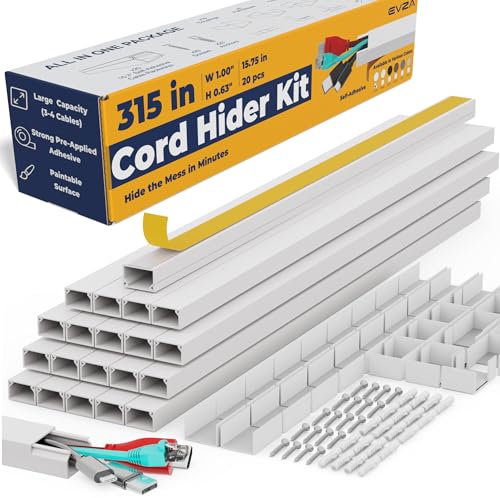
| EVZA 315 in Raceway Kit | Longest run; tape or screw fixing; full elbow set | Premium | |
| ANNISITE Silicone Cord Cover | Flexible silicone; slim 0.59 x 0.39 in; side snap opening | Mid-range | |
How to choose a wall-mounted cable raceway
Count your cables, then measure the channel
This is the step people skip, and it is the one that sends raceways back. Channel size is quoted as inner width by inner height, and it is a hard limit. The ZhiYo at 0.95 x 0.47 inches is fair that it suits two to three cords. The YesBes and EVZA profiles, around 0.96 x 0.57 inches, take three or four; EVZA gives the useful worked example of two HDMI cables plus two USB or aux cables. The ANNISITE at 0.59 x 0.39 inches is built for one cable up to 0.27 inches thick. A wall-mounted TV or monitor typically means power, HDMI, and often ethernet, so a single-cable channel will not do. Count what you have, add one for the cable you will add later, and buy the profile that fits.
Total length and the accessories that turn a corner
Kits are sold by total run length, and the gap is wide: 68 inches from the ZhiYo, 116 from the YesBes, 157 from the D-Line multipack, 315 from the EVZA. A straight drop from a wall-mounted TV to an outlet is short. A run that goes down, along a baseboard, and around a doorframe eats length fast. Corners are the other half of the problem, and this is where the cheap kits thin out. You need L-elbows for flat corners, T-fittings to branch, and inside and outside elbows to get around a wall corner. The YesBes 116 inch kit ships six couplings, two L-elbows, and one T-fitting. The EVZA and D-Line kits carry the full elbow set. Sketch the route before you buy.
Rigid PVC or flexible silicone
Rigid PVC is the default and the reason is looks: it holds a dead-straight line, it takes paint properly, and it reads as trim rather than as a tube on the wall. Silicone, on the ANNISITE, does something PVC cannot. It bends. Around a curved wall, over a slight lump, along an odd angle, silicone follows. It is also flame-resistant, waterproof, and wipes clean. The trade is capacity and rigidity, and one silicone product here, from ESUFEIR, does not support painting at all. If your run is straight, buy PVC. If it has to curve, buy silicone.
Two-piece base and lid, or a one-piece hinge
Most raceways are two pieces: you stick a base to the wall, lay cables in, then press a lid on. That means every length has to be cut twice, and the two cuts should match. The D-Line uses a one-piece design with a hinged lid and a click-lock, so there is one cut per length and the lid cannot be lost. Its profile is half-round rather than square, which is why it disappears above a baseboard, reading as the top edge of the trim. That is a real advantage in a living room and less relevant behind a desk.
Adhesive, wall texture, and getting it off again
Every kit here is peel-and-stick, no drilling. There is one shared warning worth taking literally: adhesive tape does not work on textured walls. On a knockdown or orange-peel finish, the tape touches only the high points and the raceway drops off in a week. If that is your wall, note that the EVZA and D-Line lengths can be screw-fixed with anchors instead. Two more practical points. Plan the route before you peel, because the tape is genuinely strong and repositioning it can take paint with it. And to remove a run later, warm the backing with a hairdryer first to soften the adhesive.
Fire rating and paint
Flame retardancy is not marketing on a part that wraps mains cable. The YesBes kits state a UL94 V-0 rating, the classification for a material that self-extinguishes quickly; the ANNISITE silicone is flame-resistant. Painting is the other finishing step, and D-Line gives the method that works on plastic: key the surface with fine sandpaper, then two coats. Skip the sanding and the paint peels at the first knock.
YesBes 116 in Cord Hider Kit
This is the best seller of the group and it is not close. The formula is a 0.96 inch wide, 0.57 inch high channel, 116 inches of total run, and a small bag of the right fittings: six couplings, two L-elbows, one T-fitting. That profile is the sweet spot for a wall-mounted TV or monitor, taking three or four cables without bulging. The material is UL94 V-0 flame retardant, it cuts with sharp scissors or a saw, and it paints to match the wall. Installation is peel and stick, no screws. It sits at the budget end while carrying the fire rating that some pricier kits do not mention, which is the whole reason it outsells everything else here.
Pros:
- Best-selling raceway kit in this comparison
- UL94 V-0 flame retardancy rating
- 0.96 x 0.57 in channel handles three to four typical cables
- Includes couplings, L-elbows and a T-fitting
- Cuttable and paintable; budget price
Cons:
- Adhesive is not suitable for textured walls
- 116 inches runs short for a long baseboard-board route
- Two-piece base and lid means cutting each length twice
Best for: the common job of hiding a wall-mounted TV or monitor’s cables on a smooth painted wall.
D-Line Half Round Cord Hider
The D-Line is the one that looks like it was meant to be there. Its patented profile is a half round rather than a square box, which reads as decorative molding instead of conduit, and above a baseboard it passes as the natural top section of the trim. The one-piece design matters as much as the shape: peel and stick the length, flex the hinged lid open, drop cables in, snap it shut. No separate lid to cut, align, or lose. The multipack ships ten 15.7 inch lengths, 157 inches total, plus nineteen color-matched accessories whose shoulders tuck under the lengths to hide an imprecise cut. It can be screwed instead of taped, and other profile sizes exist if 0.78 x 0.39 inches is too small.
Pros:
- One-piece hinged lid with click-lock; one cut per length
- Decorative half-round profile blends with trim and decor
- 19 color-matched accessories cover every angle
- Bends and tees hide imprecise cuts
- Can be taped or screw-fixed
- Available in several other profile sizes
Cons:
- Most expensive kit here
- 0.78 x 0.39 in channel is smaller than the square-profile kits
- Needs sanding before painting for a lasting finish
Best for: living rooms and any run where the raceway has to look like part of the room, not a repair.
ZhiYo Cable Hider Raceway Kit
The cheapest kit here, and refreshingly clear about its own limits. ZhiYo states plainly that the 0.95 by 0.47 inch channel suits two to three cords, which is the truth that longer feature lists usually bury. Total coverage is up to 68 inches across multiple sections that connect together, so this is a kit for one drop behind a TV or a short desk run, not a route around a room. The PVC has flame retardancy, it cuts to length, and it paints. Installation is the same peel-and-stick base with the same textured-wall caveat. If the job is small and you want it done for the least money, this is the plain answer.
Pros:
- Lowest price in this comparison
- Clear about capacity: two to three cords
- Slim 0.47 in height sits close to the wall
- Cuttable and paintable
- Multiple sections connect for flexible layouts
Cons:
- 68 inches total is the shortest run here
- Shallower channel than the YesBes or EVZA
- Adhesive not suitable for textured walls
Best for: a single short drop from a TV or monitor to an outlet, on a tight budget.
EVZA 315 in Raceway Kit
The EVZA is the kit for a route rather than a drop. It ships 315 inches of channel in 15.7 inch lengths, with the full connector set: couplings, flat elbows, T-fittings, and both inside and outside elbows. That inside and outside pair is what lets a run leave one wall and continue onto the next, which is exactly the point at which smaller kits leave you improvising. Capacity is quoted at up to one inch wide by 0.63 inches high, which EVZA translates into two HDMI plus two USB or aux cables, comfortably three to four cords. It is PVC, cuttable with a knife or hacksaw, and paintable. The detail that earns it a place is the choice of fixing: adhesive tape or drywall anchors and screws, which is your escape route if the wall is textured.
Pros:
- 315 inches of channel, the longest run here
- Complete fitting set including inside and outside elbows
- Generous capacity: roughly three to four cables
- Tape or screw-and-anchor fixing
- Cuttable and paintable
Cons:
- Premium price
- Two-piece design needs base and lid cut separately
- More material than a single TV drop requires
Best for: long routes around a room, multi-wall runs, or doing several rooms from one purchase.
ANNISITE Silicone Cord Cover
Different material, different job. The ANNISITE is soft silicone rather than rigid PVC, 78 inches of a slim 0.59 by 0.39 inch track sized for one cable up to 0.27 inches thick, or a couple of thin ones. Because it flexes, it follows a wall that a rigid channel would fight: ceilings, gentle curves, awkward angles behind furniture. A single-side snap opening means adding or pulling a wire later is a two-second job instead of prying a lid. It is flame-resistant, waterproof, wipes clean, and unlike some silicone channels it does take paint. It cuts with scissors, and you can miter the corners for a tidy finish. One instruction worth obeying: leave the adhesive a day to reach full strength before trusting it.
Pros:
- Flexible silicone follows curves and awkward angles
- Very slim profile disappears against a wall
- Side snap opening for easy cable changes
- Flame-resistant, waterproof, and wipes clean
- Paintable and easy to cut or miter
Cons:
- Holds one cable, or two thin ones; not a TV bundle
- 78 inches total
- Adhesive needs a full day to reach strength
Best for: a single lamp, ethernet, or charging cable, especially on a route that is not straight.
The verdict
Best Overall: YesBes 116 in Cord Hider Kit. It is the runaway best seller here, and it earns that by matching the job most people actually have. The channel is the right size for a TV or monitor’s three to four cables, the length covers a normal drop with fittings left over, it carries a UL94 V-0 flame rating, and it costs very little. Paintable, cuttable, no drilling.
Best Value: ZhiYo Cable Hider Raceway Kit. The lowest price of the group, and it tells you upfront that it is a two to three cord channel with 68 inches of coverage. For one short drop that is all you need, and there is no sense paying more for length you will throw away.
Best Premium: D-Line Half Round Cord Hider. The best-looking and best-engineered option. The half-round profile passes as trim, the one-piece hinged lid halves the cutting and cannot be lost, and nineteen color-matched accessories mean the corners look deliberate. If the run is somewhere people sit, this is worth the money.
For a long route across several walls, the EVZA has the length and the elbows, plus screw-fixing if tape is out. For one cable on a wall that is not flat, the ANNISITE silicone bends where the others cannot.
Frequently asked questions
Will a raceway stick to a textured wall?
Generally no, and the manufacturers say so themselves. Adhesive tape needs a smooth surface to bond; on a textured finish it only contacts the high points and will let go. If your walls are textured, choose a kit that can be screw-fixed with drywall anchors, such as the EVZA or D-Line, and accept the holes.
How many cables fit in one raceway?
Read the inner dimensions, not the marketing. A 0.95 x 0.47 inch channel takes two to three cords. A roughly 1 x 0.6 inch channel, like the EVZA, takes three to four, for example two HDMI plus two USB. A slim silicone track at 0.59 x 0.39 inches is for a single cable. Bundling more than the channel allows forces the lid open and looks worse than the cables did.
Can I paint a cable raceway to match my wall?
Most of them, yes, and it is what turns a visible channel into an invisible one. Plastic needs preparation: scuff the surface with fine sandpaper first, then apply two coats. Paint straight onto glossy PVC and it will chip. Note that not every product is paintable, so check before you buy.
Will removing it damage my paint?
It can, because the adhesive is designed not to fall off. Two things reduce the risk. Plan the whole route before you peel any backing, since repositioning a stuck length is what pulls paint. To remove one later, warm it with a hairdryer to soften the adhesive, then peel slowly.
Is a plastic cord cover a fire risk?
A quality one is specifically engineered against that. Look for a UL94 V-0 rating, the classification for material that resists burning and self-extinguishes quickly, which the YesBes kits state. What a raceway does not do is fix an overloaded outlet or a damaged cable, so deal with those separately.
This article may contain affiliate links; see our Affiliate Disclosure.