The litter box is the one piece of cat ownership nobody negotiates their way out of. It sits in a corner announcing itself, it needs attention every single day, and going away for a weekend turns into a favor you have to ask someone. A self-cleaning box with an app attached does not just move the chore – it tells you your cat used it four times last night and weighed 11 pounds doing it.


Two things decide whether one of these earns its corner: whether your cat will actually walk into it, and whether the sensors are good enough that you never have to think about that question again. Everything else – bin size, odor modules, app charts – is refinement on top. The five below run from a budget open-top box to a large-capacity premium unit, and they differ most in the cat sizes they can handle.
At a glance
| Product | Standout feature(s) | Price tier | Link |
|---|---|---|---|
| PARUUNTYS Open-Top Self-Cleaning Litter Box | 16.5″ open-top entry; 7 sensors; 15L sealed bin | Budget | |
| Cumrige Self Cleaning Litter Box | 95L drum, cats 2.2–33 lbs; bin lasts up to 15 days | Mid-range | |
| Mintakawa Automatic Cat Litter Box | Under 35 dB; weight, duration and visit tracking | Budget | |
| MusingFairy Automatic Litter Box | 10 sensors; tool-free setup; 15L bin, up to 14 days | Mid-range | |
| PETKIT PuraMax 2 | 76L interior; sealed ShieldBase; N50 2.0 odor remover | Premium | |
How to choose an app-controlled litter box
Check the weight range before anything else
This is the spec that decides whether a box is even an option, and it varies enormously. The Mintakawa is scoped for cats between 3.5 and 15 pounds. The PETKIT PuraMax 2 handles 3.3 to 22 pounds. The Cumrige claims 2.2 to 33 pounds, the widest range here. A Maine Coon and a kitten are not the same customer, and a box whose sensors are calibrated for a 10-pound cat may not register a very small one reliably – which is exactly the scenario the safety system exists to avoid. PETKIT also states plainly that kittens under six months should not use theirs. Start here, not with the price.
Open top or enclosed drum
Plenty of cats dislike walking into a tunnel, and a box your cat refuses is worse than the tray you already own. Open-top designs like the PARUUNTYS with its 16.5 by 16.5-inch entry, and the MusingFairy at 16.5 by 16.33 inches, keep sightlines open – cats prefer to see what is around them while they are vulnerable. Enclosed drums contain odor and scatter better. PETKIT splits the difference with a low entrance, which also helps older or arthritic cats who cannot step high.
Count the sensors, and check both kinds
This is the safety system, and it should be redundant. Infrared detectors see a cat approaching; weight sensors know one is inside. Good units run both, because either can be fooled alone. The PARUUNTYS uses four weight-activated sensors plus three infrared. The MusingFairy runs six infrared and four weight. PETKIT fields seven infrared and four weight sensors. More is genuinely better here – this is the one place in the category where the number on the box means something real.
Bin capacity decides how often you think about it
The whole promise is not thinking about the litter box, and bin size sets that interval. A 15L sealed bin holds roughly two weeks for a single cat – the Cumrige claims up to 15 days, the MusingFairy up to 14. Multiple cats divide that number. If a weekend away without a cat-sitter is the goal, this is the number that gets you there, and a sealed bin rather than an open tray is what keeps the room bearable while it fills.
The app is a health monitor in disguise
Remote cleaning is the obvious feature and the least useful one. The real value is the data: weight logged at every visit, how long each visit takes, and how often. Cats hide illness well, and a slow weight decline or a jump in bathroom frequency is often the first visible sign of a thyroid or kidney problem. The Mintakawa reports weight, visit duration and frequency; PETKIT wraps it into a broader app. One practical warning that applies to every unit here: they connect to 2.4GHz Wi-Fi only, so a router broadcasting a single merged band can make setup frustrating.
Noise, and where you put it
A motor that grinds at 3am will train your cat to avoid the box. The Mintakawa states under 35 dB, roughly a whisper. Placement matters too, and PETKIT gives the most useful warning in this entire comparison: do not put it on carpet or a mat, because a soft floor interferes with the weight sensors. That applies to every weight-sensing box, not just theirs.
PARUUNTYS Open-Top Self-Cleaning Litter Box
The best seller of this group, and it is also the cheapest – an unusual combination that says something about what buyers actually want. The 16.5 by 16.5-inch open-top entry is the headline: no tunnel, no crouching, nothing for a nervous cat to object to. Underneath that sits a properly redundant safety system of four weight-activated sensors and three infrared detectors that pause the drum the moment a cat comes near. The 15L sealed waste bin runs for days without attention, the app schedules cleaning and pushes an alert when the bin is full, and reinforced leak-proof edges plus a washable reusable liner mean the consumable cost stays low. Two liner rolls are included.
- Pros: Lowest price here and the clear best seller; genuinely spacious 16.5″ open-top entry; seven sensors across two technologies; 15L sealed bin for multi-day gaps; washable reusable liner cuts running costs; leak-proof reinforced edges; full app scheduling and alerts.
- Cons: No cat weight range published, which is the one spec you most want; open top contains odor less well than a sealed drum; 2.4GHz Wi-Fi only.
Best for: multi-cat homes and cats who refuse enclosed boxes, without spending much to find out.
Cumrige Self Cleaning Litter Box
The capacity champion. A 95L roller and a stated range of 2.2 to 33 pounds means this is the box for the large cat that does not fit anywhere else – and equally for a household mixing a kitten with a very big adult. The 15L waste bin is claimed to last up to 15 days, the longest interval here, which turns a holiday into a non-event. It runs on the Tuya Smart app rather than a proprietary one, which is a genuine double-edged feature: Tuya is a widely used smart-home platform that plays nicely with other devices, but it is generic, so the health tracking is less tailored than a cat-specific app. Sensors pause cleaning when a cat is detected, and the deodorizing design targets both leaks and odor.
- Pros: Widest cat weight range at 2.2–33 lbs; largest 95L drum; up to 15 days between empties; quiet operation; works with clumping litter; Tuya Smart app integrates with other smart-home devices; strong sales rank.
- Cons: Tuya is a general platform, so cat health tracking is less refined; sensor count not specified; mid-range price; 2.4GHz only.
Best for: large-breed cats, mixed-size households, and the longest possible gap between emptying.
Mintakawa Automatic Cat Litter Box
The quietest stated figure here and the most accurate scoping. Mintakawa says under 35 dB, and it says the box is for cats between 3.5 and 15 pounds rather than pretending to fit everything. Both claims are more useful than vague superlatives. The app is the strong point: real-time monitoring reporting your cat’s weight, how long each visit lasted and how often they went – the three numbers a vet will ask about. It connects over 2.4GHz Wi-Fi or Bluetooth, which is a helpful fallback when Wi-Fi setup fights you. The drum lifts out for washing. Assembly takes about half an hour, and the maker points you at the video before you start, which is a fair warning rather than a hidden surprise.
- Pros: Under 35 dB, the quietest published figure here; fair 3.5–15 lb range; weight, duration and frequency tracking for health trends; Bluetooth as well as Wi-Fi; removable washable drum; budget price; anti-pinch design.
- Cons: 15 lb ceiling rules out large cats; 30 minutes of assembly required; sensor count not stated; sold under other brand names with near-identical specs, so compare listings carefully.
Best for: kittens and small-to-medium cats in quiet homes, where the health data matters as much as the scooping.
MusingFairy Automatic Litter Box
Ten sensors – six infrared and four weight – is the highest count in this comparison outside the PETKIT, and they are the reason to look at it. The open-top entry measures 16.5 by 16.33 inches, so it competes directly with the PARUUNTYS on approachability, and the 15L sealed bin supports multi-cat homes for up to 14 days. Waste separates automatically after each use, which is the point people miss about these boxes: it is not only about your convenience, it keeps the remaining litter clean so the cat is happier to use it. A deodorizing module works with the sealed bin on smell. Setup needs no tools at all, which stands out against the half-hour builds elsewhere here, and the removable parts are washable.
- Pros: Ten sensors across infrared and weight; roomy 16.5″ open-top entry; 15L sealed bin, up to 14 days; automatic waste separation keeps litter cleaner; deodorizing module; no tools needed for setup; app scheduling and weight tracking.
- Cons: Mid-range price without a standout capacity or noise figure; full cat weight range not clearly stated; 2.4GHz Wi-Fi only; the weakest sales record of the open-top options here.
Best for: nervous or skittish cats – the most sensors here paired with an open, unenclosed entry.
PETKIT PuraMax 2
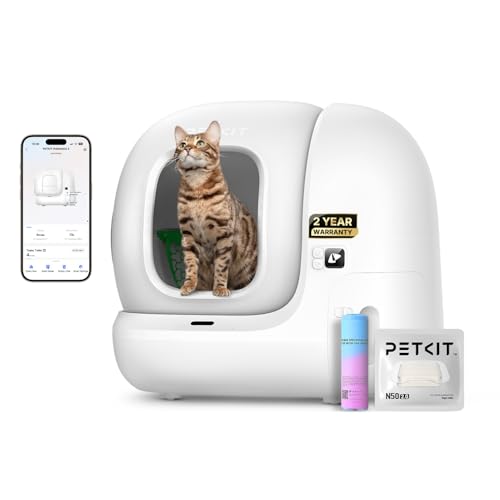
The established brand here, and the bundle reflects it: the box plus an N50 2.0 odor remover, 20 trash bags, a litter sifter, a magnetic litter remover and a deodorizer. The engineering headline is the patented seamless ShieldBase, a 360-degree seal designed to stop the leaks that plague cheaper drums – the failure mode that turns a self-cleaning box into a worse mess than a tray. A 76L interior takes cats from 3.3 to 22 pounds through a low entrance that suits older cats. Seven infrared plus four weight sensors make the most thorough safety system in this group, and four cleaning modes – auto, manual, timer and empty – are all set from the phone rather than a fiddly panel. PETKIT is refreshingly direct about the limits: not for cats under six months, and never on carpet.
- Pros: Established brand with a mature app; seamless ShieldBase 360-degree seal against leaks; N50 2.0 odor remover plus sealed bin; 76L interior, cats 3.3–22 lbs; low entrance for older cats; 11 sensors total; four cleaning modes; generous accessory bundle.
- Cons: By far the most expensive here and the weakest sales rank in the group; explicitly unsuitable for kittens under six months; cannot go on carpet or mats; enclosed design may not suit cats that dislike tunnels.
Best for: households that want a known brand, the best leak sealing, and serious odor control.
The verdict
Best overall: PARUUNTYS Open-Top Self-Cleaning Litter Box. It leads this group in sales while costing the least, and the specification explains it. The 16.5-inch open-top entry solves the single biggest failure of automatic boxes – cats refusing to go in – and behind it sit seven sensors, a 15L sealed bin, and a washable reusable liner that keeps running costs down. For most homes there is no obvious reason to spend more.
Best value: Mintakawa Automatic Cat Litter Box. Budget money for the quietest published noise figure here and the health tracking that actually justifies an app – weight, duration and frequency at every visit. It is scoped plainly at 3.5 to 15 pounds, so check your cat against that before buying.
Best premium: PETKIT PuraMax 2. The ShieldBase seal and the N50 2.0 odor system are real engineering rather than marketing, the app is the most developed here, and eleven sensors make it the most cautious box in the group. Worth the money if leaks and smell are what you are trying to solve.
One more worth knowing about: the Cumrige takes cats from 2.2 to 33 pounds on a 95L drum, and nothing else here comes close for a very large cat.
Frequently asked questions
Are automatic litter boxes safe for cats?
The mechanism is where the risk sits, which is why sensor redundancy matters so much. Every box here pauses its cycle when a cat is detected, and the better ones use both infrared and weight sensing so one failing does not matter. Follow the stated weight ranges – a cat lighter than the sensors expect is the realistic concern – and keep the unit off carpet, where soft flooring can confuse weight readings.
Will my cat actually use one?
Many will, some take a while, and a few never do. The odds improve if you run the new box alongside the old tray for a week or two, put it in the same spot, and use the same litter. Open-top designs are an easier sell for cats that dislike enclosed spaces. Do not remove the old box until the new one has been used regularly.
How often do I still have to do something?
Emptying the waste bin every one to two weeks for a single cat, topping up litter, and washing the drum occasionally. The Cumrige claims up to 15 days and the MusingFairy up to 14, though multiple cats cut that proportionally. It is a big reduction in daily work, not the elimination of all work.
What litter should I use?
Clumping litter is what these mechanisms are designed around – the Cumrige states compatibility explicitly. Clumps hold together well enough to be sifted out; crystal and non-clumping litters tend to break up and pass through, leaving waste behind. Check each maker’s guidance before switching.
Why do they all need 2.4GHz Wi-Fi?
2.4GHz travels further through walls and uses less power than 5GHz, which suits a low-bandwidth appliance in a laundry or bathroom. The catch is that many modern routers merge both bands under one network name, which can stop setup working. Temporarily separating the bands, or using the Mintakawa’s Bluetooth fallback, usually solves it.
This article may contain affiliate links; see our Affiliate Disclosure.