Some dogs hear the clippers come out of the drawer and are gone – under the bed, behind the couch, a 60-pound animal folded into a space you would swear was too small. The noise did that, not the nails. A grinder that runs at conversation volume instead of dentist-drill volume changes the whole negotiation, and the good ones are quiet enough that the dog stops taking nail day as an ambush.



Every grinder in this category claims to be whisper quiet, so the word is worthless on its own. What separates them is whether the maker publishes an actual decibel figure, how much the handle buzzes in your hand, and whether there is enough motor left to get through a thick nail without stalling and dragging the job out. The five below cover a stubbornly cheap option, two mid-range best sellers, and two that put their noise numbers in print.
At a glance
| Product | Standout feature | Price tier | Link |
|---|---|---|---|
| Whisper Quiet Dog Nail Grinder, 4 LED | 3 speeds, 12,000 RPM, 3 diamond bits, full kit | Mid-range | |
| Heusom Silent Groom Pro | Stated 30–37 dB; replacement heads available | Premium | |
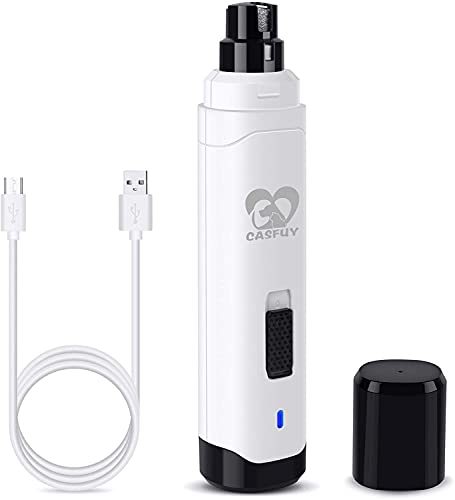
| Casfuy 2-Speed Dog Nail Grinder | 7,000–8,000 RPM, 3 grinding ports, 2-hour runtime | Mid-range | |
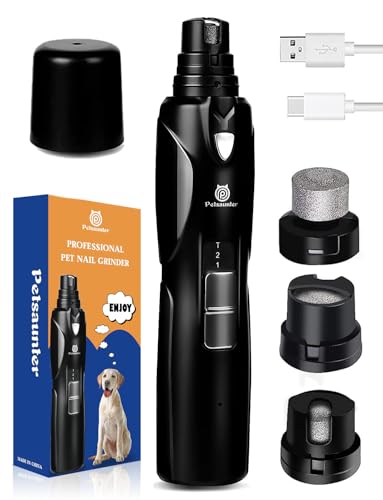
| Petsaunter Dog Nail Grinder | Under 45 dB, touch switch, roughly 10-hour runtime | Budget | |
| LuckyTail Pet Nail Grinder | Stated 30–45 dB, twin LEDs, 360-degree diamond head | Premium | |
How to choose a quiet nail grinder
Decibels, or it did not happen
Only some makers publish a number, and those are the ones to take seriously. Heusom states 30 to 37 dB. LuckyTail states 30 to 45 dB and points out that plenty of popular grinders run far louder. Petsaunter states under 45 dB. For scale, a quiet library sits around 30 to 40 dB and normal conversation is around 60. Because the decibel scale is logarithmic, a grinder at 45 dB is not slightly quieter than one at 60 – it is dramatically quieter to a dog’s ear. A grinder that only says “whisper quiet” with no figure attached is asking you to take its word for it.
Vibration is the other half
Noise-sensitive dogs are usually touch-sensitive too, and a tool that hums through the nail into the toe will be rejected even if it is silent. Every grinder here claims low vibration; the ones that back it with a specific motor design – LuckyTail’s patented layout, Casfuy’s quiet motor – are making a more concrete claim than the rest. Since you are holding the paw, you will feel the buzz before your dog complains about it.
Power against calm
There is a genuine tension here. The Whisper Quiet unit runs at 12,000 RPM; the Casfuy tops out at 7,000 to 8,000. More speed grinds a thick nail faster, which means less time holding a squirming paw – but higher speed generates more heat and usually more noise. The practical answer is variable speed. Start low for a puppy or a nervous dog, use high only for a Labrador’s thick back nails. A grinder with one fixed speed makes that choice for you.
Watch the quick, not the clock
The quick is the blood vessel inside the nail, and hitting it hurts and bleeds. This is the single reason dogs learn to hate nail day. Built-in LEDs shine through the nail so you can see where the quick ends before you get there – the Whisper Quiet grinder has four, LuckyTail places two below the head, Petsaunter has one. On dark nails no light shows you everything, so the rule stands: short passes, check often, stop early.
Ports and guards
Most of these have a guard with several openings sized for small, medium and large nails. It keeps fur out of the spinning bit – worth more than it sounds – and stops you pressing too far in. The Casfuy and Petsaunter both use three ports, and the Casfuy’s guard lifts off entirely for big nails. Heusom takes a different route with a single protective guard sized for everything from a cat to a German Shepherd.
Battery, charging and bits
Runtimes vary more than you would expect: roughly two hours on the Casfuy, over four on the LuckyTail, and about ten on the Petsaunter. Since a full set of nails takes minutes, any of these lasts weeks between charges – what actually matters is whether it is charged when you need it, so USB-C is a real convenience. Bits wear down over time; Heusom is the only one here that explicitly sells replacement heads, which is the difference between a tool and a disposable.
Whisper Quiet Dog Nail Grinder with 4 LED Lights
The runaway best seller of this group, and the specification explains why: it is the most complete package here. Four LEDs light the nail from more angles than any rival, so finding the quick is less guesswork. Three speeds cover a puppy’s paper-thin claws through a large dog’s thick back nails, and a 12,000 RPM motor means the high setting has real bite rather than politely stalling. Three diamond bits ship in the box – a soft bit for smoothing edges, a hard one for grinding through thick nails fast. The kit rounds out with clippers, a removable dust cap, a velvet bag and a USB cable, which makes it the one to buy if you own no nail tools at all.
- Pros: Four LEDs, the brightest quick-spotting setup here; three speeds plus a strong 12,000 RPM motor; three diamond bits for different nail types; dust cap contains the powder; complete kit with clippers and storage bag; the clear category best seller.
- Cons: No decibel figure published, so “whisper quiet” is unverified; the highest RPM here may be more grinder than a small nervous dog needs.
Best for: multi-dog households and anyone starting from scratch who wants one box with everything in it.
Heusom Silent Groom Pro Pet Nail Grinder
The quietest stated figure in this comparison: 30 to 37 dB, a narrow band down at library level. If your dog’s problem is specifically the sound, this is the number to beat. It is also the only grinder here that takes itself as a long-term tool – the extra-durable diamond wheel is backed by replacement heads you can actually buy, so a worn bit means a new head rather than a new grinder. A protective guard covers everything from a cat’s claw to a German Shepherd’s, and Heusom makes a fair point about clippers: they are fast, but they crush and can catch the vessel, and there is no undo.
- Pros: Lowest published noise here at 30–37 dB; replacement heads sold separately, so the tool outlives its bit; heavy-duty diamond wheel; protective guard suits cats through large dogs; strong sales rank for a premium-priced unit.
- Cons: Premium price; no LED mentioned for spotting the quick; no stated speed settings or RPM figure.
Best for: genuinely noise-phobic dogs, and owners who want a grinder they can re-bit instead of replace.
Casfuy 2-Speed Dog Nail Grinder
Casfuy has been a fixture in this category for years and this is the model that built the name. The 7,000 to 8,000 RPM motor is deliberately more moderate than the highest-revving options, which suits the quiet brief – low speed for puppies and delicate nails, high for thick ones, and no more than that. Three grinding ports sort small, medium and large nails, and the guard pulls off completely when you need to attack a big nail at speed. The diamond drum bit takes the sharp edges off rather than gouging, and the body is ergonomic enough to use left- or right-handed, which nobody thinks about until they are holding a paw with the wrong hand. Two hours of runtime from a three-hour charge.
- Pros: Proven design with a long sales record; two speeds sized sensibly for quiet work; three ports plus a fully removable guard; diamond drum bit for a smooth finish; comfortable in either hand; cordless with 2-hour runtime.
- Cons: No LED to locate the quick; lowest RPM here, so thick nails take longer; three-hour charge for two hours of use is the weakest ratio in this group.
Best for: a reliable everyday grinder for one or two dogs, from a brand with a track record.
Petsaunter Dog Nail Grinder
The cheapest grinder here by a wide margin, and it gives up remarkably little. It states its noise figure – under 45 dB – which several pricier rivals do not. It has an LED for checking the vessel, two speeds, three ports sized from small to extra-large, a 13mm head, and USB-C charging. Then there is the touch switch, which is the genuinely clever bit: a momentary contact that runs the grinder only while you press it. That cuts the “invalid noise time” of a tool whirring away between nails, which for an anxious dog is most of the stress. Roughly ten hours of runtime from a two-hour charge is the best battery ratio in this comparison.
- Pros: Budget price with a published under-45 dB figure; touch switch stops needless noise between nails; LED for the quick; two speeds and three ports; USB-C; around 10 hours per charge from a 2-hour top-up; responsive support.
- Cons: No speed or RPM figure given, so grinding power on thick nails is unknown; single LED rather than a ring; the listing itself warns buyers to check they have the right model, which suggests confusable variants.
Best for: a low-risk first grinder, or a spare to keep charged in the car or the travel bag.
LuckyTail Pet Nail Grinder
LuckyTail makes the sharpest noise argument in the category: 30 to 45 dB against the 110 dB it attributes to common competitors – a difference that is not incremental but categorical to an animal whose hearing far outstrips yours. The patented head design is built around that claim, and the two LEDs sit below the grinding head, throwing light exactly where your eye is looking rather than off to one side. The diamond bit grinds a full 360 degrees, so the angle you hold the paw at matters less, which sounds minor until a dog pulls away mid-pass. Charging is quick at one hour for over four hours of use, and the company answers questions with a real person within a day.
- Pros: Published 30–45 dB with a direct comparison to loud rivals; patented low-vibration design; two LEDs placed under the head where you are looking; 360-degree diamond bit; fast 1-hour charge for 4+ hours of runtime; well-regarded support.
- Cons: Premium price and the weakest sales rank of the five; only two speeds; no RPM figure published.
Best for: cats and small dogs, where low vibration and precise sightlines matter more than raw grinding power.
The verdict
Best overall: Whisper Quiet Dog Nail Grinder with 4 LED Lights. It outsells everything else here by a margin that is hard to argue with, and the specification backs it up – three speeds, a 12,000 RPM motor with genuine power in reserve, four LEDs, three bits, and a complete kit for a mid-range price. The one gap is a published decibel figure, so if noise is your dog’s specific trigger, read on.
Best value: Petsaunter Dog Nail Grinder. It costs a fraction of the others and still states its noise level, lights the quick, offers two speeds and three ports, charges over USB-C, and runs about ten hours. The touch switch is smarter than its price suggests. If the grinder turns out not to suit your dog, you have lost very little.
Best premium: Heusom Silent Groom Pro. The lowest stated noise here at 30 to 37 dB, and the only grinder that sells replacement heads so it stays useful after the first bit wears out. For a dog that genuinely panics at sound, it is the most direct answer, and its sales rank is strong for a premium tool.
LuckyTail sits close behind on noise and adds the best-placed LEDs and the fastest charge – the pick if you are grinding cat claws or a small dog and want the gentlest tool in the room.
Frequently asked questions
Are grinders really better than clippers?
They are harder to get badly wrong. Clippers remove a chunk in one irreversible bite, and if you misjudge the quick it bleeds. A grinder takes a little at a time, so you can stop the instant the nail’s center changes color. It also leaves a smooth edge instead of a sharp one, which your floors and your legs will notice. The trade is time and noise.
How do I introduce a grinder to a scared dog?
Slowly, and not on nail day. Let the dog sniff it switched off. Then run it across the room while they eat something good. Then hold it near a paw without touching. Days, not minutes. A quiet grinder makes this far easier, but no decibel rating substitutes for the introduction.
How often should I grind my dog’s nails?
The old rule is that if you can hear clicking on hard floors, they are too long. Every two to four weeks suits most dogs, though a dog walked daily on pavement wears them down naturally and needs less. Frequent short sessions also encourage the quick to recede, which is the only way to shorten nails that have gone too long.
Why does the nail get hot?
Friction. Holding the bit against one spot builds heat quickly and the nail conducts it to the toe. Use short passes of a second or two, move around the nail, and let it cool between. Lower speed generates less heat, which is one more argument for variable speeds.
Can I use these on a cat?
Yes – LuckyTail and Heusom both state cats explicitly, and the Casfuy is rated for cats too. Cat claws are thinner and need less power, so use the lowest speed and the smallest port. Low vibration matters even more than it does for dogs.
This article may contain affiliate links; see our Affiliate Disclosure.