A camp knife earns its keep in small, unglamorous moments: sawing a zip tie off a new tarp, shaving curls from a damp stick until it catches a spark, halving an apple on a tailgate. Pick the wrong one and it flexes, drags, or folds shut on your knuckles at the worst possible second.



A good camp folder comes down to four things: steel that holds an edge without being a nightmare to sharpen, a lock you trust under pressure, a handle that stays grippy when wet, and a weight low enough that it lives in a pocket instead of a drawer. The five below cover that ground from different angles, whether the knife rides in a pack twice a year, clips into a work pocket daily, or waits in a glovebox for a job nobody planned.
At a glance
| Product | Standout features | Price tier | Link |
|---|---|---|---|
| GOOD WORKER 6680 Folding Knife | 440C steel, serrated 2.95″ blade, glass breaker and seat belt cutter | Budget | |
| Smith & Wesson Extreme Ops SWA24S | 3.1″ serrated clip point, ambidextrous thumb knobs, limited lifetime warranty | Budget | |
| CIVIVI Mini Praxis | D2 tool steel, G10 handle, ball-bearing flipper action | Premium | |
| Gerber Paraframe Mini | 1.6 oz carry weight, frame lock, skeletonized stainless handle | Mid-range | |
| KEXMO Wood Handle Pocket Knife | Longest blade here at 3.46″, rosewood scales, glass breaker | Budget | |
How to choose a folding knife for camp and everyday carry
Blade steel, in plain language
Steel is a set of trade-offs between three things: how long the edge lasts, how easily you can bring it back, and how well it shrugs off rust. The knives here sit in three broad camps. The 3Cr13 and 4Cr13 grades are soft and forgiving; they dull sooner but come back with a few passes on a cheap stone, which suits anyone who has never sharpened a knife before. The 440C and 7Cr17MoV grades are the sensible middle: decent edge life, good corrosion resistance, still easy to maintain. D2 is the outlier, a semi-stainless tool steel that holds an edge noticeably longer and asks for more patience and a better stone when it finally goes dull.
None of it matters as much as the marketing suggests. A cheap steel you actually sharpen will out-cut a premium steel you neglect.
The lock is the part that protects your fingers
Every knife on this list locks open, which is the baseline for anything doing camp work. Two designs dominate. A liner lock uses a sprung leaf inside the handle that snaps behind the blade tang; it is light, easy to close one-handed, and found on most of the knives here. A frame lock does the same job using a section of the handle itself, so the whole structure is thicker and the lock face is broader, which is why the Gerber and the Kershaw-style frame designs feel reassuringly solid.
Whichever you pick, test it the first day. Open the knife, hold it edge-up, and press the spine firmly against wood. It should not budge. A lock that wobbles under spine pressure is a lock to return.
Plain edge, serrated, or both
Serrations tear through fibrous material such as rope, webbing, and seat belts far faster than a plain edge, and they keep working long after a plain edge has gone dull. The cost is control. Serrated blades are poor at clean slicing, hopeless at whittling a feather stick, and genuinely awkward to sharpen without a tapered rod. A plain edge does everything reasonably well and everything precise very well.
The real rule: if the knife mostly cuts cord, straps, and packaging, serrations earn their place. If it prepares food or does fine work, take the plain edge.
Weight decides whether you carry it
The gap between the 1.6 oz Gerber and the 5.68 oz KEXMO shows up in behavior, not performance. A featherweight knife disappears into a pocket and gets used constantly. A heavier knife feels better in the hand, but it tugs at a waistband and quietly migrates to the pack, then the car, then the garage. The best knife is the one that is on you when the tarp needs cutting.
How it opens
A nail nick needs two hands, which is fine standing still and irritating when one hand is holding something. Thumb studs let you roll the blade open one-handed, and ambidextrous versions matter more than people expect: the free hand is not always the one you favor. A flipper tab is faster still, and on a ball-bearing pivot like the CIVIVI’s it becomes effortless.
Handle material and wet grip
Aluminum is light, tough, and slick when wet unless textured. G10, a resin-bonded glass laminate, stays grippy through rain and cold, which is why it commands a price step. Wood looks superb and feels warm, but wants occasional oil and hates being left soaking. Skeletonized stainless saves weight at the cost of a thin grip surface.
Rescue extras, judged fairly
Glass breakers and seat belt cutters are common on budget knives and easy to dismiss as marketing. They are not useless: a hard tip on the pommel beats an elbow against a side window, and a hooked cutter beats sawing at a loaded belt. They add value to a knife that lives in a car or a pack, and nothing to one that lives on a workbench.
Carry rules vary, so check yours
Blade length limits, lock types, and assisted opening are regulated differently by state, country, and sometimes city, and carrying in public is handled differently from a knife stowed in a pack. A knife that is unremarkable at a campsite can be a problem in a courthouse queue. Check the rules where you live and where you travel.
GOOD WORKER 6680 Folding Knife
This is the best-selling knife in the group by a wide margin, and the spec sheet explains why: 440C stainless, a 2.95″ serrated blade, a liner lock, an ergonomic aluminum handle, a pocket clip, plus a glass breaker and seat belt cutter, for the price of a sandwich. At 4.12 oz and 7.17″ open, there is enough handle to grip properly with gloves on. The serrations make short work of rope and webbing, and the rescue features make it a natural glovebox knife. The compromise is the one serrations always bring: this is not the blade for slicing cheese or carving tent pegs.
Pros:
- 440C stainless blade balances edge life, rust resistance, and easy sharpening
- Serrated edge chews through cord, webbing, and seat belts
- Glass breaker and seat belt cutter built in
- Liner lock and pocket clip, with a handle long enough for gloved hands
- Costs less than almost anything else that locks properly
Cons:
- Serrated edge is poor for fine slicing and carving
- Aluminum handle can get slippery when wet
- Serrations need a tapered rod to sharpen well
Best for: a car, pack, or work pocket where cutting cord and straps is the main job and the rescue extras might one day matter.
Smith & Wesson Extreme Ops SWA24S
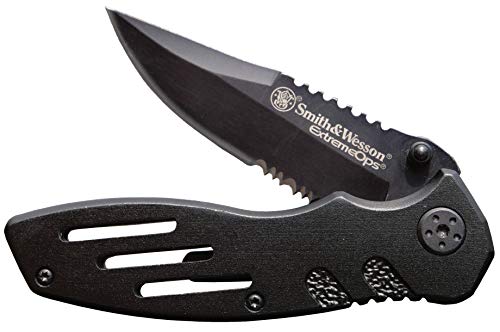
The SWA24S is a long-standing fixture in pockets and toolboxes, and the second best-seller here for good reason. You get a 3.1″ serrated clip point in 7Cr17MoV high carbon stainless with a black oxide finish, an aluminum handle, and a liner lock, all at 3.5 oz across a 7.1″ length. Deployment is what lifts it: a finger flipper and ambidextrous thumb knobs open it cleanly with either hand, and spine jimping gives your thumb somewhere to sit during a hard push cut. The limited lifetime warranty is unusual at this price.
Pros:
- Flipper plus ambidextrous thumb knobs suit either hand
- Light at 3.5 oz for a full 3.1″ blade
- Jimping gives real thumb purchase for control
- Black oxide finish over high carbon stainless resists corrosion
- Limited lifetime warranty from an established brand
Cons:
- 7Cr17MoV needs touching up more often than premium steel
- Serrations limit clean slicing and food prep
- Slim aluminum handle is less comfortable during long jobs
Best for: anyone who wants a proven, light, name-brand carry knife with a warranty behind it and no interest in spending more.
CIVIVI Mini Praxis
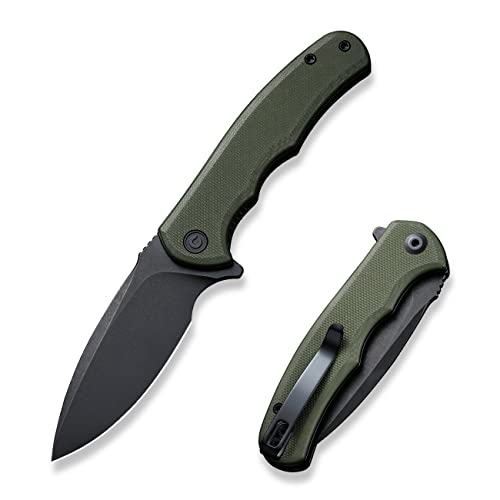
The difference lands the first time you flip it open. A ceramic ball-bearing pivot and a strong detent give the 2.98″ blade a snap the budget knives do not have, and the blade is black stonewashed D2, a tool steel that holds a working edge well past the point where softer steels give up. The G10 handle is the other upgrade: unbothered by moisture or cold, grippy in the rain. The plain edge slices, carves, and prepares food properly. CIVIVI backs it with lifetime service against defects through a US service center.
Pros:
- D2 steel holds an edge far longer than the budget grades here
- Ball-bearing pivot and strong detent give fast, crisp one-handed flipping
- G10 handle stays grippy wet, cold, or hot
- Plain edge handles carving and food prep cleanly
- Stonewashed finish hides scratches; lifetime service against defects
Cons:
- Costs roughly three times the budget picks
- D2 is semi-stainless and will spot if stored wet
- Harder to sharpen once it finally dulls
- No glass breaker or rescue features
Best for: the person who carries a knife daily, notices when an edge fades, and wants one that stays sharp between sharpenings.
Gerber Paraframe Mini
At 1.6 oz and 5.25″ open, the Paraframe Mini is the knife you forget you are carrying, which is exactly the point. The skeletonized stainless frame cuts weight everywhere it can, the frame lock is broad and positive, and the 2.2″ plain edge clip point opens with a nail nick. It suits ultralight backpackers, keyring carry, and anyone who has abandoned heavier knives as a nuisance. The trade-offs are real: the thin frame is not comfortable for extended cutting, and the nail nick means two hands. Gerber covers it with a limited lifetime warranty.
Pros:
- 1.6 oz and 5.25″ open, so it genuinely disappears in a pocket
- Frame lock is broad and solid for the size
- Plain edge clip point handles fine work and food
- Skeletonized stainless resists rust with almost no care
- Limited lifetime warranty
Cons:
- Nail nick needs two hands to open
- Skeletonized frame is uncomfortable during long cutting sessions
- 2.2″ blade is short for larger camp tasks
Best for: ultralight packing, keyring carry, and anyone who wants a real locking blade with no weight penalty.
KEXMO Wood Handle Pocket Knife
The KEXMO is the big one: a 3.46″ black 3Cr13 blade, 0.11″ thick, on an 8.46″ frame weighing 5.68 oz, with rosewood scales cut with finger indentions that lock your hand in place. Hardened to 56-59 HRC, the steel is softer, so it dulls sooner and takes an edge back in minutes on a basic stone. A finger flipper, ambidextrous thumb stud, and liner lock cover deployment; a glass breaker and reversible clip round it out. This is for people who find small folders fiddly and want presence in the hand.
Pros:
- Longest blade here at 3.46″, and thick at 0.11″
- Rosewood scales with finger indentions give a secure, comfortable grip
- Flipper and ambidextrous thumb stud both open it one-handed
- Glass breaker and reversible pocket clip included
- Soft steel sharpens back quickly with minimal skill
Cons:
- Heaviest of the five at 5.68 oz
- 3Cr13 loses its edge sooner than the other steels here
- Wood needs occasional oiling and dislikes prolonged soaking
- Longer blade runs into carry limits in some places
Best for: larger hands and bigger camp jobs, where a full grip and a long blade beat pocket-friendly dimensions.
Verdict
Best Overall: GOOD WORKER 6680 Folding Knife. The clear best-seller here, and the reason is not mysterious: 440C steel, a proper liner lock, a serrated edge that tears through camp cordage, a glass breaker, and a seat belt cutter, for less than most locking knives cost with none of those things.
Best Value: Smith & Wesson Extreme Ops SWA24S. Practically tied with the leader on sales, it adds ambidextrous flipper action, jimping for thumb control, a longer 3.1″ blade at a lighter 3.5 oz, and a limited lifetime warranty behind it all.
Best Premium: CIVIVI Mini Praxis. D2 steel, a G10 handle, and a ball-bearing flipper put it in a different class. If you carry daily and sharpen often enough to resent it, this is the one that changes that.
Frequently asked questions
Is a serrated or plain edge better for camping?
It depends on the work, not the setting. Serrations cut rope, webbing, and packaging faster and stay useful longer between sharpenings, so they suit a knife that mostly deals with cordage and straps. A plain edge is better at everything requiring control: slicing food, carving, cutting a clean line. If this is your only camp knife and you cook at camp, take the plain edge.
What blade length can I legally carry?
There is no single answer. Limits on blade length, locking blades, and assisted opening are set at state, national, and sometimes city level, and the rules for carrying on your person usually differ from the rules for a knife stored in a pack or car. Check the law where you live and where you are heading before you clip a knife to your pocket.
How do I stop a folding knife rusting?
Dry it after it gets wet, especially after cutting anything acidic or salty, and put a drop of light oil on the pivot every so often. Stainless grades such as 440C and 7Cr17MoV are forgiving. D2 is semi-stainless and will spot if you leave it damp, so it wants a wipe-down. Never store a knife wet in a closed sheath or pocket.
Does the lock type actually matter?
For normal cutting, both liner locks and frame locks are safe when well made. Frame locks generally have a broader lock face and a stiffer handle, so they feel more solid under heavy pressure. Build quality matters more than the design. Test any new knife by pressing the spine hard against wood; if the lock moves, send it back.
Are glass breakers and seat belt cutters worth having?
They are worth having on a knife that lives in a vehicle or an emergency kit, where the specific scenario they address is plausible. On a knife that mainly opens boxes at a workbench they add weight and a pointy pommel you did not need. Match the feature to where the knife will actually spend its life.
This article may contain affiliate links; see our Affiliate Disclosure.