Tomato seeds are bitter, and a blender does not know that. It shreds them into the sauce along with the skins, and no amount of simmering takes that sharp edge back out. A food mill simply refuses to let them through, and that one stubborn quality is why a hand-cranked tool from your great-grandmother’s era still has no real replacement.


A good mill is decided by three things: whether the discs give you real texture choice, whether it sits on your pot without swimming in it, and whether your wrist still works after ten pounds of tomatoes. The five below run from a compact mill for a small kitchen to a heavy-duty workhorse for canning season, which covers the once-a-year preserver, the parent making baby food, and anyone who has simply had enough of gritty sauce.
At a glance
| Product | Standout features | Price tier | Link |
|---|---|---|---|
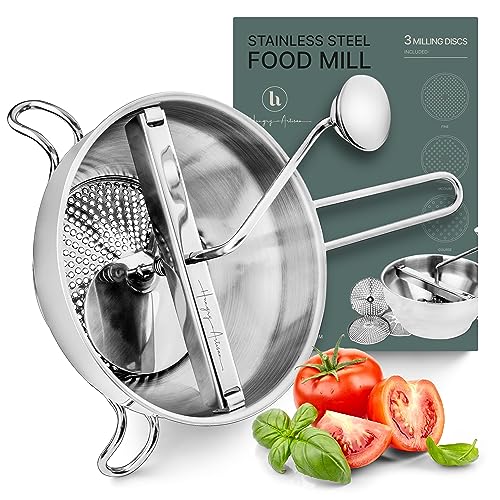
| The Hungry Artisan 3-Disc Food Mill | Three stainless discs from fine to coarse; ergonomic rotary crank; dishwasher safe; household batch size | Mid-range | |
| Gemfino Rotary Food Mill | Dual hooks plus handle form a stable triangle; silicone non-slip grips; doubles as colander or steamer; scraping spoon included | Mid-range | |
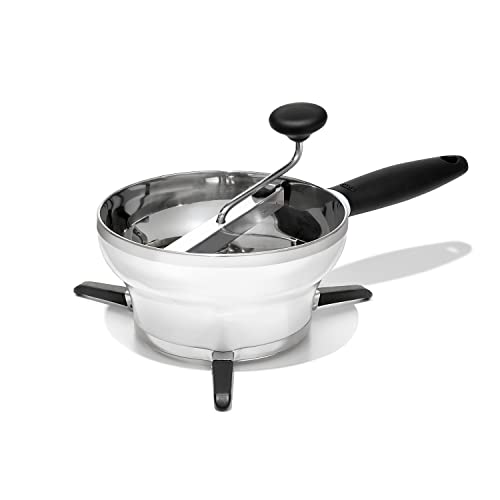
| OXO Good Grips Food Mill | Spring-loaded lever swaps discs; three folding non-slip legs for pots to 11 inches; 2.3-quart capacity | Premium | |
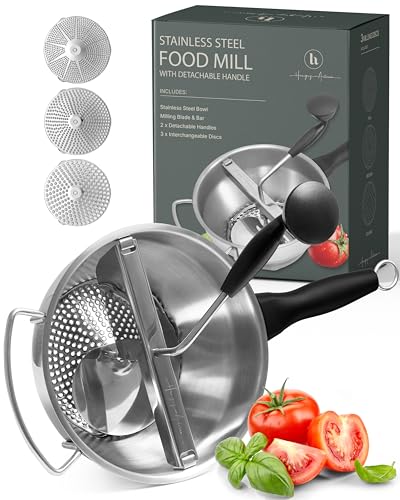
| The Hungry Artisan Compact Food Mill | Removable handles for storage; three discs; built for small batches and tight kitchens | Mid-range | |
| Compralo Rotary Food Mill | Dual side hooks for deep or shallow pots; silicone knob on a bakelite handle; hanging hole for storage | Budget | |
How to choose a food mill
What a mill does that no blender can
A mill is a sieve with a turning blade above it. Soft food gets pressed through perforations while seeds, skins, stems and cores stay behind in the hopper for you to tip out. That separation is the entire point, and it is why the tool survives. A blender has no way to leave anything behind: everything that goes in comes out, which means tomato seeds become bitter flecks and apple skins become brown specks. There is a second, quieter benefit for potatoes. Blades whip starch into glue, and mashed potato made in a processor turns gummy within seconds. A mill presses potato through holes without ever whipping it, which is why the texture stays light. Every mill here works this way; they differ in how pleasant the work is.
Discs are the texture dial
Most mills ship with three interchangeable discs, and the hole size is your only texture control. Fine is for jelly, baby food and smooth sauces where nothing should be detectable. Medium suits applesauce and vegetable soups. Coarse handles chunky sauces and mashed potatoes where some body is the point. Pantula sets this out plainly, and it maps well to how the others work. The Hungry Artisan sells a premium four-disc version that adds an ultra-fine option, worth considering if jams and jellies are the main job rather than an occasional one. If a mill offers only one disc, it is a single-purpose tool pretending otherwise.
It has to sit on your pot, not in it
This is the detail people discover too late. A mill spans a bowl or pot, and if the span is wrong it tips, slides, or drops into the food. Two designs solve it. OXO uses three non-slip legs rated for bowls and pots up to 11 inches across, and those legs fold flat for storage. Gemfino and Compralo use a dual-hook system instead, where two side hooks and the handle form a triangle that grips deep or shallow pots without wobbling. Both work. What matters is measuring the bowl you actually intend to use before ordering, because a mill that does not span your stockpot is a mill you will not use.
The crank is where your wrist finds out
Milling a small batch takes a minute. Milling a canning session takes an hour, and by then the handle design is the only thing you care about. Look for two things. A soft grip, meaning silicone or a rounded ball rather than bare steel, which Gemfino, Compralo, Pantula and Cuisinart all provide in some form. And leverage, which comes from a crank long enough to turn without clenching. The other efficiency trick worth knowing: Gemfino and Compralo both include a spoon or scraper to press food down onto the disc and clear what sticks underneath. That sounds trivial until you are half an hour in, scraping the underside with a spatula that does not fit.
Cleaning, storage, and the reason mills get abandoned
A mill is three or four parts that all touch food and all need to come apart. Every option here is stainless steel and dishwasher safe, which is the baseline to insist on; stainless also resists the staining that tomato inflicts on plastic, and handles hot food straight off the stove. Storage is the underrated problem, because a mill is an awkward shape that does not stack. The answers vary: OXO folds its legs, The Hungry Artisan’s compact model has removable handles, and Gemfino and Compralo drill a hanging hole in the handle end. If your kitchen is short on cupboard space, take this as a real criterion rather than a footnote.
The Hungry Artisan 3-Disc Food Mill
The best seller of this group, and a mill that knows exactly who it is for. Three interchangeable stainless discs cover fine through coarse, so the same tool makes seed-free tomato sauce in September and smooth mashed potato in December. The crank is shaped for comfort and control rather than speed, which is the correct priority once a batch runs past the first few pounds. Construction is stainless throughout and dishwasher safe, and it is sized for a household kitchen: big enough for canning and preserving without becoming commercial equipment you cannot store. Tomatoes, cooked apples, potatoes and other soft produce are the intended diet, and it handles all of them.
Pros
- Best-selling food mill in this comparison
- Three discs give genuine fine, medium and coarse control
- Ergonomic crank designed for longer batch sessions
- Stainless steel throughout and dishwasher safe
- Household batch size suits canning without dominating the kitchen
Cons
- No published capacity figure, so check dimensions before ordering
- Handles do not detach, so storage takes real space
- Costs more than the budget mills doing a similar job
Best for: seasonal preserving and from-scratch cooking where one mill has to handle sauces, applesauce, baby food and mash across the year.
Gemfino Rotary Food Mill
Gemfino has clearly spent its effort on the two moments that make milling tedious: holding the thing steady and clearing the disc. The dual-hook design puts two hooks and the handle into a triangle that locks onto the mixing bowl rather than balancing on it, and both the handle and the crank wear soft silicone so a wet grip does not slip. The blade is a single large one, sized to sweep more of the disc per turn. Best of all, a multi-purpose spoon comes in the box specifically to press food down onto the filter and scrape what clings underneath. The mirror-polished stainless bowl doubles as a colander and a vegetable steamer, which earns back some of the cupboard space it takes. Three discs, dishwasher safe.
Pros
- Dual hooks and handle form a stable triangle on the bowl
- Silicone on both grips for non-slip use with wet hands
- Scraping spoon included to press food through and clear the disc
- Bowl doubles as a colander and vegetable steamer
- Three discs, mirror-polished stainless, dishwasher safe
Cons
- Sold in several near-identical variants, so check which handle you are ordering
- No published capacity or span measurement
- Hook design needs a bowl rim it can actually grip
Best for: cooks who want the mill to stay put and clear itself, and who will use the colander and steamer functions too.
OXO Good Grips Food Mill
The most precisely specified mill here, and the one that answers questions the others leave open. Capacity is roughly 2.3 quarts. The three non-slip legs are rated for bowls and pots up to 11 inches in diameter and fold away for storage, so you know before buying whether it fits your kitchen. The stainless bowl is chosen for hot food and to resist staining, which matters if tomatoes are the main event. The detail that separates it in use is the spring-loaded lever: discs swap and the mill comes apart with one hand, instead of the fiddling that turns a three-disc mill into a one-disc mill in practice. Three discs cover fine, medium and coarse. It is the most expensive option here and the least gadget-like.
Pros
- Published capacity and pot span, so fit is not guesswork
- Spring-loaded lever makes disc changes and disassembly quick
- Three non-slip legs that fold flat for storage
- Stainless bowl suits hot food and resists staining
- Long-standing design from an established kitchen brand
Cons
- Highest price in this comparison
- No scraping spoon or extra accessories in the box
- Legs need a pot within the 11 inch limit
Best for: anyone who changes discs often, cooks hot batches straight from the stove, and wants exact specs before buying.
The Hungry Artisan Compact Food Mill
The same idea as its bigger sibling, rethought for kitchens where every cupboard is already full. The handles come off, which sounds minor and is not: a mill with its handles removed becomes a stackable bowl instead of an awkward spider, and that is often the difference between a tool used and a tool buried. It keeps the three-disc range from fine to coarse, so nothing is given up on texture, and the ergonomic crank is unchanged. Stainless steel and dishwasher safe as before. The trade is batch size: this is aimed at smaller households, everyday meal prep and small-batch canning, not at forty pounds of tomatoes in an afternoon.
Pros
- Removable handles make storage genuinely easier
- Full three-disc range despite the smaller size
- Cheaper than the full-size version
- Same ergonomic crank and stainless dishwasher-safe build
- Well suited to baby food and everyday small batches
Cons
- Small batches mean more refills during a canning session
- Removable handles are another part to keep track of
- Capacity is not published, so check dimensions carefully
Best for: small kitchens, one or two person households, and anyone making baby food or single-jar batches.
Compralo Rotary Food Mill
The cheapest mill here, and it gives up remarkably little to get there. Three interchangeable grinding pans cover coarse, medium and fine. The two side hooks hold deep or shallow pots without wobbling, which is the same sensible approach the pricier Gemfino takes. The crank pairs a soft silicone knob with a bakelite handle, chosen so a long session does not punish your wrist, and the upgraded larger blade sweeps more of the disc per turn while pressing food through and scraping the underside clean. Stainless steel construction is stain and corrosion resistant and dishwasher safe, and a hole in the handle end lets it hang rather than eat a cupboard shelf.
Pros
- Lowest price in this comparison by a clear margin
- Three discs, so no texture compromise for the money
- Dual side hooks fit deep and shallow pots alike
- Silicone knob and bakelite handle for longer sessions
- Hanging hole solves storage in a crowded kitchen
Cons
- Sells in much lower volume than the leaders here
- No published capacity or pot span
- Bakelite handle is less refined than silicone throughout
Best for: a first mill, or anyone who wants the full three-disc capability without paying for a name.
The verdict
Best Overall: The Hungry Artisan 3-Disc Food Mill. It outsells everything else here, and the reasons are sound: the full fine-to-coarse disc range, a crank built for long sessions, and a household size that handles canning season without needing its own shelf. For most kitchens this is simply the mill.
Best Value: Compralo Rotary Food Mill. The lowest price still buys three discs, dual hooks, a comfortable crank and dishwasher-safe stainless. Nothing important is missing, which makes it the sensible way to find out whether you will use a mill often.
Best Premium: OXO Good Grips Food Mill. The 2.3-quart capacity, the 11 inch pot span, the folding legs and the one-handed spring lever are what you pay for. If you mill often and swap discs mid-batch, it is the one that stays pleasant.
Frequently asked questions
Can a blender or food processor replace a food mill?
No, for two reasons. A mill separates: seeds, skins and cores stay in the hopper while the flesh goes through, so tomato sauce comes out sweet rather than bitter. A blender pulverizes everything together. Second, blades whip starch, which turns mashed potato gluey in seconds. A mill presses potato through holes without whipping it, so it stays light.
Do I have to peel and seed tomatoes first?
That is the point of owning one. Cook the tomatoes down, then mill them: the skins and seeds stay behind and you tip them out. It removes the slowest step in sauce-making. The same applies to apples for applesauce, where cores and skins are separated as you go.
Which disc should I use?
Fine for jellies, baby food and smooth sauces. Medium for applesauce and vegetable soups. Coarse for chunky sauces and mashed potatoes. Most cooks settle on one for daily use and reach for the others seasonally, which is exactly why quick disc changes, like the OXO’s spring lever, matter more than the disc count itself.
Will it fit my pot?
Measure the rim before ordering. OXO publishes the answer directly, with legs rated for bowls and pots up to 11 inches across. Hook-style mills like the Gemfino and Compralo grip the rim instead, which suits deep and shallow pots but needs a rim they can clamp. This is the most common sizing mistake with food mills.
Are they hard to clean?
Not if they are stainless and come apart. All five here are dishwasher safe. The one habit worth keeping is rinsing straight after use, because pulp dries into the perforations and then needs a brush. Stainless also avoids the orange tomato stain that plastic never quite loses.
This article may contain affiliate links; see our Affiliate Disclosure.