Nine hours in seat 34B and your upper back has fused into a single unhappy plate. The full-size massage gun that would fix it is at home, because it weighs as much as a pair of boots and sounds like a hedge trimmer in a quiet hotel corridor. A mini gun is the compromise that turns out not to be one.


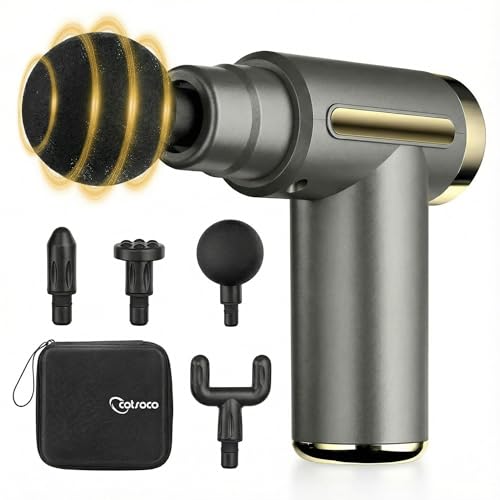
The engineering question with a mini gun is what got cut. Some lose amplitude, which is the thing that makes percussion feel deep rather than buzzy. Some lose battery. The good ones lose only size. Below are five that keep the useful parts, whether you are a lifter chasing recovery between hotel gym sessions, a desk worker whose neck has opinions by Thursday, or someone who simply wants a knot gone before a long drive.
At a glance
| Product | Standout feature | Price tier | Link |
|---|---|---|---|
| LEERCON Portable Massage Gun | Pressure sensor raises power automatically; 150 min battery | Budget | |
| BOB AND BRAD Q2 Mini Massage Gun | 35 lb stall force, under 45 dB, USB-C, FSA and HSA eligible | Premium | |
| RENPHO Mini Thermal Massage Gun | Heated steel head reaches about 114 F in a minute | Mid-range | |
| HEYCHY Super Mini Massage Gun | Lightest here at 0.6 lb; 7 mm amplitude; 5 hour battery | Mid-range | |
| Jancane Mini Massage Gun | Under 40 dB; 6 speeds; up to 3,200 percussions per minute | Budget | |
How to choose a mini massage gun for travel
Amplitude matters more than speed
Percussions per minute is the number every listing shouts, and it is the less useful one. Amplitude, the distance the head actually travels, is what decides whether a gun feels like deep pressure or an electric toothbrush. Full-size guns run 12 to 16 mm. Minis land nearer 6 to 8 mm, which is why they are better on necks, forearms and calves than on a thick, angry glute. Between two minis, the one with more amplitude will feel meaningfully deeper, regardless of which claims more percussions.
Stall force, or what happens when you lean in
Stall force is the pressure at which the head stops moving. Push harder than that and the gun is just a vibrating brick against your skin. Small motors stall early, which is the real limitation of the whole category. A mini rated around 35 lb of stall force will take a firm press; an unrated one usually stalls the moment you mean it.
Noise, because you are in a shared space
A hotel room at 11pm, an open-plan office, a plane. Under about 45 dB is quiet conversation territory and nobody looks up. Above 60 dB and you are the person with the power tool. Brushless motors are the reason the quiet ones are quiet, and they also last longer than the brushed motors in the cheapest guns.
Charging that does not need a special cable
USB-C is the feature that stops a massage gun becoming luggage. It means the cable already in your bag works, and a power bank will do the job on a train. Proprietary barrel plugs are a genuine liability on the road: lose it and the device is dead weight for the rest of the trip. Note also which listings include a wall plug, because several of these deliberately do not.
Weight, and how much you will actually carry
The spread here runs from 0.6 lb to 0.95 lb, which sounds trivial and is not. A gun that fits a jacket pocket gets used at the airport. A gun that needs its own bag compartment gets used at home, which rather defeats the purchase. Be clear about which one you are buying.
Heads, and the one you will use
Four heads ship with almost everything. In practice most people use the ball for general work and the flat head for larger muscles, while the bullet head is for people who know precisely what they are doing and should be used carefully. Extra heads are not a differentiator; a comfortable grip and a case that holds them are.
LEERCON Portable Massage Gun
The most popular gun in this group is also one of the cheapest, and its cleverest feature is one the premium brands mostly skip. An intelligent pressure sensor raises output as you press harder, so intensity follows your hand instead of a button. LEERCON is admirably blunt that this takes practice, warning in the listing that the learning curve is not a fault. A 1,800 mAh battery gives up to 150 minutes depending on speed, four heads cover the usual muscle groups, and a 15-minute auto-stop protects both the motor and you from overdoing a single spot. It charges over USB, though the plug is not included.
Pros
- Pressure-sensitive output; intensity follows how hard you press
- Up to 150 minutes of runtime from an 1,800 mAh battery
- Four heads and a charge indicator light
- Auto-stop after 15 minutes of continuous use
- Most popular pick here, at a budget price
Cons
- No wall plug in the box
- Pressure sensing takes a session or two to control
- No stall force or amplitude figures published
Best for: a first mini gun, or a spare that lives in a suitcase and is not mourned if lost.
BOB AND BRAD Q2 Mini Massage Gun
This is the one that publishes the numbers that matter, which is itself a signal. A high-torque brushless motor produces up to 35 lb of stall force at 3,000 RPM, meaning you can press with intent before the head gives up, and it runs under 45 dB while doing it. It weighs 0.95 lb, the heaviest here and still under a pound, and ships in a carry case with an ergonomic silicone grip that does not slide when your hands are damp. USB-C charging works from any standard 5V 2A adapter. It is designed by the physical therapist duo the brand is named for, it is FSA and HSA eligible in the US, and it carries a two-year customer care promise.
Pros
- 35 lb stall force is class-leading for a pocket gun
- Brushless motor stays under 45 dB
- USB-C charging from any standard adapter
- FSA and HSA eligible; two-year support promise
- Carry case and non-slip silicone grip included
Cons
- Most expensive gun here by a clear margin
- Heaviest of the five, though still under a pound
- No heat function
Best for: anyone who wants real percussive pressure in a pocket and will notice when a cheap gun stalls.
RENPHO Mini Thermal Massage Gun
Heat is the reason to look at this one. A conductive steel head warms to roughly 114 F in about a minute, and warmth on a cold, stiff neck does something percussion alone cannot, particularly at the end of a long travel day. A high-torque motor drives 6 mm of amplitude at up to 3,000 RPM across four intensity levels, and the whole thing weighs 0.78 lb. RENPHO is specific about the details that trip people up: double-press the power button to start heating, watch for the red light, and never fit the silicone head while heat is running. The interchangeable colored silicone sleeves are cosmetic but do add grip. The International Massage Association endorses the range.
Pros
- Heated steel head warms in about a minute
- Light at 0.78 lb, with a carry case
- Four intensity levels and four head casings
- Clear instructions about safe heat use
- Endorsed by the International Massage Association
Cons
- 6 mm amplitude is modest even among minis
- Heat rules out the silicone head while running
- No stall force figure given
Best for: cold-weather travel, stiff necks, and anyone who finds heat does more for them than raw percussion.
HEYCHY Super Mini Massage Gun
At 0.6 lb this is the smallest thing here, and it is the only one that genuinely disappears into a coat pocket. The surprise is that it does not trade away the important number: 7 mm of amplitude is more than the RENPHO manages and near the top of what minis achieve, driven by a brushless motor through a T-shaped body that is easier to angle at your own upper back than a pistol grip. The 650 mAh 3C battery is rated for five hours of use and, HEYCHY claims, several times the cycle life of a standard cell. Five speeds, four attachments, a drawstring bag, and USB-C charging that works off a power bank. No wall adapter included.
Pros
- Lightest here at 0.6 lb; true pocket size
- 7 mm amplitude, the deepest stroke in this group
- Five hours of runtime; long-cycle-life battery
- T-shape reaches your own shoulders and upper back
- USB-C, so a power bank charges it anywhere
Cons
- No wall plug supplied
- Cloth drawstring bag rather than a hard case
- No published stall force
Best for: carry-on-only trips and anyone who wants depth without the bulk.
Jancane Mini Massage Gun
The quietest claim in the group belongs to the cheapest gun: under 40 dB, which is library territory, from a brushless motor with noise reduction. Jancane pairs that with six speed levels, more granularity than anything else here, four heads, and up to 3,200 percussions per minute. Battery life is quoted at four to six hours on low, charged over USB-C, and the listing sensibly recommends keeping any single session under 15 minutes. It publishes no amplitude or stall force, which at this price is the trade you are making. As a quiet, light gun for necks and forearms on a shared flight, it is a lot of function for very little money.
Pros
- Under 40 dB, the quietest claim here
- Six speeds give fine control
- Four to six hours of runtime on low
- USB-C charging; four heads included
- Lowest price in the group
Cons
- No amplitude or stall force published
- Least popular of the five
- Unlikely to satisfy anyone wanting deep glute or quad work
Best for: quiet spaces, light muscle care, and gifting without much outlay.
Verdict
Best overall: the LEERCON Portable Massage Gun. It is the clear favorite here, and the pressure sensor is a smarter answer to intensity than a row of speed buttons. For the money, the runtime and the auto-stop make it hard to fault.
Best value: the HEYCHY Super Mini Massage Gun. The lightest body with the deepest stroke is a genuinely unusual combination, and five hours of battery means it charges before a trip, not during one.
Best premium: the BOB AND BRAD Q2. It is the only gun here that publishes a stall force worth quoting, and 35 lb in a pocket-sized body is the difference between a massage and a tickle.
If heat is what your muscles respond to, the RENPHO thermal gun is the specialist worth the detour.
Frequently asked questions
Can I take a massage gun on a plane?
Generally yes, in your carry-on. Devices with built-in lithium batteries are normally fine in the cabin, and airlines want them there rather than in checked luggage, precisely because a battery fault is easier to deal with in the cabin. Any spare lithium battery must go in carry-on. Rules vary by airline and country, so check yours before a trip that matters.
Is a mini massage gun powerful enough to be useful?
For necks, shoulders, forearms, calves and feet, comfortably yes. For deep work on glutes, hamstrings and thick quads, a mini will stall where a full-size gun would not. The plain way to think about it is maintenance rather than heavy therapy: a mini keeps things loose on the road, and a full-size gun does the serious sessions at home.
How long should I use one on a single muscle?
Around one to two minutes per muscle group is the usual guidance, and several of these guns enforce a 15-minute total cutoff for good reason. Longer is not better. Avoid bone, joints, the front of the neck and anywhere that is bruised, swollen or injured, and stop if something hurts sharply rather than aches.
What does amplitude mean and why should I care?
Amplitude is how far the head travels with each stroke. It, more than speed, decides whether percussion feels deep or superficial. Full-size guns manage 12 to 16 mm; minis are usually 6 to 8 mm. When comparing two similar guns, the amplitude figure tells you more than the percussions-per-minute number on the front of the box.
Do I need one with heat?
Not need, but heat is genuinely useful on stiff, cold muscles and many people find it more effective than percussion alone on a neck or lower back. It costs battery and adds a little weight. If you travel somewhere cold, or you stiffen up on long flights and drives, it is worth the trade.
This article may contain affiliate links; see our Affiliate Disclosure.