Hour four at the desk is when a cheap chair confesses. The foam has packed down to a board, the backrest pushes in exactly the wrong place, and you catch yourself perched on one hip just to make it stop.



A budget chair earns its keep in four places: a back that supports the lumbar curve instead of flattening it, a seat that still has loft after months of use, adjustments that fit your body rather than an average, and a base rated well above your weight. Everything else is trim. The five chairs below cover a working-from-home desk, a shared study nook, a dorm room, and a long gaming session, and they are ordered by how well they solve those four problems.
At a glance
| Chair | Standout features | Price tier | Link |
|---|---|---|---|
| DUMOS Mid Back Mesh Desk Chair Best Overall |
Contoured lumbar, mesh back, rocking recline, rear storage pocket | Budget | |
| GTPLAYER Flip-up Armrest Chair | Armrests fold flat, wide seat, 300 lb base, quiet casters | Budget | |
| amseatec Mesh Office Chair Best Value |
BIFMA certified, 3 in foam seat, steel base, 5 year warranty | Budget | |
| Ergonomic Chair with 3D Headrest Best Premium |
Headrest adjusts three ways, movable lumbar pad, 350 lb rating | Premium | |
| HUANUO High Back Office Chair | 3D armrests, lumbar slides two directions, reclines to 120 degrees | Mid-range | |
How to choose a budget office chair
Find the lumbar support before you look at anything else
Your lower spine curves inward, and a chair either fills that gap or leaves it hollow. Cheap chairs fail in two directions. Some are flat as a plank, so your pelvis rolls back and the curve collapses within the hour. Others build in a bulge so aggressive it feels like a fist between the kidneys. The useful middle is a shaped back that meets you gently, and the genuinely good news at this price is that adjustable lumbar has arrived: two of the chairs here let you slide the pad up, down, forward, or back until it lands on your curve rather than someone else’s.
Mesh, foam, or both
Mesh backs breathe, which matters in a warm room or a long session, and they flex a little as you shift. Padded backs feel plush on first sit and hold heat. The pairing worth having is a mesh back with a real foam seat, because the seat is where your weight actually lands. Look at seat thickness: three inches of high density foam keeps its shape far longer than a thin pad stretched over a board, and a seat that bottoms out will make even a well shaped backrest feel wrong.
Armrests are the quiet dividing line
Fixed armrests are stable and cost nothing, but if they sit too high they push your shoulders toward your ears all day. Flip-up arms solve a different problem: they fold clear so the chair tucks fully under the desk, which is the difference between a usable bedroom nook and a cluttered one. Arms that adjust for depth and angle are the ones that let you keep your elbows near your ribs while typing, and finding those on a budget chair is a genuine win rather than a spec sheet line.
Recline range, tension, and locks
Rocking is not a luxury feature. Shifting your angle every so often moves the load off one set of discs and gets blood back into your legs. A range up to 120 degrees is enough to lean back and read properly; 110 degrees is a lean rather than a recline. The tension knob is what makes it work, because a spring tuned for a much heavier person will not budge and one tuned for a lighter person will drop you backward. A recline lock is a bonus, letting you park the angle where you want it.
Ratings that mean something
Two numbers do real work here. Weight capacity is a structural rating, and buying well under the limit gives the base and the gas lift an easier life. BIFMA testing puts a chair through repeated load cycles on the seat, back, and casters, and a BIFMA certified gas lift is a fair sign the cylinder has been tested rather than just fitted. A five year warranty tells you the maker expects the frame to outlast the return window.
DUMOS Mid Back Mesh Desk Chair
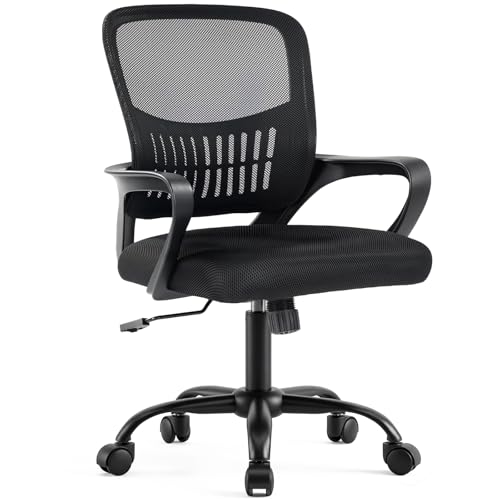
This is the chair shoppers reach for most often in the budget bracket, and the reason is legible the moment you read the spec: it does the fundamentals and skips the theater. A contoured mid-back with a lumbar shape built into it, breathable mesh, a high-resilience foam seat that resists sinking, and a rocking mechanism that swings from upright to a proper 120 degree lean with a tension knob to match your weight. The height range runs from 16.7 to 19.7 inches, which suits most standard desks. There is even a storage pocket on the back of the seat for a tablet or a notebook. The gas lift is BIFMA certified and the base is rated to 250 pounds.
- Pros: Contoured lumbar shaping; breathable mesh back; high-resilience foam seat; 90 to 120 degree recline with tension control; BIFMA certified gas lift; rear storage pocket; roughly 15 minute assembly.
- Cons: Fixed armrests, so no height or depth tuning and no tucking fully under a low desk; 250 pound rating is the lowest here; mid-back only, so no head or neck support.
Best for: a standard desk setup where you want the ergonomic essentials done properly and would rather not pay for adjustments you will set once and forget.
GTPLAYER Ergonomic Office Chair with Flip-up Armrests
Small rooms are where this one makes sense. The armrests fold up 45 degrees and the whole chair slides under the desk, so it stops eating floor space the minute you stand up. Underneath the space saving trick is a sensible chair: a mesh back with lumbar support that catches your waist as you lean, a wider seat that spreads the load across your hips instead of concentrating it, a five-star base rated to 300 pounds, and the same 90 to 120 degree rocking range with a tension column under the seat. The casters are the quiet type meant for hard floors, which is worth something in a flat with neighbors below.
- Pros: Armrests fold up to clear the desk edge; wider seat spreads hip pressure; 300 pound five-star base; 90 to 120 degree recline with tension adjustment; quiet casters suited to hard floors; wear resistant mesh.
- Cons: Armrests fold but do not adjust for height or depth; no headrest; lumbar shape is fixed, so it lands where it lands.
Best for: a desk in a bedroom, studio flat, or shared living room, where the chair has to disappear under the desk when the day ends.
amseatec Ergonomic Mesh Office Chair
The amseatec reads like a chair built by someone who has watched budget chairs fail. The frame is a polymer rated to 300 pounds and the base is coated steel rather than plastic. The seat is three inches of high density foam, which is the single spec that separates a chair you can sit in all day from one you tolerate. It is BIFMA certified, the armrests flip up so it tucks away, assembly runs about 15 minutes, and it carries a five year factory warranty, which is unusually long for the money. The recline is the one place it plays safe, offering 90 to 110 degrees with tension control.
- Pros: BIFMA certified with a 300 pound rating; three inch high density foam seat; coated steel base rather than plastic; flip-up armrests; five year factory warranty; floor-friendly casters; quick assembly.
- Cons: 110 degree recline is the shallowest of this group, closer to a lean than a rest; no headrest; lumbar support is the fixed mesh contour, with nothing to move.
Best for: anyone who wants the longest warranty and the most substantial seat in the budget tier, and who works upright rather than reclined.
Ergonomic Office Chair with Lumbar Support and 3D Headrest
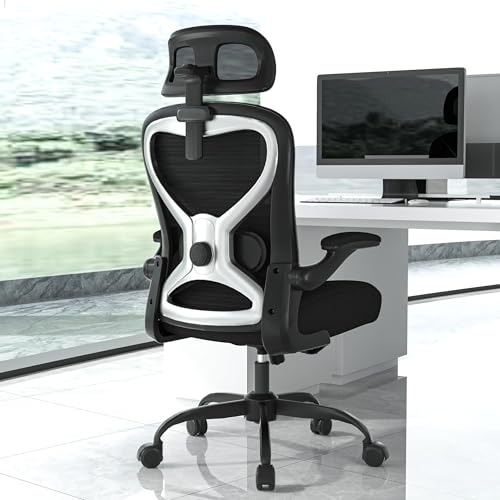
This is the chair for people whose necks give out before their backs do. The headrest adjusts three ways, for height, depth, and angle, so it can actually meet the back of your skull instead of shoving your chin down. The lumbar cushion moves in two directions, letting you place the support on your curve rather than accepting a fixed bulge. The seat is virgin foam built to hold its resilience through eight hour stretches, the base is reinforced metal, and the whole thing is rated to 350 pounds, the highest here. Flip-up armrests keep it tidy under the desk.
- Pros: Headrest adjusts for height, depth, and angle; lumbar cushion moves two directions; 350 pound rating on a reinforced metal base; virgin foam seat aimed at 8 hour days; flip-up armrests; tilt with adjustable tension.
- Cons: The priciest chair here by a clear margin; armrests fold but offer no depth or swivel adjustment; no stated recline angle, so the lean is a question mark.
Best for: long days that end in neck ache, taller sitters, and anyone who wants the sturdiest frame and the most adjustable head support in this group.
HUANUO High Back Office Chair
The HUANUO is the adjustment specialist. Its armrests move in three dimensions, sliding almost two inches fore and aft and swivelling 15 degrees either way, which is what lets you keep your elbows tucked and your wrists straight while typing. They also flip up 90 degrees to clear the desk. The lumbar support slides more than an inch forward and back and over two inches up and down, so short and tall sitters can both find the curve. Add a 2D headrest, a mesh back, a 3.14 inch foam seat, a 90 to 120 degree recline, and an SGS certified build rated to 300 pounds, and you have the most tunable chair in this comparison.
- Pros: 3D armrests with depth and swivel plus a 90 degree flip-up; lumbar moves both vertically and horizontally; 2D adjustable headrest; 3.14 inch high density foam seat; 90 to 120 degree recline; SGS certified to 300 pounds.
- Cons: Headrest adjusts two ways rather than three; no recline lock mentioned, so you hold the angle with tension; the number of adjustments means a longer setup before it feels right.
Best for: shared desks and households where two people of different heights use the same chair, and anyone with fussy shoulders or wrists.
The verdict
Best Overall: the DUMOS Mid Back Mesh Desk Chair. It is comfortably the most popular chair in this bracket, and the spec explains why: contoured lumbar, breathable mesh, a foam seat that resists sinking, a full 120 degree recline with tension control, and a BIFMA certified lift. The fixed armrests are the real compromise, so check their height against your desk first.
Best Value: the amseatec Ergonomic Mesh Office Chair. A three inch foam seat, a coated steel base, BIFMA certification, and a five year warranty add up to more chair than the price suggests. Take it if you sit upright and want the longest safety net.
Best Premium: the Ergonomic Office Chair with 3D Headrest. The three-way headrest, the movable lumbar pad, and the 350 pound metal base make it the one to buy if your neck is the part that complains. If your budget sits between the two, the HUANUO gives you the most adjustment per pound spent.
FAQ
Is a mesh back or a padded back better for long hours?
Mesh wins on airflow and flex, which is why most chairs here use it. A padded back feels softer for the first ten minutes and warmer for the next three hours. What matters more than the back material is the seat under you: a thin seat pad will end your day early regardless of what the backrest is made of.
What does BIFMA certification actually tell me?
BIFMA is a furniture standards body, and its seating tests cycle a chair through repeated loading on the seat, back, arms, and casters to see what breaks. A BIFMA certified chair or gas lift has been through that program rather than simply assembled to a price. It is not a comfort rating, and it says nothing about how the chair fits you, but it is a reasonable floor for structural safety.
Do I need a headrest?
Only if you recline. Sitting upright at a desk, your neck holds its own weight and a headrest usually just nudges your head forward. Lean back to read, take calls, or think, and a headrest earns its place immediately. If you do want one, an adjustable headrest beats a fixed one every time, because a headrest set at the wrong height is worse than none at all.
How much weight capacity should I look for?
Choose a chair rated well above your weight rather than near it. Ratings here run from 250 to 350 pounds, and a base carrying less than its limit flexes less, and the gas cylinder holds height longer. If two people share the chair, size it for the heavier one.
Will a budget chair last?
The parts that fail first are the gas cylinder, the casters, and the seat foam. A certified gas lift, a steel or reinforced base rather than thin plastic, and a thick high density seat address all three, and every chair on this list gets at least two of them right. A five year warranty, like the one on the amseatec, tells you where the maker’s own confidence sits.
This article may contain affiliate links; see our Affiliate Disclosure.