Drop the tailgate on an open bed and every tool in it becomes an opportunity for somebody else. A crossover box is the difference between leaving the impact wrench and the good drill in the truck overnight and hauling an armload of gear into the house at the end of every shift.

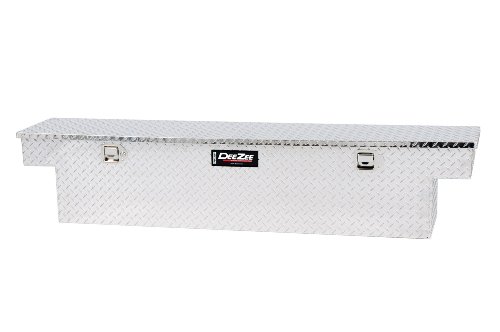


A crossover box sits across the bed rails just behind the cab, which is the one place in a pickup that stays out of the way of sheet goods, ladders and everything else you throw in the back. What separates a good one from a rattling liability is wall thickness, how stiff the lid stays over a long span, and whether the latches still work after a winter of salt. The four below are the genuine crossover boxes in this group, and they suit tradespeople, weekend haulers and anyone who has already lost a tool to an open bed.
At a glance
| Product | Standout feature | Price tier | Link |
|---|---|---|---|
| UWS EC10473 69-Inch | Best seller here; foam-filled RigidCore lid and 0.058-inch walls | Premium | |
| Dee Zee DZ6163N Specialty Series | Narrow profile that leaves usable bed space behind it | Budget | |
| Dee Zee DZ8170DB Red Label | Extra deep tub with a double V-pan lid stiffener | Mid-range | |
| HEVIKE Crossover with rack | Luggage rack on the lid for a second layer of cargo | Mid-range | |
How to choose a crossover truck bed toolbox
First, make sure you are buying a crossover at all
Search this category and most of what comes back is not a crossover. Chest boxes, the 39 to 48-inch aluminum tubs with a handle at each end, sit loose in the bed or bolt to the floor, and they are a different product for a different job. A crossover spans the full width of the bed, roughly 69 to 70 inches on a full-size truck, and rests on the bed rails so the floor underneath stays clear. That gap under the box is where a crossover earns its money: you can still slide lumber and sheet goods beneath it. If a listing quotes a length under about 60 inches, it is a chest box whatever the title calls it.
Measure the rails, then the rear window
Bed width across the rails is the number that decides fit, and it varies between full-size, mid-size and older trucks. The boxes here run 69 to 70 inches long, which suits most full-size beds. Then check the height. A deep box like the Red Label stands 18.25 inches tall and swallows a lot of gear, but it also fills the rear window. A low-profile design, which is what the UWS uses, keeps the view out the back cab window usable. If you reverse onto job sites all day, that view is worth more than the extra capacity.
Narrow or deep is a real trade
Front-to-back depth costs you bed length. The Dee Zee Specialty Series is built narrow specifically to give some of that space back, which matters on a short bed where every inch behind the box counts. The Red Label goes the other way at 20 inches front to back and 18.25 inches deep, aimed at people carrying bulky kit rather than lumber. Neither is more correct; it depends on whether the bed mostly hauls tools or mostly hauls materials.
Wall thickness and lid stiffness
Aluminum thickness is quoted in thousandths of an inch and the differences are small on paper and large in the bed. The Dee Zee boxes use 0.056-inch brite-tread; the UWS uses welded 0.058-inch in a one-piece tub. Over a 69-inch span the lid is the part that suffers, because a long unsupported lid flexes, then binds, then stops latching cleanly. Manufacturers fight this in different ways: UWS fills the lid with solid foam, Dee Zee uses a double V-pan stiffener pressed into the metal. Both approaches work, and a box with neither will eventually sag in the middle.
Latches, locks and what actually gets stolen
Stainless steel paddle handles are the standard for a reason, since plated steel corrodes and starts to seize. Every box here locks, and every box here can be defeated by somebody determined with the right tool. Take a crossover as protection against opportunists and weather rather than as a safe. Wide-spread handles, as on the UWS, mean you can open it from either side of the truck without climbing into the bed.
Sealing, or why your tools rust anyway
Water gets in two ways: past a poor lid seal, and as condensation from damp gear locked in overnight. An overlapping lid sheds most of it, and a closed-cell foam gasket, which the Red Label specifies, seals the rest. No crossover box is submersible. Fitting one does not make wet tools dry, so let things air off before they go in.
Installation
Most crossovers, including the UWS here, ship with pre-drilled mounting slots and J-hook hardware, and mount without drilling the truck. Two people make it easy, one person and a moving blanket makes it possible. Check the box clears your tonneau cover or bed cap before ordering, since that combination is where fitment problems usually appear.
UWS EC10473: the one that outsells the rest
This is the best-selling true crossover in the group and also the most expensive, which is unusual enough to be worth saying plainly: people are paying up for it on purpose. The tub is a one-piece welded unit in 0.058-inch aluminum, thicker than the others here, in a matte black finish. The lid is the headline, filled with solid foam under a patented RigidCore construction that keeps it from flexing and binding over the full 69-inch span, and kept low profile so the rear cab window stays useful. Stainless paddle handles sit wide apart so you can open it from either side without climbing in. Inside there is a tool tray with built-in screwdriver holders, and it arrives with pre-drilled slots and mounting hardware.
Pros:
- Thickest walls here at 0.058-inch, in a one-piece welded tub
- Foam-filled RigidCore lid resists the sag and bind that kills long lids
- Low profile keeps the rear cab window clear
- Wide-spread stainless paddle handles, reachable from both sides
- Tool tray and screwdriver holders included
- Pre-drilled mounting slots and hardware in the box
Cons:
- Premium price, by a distance the dearest box in this comparison
- Low profile means less capacity than the deep boxes
Best for: daily work trucks where the box gets opened a dozen times a shift and rear visibility matters.
Dee Zee DZ6163N Specialty Series: the narrow one
The cheapest box here has the clearest reason to exist. Its narrow profile takes up less of the bed front to back, so on a short bed you keep room for a wheelbarrow, a bike or a run of timber behind it rather than losing most of the useful floor to storage. The build is standard Dee Zee: non-rusting 0.056-inch brite-tread aluminum, lockable stainless steel paddle handle latches, and internal bends pressed into the body to stiffen it without adding weight. There is no foam-filled lid or V-pan stiffener at this price, and the brite-tread finish shows dust and fingerprints in a way the powder-coated boxes do not. For the money it is a lot of real box.
Pros:
- Least expensive crossover in this comparison
- Narrow profile preserves usable bed space
- Non-rusting brite-tread aluminum, so no paint to chip
- Lockable stainless steel paddle handle latches
- Internal bends add rigidity to the body
Cons:
- No dedicated lid stiffening system
- Narrow means less capacity, which is the whole point but still a limit
Best for: short beds, tight budgets, and anyone who hauls materials as often as tools.
Dee Zee DZ8170DB Red Label: the deep one
Where the Specialty Series saves space, the Red Label uses it. At 69.75 inches long, 20 inches front to back and 18.25 inches tall, this is the box for people whose gear does not fold flat: cordless kits in their cases, a small compressor, chains, straps and the rest. The construction steps up accordingly. A double V-pan stiffener runs through the lid to keep the span rigid, the body is a 3-piece design with internal bends for strength, and the latches are contractor-grade stainless paddle handles. The 0.056-inch brite-tread aluminum wears a protective gloss black powder coat, which looks better for longer than bare tread and hides less well when it does chip. A closed-cell foam gasket seals the lid against weather.
Pros:
- Extra-deep tub, the largest capacity in this comparison
- Double V-pan lid stiffener keeps the long lid rigid
- 3-piece body with internal bends for strength
- Closed-cell foam gasket seals against water and dust
- Gloss black powder coat over non-rusting aluminum
Cons:
- 18.25 inches tall blocks a good part of the rear cab window
- 20 inches front to back takes a real bite out of a short bed
Best for: tradespeople carrying bulky kit who would rather have capacity than a clear rear view.
HEVIKE Crossover: storage with a roof rack on top
The idea here is simple and nobody else in this group does it: a luggage rack built into the lid, so the top of the box becomes a tie-down point rather than dead space. At 70 by 20 by 15 inches it is long and roomy without being as tall as the Red Label, the aluminum uses a stripe tread pattern for stiffness, and a stainless latch with a weather-guard rubber seal handles security and water. Several sizes are offered, so measure before ordering. The caveat is straightforward: this is by far the least established product here, with a sales rank far behind the others, so there is less collective experience to draw on than with the UWS or the Dee Zee boxes.
Pros:
- Integrated luggage rack adds tie-down space on the lid
- Long and roomy at 70 inches without the full height of a deep box
- Rubber weather seal and stainless latch with keys
- Rust-resistant aluminum with a stripe tread pattern
- Offered in several sizes
Cons:
- Much lower sales rank than the others, so far less of a track record
- Listing says little about wall thickness or lid stiffening
Best for: campers, overlanders and anyone who wants to strap gear on top of the box as well as inside it.
The verdict
Best overall, and best premium: UWS EC10473. These are usually two different boxes. Here they are the same one, because the best-selling crossover in this group is also the dearest. The thicker 0.058-inch welded tub, the foam-filled lid that will not bind, and the low profile that keeps your rear window usable are what people are paying for, and the sales rank says they keep deciding it is worth it.
Best value: Dee Zee DZ6163N Specialty Series. The lowest price here, in non-rusting aluminum with proper stainless latches, and the narrow profile hands back bed space the others take. You give up lid stiffening, which matters more the more you load the lid.
Best for bulk: Dee Zee DZ8170DB Red Label. If your gear is bulky and the rear window is negotiable, the extra-deep tub with the V-pan lid and a foam gasket is the sensible pick. The HEVIKE is the wildcard: nobody else here gives you a rack on the lid, but nobody else here is this far down the sales rank either.
FAQ
What is the difference between a crossover and a chest box?
A crossover spans the bed side to side and sits on top of the bed rails behind the cab, leaving the bed floor clear underneath so long items still slide in. A chest box is a smaller standalone tub, usually 39 to 48 inches, that sits on the bed floor and takes that space away from you. Both get sold under the same search terms, so check the quoted length. Under about 60 inches and it is not going to reach your rails.
Will a crossover box fit my truck?
Measure across the bed rails, outside to outside, and compare that to the box length; these run 69 to 70 inches, which fits most full-size beds. Then check two clearances: the rear cab window, if you want to keep seeing out of it, and any tonneau cover or bed cap already fitted. Mid-size trucks and older beds are where standard crossovers most often come up short or long.
Do I have to drill holes in my truck?
Usually not. Crossover boxes are designed to clamp to the bed rails with J-hooks, and boxes like the UWS come with pre-drilled mounting slots and hardware for exactly that. The box holds itself in place with its own weight plus the clamps. If a set of instructions asks you to drill the rails, stop and check you have the right box for the bed.
Is aluminum strong enough, or should I look at steel?
For a crossover, aluminum is the sensible default. It does not rust, which matters enormously on a box that lives outdoors and gets salted every winter, and it keeps the weight down on a part of the truck you have to lift into place. Strength comes from the tub construction rather than the material alone: welded one-piece tubs, internal bends and lid stiffeners are what stop a box flexing. Steel boxes exist and are heavier, and their coating becomes the weak point the first time it gets scratched.
Are my tools safe in there?
Safer, not safe. A locked aluminum box with stainless paddle latches stops the casual thief who walks past an open bed and helps itself, which is the overwhelming majority of what happens. It will not stop somebody who came prepared. Keep the expensive, easily resold items out overnight where you can, and take the box as weather protection and opportunist deterrence rather than a vault.
This article may contain affiliate links; see our Affiliate Disclosure.