The bag that keeps your camera safest is the one you leave in the hotel room, and a camera left in a hotel room takes no photographs. The bag worth carrying is the one that holds a body and two lenses on the way out, then passes for an ordinary shoulder bag over dinner – no padded-brick silhouette announcing what is inside.


A travel camera bag has to solve three problems at once: protect glass from knocks, get the camera into your hands before the moment passes, and not look like luggage for expensive electronics. The bags below span a full backpack that swallows a body, four lenses, and a tripod, down to a sling light enough to forget you are wearing. This is a researched comparison of what each one is built to do, and none of these listings publish a sales ranking, so nothing here is ordered by popularity.
At a glance
| Product | Standout feature | Price tier | Link |
|---|---|---|---|
| CADeN D6 Camera Backpack | Body, four lenses, flash, iPad and tripod at 1.74 lb | Mid-range | |
| RAINSMORE Camera Backpack | Full rain cover, MOLLE webbing, 15.6-inch laptop slot | Premium | |
| MOSISO Camera Sling Bag | Swings front-to-back for camera access without stopping | Mid-range | |
| BAGSMART 2 in 1 Puffy Camera Sling | Pull the divider and it becomes an ordinary crossbody | Budget | |
| Besnfoto Canvas Crossbody Camera Bag | Shoulder bag, waist pouch, or insert for a bigger pack | Budget | |
How to choose a travel camera bag
Start from the kit, not the bag
Lay out what actually travels with you. One mirrorless body and a walkaround zoom fits a small crossbody with room for a phone and a spare battery. Add a second lens and you want a sling. Add a flash, a drone, a tripod, and a laptop and only a backpack will do it without a fight. Buying two sizes down is the classic mistake, but buying three sizes up is worse: a half-empty backpack lets gear shift around inside, and it makes every day trip feel like an expedition.
Access speed is the feature that changes your photographs
A backpack has to come off both shoulders and go somewhere clean before you can open it. That is fine at a viewpoint and useless on a moving train. A sling rotates around your body and opens while it is still on you, which is why slings survive in city travel long after the backpack has been left behind. If you shoot people, markets, or streets, prioritize the opening over the capacity – the difference shows up in the pictures you get rather than the gear you carried.
Water protection comes in two very different grades
Water-resistant fabric shrugs off drizzle and a spilled drink. A dedicated rain cover is a separate sheet that wraps the whole bag and is the only thing that reliably survives a downpour. Zips are the weak point in both cases, since almost none of them are sealed. If your travel involves monsoon season or a long day on a boat, a bag with its own stowed rain cover is worth more than any fabric claim on the label.
The everyday carry test
A bag doubles as everyday carry when three things are true: it does not look like camera gear, the padding comes out or gets out of the way, and it holds normal life – wallet, phone, keys, water. Removable dividers are the mechanism that makes this work. Take the divider out of a small sling and you have a plain shoulder bag; leave it in and you have a camera case. Canvas and muted colors help more than any marketing feature, because the point is not being noticed.
Comfort is a weight-and-strap problem
Camera gear is dense, so a modest bag gets heavy fast. On a backpack, look for a padded, breathable back panel and a chest strap to stop shoulder creep. On a sling or a crossbody, the strap width does most of the work: a thin strap under a loaded bag turns into a wire by the afternoon. A trolley strap that slides over a suitcase handle is a small detail that matters enormously in an airport.
CADeN D6 Camera Backpack – the most gear for the least weight
The numbers here are the argument. CADeN puts the D6 at 11 by 5.9 by 15 inches and 1.74 lb empty, and says it holds a body, four lenses, a flash, an iPad, a tripod and accessories – or a drone instead. That ratio of capacity to carried weight is what you want on a long travel day, because the bag itself is the one thing in your kit that does no photographic work. Inside, seven-layer PE foam and PP board handle the shock; outside, the fabric is scratch and water resistant, with a hidden front zip pocket and a mesh side pocket for a bottle or umbrella.
Pros
- Body plus four lenses, flash, iPad, and tripod capacity
- Only 1.74 lb empty for that volume
- Seven-layer PE foam and PP board internal padding
- Scratch and water resistant shell; hidden front pocket
- Doubles as drone storage if that is your other hobby
Cons
- Backpack access means taking it off to reach the camera
- No dedicated rain cover, only resistant fabric
- Looks like a camera bag; limited everyday crossover
Best for: travel where the whole kit comes along and the walking is long.
RAINSMORE Camera Backpack – built for weather and airports
This is the bag for trips where the weather has opinions. It carries a full-coverage rain cover rather than relying on fabric alone, and pairs it with a 15.6-inch laptop compartment, six adjustable dividers, MOLLE webbing for external expansion, and a luggage strap that slides over a suitcase handle. The side-entry quick-access opening lets you pull the body out without unpacking, which softens the usual backpack penalty. A padded breathable back panel carries the weight on the long days this bag is clearly designed for.
Pros
- Dedicated full-coverage rain cover, not just sealed fabric
- 15.6-inch laptop compartment for working travel
- Six adjustable padded dividers, reconfigurable per trip
- Luggage strap and MOLLE external attachment points
- Quick-access side entry to the main compartment
Cons
- Highest price in this group
- Tactical styling is conspicuous in some settings
- More bag than a body-and-one-lens kit needs
Best for: photographers who fly with a laptop and shoot in unpredictable weather.
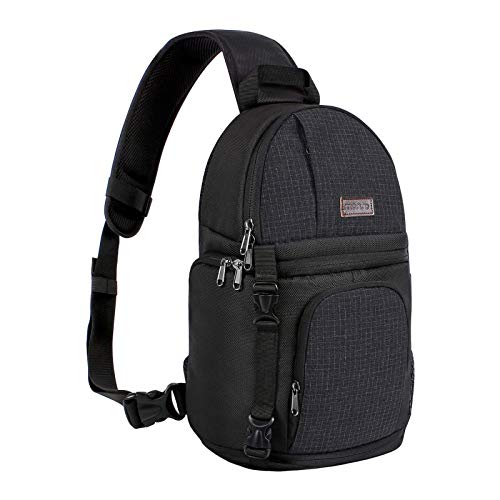
MOSISO Camera Sling Bag – the fast one
The sling exists for one reason, and this bag delivers it: swing it from your back to your chest and the camera is out without the bag ever leaving your body. At 15.7 by 9.06 by 4.8 inches it takes a body and a couple of lenses in a lower case with removable modular inserts, keeps a separate upper section for a phone and personal items, and still mounts a tripod on the side. Soft foam wraps the gear. The strap adjusts from 19.3 to 38.7 inches, which covers most builds and layers.
Pros
- Front-to-back swing gives genuinely quick camera access
- Removable modular inserts reconfigure around your lenses
- Separate upper compartment keeps daily items out of the gear
- Tripod holder despite the compact footprint
- Wide strap adjustment range
Cons
- Single-shoulder load tires faster than a backpack
- No laptop space
- Capacity stops well short of a full kit
Best for: city travel and street shooting where the shot is gone in three seconds.
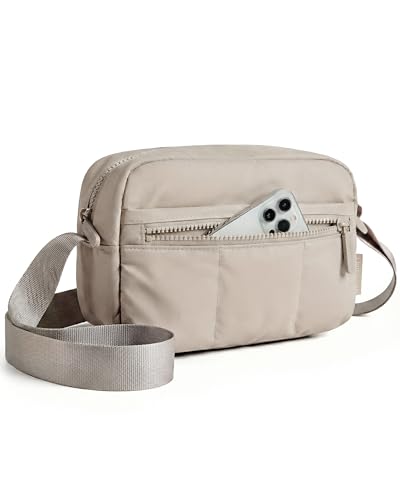
BAGSMART 2 in 1 Puffy Camera Sling – the one that stops being a camera bag
Pull the single removable divider and this stops being camera equipment and starts being a puffy crossbody you would carry anyway. That is the whole idea, and at 9.84 by 4.13 by 5.51 inches and 0.42 lb it is light enough to make the switch worth it. With the divider in, it secures a mirrorless or DSLR body plus a spare lens; with it out, it holds a phone, a wallet, and the rest of an evening. Water-repellent nylon and an anti-scratch lining cover the protection side, and a hidden zip pocket takes a phone or passport.
Pros
- Genuine dual identity: divider in for gear, out for daily carry
- 0.42 lb and pocket-sized dimensions
- Water-repellent nylon with soft anti-scratch lining
- Hidden zip pocket for phone or documents
- Strap adjusts from 11 to 24 inches
Cons
- One body and one lens is the real ceiling
- Puffy styling will not suit everyone
- No rain cover and no tripod mount
Best for: one-camera travel days that turn into evenings out.
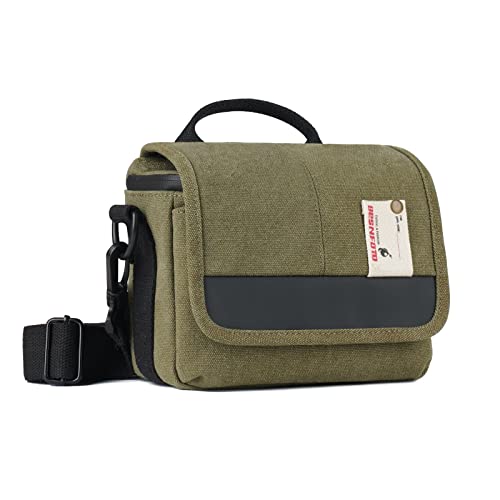
Besnfoto Canvas Crossbody Camera Bag – quiet, and four bags in one
Retro canvas with PU leather trim reads as a messenger bag, not as a case for a camera worth more than the flight. That discretion is a real travel feature. It measures 8.27 by 4.72 by 6.7 inches, takes a mirrorless or DSLR with an extra lens in a compartment padded with thick shock-absorbing PE foam, and closes with a flip cover that stops a body sliding out. The clever part is the mode-switching: wear it crossbody, put it on a belt through the rear loop, or drop the strap and use it as a padded insert inside a larger backpack.
Pros
- Four carry modes, including as an insert in another bag
- Discreet retro canvas that does not signal camera gear
- Thick PE foam padding and a secure flip-cover closure
- Water-resistant high-density canvas with heavy stitching
- Rotatable metal hooks and an adjustable wide strap
Cons
- The smallest capacity here; one lens spare at most
- Canvas marks more readily than technical nylon
- Flip cover is slower than a zip in a hurry
Best for: traveling light and not advertising what you are carrying.
The verdict
Best Overall – CADeN D6 Camera Backpack. It wins on the ratio that matters most on a travel day: a body, four lenses, a flash, a tablet and a tripod inside a shell that weighs 1.74 lb empty, with serious layered foam protection. It is not the fastest to open and it looks like what it is, but for carrying a full kit a long way it asks the least of you.
Best Value – Besnfoto Canvas Crossbody. The cheapest bag here and the most versatile per pound. Four carry modes, real foam padding, and styling that keeps your gear unremarkable. It also works as an insert, so it stays useful even after you buy something bigger.
Best Premium – RAINSMORE Camera Backpack. The only bag here with a dedicated rain cover and a 15.6-inch laptop compartment, plus a luggage strap and quick side access. If your travel mixes weather, work, and airports, it covers all three.
FAQ
Backpack or sling for travel photography?
Sling if the camera needs to be in your hands quickly and the kit is small; backpack if you are carrying more than two lenses or walking all day. Many photographers end up with both and choose by the day rather than by the trip. Weight distribution is the tiebreaker: past roughly a body and two lenses, two shoulders beat one.
Will a camera bag protect gear in checked luggage?
No. Padded camera bags are built for bumps and knocks, not for the crushing and drops that checked baggage handling involves. Camera bodies and lenses belong in the cabin, which is another reason a bag that fits under a seat or over a suitcase handle is worth choosing.
What does “waterproof” really mean on a camera bag?
Almost always water resistant rather than waterproof. The fabric may repel water, but unsealed zips and seams will let it through in sustained rain. If the bag includes a separate rain cover, that is the part doing the real work, and it is worth deploying earlier than you think.
Can I use a normal backpack with a padded insert instead?
Yes, and it is a good approach for anyone who wants zero camera styling. A padded insert drops into a daypack you already own and comes out when you do not need it. The trade is access speed and the loss of purpose-built features like tripod straps and quick side openings.
How much padding is enough?
Enough that no part of a lens or body touches the outer wall directly, and that dividers stop gear knocking together. Roughly a centimeter of dense foam around the compartment is the practical baseline for travel. Beyond that you are mostly buying bulk, and bulk is the thing that eventually makes a bag stay behind.
This article may contain affiliate links; see our Affiliate Disclosure.