Wrestling a full sheet of plywood across a table saw alone is how good projects and good fingers get ruined. A track saw inverts the problem: the sheet stays flat on the floor or a couple of foam boards, and the saw walks a straight aluminum rail across it, leaving an edge clean enough to glue straight off the blade.
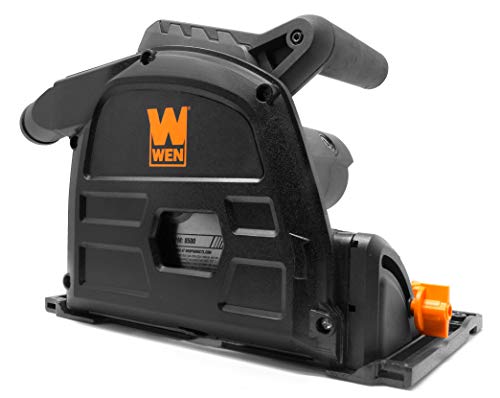


What makes a track saw worth owning is the combination of a plunging blade, a rail with anti-splinter edges, and enough depth to get through 18 mm ply in one pass. What separates them is motor power, whether the speed is adjustable, and how much of the system is in the box. These five run from an entry-level corded saw to a cordless kit, and suit a garage with no room for a table saw, a jobsite, or a workshop that has one and still wants sheets broken down safely.
At a glance
| Product | Standout features | Price tier | Link |
|---|---|---|---|
| WEN CT1065 Plunge Cut Track Saw | 10-amp motor, rips to 2-1/3 inches, internal plunge cuts | Budget | |
| WEN 7.25-Inch Track Saw (CT1274) | Variable 2,000–6,000 RPM, 2.6-inch depth, takes standard 7-1/4-inch blades | Mid-range | |
| DEWALT TrackSaw Kit (DWS520K) | 12-amp motor, riving knife, continuous anti-kickback, dual-edged track use | Premium | |
| Makita SP6000J Plunge Circular Saw | 12-amp motor, electronic speed control under load, mirror-finish cuts | Premium | |
| Makita 18V X2 LXT Cordless Plunge Saw Kit | 36V brushless, 6,300 RPM, automatic speed change, batteries included | Premium | |
How to choose a track saw
Check what comes with the track, because usually nothing does
This is the single most common surprise, and it applies to every saw on this list. Not one of these listings includes the rail in the box. The WEN CT1065 pairs with WEN’s 100-inch track; the CT1274 works with the 100-inch or the 110-inch; the Makita cordless kit names a 39-inch guide rail sold separately; DEWALT’s saw is described for use with its dual-edged tracks. Clamps are usually separate again. Before you compare prices, work out the real total: saw, a rail long enough for your work, and probably clamps.
Rail length decides what you can actually cut
To rip an eight-foot sheet in one pass you need a rail longer than eight feet, because the saw must start and finish off the workpiece. That means roughly 100 inches or more. Shorter rails cut crossways on a sheet or handle doors and worktops, and many rails join together, though the joint must be set dead straight or it prints a step into the cut. Buy the length that matches the sheet, not the length that matches the budget.
Depth of cut, at 90 and at 45
Depth on a rail is always less than the saw’s raw capacity, because the track itself sits under the base and eats some. The real figures here range from about 2-1/8 inches at 90 degrees on the DEWALT to 2.6 inches on the WEN CT1274, and every one of them drops significantly at 45 degrees, typically to somewhere between 1-1/2 and 1.85 inches. DEWALT’s depth scale is calibrated to account for the track thickness, which removes an easy mistake. For sheet goods any of these is ample; for thick worktops, check the bevel figure specifically.
Variable speed is about material, not power
Full speed suits solid timber and plywood. Melamine, laminate, acrylic and aluminum want slower, because heat is what melts plastic edges and welds chips back onto the cut. The WEN CT1274 spans 2,000 to 6,000 RPM, the Makita corded saw 2,000 to 5,200, and the Makita cordless 2,500 to 6,300. Both Makitas add the more valuable trick: electronics that hold the set speed as the blade loads up, so the cut quality does not change halfway across a sheet.
Safety features that earn their keep
A plunging blade in the middle of a sheet is where kickback lives. A riving knife holds the kerf open behind the blade so the offcut cannot pinch it, and an anti-kickback mechanism stops the saw climbing backwards out of the cut. The DEWALT lists both. A fully shrouded blade and an electric brake are worth having on any saw you plunge blind into a panel.
Blades and arbors
Check the arbor before you plan your blade collection. The WEN CT1065 takes 165 mm blades on a 20 mm arbor, which is the metric plunge-saw standard and a smaller aftermarket. The CT1274 takes ordinary 7-1/4-inch blades with 5/8-inch arbors, meaning any hardware store blade fits it. Tooth count matters as much as brand: 24 teeth rips solid wood fast and rough, 40 to 48 teeth is where clean sheet cuts start.
WEN CT1065 Plunge Cut Track Saw
The best-selling track saw of this group, and the cheapest way into the category by a long way. The 10-amp motor rips boards up to 2-1/3 inches thick with splinter-free edges, which comfortably covers every thickness of sheet goods you are likely to buy, and bevels to 45 degrees through 1-5/8 inches. It plunges, so internal cuts, worktop sink openings and stopped grooves are on the menu rather than a jigsaw compromise. It ships with a 6.5-inch 24-tooth carbide blade on a 20 mm arbor. Budget for the WEN CT9502 100-inch track and the CT992F clamps, because neither is included, and without a rail this is simply a plunge saw.
Pros
- The best-selling track saw here
- Costs a fraction of the DEWALT or Makita saws
- 2-1/3-inch rip depth, more than sheet goods need
- True plunge action for internal cuts
- Carbide blade included
- Works with WEN’s 100-inch track for full-sheet rips
Cons
- Track and clamps sold separately
- Single speed, so no slowing down for laminate or plastics
- 165 mm blade on a 20 mm arbor limits blade choice
- The 24-tooth blade is a ripping blade; finer cuts want more teeth
Best for: a first track saw, and anyone breaking down sheets in a garage without a table saw.
WEN 7.25-Inch Track Saw (CT1274)
WEN’s bigger saw fixes the two things the CT1065 gives up, for a modest step in price. Variable speed runs 2,000 to 6,000 RPM, so melamine and laminate can be cut slowly enough to stop the edges melting, and the blade is a standard 7-1/4-inch with a 5/8-inch arbor, meaning every circular saw blade on the shelf fits it. Capacity is the deepest here: 2.6 inches on a rip or plunge, 1.85 inches at 45 degrees, which is enough for a thick worktop bevel that would stop the others. A 40-tooth carbide blade is included, along with a 360-degree dust port adapter, and it carries a two-year warranty. It runs on WEN’s 100-inch or 110-inch tracks, sold separately.
Pros
- Variable speed, 2,000 to 6,000 RPM
- Deepest capacity here: 2.6 inches at 90, 1.85 inches at 45
- Takes standard 7-1/4-inch blades with 5/8-inch arbors
- 40-tooth carbide blade in the box, better for clean sheet cuts
- 360-degree dust port adapter
- Two-year warranty; ties as best-selling pick here
Cons
- Tracks and clamps still sold separately
- A 7-1/4-inch saw is bulkier than the 6-1/2-inch plunge saws
- No published riving knife or anti-kickback mechanism
Best for: thick stock, laminate and melamine, and anyone who wants cheap blades from any hardware store.
DEWALT TrackSaw Kit (DWS520K)
This is where the money starts buying safety and precision rather than raw capacity. The 12-amp, 1300W motor pushes through 2-1/8 inches of hardwood without complaint, and the zero-clearance system means the anti-splinter edge is cut to the exact blade path the first time you use it. DEWALT’s tracks are dual-edged, so the saw runs in both directions off one rail. Two features stand out: a continuous anti-kickback mechanism combined with a riving knife, which together address the specific danger of plunging into the middle of a panel, and a depth scale calibrated to include the track’s own thickness, so what you dial is what you cut. The low-profile blade guard lets it work close in confined spaces.
Pros
- Continuous anti-kickback plus a riving knife
- 12-amp, 1300W motor for hardwood up to 2-1/8 inches
- Zero-clearance splinter-free cutting system
- Dual-edged tracks: cut in both directions
- Depth scale accounts for track thickness
- Low-profile guard for tight spaces
Cons
- Among the most expensive saws here
- The listing does not include a track
- No variable speed listed
Best for: plunge cuts into panels and worktops, where kickback protection is worth real money.
Makita SP6000J Plunge Circular Saw
The finish saw. Makita’s claim for the SP6000J is a splinter-free mirror finish, and the engineering behind it is electronic speed control that holds the blade at a constant speed under load, so the cut does not coarsen where the timber gets dense or your feed rate wavers. The variable speed dial runs 2,000 to 5,200 RPM, letting you drop the speed for laminate and plastics rather than melting them. The 12-amp motor handles a wide range of materials and the capacity is a useful 2-3/16 inches at 90 degrees, 1-9/16 at 45. If the cut edge is going to be a visible finished edge, this is the saw on this list built for exactly that.
Pros
- Electronic speed control holds speed under load
- Variable speed dial, 2,000 to 5,200 RPM
- 12-amp motor across a wide material range
- 2-3/16-inch capacity at 90 degrees
- Built specifically for a splinter-free finished edge
Cons
- Priced with the premium saws
- No guide rail listed with the saw
- No riving knife or anti-kickback mechanism published
- Lowest top speed here at 5,200 RPM
Best for: visible finished edges, cabinet work, and anyone cutting a mix of ply, laminate and solid timber.
Makita 18V X2 LXT Cordless Plunge Saw Kit
The only cordless saw here, and it does not achieve that by giving anything up. Two 18V LXT batteries combine for 36V, driving a brushless motor to 6,300 RPM, the highest figure in this group, with Makita citing 50% longer runtime per charge than a brushed equivalent. Automatic speed change adjusts speed and torque during the cut, so it digs in when the material gets hard instead of bogging, and the dial spans 2,500 to 6,300 RPM for material control. It cuts to within 11/16 of an inch of a wall, which is a genuinely useful trick for flooring and fitted work. This one is a kit: two 5.0Ah batteries are included, though the 39-inch guide rail is sold separately.
Pros
- Fully cordless: no lead across a sheet, no outlet needed
- 36V brushless power at up to 6,300 RPM, the fastest here
- Automatic speed change holds performance as the cut loads
- Variable speed, 2,500 to 6,300 RPM
- Two 5.0Ah batteries included in the kit
- Cuts to within 11/16 inch of a wall
Cons
- The most expensive option here
- Guide rail sold separately
- Needs two batteries charged to run at all
Best for: jobsites, fitted work against walls, and anyone already carrying LXT batteries.
The verdict
Best overall: WEN CT1065 Plunge Cut Track Saw. It is the best-selling track saw of this group, and for the job in the title, breaking sheets down accurately without a table saw, it does everything the expensive saws do at a small fraction of the price: plunges, rips 2-1/3 inches, runs a 100-inch rail, and leaves a splinter-free edge. Add the track and clamps and it is still the cheapest complete answer here.
Best value: WEN 7.25-Inch Track Saw (CT1274). A small step up in price buys variable speed, the deepest cut in this group, a better 40-tooth blade, a two-year warranty, and blades you can buy anywhere for a few dollars. For most workshops that combination is the sweet spot on this list.
Best premium: DEWALT TrackSaw Kit (DWS520K). The riving knife and continuous anti-kickback, on the tool most likely to be plunged blind into the middle of a panel, are what the extra money is really for, and the track-aware depth scale removes a genuine source of error. If a flawless finished edge matters more than kickback protection, the Makita SP6000J is the better saw; if the work happens away from an outlet, the Makita cordless kit is the only one here that solves it.
FAQ
Can a track saw really replace a table saw?
For sheet goods, it is often better: safer, more accurate, and it does not require you to balance eight feet of ply on a small cast-iron table. What a table saw still wins at is repeatable narrow rips of solid timber, where a fence and a stop beat measuring and clamping a rail every time. Plenty of workshops run both; plenty of good work comes out of a garage with only a track saw.
Is the track included?
On these listings, no. Every saw here names compatible tracks that are sold separately, and clamps are usually separate again. Work out the full cost of saw plus rail before comparing prices, because a cheap saw with an expensive rail can land above a dearer saw.
What rail length do I need for a full sheet?
For an eight-foot rip, roughly 100 inches or more, so the saw can start and stop clear of the panel. WEN’s 100-inch and 110-inch tracks are sized for this. Shorter rails still handle crosscuts, doors and worktops. Rails can be joined, but the joint has to be aligned precisely or the cut will show it.
Why is my cut chipping on the top face?
Usually the blade. A 24-tooth blade is built to rip solid timber and will tear the veneer on plywood or melamine. Step up to 40 teeth or more for sheet goods, which is what the CT1274 ships with. After that, look at speed: fast blades melt and chip laminate, which is where the Makitas’ speed control earns its place. And check the rail’s splinter strip is intact, since it is a wear part.
Corded or cordless?
Corded gives constant power for less money and never needs charging, which suits a workshop. Cordless removes the one thing that snags on every sheet you cut and matters most on a jobsite or a floor. The Makita X2 kit is the only cordless saw here and includes its batteries, which many bare tools do not.
This article may contain affiliate links; see our Affiliate Disclosure.