Nine miles in, a hot spot on the heel becomes a blister, the blister tears, and suddenly there are eleven miles between you and the car. Nobody plans for the boring injuries, and the boring injuries are the ones that end trips.



Kits sold for the backcountry split into two philosophies that barely speak to each other. One group is built around catastrophic bleeding: tourniquets, chest seals, pressure bandages. The other is built around what actually happens on trail: blisters, cuts, sprains, headaches, and stings. Knowing which problem you are buying for is the entire decision, and the plain answer for a lot of people is a bit of both.
At a glance
| Product | Standout feature | Price tier | Link |
|---|---|---|---|
| Survival First Aid Kit with Israeli Bandage | Tourniquet, chest seal, splint, full trauma coverage | Mid-range | |
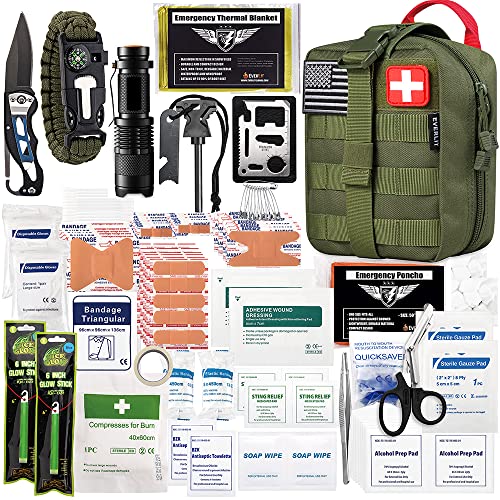
| EVERLIT 250 Piece Survival First Aid Kit | First aid plus survival gear in one pouch | Mid-range | |
| RHINO RESCUE Small Ultralight Medical Kit | Under half a pound fully loaded, 79 items | Budget | |
| Adventure Medical Kits Mountain Series Hiker | Wilderness first aid guide book and trauma pad | Mid-range | |
| Adventure Medical Kits Mountain Series Explorer | Four people for seven days, CPR shield, guide book | Premium | |
How to choose a first aid kit for the backcountry
Trauma kits and wilderness kits solve different problems
A trauma kit, often sold as an IFAK, exists for one scenario: someone is bleeding badly and will die in minutes without intervention. Tourniquets, pressure bandages, and chest seals are the tools. A wilderness kit exists for the far likelier scenario: a long walk out with a blister, a turned ankle, a cut hand, or a splitting headache. Moleskin, elastic bandages, antiseptic, and medications are those tools. Neither kit substitutes for the other. A tourniquet will not fix a blister, and a packet of moleskin will not stop arterial bleeding.
Weight decides whether the kit comes with you
The best kit is the one still in your pack on day three. A two-pound trauma kit is a serious commitment on an ultralight setup, and there is a well-worn pattern of people buying the big kit, carrying it twice, and then leaving it in the car forever. Under half a pound is the range where a kit stops being a decision. Be clear with yourself about which one you will actually carry, because a kit at home has a success rate of zero.
Blisters are the injury you will actually get
Ask anyone who has walked a long trail. Friction injuries outrank everything else combined, and they are entirely manageable if you catch them at the hot-spot stage. Die-cut moleskin is the specific item that matters, and it is worth checking a kit contains some before you buy. Work on a hot spot the moment you feel it, not at the next break, because the next break is where the blister has already opened.
A wet kit is not a kit
Cardboard-backed bandages turn to mush, moleskin will not stick, and gauze becomes a wet lump. Water-resistant outer fabric is common; a genuinely waterproof inner bag is the feature that matters, and it is rarer. If your kit lacks one, a freezer bag around the contents costs nothing and solves it entirely.
Organization, for when your hands are shaking
Rummaging through a single stuffed pocket is fine on the sofa and hopeless when someone is bleeding and you are cold and frightened. Labeled compartments that group supplies by injury type let anyone in the party find the right thing, including the people who did not pack the kit and have never opened it. That last point matters more than it sounds: the person caring for you may well be the one who knows nothing about your gear.
Training beats contents
A kit is a box of supplies, not a skill. The kits that include a wilderness first aid guide book are quietly offering the most valuable item in the bag, because knowing when to walk out, when to stay put, and how to manage an injury for six hours is worth more than any single piece of equipment. A weekend wilderness first aid course is the best upgrade available to any kit on this page.
Size it to the party and the trip
Kits are rated by people and days for a reason. A kit built for two people over two days is right for a weekend pair and thin for a week-long group of four. Scale up for longer trips and bigger parties, or accept that you will be rationing bandages on day five.
Survival First Aid Kit with Israeli Bandage, Chest Seal and Tourniquet
The best seller of this group, and the most serious kit in it for one specific job. Inside are a six-inch Israeli bandage, a snap-on tourniquet, a chest seal, a splint, EMT shears, compressed gauze, a large trauma pad, and a CPR mask, alongside the ordinary supplies: adhesive bandages, iodine pads, burn gel, tape, and gloves. Sixty pieces, 1.9 pounds, in a 1200D nylon molle pouch with a waterproof lining, quick-release panel, and double zippers. Be clear about what it is. This is bleeding-control equipment built for the accident that could kill someone before help arrives, and it earns its place if you are far from a road, working with sharp tools, or hunting. It is thinner on the trail-medicine side, so backpackers should plan to add moleskin, medications, and blister supplies.
Pros
- Genuine bleeding control: Israeli bandage, tourniquet, chest seal
- Includes a splint and EMT shears
- Tough 1200D nylon pouch with waterproof lining
- Molle compatible with a quick-release panel
- CPR mask and large trauma pad included
- Compact for its capability at under eight inches
Cons
- At 1.9 pounds, heavy for ultralight backpacking
- Light on blister care and medications
- No wilderness first aid guide included
- Trauma gear needs training to use safely
Best for: remote trips, hunting, and anyone who wants real bleeding control in the pack.
EVERLIT 250 Piece Survival First Aid Kit
This one hedges, and for some trips the hedge is exactly right. Alongside first aid supplies the maker says exceed OSHA guidelines, you get a mylar blanket, a three-mode tactical flashlight, a paracord bracelet with compass and whistle, a fire starter, a knife, a saber card, glow sticks, and a rain poncho. Designed by army veterans and survivalists, in their telling, and aimed squarely at a bug-out bag. Two pounds, 250 pieces, in a 1000D water-resistant nylon molle pouch with three large compartments. The plain read: as a pure medical kit it is not more capable than the others, but as a single grab-bag for someone who has no emergency gear at all, it covers a lot of ground in one purchase. If you already carry a headlamp, a fire kit, and a shelter, you are paying for duplicates.
Pros
- First aid plus survival gear in one pouch
- 250 pieces, broad coverage for the money
- 1000D water-resistant nylon with three compartments
- Molle compatible for pack, vest, or vehicle
- Includes shelter, light, fire, and signaling items
- Two pounds despite the contents
Cons
- Duplicates gear most backpackers already carry
- Piece count is inflated by small consumables
- No wilderness first aid guide
- Heavy for a weekend on trail
Best for: a vehicle, a bug-out bag, or a first kit for someone starting from nothing.
RHINO RESCUE Small Ultralight Medical Kit
The kit that solves the carry problem. Fully loaded with 79 items it weighs 0.45 pounds and measures roughly seven by four by one inches, which is small enough to disappear into a side pocket and stay there all season. The pouch fabric alone is 20 grams of nylon, chosen from dozens of candidates according to the maker, and the contents were curated rather than counted: minor wounds, cuts, scrapes, burns, cold symptoms, and blister protection. That last one is the tell that somebody who actually hikes had a hand in it. RHINO RESCUE’s day job is supplying pre-hospital and IFAK equipment to emergency medical crews, which lends some weight to the material choices. It moves between backpacking, climbing, cycling, and kayaking without needing to be repacked.
Pros
- 0.45 pounds fully loaded, genuinely ultralight
- 79 items chosen for real trail injuries
- Includes blister protection supplies
- Water-resistant high-quality nylon
- Small enough to live in a pack pocket permanently
- Cheapest kit here by a clear margin
- Made by an established emergency medical supplier
Cons
- No tourniquet or major bleeding control
- Sized for one or two people on short trips
- No guide book
- Water-resistant, not a sealed waterproof inner bag
Best for: ultralight backpackers, day hikers, and cyclists who want a kit they never think about.
Adventure Medical Kits Mountain Series Hiker
The most complete answer to what a wilderness kit should be, at a weight a hiker will accept. It is built for two people over two days, and it carries the one item almost nothing else here does: a wilderness first aid book, covering how to manage injuries when the hospital is a day’s walk away. That is the difference between owning supplies and knowing what to do with them. Wound care goes beyond plasters, with a trauma pad for severe bleeding and an elastic bandage for stabilizing a rolled ankle, which is the injury that most often decides whether you walk out or wait. The Easy Care organization system splits everything into clearly labeled pockets inside a water-resistant bag, so a stranger can find the right pocket without emptying the bag onto the dirt.
Pros
- Wilderness first aid guide book included
- Trauma pad for severe bleeding
- Elastic bandage for sprains and strains
- Labeled pockets grouped by injury type
- Water-resistant bag
- Sized sensibly for two people over a weekend
- Light enough for genuine summit trips
Cons
- No tourniquet or chest seal
- Two people for two days runs thin on longer trips
- Costs more than the ultralight option
Best for: weekend backpacking pairs who want wilderness care and the knowledge to use it.
Adventure Medical Kits Mountain Series Explorer
The same thinking as the Hiker, scaled up to four people for seven days. That is a different kind of trip: a group traverse, a week in the backcountry, somewhere a resupply is not happening. It adds a CPR face shield to the trauma pad, keeps the wilderness first aid book, and keeps the Easy Care labeled-pocket system, which matters far more with four people because any of them may need to open it on your behalf. Adventure Medical still calls it a summit kit, so it is not a footlocker, but it is unmistakably the heaviest and priciest option here. Buy it for the group and the duration, not for a weekend with a friend.
Pros
- Rated for four people over seven days
- Wilderness first aid guide book included
- Trauma pad plus CPR face shield
- Easy Care labeled pockets, findable under stress
- Water-resistant bag
- Expedition-grade coverage in a carryable package
Cons
- Most expensive kit here by a wide margin
- Overkill for solo or weekend trips
- No tourniquet or chest seal
- Heavier than a solo hiker needs
Best for: group expeditions and week-long trips well beyond road access.
The verdict
Best Overall: Survival First Aid Kit with Israeli Bandage, Chest Seal and Tourniquet. It is the best seller of the group, and it is the only kit here that answers the emergency you cannot walk away from. Bleeding control, a splint, shears, and a CPR mask in a tough molle pouch. One real caveat: it is a trauma kit first, so if you are backpacking, budget a little weight for moleskin, blister supplies, and your own medications, and get some training before you need the tourniquet.
Best Value: RHINO RESCUE Small Ultralight Medical Kit. Cheapest here, under half a pound, and stocked with the things that go wrong on trail rather than the things that go wrong in a firefight. It is the kit most likely to still be in your pack in six months, which is the quality that counts most.
Best Premium: Adventure Medical Kits Mountain Series Explorer. Four people, seven days, a CPR shield, labeled pockets, and a wilderness first aid book in the bag. For a group heading somewhere genuinely remote, it is the most complete wilderness kit on this page.
For the common case, a weekend pair on a trail, the Mountain Series Hiker is the sweet spot, and its guide book makes it the best teaching kit here.
Frequently asked questions
Do I need a tourniquet for backpacking?
For most trail walking, no. Tourniquets exist for catastrophic bleeding, which is rare on a footpath and much less rare around chainsaws, firearms, and remote vehicle tracks. If you are hunting, working with sharp tools, or a very long way from help, carry one and learn to use it. Otherwise your weight is better spent on blister care.
How heavy should a backpacking first aid kit be?
Under half a pound covers a solo hiker or a pair on a short trip without you noticing it. Around a pound is reasonable for a weekend group. Past two pounds you are into trauma or expedition territory, which is a deliberate choice rather than a default.
What is missing from most kits out of the box?
Your own prescriptions, painkillers in a quantity that means anything, and enough blister supplies. Kits are built to a price and a piece count, so the consumables you will genuinely burn through are the ones that run short. Open yours at home, use it once on a small cut, and you will spot the gaps immediately.
Is a bigger piece count a better kit?
No. Piece counts are padded with cotton tips, plasters, and swabs. A curated 79-item kit aimed at real trail injuries can be more useful than a 250-piece kit half full of things you already carry. Read the contents list, not the headline number.
Does the guide book actually matter?
More than most of the contents. Supplies do not tell you whether to walk out on a swollen ankle or wait for help, and that decision has far more effect on the outcome than which bandage you reach for. A weekend wilderness first aid course is the best possible companion to any kit here.
This article may contain affiliate links; see our Affiliate Disclosure.