On a quarter-acre block you can shout the dog back. On ten acres, by the time you notice the tail vanishing past the tree line, the road is closer to your dog than you are. That is the gap a GPS fence closes – no trenching, no wire, just a boundary you draw around whatever shape your land actually is.


Acreage changes what matters. A radius measured in thousands of feet, a collar battery that survives a full day outdoors, and a fence shape that follows a creek instead of a circle are the specs that decide whether a system fits your land. The five below split along one line that costs more than any feature: whether the fence keeps working without a subscription.
At a glance
| Product | Standout features | Price tier | Link |
|---|---|---|---|
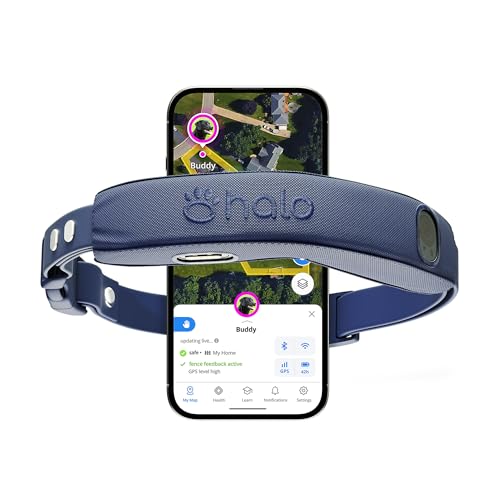
| Halo Collar 5 | Dual-frequency L1/L5 satellites with ground-station corrections, accuracy quoted within 2 ft, always-on tracking, multiple stored fences | Premium | |
| PetSafe Guardian GPS Dog Fence | No subscription, AccuGuard blends GPS with motion detection and AI, up to 5 days of collar battery, app-based setup | Mid-range | |
| DJNFGQ GPS Wireless Dog Fence System | Circular fence from 49 to 6,561 ft radius plus free-form polygon mode, IPX7, about 24 hours per charge | Budget | |
| Dogtra GPS Fence | No subscription, layered warning zone plus primary and two backup fences, up to 30 stored fences, IPX9K | Mid-range | |
| VUMXPE GPS Wireless Dog Fence System | Walk-the-perimeter multi-point mode, 6,561 ft radius, no app or SIM needed, LCD screen, 24-36 hour battery | Budget | |
How to choose a GPS fence for a large property
Subscription or no subscription
This is the first fork, and it decides more than any spec. The Halo Collar 5 requires a membership to activate GPS and fence features at all – the hardware alone will not contain a dog. What the plan buys is real: unlimited cellular data, live tracking that never sleeps, instant alerts, and stored training guidance. The PetSafe Guardian, Dogtra and the two budget systems charge nothing after purchase, and PetSafe is direct about the trade – no tracking and no portability means no fees. Decide whether you want a containment system or a containment-plus-tracking service, because that choice sets your cost for the life of the collar.
Boundary shape beats boundary size
On acreage, a circle is rarely the shape you want. A circle big enough to cover the far paddock usually spills across the road at the front. Most systems here can draw a custom perimeter: the DJNFGQ adds a free-form polygon mode where you place vertices to follow the terrain, Dogtra’s app builds circular or custom shapes and stores up to 30, and the VUMXPE lets you walk the boundary and drop anchor points as you go – useful when the line you want is a fence row you can see but cannot find on a map. Raw radius is generous across the board: the DJNFGQ and VUMXPE both reach 6,561 feet, far larger than most rural blocks.
Accuracy and drift
A GPS fence is only as trustworthy as its position fix. Ordinary single-frequency GPS wanders, and a boundary that drifts by twenty feet either corrects a dog standing safely in the yard or lets one walk through the line untouched. Both outcomes destroy the dog’s trust in the system. The Halo attacks this hardest, combining dual-frequency L1 and L5 satellites with corrections from a network of ground stations, updating position twenty times per second, and filtering obstacles to hold a quoted accuracy within two feet. Dogtra uses dual-band GPS with layered fences – a warning zone, the primary boundary, then two backup fences – so a momentary wobble does not become an escape. PetSafe’s AccuGuard blends satellite data with motion detection and AI for the same reason. All of them need a clear view of the sky, worth remembering if your land is heavily timbered.
Battery, waterproofing and the dog itself
A collar that dies at dusk is a fence that switches off at dusk. The budget systems run roughly 24 hours per charge, the VUMXPE stretches to 24-36 hours, and the PetSafe Guardian claims up to five days. Waterproofing matters on a property with a dam or a creek: IPX7 covers immersion, and Dogtra’s IPX9K rating adds resistance to high-pressure, high-temperature water. Check the dog, too. The Dogtra and VUMXPE suit dogs from 15 lb, while the PetSafe Guardian is designed for dogs over 25 lb with necks from 13 to 28 inches. A collar that does not fit is not a containment system.
Training is not optional
None of these work as a surprise. A dog has to learn what the tone means before the boundary means anything, which is why the Halo bundles a training program and Dogtra recommends flag training. Every system here offers tone and vibration with static as an option you control. Start with tone; most dogs never need more.
Halo Collar 5 Wireless Dog Fence & GPS Dog Collar
The Halo is the best-selling system in this group and the most technically ambitious. It is the only one here that pairs dual-frequency L1 and L5 satellite reception with real-time corrections streamed from a global network of ground stations, and that combination is what lets it quote accuracy within two feet of the dog’s actual position. Position updates land twenty times a second across Wi-Fi, Bluetooth and cellular, with drift protection and obstacle filtering doing the rest. It is built explicitly for rural properties and open country, holds multiple stored fences for home, the trail and the cabin, and always-on tracking means you know where the dog is rather than only whether it crossed a line. A professional training program is built into the app. The catch is unmissable: without a membership, the GPS and fence features do not activate.
Pros
- Dual-frequency L1 and L5 GPS with ground-station corrections, quoted to within 2 ft
- Location updated 20 times per second over Wi-Fi, Bluetooth and cellular
- Always-on tracking with instant alerts as the dog nears or crosses a boundary
- Designed for rural land, trails and remote locations; multiple fences stored
- Structured professional training program included
Cons
- Subscription required to activate GPS and fence features – the hardware alone will not contain a dog
- Premium tier before the plan is added
- Depends on cellular coverage for its live features
Best for: large or remote properties where knowing the dog’s live position matters as much as containing it.
PetSafe Guardian GPS Dog Fence
The Guardian is for owners who want serious containment technology and nothing on the credit card afterwards. Its AccuGuard system blends GPS satellite data with real-time motion detection and AI – a different approach to the problem the Halo solves with better satellites: work out whether the dog is really crossing the boundary or the signal is having a moment. PetSafe is blunt about what you give up: because there is no tracking and no portability, there is no subscription. The collar is slim and light with up to five days of battery, the longest here by a wide margin, and setup is an hour-ish job done from the couch in the app. It suits single-yard fences on properties three-quarters of an acre or larger, and dogs over 25 lb with necks from 13 to 28 inches.
Pros
- No subscription or ongoing fees, ever
- AccuGuard combines satellite data, motion detection and AI to reduce false corrections
- Up to five days of collar battery – the longest in this comparison
- Slim, light, rechargeable, waterproof collar
- Setup in around an hour, designed in the app; battery and settings monitored from your phone
Cons
- No live tracking and no portability – it is a containment system for one property
- Not suitable for dogs under 25 lb
- Add-A-Dog collars are a separate purchase for multi-dog homes
Best for: one large home property, where a fence that never bills you again beats live tracking.
DJNFGQ GPS Wireless Dog Fence System
The DJNFGQ is the budget entry that does not compromise on the one number acreage owners care about: its circular mode takes a center point and any radius from 49 up to 6,561 feet, generating the fence in about three seconds. The second mode is the interesting one – a custom polygon where you set vertices to trace the real shape of the land, avoiding the dead corners a circle always leaves. There is no wire to bury and no posts to sink, so a boundary you get wrong on Saturday is a boundary you redraw on Sunday. The collar is IPX7 waterproof, charges in about three hours and runs roughly 24. It is outdoor-only, true of every GPS fence here but stated plainly by this one.
Pros
- Circular fence radius from 49 ft to 6,561 ft, drawn in about three seconds
- Free-form polygon mode traces the real terrain instead of a circle
- Budget tier, with no subscription
- IPX7 waterproof, about three hours to charge and roughly 24 hours of use
- Adjustable collar suits medium and large dogs; boundaries change with no digging
Cons
- Outdoor use only – it needs a clear view of the sky to hold a fix
- Roughly 24 hours of battery, so charging becomes a daily habit
- No published accuracy figure or drift-correction technology
Best for: large blocks on a tight budget, especially awkward shapes a circle cannot cover.
Dogtra GPS Fence
Dogtra’s approach is layered defense, and on a big property that thinking is worth a lot. Instead of one line, the system builds a warning zone, a primary fence, and two backup fences behind it, so a dog moving fast through a marginal GPS moment still meets something before it meets the road. Dual-band GPS holds the position, each boundary can be set to tone, vibration or stimulation across 100 levels, and smart detection switches correction off when the dog is heading home while a continuous beep guides it back. The app is needed only during setup – after that the collar runs standalone with no Wi-Fi, no data and no fees, storing up to 30 fences. IPX9K waterproofing is the toughest rating here, and it suits dogs from 15 lb with necks from 10 to 22 inches.
Pros
- Layered protection: warning zone, primary fence and two backup fences
- No subscription; the app is needed only to set the fence up
- Stores up to 30 fences; up to three dogs share one profile
- Come-home sequence disables correction when the dog is returning
- IPX9K waterproof, 100 stimulation levels, suits dogs from 15 lb
Cons
- No live tracking and no notifications – containment only
- Neck range tops out at 22 inches, so large-necked breeds need a longer strap, sold separately
- Flags for training are a separate purchase
Best for: owners who want redundancy at the boundary and refuse a monthly bill.
VUMXPE GPS Wireless Dog Fence System
The VUMXPE removes the phone entirely. There is no app, no SIM card and no account – a color LCD on the collar walks you through setup, and anti-accidental-touch protection stops a stray press from redrawing your fence. Its multi-point mode is the standout: rather than tapping a map, you walk your perimeter and press to drop anchor points, building rectangles, hexagons or whatever shape your land really is. Radius mode reaches the same 6,561 feet as the DJNFGQ. A 10-foot early-warning zone gives the dog a tone before any correction, stimulation runs 0-9 with a safety cutoff after two cycles, and alerts stop the instant the dog is back inside. The 1,000 mAh battery covers 24 to 36 hours, and it is IPX7 waterproof.
Pros
- Walk-the-perimeter multi-point mode builds a fence that matches what you can see
- No app, SIM, account or fees – everything runs on the collar’s LCD
- 6,561 ft radius mode for very large blocks
- 10 ft early-warning zone and a safety cutoff after two correction cycles
- 24-36 hours per charge, IPX7 waterproof, settings survive power-off
Cons
- No tracking, alerts or phone integration of any kind
- Explicitly not recommended for small spaces
- Needs a clear view of the sky, and walking the perimeter takes time on big land
Best for: rural owners who would rather walk their boundary than draw it, and want nothing to do with an app.
The verdict
Best overall: Halo Collar 5. It is the most popular system here and the only one whose hardware attacks GPS drift with dual-frequency satellites and live ground-station corrections. On land measured in acres, a boundary you can trust to a couple of feet plus always-on tracking is the combination worth paying for. Budget for the membership from day one, because without it the fence does not exist.
Best value: DJNFGQ GPS Wireless Dog Fence System. A 6,561-foot radius, a free-form polygon mode for real terrain, IPX7 sealing and no fees, at the lowest price in the comparison. You give up published accuracy claims and live tracking; on a big open block with a sensible boundary margin, many owners will never miss them.
Best premium without a subscription: PetSafe Guardian GPS Dog Fence. Five days of battery, AccuGuard’s motion-plus-AI filtering, an hour to install, and no bill after the box. If your dog is over 25 lb and stays on one property, it is the most refined system here that costs nothing to keep running. The Dogtra GPS Fence is the close alternative, and its four-layer boundary suits a determined escape artist.
FAQ
How much land can a GPS fence actually cover?
Far more than most properties need. The DJNFGQ and VUMXPE both offer a radius up to 6,561 feet, well over a mile across. The practical limit is rarely the radius – it is signal quality under tree cover and the shape of the boundary you can draw.
Does a GPS fence work under trees or in a valley?
Less reliably. Every system here needs a clear view of the sky, and canopy, steep terrain or big structures degrade the fix. That is what the Halo’s dual-frequency reception, Dogtra’s backup fences, and PetSafe’s motion-plus-AI checking compensate for. On timbered land, set the boundary well inside the true property line so any drift has somewhere harmless to go.
Can I use one system for two or three dogs?
Usually, with extra collars. Dogtra allows up to three dogs to share a fence profile, and PetSafe sells Add-A-Dog collars separately. Budget on one collar per dog whatever the brand – the collar is the fence.
Is the static correction necessary?
No. Every system here gives you tone and vibration as standalone options, with static available only if you turn it on. Dogtra offers 100 levels, PetSafe ten, and the VUMXPE nine with an automatic cutoff after two cycles. Most dogs learn the boundary from the warning tone alone.
What happens if the collar battery dies?
The fence stops. That is the strongest practical argument for the PetSafe Guardian’s five-day battery, and why the roughly 24-hour budget collars need charging built into your routine rather than remembered.
This article may contain affiliate links; see our Affiliate Disclosure.