Laptop speakers fire downward into a desk, which is why every song sounds like it is playing in the next room. A pair of real speakers at ear height fixes that in about ten seconds, and Bluetooth means your phone can borrow them without you crawling under the desk to swap a cable.


One thing to set straight before you spend anything: none of these are cordless. Every desktop speaker here draws power from a USB port and none has a battery, so “wireless” describes the audio link, not the cable count. What Bluetooth buys you is the freedom to send sound from a phone, tablet or second laptop without replugging anything, while your desktop stays connected over USB or a 3.5mm lead. That suits a shared desk, a small studio, or anyone who listens on a work machine by day and a personal one at night.
At a glance
| Product | Standout features | Price tier | Link |
|---|---|---|---|
| Amazon Basics Bluetooth Computer Speakers | Best seller; Bluetooth 5.3, USB audio and AUX; wired control pod; pair | Budget | |
| SOULION R50 Sound Bar | Single-bar design; Bluetooth or AUX; four LED modes; tilted baffle | Budget | |
| Logitech Z207 | Easy-Switch between two paired devices; headphone jack; passive radiators | Mid-range | |
| KEiiD Bluetooth Computer Speakers | Wireless touch control pod; four EQ modes; silk dome tweeters | Mid-range | |
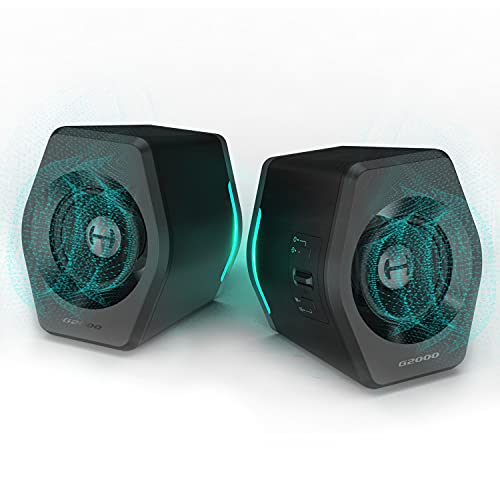
| Edifier G2000 | 16W RMS; three EQ modes; subwoofer output; 12 RGB effects | Premium | |
How to choose desktop speakers with Bluetooth
Wireless audio is not a wireless speaker
Read the fine print on any desk speaker and you will find a line like “no built-in battery, powered by USB cord”. That is the whole category, not one bad apple. These speakers stream audio over Bluetooth but still need a permanent power lead, and a stereo pair also runs a cable between the left and right units. Expect to tidy two or three cables, not zero. If you genuinely want no cable at all, you are shopping for a portable Bluetooth speaker instead, and you will trade away the stereo spread that makes a desk setup worth having.
Bluetooth lag is real, so keep the wire for games
Bluetooth compresses and buffers audio, which adds a delay of anywhere from a fraction of a second down to something barely noticeable on newer versions. Music does not care. Games and video very much do, because gunshots landing late or lips out of sync are impossible to ignore. The practical answer is to use both: wire the desktop over USB or 3.5mm for anything interactive, and keep Bluetooth for streaming from a phone. Every speaker here supports at least one wired path alongside Bluetooth, which is why that hybrid approach works.
Bluetooth version tells you something
The jump from 4.2 to 5.x brought better range, a steadier connection and lower latency. It is not a reason to reject an older speaker outright, since a Bluetooth 4.2 model from a serious audio brand can still sound better than a 5.3 model built to a price. Take the version as one input rather than the deciding number, and weigh it against the drivers and the cabinet.
Watch the wattage claims
Speaker listings quote peak power because it is the bigger number. Peak is a momentary burst; RMS is the continuous output that determines how loud a speaker actually plays without distorting. A model quoting 16W RMS and 32W peak is telling you the truth twice, which is a good sign. A model quoting only a large total is telling you less than it appears to. There is also a hard ceiling on anything USB-powered: a standard USB port supplies limited current, so genuinely loud speakers tend to come with their own power adapter.
Sound bar or stereo pair
A single bar sits under the monitor, takes one cable and keeps the desk clear, but both channels come from one box a few inches wide, so the stereo image is narrow. A pair gives you real left and right separation, which matters for music and for hearing footsteps come from a direction in a game. The trade is desk space and an extra cable. Neither choice is wrong; it depends on whether you want tidiness or width.
Drivers and the box around them
Bass needs air and a rigid enclosure. That is why a wooden MDF cabinet outperforms thin plastic at the same driver size, and why passive radiators keep showing up in small speakers: they extend the low end without needing a bigger box. A separate tweeter for the highs and a woofer for everything else usually beats one full-range driver trying to do both, though a good full-range unit in a well-braced box can still surprise you.
Amazon Basics Bluetooth Computer Speakers
This is the one product here with a proven sales record, and it is also the cheapest, which is a rare combination. You get a genuine stereo pair with 1.75-inch full-range drivers and a passive radiator each, plus the newest Bluetooth version in this group at 5.3. The detail that lifts it above the usual budget fare is the wired control pod: source switching, volume, the LED toggle and an AUX input all sit in one puck on the desk rather than on a knob hidden behind a speaker. Three input paths are available, covering Bluetooth, USB audio and 3.5mm. Note the caveat in the listing that many TV USB ports carry power but not audio.
Pros
- The only model here with a demonstrated sales ranking
- Bluetooth 5.3, the most current version in this group
- Control pod puts every function within reach
- Three inputs: Bluetooth, USB audio and 3.5mm AUX
- True stereo pair at a budget price
Cons
- Small drivers limit real bass depth
- USB power only, so no battery and no adapter headroom
- Blue LED is fixed, with only an on/off choice
Best for: a first upgrade from built-in laptop sound, and anyone who wants the safe, proven option.
SOULION R50 Sound Bar
If the desk is already crowded, the R50 solves the problem by being one object instead of two. It slides under a monitor, runs on USB power, and switches between Bluetooth and 3.5mm with a mode button. The baffle is tilted 30 degrees so the sound aims at your face rather than your chin, and a breathable cloth cover keeps dust out of the drivers, which is a sensible touch on something living permanently under a screen. Two independent diaphragms with boosters handle the audio, and four LED modes run from a slow gradient to a rhythm-reactive pulse. Stereo width is the obvious compromise, since both channels leave from one narrow bar.
Pros
- One bar, one cable, minimal desk footprint
- Bluetooth and 3.5mm with a simple mode switch
- Tilted baffle aims sound at seated ear height
- Four LED modes including an off setting
- Dust cloth over the drivers
Cons
- Narrow stereo image from a single enclosure
- No USB audio path, so wired means analog only
- No published sales ranking
Best for: tight desks and monitor-shelf setups where a second speaker will not fit.
Logitech Z207
The Z207 earns its place on one feature that sounds mundane and turns out to matter daily. Easy-Switch lets two devices stay paired at once, and you move between them by pausing on one and pressing play on the other, with no menu diving and no re-pairing. For a desk with a work laptop and a personal phone, that is the whole problem solved. Each speaker pairs one powered full-range driver with a passive radiator for low-end extension, and there is a headphone jack plus power, volume and pairing controls on the speaker itself. Bluetooth is 4.2, the oldest here, which shows up as slightly more lag and less range than the 5.x models.
Pros
- Easy-Switch holds two devices paired simultaneously
- Headphone jack built into the speaker
- Passive radiators add bass without a subwoofer
- Established audio brand with long support history
- Bluetooth or 3.5mm, both straightforward
Cons
- Bluetooth 4.2 lags behind the 5.x models on range and latency
- No USB audio input
- Plain looks, no lighting if that appeals to you
Best for: juggling a work machine and a phone on the same desk all day.
KEiiD Bluetooth Computer Speakers
KEiiD splits the difference between a computer speaker and a small bookshelf system. Each side carries its own silk dome tweeter for the highs, with a 12W woofer handling bass and mids, which is a proper two-way arrangement rather than one driver covering everything. The party trick is a wireless control pod shaped like a mouse that runs the speakers from anywhere in the room, so you can mute from the sofa. Four EQ presets cover news, music, movies and games, the last adding a 3D surround effect. Connection is Bluetooth or an audio cable.
Pros
- Separate silk dome tweeters in both channels
- Wireless control pod works across the room
- Four EQ modes tuned for different content
- Works with TVs, phones and tablets as well as computers
- One-year warranty with responsive support
Cons
- Bluetooth version is not published
- Another pod to keep charged and not lose
- No published sales ranking
Best for: desks that double as a media setup, where controlling volume from across the room is useful.
Edifier G2000
Edifier is an audio company first, and the G2000 spec sheet reads like one wrote it. Power is quoted plainly as 16W RMS with a 32W peak, rather than hiding behind the big number alone. The 2.75-inch full-range drivers sit in column cabinets angled up 10 degrees with a rear bass port, and there is a subwoofer output on the back if you ever want to add low end. Three EQ modes cover game, music and movie, and all three input types are here: Bluetooth, USB sound card and 3.5mm. Twelve RGB effects handle the aesthetic side. It is the most expensive option here and the most capable.
Pros
- Real RMS and peak power figures
- Subwoofer output for a future upgrade
- All three inputs: Bluetooth, USB and 3.5mm
- Angled column cabinets with a rear bass port
- Three EQ modes plus 12 RGB effects
Cons
- Costs several times the budget options
- Bluetooth version is not stated
- Column shape takes more desk depth than a bar
Best for: gaming and music on a desk where sound quality is the point and the budget can stretch.
The verdict
Best Overall: Amazon Basics Bluetooth Computer Speakers. It is the only model here with a demonstrated sales record, it carries the newest Bluetooth version of the group, and the control pod is a genuinely good idea at any price. For most desks moving up from built-in laptop audio, this is enough speaker and the least money at risk.
Best Value: Logitech Z207. The mid-range step up that earns its money through Easy-Switch, a headphone jack and passive radiators from a brand with a real support history. Accept the older Bluetooth 4.2 radio and it handles a two-device desk better than anything else here.
Best Premium: Edifier G2000. Real power ratings, a subwoofer output, every input you might want and cabinets built to do a job rather than hit a price. If sound quality is the reason you are shopping, this is the one to stretch for.
Frequently asked questions
Are any desktop speakers truly wireless?
Not in this class. Every model here runs on USB power with no battery, and stereo pairs also link the two speakers with a cable. Bluetooth removes the audio cable to your source device, which is the useful part, but the power lead stays. Cordless means a portable Bluetooth speaker, and that sacrifices the stereo width a desk setup gives you.
Will Bluetooth ruin gaming audio?
It can. Bluetooth buffers audio, so sound arrives slightly after the picture, and in a fast game that is distracting. The fix is simple: connect the gaming machine with USB or 3.5mm and save Bluetooth for music from your phone. All five here support a wired connection as well, so you never have to choose one path forever.
Do I want USB or 3.5mm for the wired connection?
USB carries digital audio and uses the speaker’s own converter, which sidesteps a noisy PC headphone output and often sounds cleaner. A 3.5mm lead uses the computer’s built-in sound card and works with anything that has the jack, including consoles and older machines. If your computer’s audio output hisses, USB will likely fix it.
Is a sound bar worse than two separate speakers?
Worse at stereo, better at fitting. One bar cannot place sound to your left and right the way two speakers set apart can, so music loses width and games lose some directional cue. In exchange you get one box, one cable and a clear desk. If space is the binding constraint, a bar is the right call.
Do I need a subwoofer?
Most desks do not. Small speakers with passive radiators or a rear bass port produce enough low end for music and games at desk distance, and a subwoofer under a desk mainly annoys anyone in the room below. If you do want the option later, the Edifier is the only model here with a subwoofer output.
This article may contain affiliate links; see our Affiliate Disclosure.