Read these listings closely and every one of them quietly hedges the same way: sticks to any flat surface, adheres to most smooth, non-porous surfaces, grips securely to most dining tables. That word most is doing a lot of work. What decides whether a suction plate survives dinner is not the plate, it is what you put it on, and no listing on this page leads with that.




Suction needs a smooth, non-porous, continuous surface. A glass table or a high chair tray works. A textured plastic tray, a wooden table, or anything with a grain or a seam under the cup does not, and no amount of engineering fixes that. Check your table before you choose a plate.
At a glance
| Product | Standout feature | Price tier | Link |
|---|---|---|---|
| Eascrozn 3-Pack Plates | Cheapest here; three plates, four suckers each | Budget | |
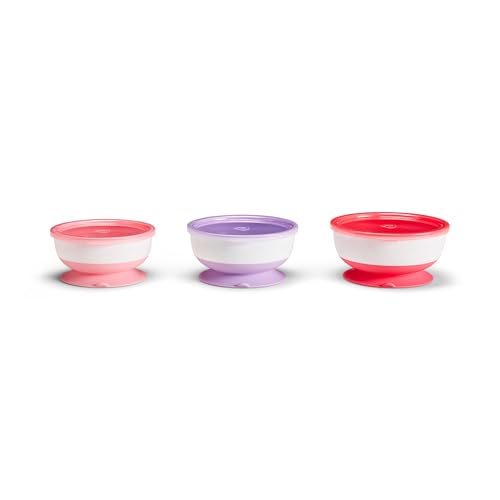
| Munchkin Bowls 3-Pack | Three sizes; quick-release tabs | Budget | |
| Eascrozn Feeding Set | Plates plus stainless forks and spoons | Budget | |
| Munchkin Bowls with Lids | Leakproof lids; bowl goes straight to the fridge | Budget | |
| OXO Tot Stick and Stay | Easy for you to lift, tricky for them | Mid-range | |
| WeeSprout Plates | The best seller here; four suction points | Premium | |
| Munchkin Plates | Deep sides; food goes onto the spoon | Premium | |
How to choose a suction plate or bowl
The surface decides everything
Suction works by excluding air, so it needs a surface with no texture, no grain and no seam under the cup. Munchkin is the most accurate about it, saying most smooth, non-porous surfaces, which is precisely the right qualifier. If your high chair tray has a molded texture, or your table is wood, or there is a join running through the middle, nothing on this page will hold. Try a cup on the actual surface before you buy three of them. This is the reason almost every bad review in the category exists.
Easy for you, hard for them, is the whole engineering problem
OXO Tot puts it best and puts it plainly: easy for parents to remove, but tricky for little ones. That sentence is the entire design brief. A plate a toddler cannot lift is only useful if you can, without upending it over yourself. Munchkin’s answer runs across its whole range: quick-release tabs on each suction base, so you break the seal deliberately with a fingernail. Where a listing boasts about strong suction and says nothing about getting it off, that is a gap you will notice at the end of every meal.
One suction base or four points
These fail differently and it is worth knowing which. WeeSprout uses four suction points and Eascrozn uses four suckers evenly distributed around the base, which spreads the grip so a child pulling at one edge meets resistance from the other three. Munchkin and OXO Tot use a single base under the middle, which grips a bigger area but gives a determined toddler a lever: lift one edge and the whole thing peels. Four points resist tipping; one base resists sliding. Most children discover the difference within a week.
All silicone, or a bowl with a pad
WeeSprout and Eascrozn are 100% food-grade silicone, and WeeSprout specifically says no fillers, which means the whole plate is one unbreakable piece with the suction molded in and nothing to come apart. OXO Tot goes the other way with a rigid bowl and a separate silicone pad, which gives you deep, firm walls a child can push against while the pad does the gripping. Both work. A one-piece silicone plate is floppy to carry when full; a two-part bowl has a joint that eventually needs a proper clean.
Deep walls are what teach self-feeding
This is the feature that matters at the stage where the plate matters. OXO Tot says deep walls help tots with scooping, and Munchkin’s plates have deep sides for easy scooping, and both are describing the same physics: a child learning a spoon needs a wall to push the food up against. A flat plate means chasing peas across a plain and giving up. If your child is at the self-feeding stage rather than the being-fed stage, depth beats divisions.
Lids turn a plate into a container
Small thing, real difference. WeeSprout includes lids with all three plates, and Munchkin’s lidded bowls are leakproof and rated for thick fluids, yogurt and purees, so an unfinished meal goes straight into the fridge on the same dish rather than being decanted into something else while a toddler complains. That saves a bowl and a wash every time it happens, which for anyone feeding a small child is several times a day.
Eascrozn 3-Pack Plates
The cheapest thing here by a distance, and it is three plates, not one, which makes the arithmetic hard to beat. They are 100% food-grade silicone with no added fillers, BPA and PVC free, high temperature resistant and unbreakable, with four strong suckers evenly distributed underneath so a pull at one edge meets resistance elsewhere. The compartments come in different sizes, which is the right idea for portioning a meal rather than dividing it into three equal wells. It is the second best-selling product on this page, and it is a fraction of the price of the first.
Pros:
- Cheapest here by a wide margin, and it is three plates
- Four suckers evenly spread; resists tipping from one edge
- 100% food-grade silicone, no fillers; BPA and PVC free
- Compartments in different sizes for real portions
Cons:
- No lids; nothing goes to the fridge on the plate
- No quick-release tab mentioned for getting it off
- One-piece silicone is floppy to carry when full
Best for: three plates for less than one, if your table is smooth.
Munchkin Bowls 3-Pack
Three bowls in three different sizes, which is more thoughtful than three of the same: a small one for a snack, a bigger one for a meal, and the third for whatever the day requires. Quick-release tabs on each suction base mean you break the seal on purpose with a fingernail rather than wrestling the bowl and redistributing dinner. Silicone, BPA free, and cheap. Munchkin keeps the listing short and does not pretend: no lids, no claims about surfaces beyond what the range says elsewhere, just three bowls that stay put and come off when you want them to.
Pros:
- Three bowls in three genuinely different sizes
- Quick-release tabs; deliberate removal, no wrestling
- Silicone and BPA free; very cheap
- An established name in this exact category
Cons:
- No lids in this version
- Single suction base; a lifted edge peels the whole bowl
- Bowls, so no divided compartments
Best for: snacks and meals in the right-sized bowl, off the table easily.
Eascrozn Feeding Set
Two plates and two sets of cutlery, and the cutlery is the reason to look: forks and spoons in food-grade silicone and 18/8 stainless steel, which is proper cutlery metal rather than the soft alloy that bends on a fish finger. They are shaped for small hands with no sharp edges, which matters because a plate that stays put is only half the self-feeding problem; the other half is a spoon a child can actually steer. The plates have compartments in different sizes so flavors stay apart. Two color combinations in each set.
Pros:
- Two plates and two full sets of cutlery
- 18/8 stainless steel; proper cutlery metal
- Ergonomic shapes with no sharp edges
- Divided compartments in different sizes; very cheap
Cons:
- Two plates, where Eascrozn’s own 3-pack gives three for less
- No lids
- Sells behind the plain plate packs
Best for: starting self-feeding, with cutlery that will not bend.
Munchkin Bowls with Lids
The same idea as Munchkin’s plain bowls with the two upgrades that matter. The suction cups are bigger and stronger, which Munchkin says outright rather than leaving you to compare, and the lids are leakproof and rated for thick fluids, yogurt and purees. That second point is the real one: an unfinished meal goes into the fridge on the same bowl, and a made-up breakfast travels to the grandparents without decanting. The suction base grips most dining tables and high chairs, and quick-release tabs get it off again. Barely more than the version without lids.
Pros:
- Leakproof lids; the bowl becomes a fridge container
- Bigger, stronger suction cups than the plain version
- Quick-release tabs for easy parent removal
- Costs barely more than the lidless bowls
Cons:
- Single suction base rather than four points
- No divided compartments
- No size or capacity published
Best for: leftovers, travel, and one fewer bowl to wash every day.
OXO Tot Stick and Stay
The listing that states the actual design brief: easy for parents to remove, but tricky for little ones. Everything else here boasts about strength; OXO is the only one naming both halves of the problem, and both halves are the product. The bowl base and a separate silicone pad work together to stop sliding, tipping and tossing, which are three different failures and worth separating. The walls are deep, which is what lets a child learning a spoon push food up a side rather than chase it. It is a single rigid bowl at several times the price of a three-pack.
Pros:
- The only listing naming both halves of the problem
- Base and silicone pad stop sliding, tipping and tossing
- Deep walls; genuinely helps a child learn a spoon
- Rigid bowl; not floppy to carry when full
Cons:
- One bowl, at several times the price of a three-pack
- Two-part construction; a joint to keep clean
- No lid; no compartments
Best for: a child at the throwing stage who is learning to scoop.
WeeSprout Plates
The best-selling product on this page, and the specification explains why: three divided plates, each with four suction points rather than one base, each with a lid. Four points is the arrangement that resists a child lifting one edge and peeling the lot, because the other three are still holding. The silicone is food grade with no fillers and unbreakable, and the divisions suit a child who objects to foods touching, which is a real and daily negotiation. Three plates and three lids means the whole week’s dinners and the whole fridge shelf.
Pros:
- The best-selling product here by a wide margin
- Four suction points per plate; resists edge-lifting
- Three plates, three lids; straight to the fridge
- Food-grade silicone with no fillers; unbreakable
Cons:
- Roughly triple the Eascrozn three-pack
- No quick-release tab mentioned
- Plates rather than deep bowls; less help with scooping
Best for: a picky eater, three meals ahead, with lids for the rest.
Munchkin Plates
Two divided plates with the feature the flat ones lack: deep sides for easy scooping. That is the detail that decides whether a child learning a spoon succeeds or gives up, because food has to be pushed up against something. Three sections keep dinner separated. A strong suction base grips most smooth, non-porous surfaces, which is Munchkin being straight about the limit, and quick-release tabs mean you take it off deliberately instead of prising. BPA free. It is the most expensive item here and gives you two plates where WeeSprout gives three.
Pros:
- Deep sides; the plate that actually helps with a spoon
- Three divided sections
- Quick-release tabs on the suction base
- Real about needing smooth, non-porous surfaces
Cons:
- Most expensive item here, for two plates
- Single suction base rather than four points
- No lids; sells well behind the cheaper bowls
Best for: divided food with walls to scoop against.
The verdict
Before any of these: check your table. Suction needs smooth and non-porous with no grain and no seam under the cup, and Munchkin’s phrase, most smooth surfaces, is the real one. A textured high chair tray defeats every product on this page.
Best overall: WeeSprout Plates. The best seller here and the design that resists the actual attack: four suction points per plate rather than one base, so a child lifting an edge finds three others still holding. Three divided plates with three lids means a picky eater is covered and the leftovers go to the fridge on the same dish. Food-grade silicone with no fillers, unbreakable. It costs roughly triple the cheapest three-pack, and it is the one built for a toddler who is trying.
Best value: Eascrozn 3-Pack Plates. Three plates for less than a single bowl elsewhere on this page, in 100% food-grade silicone with no fillers, BPA and PVC free, with four suckers spread evenly underneath and compartments in genuinely different sizes. No lids and no release tab. As the second best seller here at a fraction of the price of the first, the arithmetic speaks for itself.
Best premium: Munchkin Plates. The only divided plates here with deep sides, and that wall is what a child learning a spoon pushes food against; without it they chase peas and lose. Three sections keep foods apart, quick-release tabs get the plate off without upending it, and Munchkin is straight that the base needs a smooth, non-porous surface. Two plates rather than three, and no lids.
FAQ
Why does my suction plate keep coming off?
Almost always the surface. Suction needs smooth, non-porous and continuous, with no texture, grain or seam under the cup. Munchkin’s most smooth, non-porous surfaces is the real phrasing. A molded high chair tray or a wooden table defeats every plate on this page, whatever it cost.
Four suction points or one base?
They fail differently. WeeSprout and Eascrozn use four points, so a child lifting one edge meets resistance from three others. Munchkin and OXO use a single central base, which grips a larger area and gives a determined toddler a lever. Four points resist tipping; one base resists sliding.
How do I get it off without wearing dinner?
Look for a release tab. Munchkin fits quick-release tabs across its range, and OXO Tot states the design brief outright: easy for parents, tricky for little ones. A listing that boasts about strong suction and says nothing about removal has answered half the question.
Plate or bowl?
Bowl, if your child is learning a spoon, because deep walls give them something to push food against. OXO Tot and Munchkin’s plates both have that depth. Divided plates suit a child who objects to foods touching, which is a different problem entirely.
Are the lids worth it?
Yes, if meals get abandoned, which they do. WeeSprout includes lids on all three plates and Munchkin’s lidded bowls are leakproof enough for yogurt and purees, so leftovers go to the fridge on the same dish. That is one fewer bowl and one fewer wash, several times a day.
This article may contain affiliate links; see our Affiliate Disclosure.