Two headlamps here claim 99,000 lumens. That is roughly what a car’s full headlight array produces, from a device the size of a matchbox strapped to your forehead, running off a battery you charge over USB. A third quotes 210,000 lux, which sounds bigger still and is not even the same unit. Meanwhile the credible lamps on this page all say 1000, and mean it.
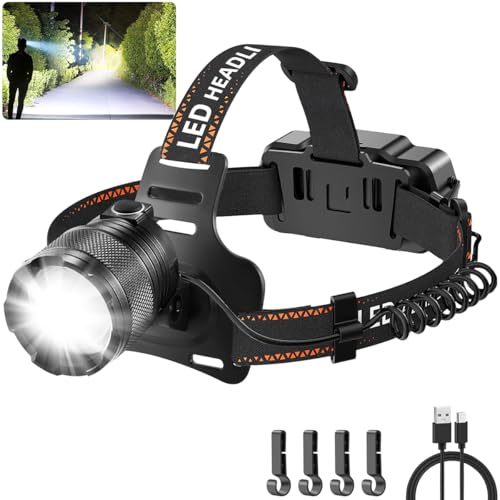


That gap is the whole story of this category. A thousand lumens from a headlamp is genuinely a lot of light, enough to pick a line down a trail at running pace or read a cave wall at distance. The brands quoting a hundred times that are not selling a hundred times the light.
At a glance
| Headlamp | Standout feature | Price tier | Link |
|---|---|---|---|
| Staaricc | Cheapest here; aluminum body, zoomable | Budget | |
| Mavtrail | 9000mAh battery; 12 modes | Budget | |
| Lepro | Publishes battery and runtime that agree | Budget | |
| sofirn H25L | The only CRI figure here: 90 | Mid-range | |
| TIROFLX | Motion sensor; quotes lux, not lumens | Mid-range | |
| DanForce | Best seller; names its LED and its rating | Mid-range | |
| Coast WPH10R | Named battery, magnet and red mode | Premium | |
How to choose a high-output headlamp
Lux and lumens are different things
This is the trick worth understanding, because it is not quite a lie. Lumens measure total light produced. Lux measures how much of it lands on a square meter at a given spot. Focus the same lamp into a tighter beam and the lumens do not change at all while the lux number climbs enormously, which is why TIROFLX can plainly quote 16,000 lux on flood and 210,000 lux on spotlight from one device. Both figures describe the same light, squeezed. When a listing gives you lux and no lumens, it is telling you about the beam, not the output.
A hundred thousand lumens is not a thing
Mavtrail quotes 99,000 lumens and so does another lamp on this shelf. For scale, the real lamps here quote 1000, and a thousand lumens genuinely lights a trail at running pace. Ninety-nine thousand from a forehead-mounted LED on a rechargeable cell is not a claim anyone is testing. That does not make Mavtrail a bad lamp; its 9000mAh battery and 12 modes are real and useful. It means you cannot use the headline number to compare it against anything, and you should look at what else the listing says instead.
Color rendering is the spec that matters underground
One brand here publishes it. sofirn quotes 90 CRI at 5000K, which describes how truly you see color under the beam rather than how much beam there is. Cheap LEDs push a cold blue-white that makes everything look flat and gray, which in a cave or on a technical trail means rock, mud and shadow all read the same. A high CRI at a neutral temperature is why sofirn describes its beam as comfortable rather than dazzling. It is the difference between a lot of light and useful light.
Runtime figures apply to the lowest mode, and one brand says so
Mavtrail claims 95 hours and another lamp claims 45. Both are almost certainly on their dimmest setting, which is standard practice and useless for comparison. sofirn is the only brand here that tells you which mode: more than 6 hours of bright beam on medium. Lepro is the next most accurate, pairing a stated 2200mAh battery with up to 10 hours of use and a 4-hour charge, figures that at least sit sensibly beside each other. Read runtime and battery capacity together, or neither means anything.
Named parts beat named nothing
DanForce names its LED as a LUMINUS, and Coast names its battery as a ZX440 with a USB-C cable included. Those are parts you can look up, replace and hold somebody to. Everywhere else you get upgraded chips and powerful LED chips and super LED chips, which are three ways of not answering. On a page where the lumen figures span a hundredfold, a named component is the most reliable information available.
Check the water rating before the beam
Night hiking means rain and caving means dripping water, and exactly one lamp here addresses it: DanForce quotes IPX45 for water, dust and damage resistance. Everyone else stays quiet, which for a device you wear outdoors in the dark is a strange omission. A lamp that dies in drizzle is not a lamp. Where a listing talks about all-weather readiness without a rating, it is describing an intention.
Staaricc
The cheapest lamp here by a wide margin, and the second best-selling, which is a combination worth noticing. It is an aluminum body rather than plastic, which sheds heat and survives being dropped on rock, with four working modes and a focus you can slide from floodlight to spotlight depending on whether you want the whole clearing or the far end of the trail. The head tilts through 90 degrees so the beam goes where you are looking rather than where your forehead points. What it does not do is publish a lumen figure, a battery capacity or a water rating.
Pros:
- Cheapest headlamp here; second best seller
- Aluminum body; sheds heat and survives drops
- Adjustable focus from flood to spot
- Tilts through 90 degrees
Cons:
- No lumen figure published at all
- No battery capacity, runtime or water rating
- Upgraded chips is not a specification
Best for: a cheap spare lamp in the boot or the drawer.
Mavtrail
Ignore the 99,000 and there is a genuinely interesting lamp underneath. The battery is 9000mAh, by far the largest on this page and four times what the fair 1000-lumen lamps carry, which is what makes the long-runtime claim possible at all. Twelve modes cover high, medium, low, strobe and SOS with an adjustable focus, USB-C fast charging, and a beam that tilts 90 degrees one-handed so you can aim it without taking the lamp off. It is the second cheapest thing here. The headline number is fiction and the battery is not.
Pros:
- 9000mAh; the biggest battery here by a distance
- Twelve modes including strobe and SOS
- USB-C fast charging; one-handed 90 degree tilt
- Very cheap for the capacity
Cons:
- The 99,000 lumen claim is not a usable number
- The 95 hour runtime will be on the lowest mode
- Sells poorly; no water rating or LED named
Best for: a large battery cheaply, if you disregard the headline.
Lepro
The most internally consistent listing on this page. A 1000-lumen LED, a stated 2200mAh battery, up to 10 hours of use and a 4-hour charge: four numbers that sit sensibly beside one another rather than fighting. The shell is aero-grade aluminum for a long life, and the head detaches so it becomes a torch when you want one. Lepro also talks about protecting the battery’s lifespan rather than just its capacity, which is the sort of thing a brand mentions when it expects you to still own the lamp in three years. Fair, cheap, and unexciting in the best way.
Pros:
- 1000 lumens, 2200mAh, 10 hours, 4-hour charge: all stated
- The figures agree with each other, which is rare here
- Aero-grade aluminum shell; head detaches as a torch
- Cheap for a lamp that publishes real numbers
Cons:
- 2200mAh is a quarter of the Mavtrail’s battery
- No water rating published
- Sells poorly against the big-number lamps
Best for: a thousand real lumens with the arithmetic on the page.
sofirn H25L
The only lamp here that talks about the quality of the light rather than the quantity. Dual LEDs give a maximum 1000 lumens at 5000K with 90 CRI, and that CRI figure is the one nobody else publishes: it describes how accurately you see color under the beam, which underground or on technical ground is the difference between reading the rock and staring at gray. sofirn calls the result a neutral, comfortable beam rather than a dazzling one, which is an unusual thing to boast about and the right thing. It is also the only brand stating which mode its runtime applies to: more than 6 hours on medium.
Pros:
- The only CRI figure here: 90, at a neutral 5000K
- The only brand stating which mode its runtime applies to
- Dual LEDs; 1000 lumens of genuinely useful light
- Passed a stated set of tests before shipping
Cons:
- Charger not included; you supply a 5V adaptor
- The worst-selling lamp on this page
- No water rating or battery capacity published
Best for: caving and technical ground, where seeing color properly matters.
TIROFLX
The most featured lamp here and the one whose numbers need translating. It quotes 16,000 lux on flood and 210,000 lux on spot, which are real figures describing the same light focused two ways, and it never gives you a lumen count, so it cannot be lined up against anything else on this page. What it does give is genuinely useful: a motion sensor so you wave a hand instead of groping for a switch with full arms, twelve modes, a red warning light, Type-C charging in three and a half to four hours, and 90 to 125 degrees of tilt.
Pros:
- Motion sensor; switch it with a wave, hands full
- Twelve modes including a red warning light
- 90 to 125 degrees of tilt; the widest range here
- Type-C charging in three and a half to four hours
Cons:
- Quotes lux, never lumens; cannot be compared to the rest
- 210,000 lux describes a tight beam, not more light
- No LED named; no water rating
Best for: working with your hands full, if you ignore the headline unit.
DanForce
The best-selling headlamp here, and the only one that answers the question this page actually asks. Its 1080 lumens is genuinely over a thousand, and DanForce names the LED behind it, a LUMINUS, which is a part you can look up rather than an adjective. It carries a stated IPX45 rating for water, dust and damage, which almost nobody else here bothers with on a device you wear outdoors at night. The focus zooms from flood to a searching spot, and the headband is built for long wear. Designed in the US, and specified like somebody meant it.
Pros:
- The best-selling headlamp here
- 1080 lumens; genuinely over the thousand this page asks for
- Names its LED, a LUMINUS; a part you can verify
- Stated IPX45 water, dust and damage rating
Cons:
- No battery capacity or runtime published
- No CRI or color temperature given
- Costs several times the cheap lamps here
Best for: a genuine 1000-plus lumens, from a lamp that names its parts.
Coast WPH10R
The most thoughtfully built lamp here. A 1000-lumen fixed spot beam, and Coast is upfront that it is fixed rather than pretending a zoom is a feature: a clean long-range bullseye that does one thing properly. The red mode runs low, high or flashing, which preserves night vision and signals, and matters more on a night hike than another hundred lumens. The magnet in the tailcap means it sticks to anything metal, so it becomes a work light the moment you take it off your head. The battery is named, a ZX440, and USB-C is included.
Pros:
- Names its battery, a ZX440; USB-C cable included
- Red mode in low, high and flashing; preserves night vision
- Magnetic tailcap; sticks to metal as a work light
- Clean fixed 1000-lumen spot beam, plainly described
Cons:
- Most expensive lamp here
- Fixed beam; no flood option or zoom
- Sells poorly; no runtime or water rating published
Best for: long-range spot, red light, and a lamp that sticks to things.
The verdict
Two rules for this page. Ignore any lumen figure in the tens of thousands, and ignore lux entirely unless you are comparing beam shapes. What is left is a set of lamps around 1000 lumens, which is what a headlamp actually produces and plenty of light.
Best overall: DanForce. The best seller here and the one that genuinely answers the brief: 1080 lumens, which is over a thousand and stated without theatrics, from a named LUMINUS LED you can look up rather than an unnamed super chip. It carries a stated IPX45 rating for water, dust and damage, which is a real omission everywhere else on a device worn outdoors in the dark, and the focus zooms from flood to a searching spot.
Best value: Lepro. The most internally consistent listing here: 1000 lumens, a 2200mAh battery, up to 10 hours of use, a 4-hour charge, all published and all agreeing with each other, which on this page is genuinely unusual. The aero-grade aluminum shell should outlast the battery, and the head detaches so it works as a torch. No water rating, and nothing exaggerated either.
Best premium: Coast WPH10R. The one built by people who use these. It names its battery, includes the USB-C cable, and puts a magnet in the tailcap so the lamp becomes a work light the second it leaves your head. The red mode in low, high and flashing preserves night vision, which matters more on a dark trail than another few hundred lumens. The beam is a fixed spot, and Coast says so rather than dressing it up.
FAQ
Is 99,000 lumens real?
No. For scale, the credible lamps on this page quote 1000, and a thousand lumens lights a trail at running pace. Ninety-nine thousand from a forehead LED on a USB-charged cell is not a figure anyone is measuring. It does not make those lamps useless; it makes the headline useless for comparing them.
What is the difference between lux and lumens?
Lumens is total light produced; lux is how much lands on a square meter at a spot. Focus the same lamp tighter and the lux climbs while the lumens do not move, which is why TIROFLX plainly quotes 16,000 lux on flood and 210,000 on spot from one device. Lux describes the beam, not the output.
What actually matters besides brightness?
Color rendering, and only sofirn publishes it: 90 CRI at 5000K. Cheap LEDs throw a cold blue-white that flattens everything to gray, which underground or on technical ground is the whole problem. A high CRI at a neutral temperature is why a beam feels useful rather than merely bright.
Can I trust the runtime claims?
Only alongside a battery figure. The long claims here, 95 hours and similar, will be on the lowest mode. sofirn is the only brand naming the mode: over 6 hours on medium. Lepro pairs 2200mAh with 10 hours and a 4-hour charge, which at least adds up.
Do I need a waterproof rating?
You are wearing it outdoors in the dark, so yes. DanForce quotes IPX45 for water, dust and damage. Most listings here talk about all-weather readiness without a rating, which is a statement of intent rather than a test result.
This article may contain affiliate links; see our Affiliate Disclosure.