Three purifiers here state that their HEPA filter removes VOCs. A HEPA filter is a mechanical strainer: air passes through a dense mat of fibers and particles get caught in it. VOCs are not particles. They are gas molecules, vastly smaller than anything a fiber mat can intercept, and they pass through HEPA the way wind passes through a tennis net. If outgassing is your problem, that sentence reorders this entire page.


The material that does capture gas molecules is activated carbon, which works by adsorption: the molecules stick to a vast internal surface area rather than being strained out. Zeolite works alongside it on a different set of molecules. Two brands here build their filters around those materials and name them. The rest are particle purifiers.
At a glance
| Purifier | Standout feature | Price tier | Link |
|---|---|---|---|
| Medify MA-35 | Cheapest here; wall mounted, CADR 290 | Budget | |
| Medify MA-22 | Tabletop size; lab-tested H13 | Budget | |
| Medify MA-40 | Best seller here; CADR 406, the highest | Mid-range | |
| Air Health Haven Plus | Goes in the ductwork, not a room | Mid-range | |
| Austin Air HealthMate Junior | Activated carbon and zeolite, named | Premium | |
| Kaltech KL-W01U | Washable filters; nothing to replace | Premium | |
| Austin Air Bedroom Machine | Five stages with carbon and zeolite | Premium | |
How to choose for VOCs rather than dust
HEPA is a strainer, and gases do not strain
This is the whole thing. A HEPA filter intercepts particles: dust, pollen, dander, smoke droplets, the physical bits floating in air. It is superb at that and it is the wrong tool for a gas. VOCs from fresh paint, new furniture, adhesives or flooring are individual molecules, and they travel through fiber the way air does, because they are air-sized. All three Medify listings state that HEPA H13 removes 99.9% of particles including VOCs. The particle half of that sentence is a real, tested claim. The VOC half is describing a filter doing something filters do not do.
Activated carbon is the material that captures gas
Carbon works by adsorption rather than straining: gas molecules stick to an enormous internal surface area inside the carbon’s pores. That is a completely different mechanism from HEPA and it is the one that addresses outgassing. Austin Air is the only brand here that puts it in the filter description on both its machines, integrated activated carbon and zeolite across four or five stages, and zeolite is worth noticing separately because it works on a different set of molecules than carbon does. When a listing mentions VOCs, look for what material it names. If the answer is only HEPA, that is the answer.
CADR is a particle number, so it cannot help you here
Medify publishes CADR figures, 406 on the MA-40 and 290 on the MA-35, and that is genuinely good practice because CADR is a standardized, independently measured rate rather than a brand’s own arithmetic. It is also, specifically, a measure of how fast a machine removes particles: smoke, dust and pollen. There is no CADR for gases. So the best-documented figures on this page describe the job you are not shopping for, and Austin Air, which is built around the job you are, publishes no CADR at all. Both facts are worth holding at once.
Check Austin Air’s own coverage figures against each other
Something odd sits in these listings. The Bedroom Machine, the more expensive of the two by a wide margin, states coverage up to 500 square feet and calls that a solution for larger living spaces. The HealthMate Junior, at well under two thirds the price, states coverage up to 750 square feet and calls that a solution for small living spaces. The numbers and the descriptions do not agree with each other, from the same brand. Neither figure explains what the extra stage on the dearer machine actually buys. Ask before ordering rather than assuming.
Destroying versus capturing
Two purifiers here take a third approach. Air Health’s PCO stage and Kaltech’s LED photocatalyst both use a chemical reaction rather than a physical trap: rather than holding a molecule, they break it apart. The practical consequence is real and neutral. There is nothing to saturate and nothing to throw away, and Kaltech leans into that with washable, reusable filters and a dual photocatalyst arrangement. Carbon, by contrast, fills up and then does nothing until replaced. Neither approach is the obvious winner. They fail in different ways: one runs out, the other keeps reacting.
A room unit or the whole house
Air Health’s Haven Plus is not a room purifier at all. It installs into your ductwork in around fifteen minutes and takes the air as it circulates through the system, with a 16 inch, 30 watt UV-C lamp at 253.7nm, a PCO stage and carbon filtration. That is a different proposition: it works everywhere the ducts reach and only while the system is running, and it needs ducts and a willingness to cut into them. A room unit works in one room, all the time, and moves house with you.
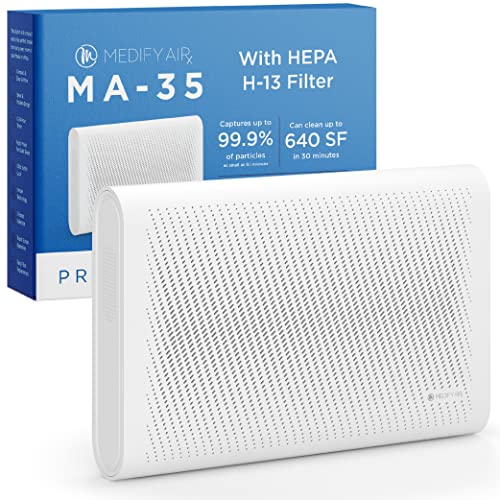
Medify MA-35
The cheapest purifier here and a strong particle machine. A CADR of 290 is a real, standardized figure, and it turns over up to 1,280 square feet in an hour or 640 in half of that, which is a lot of air for the money. It mounts on the wall, which Medify makes a point of: out of reach of children, pets and anything that might knock it over, and it takes up no floor in a small flat. Three fan speeds run down to near silence. The H13 element is a fine particle filter, and Medify’s listing extends its claims to VOCs, which is where the physics stops agreeing.
Pros:
- Cheapest purifier here
- Publishes CADR 290; a standardized, comparable figure
- Up to 1,280 sq ft in an hour
- Wall mounted; saves floor space and stays out of reach
Cons:
- No gas-adsorbing material named; the VOC claim rests on HEPA
- Sells poorly against the MA-40
- Wall mounting means committing it to one spot
Best for: dust, pollen and smoke in a large room, cheaply.
Medify MA-22
The small one, sized for a desk or a bedside table, covering up to 555 square feet in an hour, which is a genuine room rather than a token. Medify describes the H13 element as lab tested, which is a more careful phrase than most of this category manages and worth crediting. Three fan speeds drop to virtually silent, and there is a touch panel with a timer up to eight hours, a sleep mode and a filter replacement indicator, so it tells you when it has stopped working rather than quietly continuing to hum. Like its stablemates, it is a particle filter that claims VOCs.
Pros:
- Tabletop size; up to 555 sq ft in an hour
- Lab tested H13, which Medify states carefully
- Filter replacement indicator; it tells you when it is spent
- Near-silent on its lowest speed
Cons:
- No CADR published, unlike its stablemates
- No carbon or zeolite named for gases
- Costs more than the larger MA-35
Best for: particles in a bedroom, on a table, quietly.
Medify MA-40
The best-selling purifier here and the most capable particle machine on the page. A CADR of 406 is the highest figure here by a distance, turning over up to 1,793 square feet in an hour and 896 in thirty minutes, which is an open-plan floor rather than a room. Three fan speeds run down to near silence, and the touch screen handles a timer, sleep mode, a filter indicator and a child lock. If your problem is wildfire smoke, dust or pollen across a big space, this is a lot of machine. If your problem is outgassing, the specification does not address it.
Pros:
- The best-selling purifier here
- CADR 406; the highest standardized figure on this page
- Up to 1,793 sq ft in an hour; genuinely open-plan capable
- Touch screen with timer, sleep mode, filter indicator and child lock
Cons:
- The VOC claim is attributed to a HEPA element
- No carbon or zeolite named
- Costs more than double the MA-35 for more airflow
Best for: smoke and dust across a large open space.
Air Health Haven Plus
Not a room purifier. This installs into your ductwork, in about fifteen minutes according to Air Health, with parts for either metal or duct board, and takes air as it circulates through the system rather than sitting in a corner. That means it reaches every room the ducts reach, and it works only while the system runs. The specification is specific where it counts: a 16 inch, 30 watt UV-C lamp at 253.7nm, a PCO stage that addresses VOCs as a chemical reaction, and carbon filtration alongside for odors. Three mechanisms, all named, none of them pretending to be a fourth.
Pros:
- PCO stage plus carbon; two gas mechanisms, both named
- Handles the whole house through the ducts
- Publishes lamp size, wattage and wavelength precisely
- Installs in around fifteen minutes; metal or duct board parts
Cons:
- Needs ductwork, and a willingness to cut into it
- Works only while the system is running
- Sells poorly; not portable, and it does not move house
Best for: a ducted house, handled everywhere at once.
Austin Air HealthMate Junior
The cheaper of Austin Air’s two, and the specification is what this page is about. Four stages built around a filter with integrated activated carbon and zeolite, which are the materials that actually adsorb gas molecules rather than strain particles, and Austin names both rather than hiding them behind a stage count. That is the difference between a machine designed for outgassing and a machine designed for dust that mentions outgassing. It states coverage up to 750 square feet. It is expensive, it publishes no CADR, and CADR would not describe the thing it does anyway.
Pros:
- Names activated carbon and zeolite; the materials that capture gas
- Four-stage filtration built around adsorption, not straining
- States coverage up to 750 sq ft
- Far cheaper than the Bedroom Machine from the same brand
Cons:
- No CADR published; no carbon quantity given either
- Coverage figures conflict with Austin’s own dearer model
- Costs several times a comparable HEPA machine; sells very little
Best for: outgassing rather than dust, at the lower Austin price.
Kaltech KL-W01U
The one with nothing to buy again. Kaltech uses an LED photocatalyst rather than a filter mat, and makes the distinction itself: traditional purifiers trap particles, and this acts on molecules, targeting things as small as 0.0001 microns, which is the scale odor and VOC molecules live at rather than the scale dust does. Because the mechanism is a reaction rather than a trap, the filters are washable and reusable, in a dual arrangement pairing a photocatalyst filter with another stage. Made in Japan, wall mounted, quiet. It publishes no coverage area and no airflow at all.
Pros:
- Washable, reusable filters; no replacements to buy, ever
- Acts on molecules rather than straining particles
- States the scale it targets: down to 0.0001 microns
- Dual filter system; wall mounted and quiet
Cons:
- No coverage area, airflow or CADR published at all
- Expensive, and sells almost nothing
- A reaction rather than a capture; nothing is removed from the room
Best for: odors and molecules, with no filter bills ever again.
Austin Air Bedroom Machine
Austin Air’s flagship, and the most stages on this page: five, built around the same integrated activated carbon and zeolite filter as the Junior, with a HEPA element handling the particles alongside. That combination is the right shape for a room with both problems, gas and dust, because each material does the job it is actually capable of. It is designed to run quietly enough for a bedroom, which is the point of the name. It is by a wide margin the most expensive thing here, and it states coverage of 500 square feet, which is less than its own cheaper sibling claims.
Pros:
- Five stages; carbon and zeolite alongside HEPA
- Handles gas and particles with the right material for each
- Built to run quietly enough for a bedroom
- The most complete filtration on this page
Cons:
- The most expensive purifier here by a wide margin
- States 500 sq ft, less than the cheaper HealthMate Junior claims
- No CADR, no carbon quantity, no explanation of the extra stage
Best for: one room where both gas and dust are the problem.
The verdict
Medify’s MA-40 outsells everything here several times over, and it is an excellent particle purifier. That is the plain shape of this page: the popular machines are built for dust and smoke, and outgassing is a different problem needing a different material.
Best overall: Austin Air HealthMate Junior. The cheaper of the two machines here whose filter is built around activated carbon and zeolite, which are the materials that adsorb gas molecules rather than strain particles. Austin names both instead of hiding them behind a stage count, which on this page is the distinction that matters. It states 750 square feet of coverage. It publishes no CADR, and CADR measures particles anyway, so it would not tell you what you want to know.
Best value: Medify MA-35. The cheapest thing here and a genuinely strong particle machine: CADR 290 is a real, standardized figure, it turns over up to 1,280 square feet in an hour, and it mounts on a wall out of everyone’s way. Buy it for dust, pollen and smoke, where it is very good value. Its VOC claim rests on a HEPA element, and that is not what HEPA does.
Best premium: Austin Air Bedroom Machine. Five stages, with carbon and zeolite for the gas and HEPA for the particles, which is the right material doing each job rather than one material claiming both. Built to run quietly in a bedroom. Two things to weigh: it costs a great deal more than the Junior, and Austin’s own listings say it covers 500 square feet where the Junior covers 750, without explaining what the extra stage buys.
FAQ
Does a HEPA filter remove VOCs?
No. HEPA is a mechanical strainer that catches particles in a fiber mat: dust, pollen, dander, smoke droplets. VOCs are gas molecules, far smaller, and they pass straight through. All three Medify listings here claim VOC removal from an H13 element. The particle claims are tested and real; the VOC part describes something a strainer cannot do.
What does capture gases, then?
Activated carbon, by adsorption: molecules stick to a huge internal surface area inside its pores. Zeolite works alongside it on different molecules. Austin Air names both in its filter description on both machines. When a listing mentions VOCs, look for the material named. If the only answer is HEPA, that is your answer.
Is a high CADR what I want?
Only for particles. CADR is a standardized measure of how fast a machine clears smoke, dust and pollen, and Medify deserves credit for publishing it, 406 on the MA-40 and 290 on the MA-35. There is no CADR for gases, so on this page the best-documented number describes the wrong job.
What is PCO or photocatalyst?
A chemical reaction rather than a trap: instead of holding a molecule, it breaks it apart. Air Health uses PCO in the ducts and Kaltech uses an LED photocatalyst on a wall, which is why Kaltech’s filters are washable and never replaced. Carbon fills up and stops; a reaction does not. They fail differently.
Why does the cheaper Austin claim more coverage?
Nothing in the listings explains it. The Bedroom Machine states 500 square feet and calls that larger living spaces; the HealthMate Junior states 750 and calls that small living spaces, at well under two thirds the price. The figures and the descriptions disagree. Ask the seller before ordering.
This article may contain affiliate links; see our Affiliate Disclosure.