Two chargers on this page do not have two USB-C ports. They have one USB-C and one USB-A, which is a different thing sold under the same search, and both say so plainly in their own descriptions if you read past the title. If the reason you are here is charging two modern phones at once, that single check eliminates a third of the page before you look at a wattage figure.


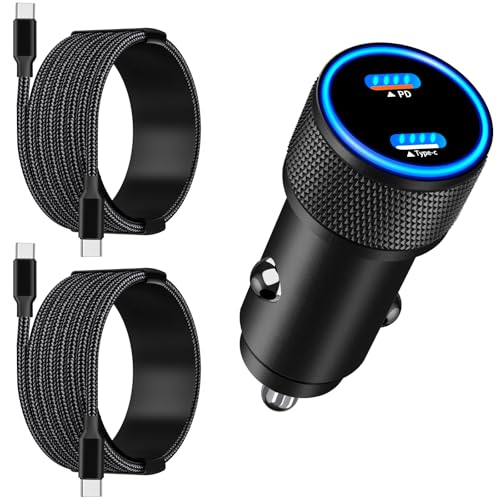


The other thing worth knowing is where the power comes from. A cigarette lighter socket is fed by a fuse, usually somewhere between 10 and 20 amps, and at 12 volts that sets a hard ceiling on what any charger plugged into it can deliver, no matter what the box says.
At a glance
| Charger | Standout feature | Price tier | Link |
|---|---|---|---|
| iSeekerKit 38W | Cheapest here; two in the pack, one USB-C each | Budget | |
| KENHAO 67W | Best seller here; two USB-C plus a USB-A | Budget | |
| Linocell 90W | Dual PD USB-C; MFi cable with an E-Marker | Budget | |
| Belkin BoostCharge 42W | Publishes a real charge time; one USB-C | Budget | |
| JUNVANG 90W | Four ports; 45W on each USB-C | Mid-range | |
| SUPERONE Retractable | Two cables built in; a voltage display | Mid-range | |
| ROADRESS 200W | 100W on each USB-C; check your fuse first | Premium | |
How to choose a dual USB-C car charger
Count the USB-C ports, not the ports
Dual port and dual USB-C are not the same claim and this page proves it. Belkin’s BoostCharge is a 42 watt dual port charger with a 30W USB-C and a 12W USB-A, and it says so in its own title. iSeekerKit’s 38W dual port pairs a 20W USB-C with an 18W second port. Both are perfectly good chargers and neither will fast charge two USB-C phones, because there is only one USB-C socket. KENHAO, JUNVANG, Linocell, SUPERONE and ROADRESS all genuinely have two.
Check the arithmetic against your fuse
ROADRESS advertises 200 watts with 100 watts available on each of its two USB-C ports. At 12 volts, 200 watts means drawing over 16 amps through your cigarette lighter socket, and plenty of cars fuse that circuit at 15. ROADRESS states 12V to 24V compatibility, and on a 24 volt system the same 200 watts is a comfortable 8 amps. The charger is not lying. It is telling you what it can do given a supply, and your car decides the supply. Look up your fuse rating before you buy the biggest number on the page.
The per-port figure is the one that matters
Total wattage tells you almost nothing on its own. KENHAO’s 67 watts breaks down to 37 watts maximum on a single USB-C, which is a genuine fast charge for a phone and short of what a laptop wants. JUNVANG’s 90 watts splits as 45 watts maximum on each of two ports, which is the more useful arrangement if two people are charging. ROADRESS gives 100 on each. Belkin’s 42 is 30 plus 12. Find the number next to the port you will actually use, because that is the number you get.
MFi and E-Marker are real certifications
Two brands here name things you can look up. Linocell states an MFi certified braided cable with an E-Marker chip, and both parts of that mean something specific: MFi is Apple’s licensing program for Lightning accessories, and an E-Marker is the chip a USB-C cable needs to negotiate currents above 3 amps. Without one, a 90 watt charger and a 90 watt phone will politely agree on far less. Where a listing talks about smart chips and intelligent protection without naming a standard, it is describing an intention rather than a certification.
Built-in cables solve the real problem
The thing that actually goes wrong in a car is not wattage. It is that the cable is in the house. SUPERONE builds in two retractable 80cm Type-C cables and adds a USB-C and a USB-A port alongside, so four devices are covered and two of them need nothing from you. Retractable means they wind back rather than tangling round the gearstick. It also adds a voltage display, which is the only readout on this page and which tells you what your car’s electrical system is actually doing.
Size matters in a socket you also want to use
A charger that stands proud of the dashboard gets knocked, gets hot and gets in the way of the gear selector in some cars. iSeekerKit is the only brand here publishing dimensions, at 2.75 by 0.98 by 0.98 inches, thumb-sized and sitting flush. Everyone else calls itself compact without one. ROADRESS goes the other way and adds an ice blue LED ring, which is genuinely useful for finding the socket at night and is another thing protruding into your footwell.
iSeekerKit 38W
The cheapest thing here and it is two chargers, so one lives in each car and nobody argues. It is thumb-sized at 2.75 by 0.98 by 0.98 inches, the only dimensions published on this page, and it sits flush in the socket rather than protruding into your knee. Output is 20 watts maximum on the USB-C and 18 on the second port, 38 total, with an independent smart chip identifying the right current for each device. Read the port list carefully: this is a USB-C and a USB-A, not two USB-C, so it is a phone-and-something charger rather than two phones fast.
Pros:
- Cheapest option here, and it is a two-pack
- The only charger publishing its dimensions; sits flush
- Independent smart IC per port
- 20W on the USB-C is a genuine phone fast charge
Cons:
- One USB-C and one USB-A; not a dual USB-C charger
- 38 watts total; the lowest here
- Sells poorly
Best for: a tidy cheap charger in every car, if one USB-C is enough.
KENHAO 67W
The best-selling charger here and it genuinely does what this page asks: two USB-C ports plus a USB-A, three devices at once, for less than a sandwich. Sixty-seven watts total with 37 watts maximum on a USB-C, which is a real fast charge for any phone and clear about being short of laptop territory. It supports PD and QC 3.0 and runs on 12V to 24V, so it works in a car or a truck. An intelligent chip handles protection against overcurrent and the rest. For the money and the port count, nothing here competes.
Pros:
- The best-selling charger on this page
- Genuinely two USB-C ports, plus a USB-A: three devices
- 37W maximum on USB-C; a real phone fast charge
- PD and QC 3.0; works on 12V or 24V
Cons:
- 37W per port; not a laptop charger
- 67W total is shared across three ports
- No dimensions or certifications named
Best for: most people, three devices, almost no money.
Linocell 90W
The best-specified cheap charger here, because Linocell names things instead of describing them. The cable is MFi certified, which is Apple’s actual licensing program rather than a claim, and it carries an E-Marker chip, which is the part a USB-C cable needs to negotiate more than 3 amps. Without one, a 90 watt charger and a 90 watt phone quietly settle for much less, and almost nobody explains that. Dual USB-C Power Delivery ports share 90 watts total, with dynamic temperature sensors and a smart power chipset managing the split. Same price as the best seller.
Pros:
- MFi certified cable; a real Apple program, not a claim
- E-Marker chip; needed to negotiate above 3 amps
- Genuinely dual USB-C Power Delivery
- 90W total, at the same price as the best seller
Cons:
- No per-port breakdown of the 90 watts
- Two USB-C only; no USB-A for older devices
- Sells modestly
Best for: two USB-C phones and a cable that can actually carry it.
Belkin BoostCharge 42W
The only charger here that publishes a result rather than a rating: an iPhone from empty to half charge in 21 minutes, which is a claim you can hold a stopwatch to and which nobody else on this page attempts. It is USB-C PD 3.0 certified with PPS, which lets the supply adjust voltage continuously to what the phone asks for instead of stepping between fixed levels, and that is real engineering. Belkin is also plain in its own title about the ports: a 30 watt USB-C and a 12 watt USB-A. One USB-C, not two.
Pros:
- Publishes a real charge time: empty to half in 21 minutes
- USB-C PD 3.0 certified with PPS; the supply adapts continuously
- Real about its ports in the title
- An established brand with extensive testing behind it
Cons:
- One USB-C and one USB-A; not a dual USB-C charger
- 42 watts total; 30 on the USB-C
- Costs more than chargers with twice the ports
Best for: one phone charged fast, from a brand that timed it.
JUNVANG 90W
Four ports and the most sensible split on this page: 90 watts total with 45 watts maximum available on PD and 45 on QC, which means two people can both charge properly at the same time rather than one fast and one crawling. Forty-five watts is enough for a phone at full speed with room to spare, and enough for a small tablet. It handles both USB-C and USB-A devices, works with essentially any phone, and an onboard power management chip handles the protections. It is the second best seller here and costs very little.
Pros:
- 45W maximum on each of two ports; both charge properly
- Four ports total; USB-C and USB-A both covered
- The second best-selling charger here
- PD and QC; onboard power management
Cons:
- 90W total is shared, so four devices means less each
- No dimensions or certifications named
- 45W is short of a full laptop charge
Best for: two people charging at full speed, plus two more slowly.
SUPERONE Retractable
The one that fixes the actual problem, which is that the cable is never in the car. Two retractable 80cm Type-C cables are built in and wind back when you are done, so nothing tangles round the gearstick and nothing gets left in the house. A USB-C and a USB-A port sit alongside for anyone else, making four devices in total. It runs on 12V or 24V and delivers 69 watts. The detail worth noticing is the voltage display, the only readout on this page, which tells you what your car’s electrical system is doing rather than leaving you to guess.
Pros:
- Two retractable 80cm Type-C cables built in; nothing to forget
- Plus a USB-C and a USB-A port: four devices
- Voltage display; the only readout here
- 12V or 24V; 69W total
Cons:
- Built-in cables cannot be replaced when they wear
- No per-port wattage breakdown published
- Sells modestly; costs double the best seller
Best for: never hunting for a cable in the car again.
ROADRESS 200W
The only charger here that gives you 100 watts on each USB-C, which is genuine laptop territory on both ports at once, alongside a third USB port. It supports PD 3.0, QC 4.0 and PPS, has a redesigned heat dissipation process for low temperature running, and adds an ice blue LED ring that makes finding the socket at night trivial. Do the arithmetic before ordering: 200 watts at 12 volts is over 16 amps, and many cars fuse the lighter circuit at 15. ROADRESS states 12V to 24V, and on a 24 volt system 200 watts is comfortable.
Pros:
- 100W on each USB-C; laptop speed on both at once
- PD 3.0, QC 4.0 and PPS all supported
- Redesigned heat dissipation for low-temperature running
- LED ring makes the socket findable at night
Cons:
- 200W at 12V draws over 16 amps; check your fuse rating
- The most expensive charger here
- An LED ring is another thing glowing in your footwell
Best for: a truck, or a car whose lighter circuit can actually feed it.
The verdict
Two checks before any of this. Count the USB-C sockets, because dual port does not mean dual USB-C and two chargers here prove it. And find the per-port wattage, because the total is shared and the number next to your socket is the number you get.
Best overall: KENHAO 67W. The best seller here and it actually does the job the search describes: two USB-C ports plus a USB-A, so three devices charge at once, with 37 watts maximum on a USB-C, which is a real phone fast charge and plainly short of a laptop. PD and QC 3.0, 12V or 24V. It costs almost nothing, which is why it outsells everything on this page by a distance.
Best value: Linocell 90W. The same low price as the best seller with two genuine USB-C Power Delivery ports and, more usefully, the two certifications nobody else names: an MFi cable, which is Apple’s actual program, carrying an E-Marker chip, which is what a USB-C cable needs to negotiate above 3 amps. Without one, a 90 watt charger quietly delivers far less. It gives no per-port breakdown, and it tells you more than anything else here.
Best premium: ROADRESS 200W. The only charger giving 100 watts on each USB-C, which means two laptops at full speed, with PD 3.0, QC 4.0 and PPS and a proper heat dissipation design. Buy it knowing the arithmetic: 200 watts at 12 volts is over 16 amps and many cars fuse that socket at 15. On a 24 volt truck it is comfortable. Check the fuse, then decide.
FAQ
How do I know it really has two USB-C ports?
Read the port breakdown, not the title. Belkin’s 42W dual port is a 30W USB-C and a 12W USB-A, and says so. iSeekerKit’s 38W pairs a 20W USB-C with an 18W second port. KENHAO, JUNVANG, Linocell, SUPERONE and ROADRESS all genuinely have two USB-C sockets.
Can my car actually deliver 200 watts?
Possibly not. At 12 volts, 200 watts is over 16 amps, and plenty of cars fuse the lighter circuit at 15. ROADRESS supports 12V to 24V, and on a 24 volt system the same 200 watts is about 8 amps and fine. Look up your fuse rating before buying the biggest number.
Is total wattage the right number?
No, the per-port figure is. KENHAO’s 67 watts is 37 maximum on one USB-C. JUNVANG’s 90 splits as 45 and 45, which is why it suits two people. ROADRESS gives 100 each. The total is shared across everything plugged in.
What is an E-Marker chip?
The part a USB-C cable needs to negotiate more than 3 amps. Without it, a 90 watt charger and a 90 watt phone agree on considerably less, and your fast charger is not one. Linocell is the only brand here naming it, alongside MFi certification for Lightning.
Are built-in cables a good idea?
They solve the thing that actually goes wrong, which is that the cable is at home. SUPERONE has two retractable 80cm Type-C cables plus two spare ports. The trade is that a built-in cable cannot be replaced when it eventually frays.
This article may contain affiliate links; see our Affiliate Disclosure.