Three boards in this search call themselves a wobble board and a rocker board in the same title. Those are two different tools at two different difficulty levels, and exactly one listing on this page knows it, explains the difference, and tells you plainly where its own board sits between them. The rest use both words because both words get searched.




At a glance
| Product | What it tells you | Price tier | Link |
|---|---|---|---|
| Amazon Basics | 265 lbs. The only real capacity, and full dimensions | Budget | |
| Wooden Wobble (no brand) | 350 lbs. Beginners and children, it says | Budget | |
| Yes4All Wooden | 15-degree tilt. One of only two publishing the angle | Budget | |
| 3-in-1 Slant Board | Switches 180 degrees to 360 degrees with magnets. And 11-ply poplar | Budget | |
| Yes4All Plastic | 16.3″ TPE with handles. The only one you can carry properly | Mid-range | |
| StrongTek Advanced | The only listing that grades its own difficulty | Mid-range | |
| 360 degrees Rotating (no brand) | 500 lbs, a 25-degree tilt, and some remarkable claims | Premium | |
How to choose
A rocker and a wobble board are not the same thing
A rocker board tips along one axis, front to back or side to side, like standing on a see-saw. A wobble board sits on a round or domed base and tips in every direction at once, so your ankles are correcting continuously rather than in one plane. One listing here spells that out and the rest do not, which is why three of them put both words in the same title for the same board. If you are training after an ankle injury, that difference is the entire purchase.
Only one board tells you how hard it is
The most useful bullet in this search reads like advice rather than marketing: it says a basic rocker mostly moves in one plane, that a round-base wobble board is the hard end, and that its own cross base sits between them as a middle step. That is a company placing its product on a ladder and admitting there are rungs above it. Everything else here is somewhere on that same ladder and will not say where.
Watch a listing be for beginners and advanced users at once
One board here says in its first bullet that it is a good choice for beginners, the elderly and people with balance issues, then says in its second that it is ideal for advanced balance training. Those describe opposite products. A board stable enough for someone recovering their balance is not challenging an athlete, and one that challenges an athlete is not where you start after a sprain. Two other listings on this page make the same double claim.
Tilt angle is difficulty, and two boards publish it
How far the board can lean before the edge hits the floor is what decides how hard it is, and it is the number almost nobody prints. One board here states a 15 degree tilt. One states 25. That is a large gap in how far you can go wrong before the deck stops you, and it is the closest thing to a difficulty rating in this search. Every other board leaves you to judge it from a photograph.
The shape of the base is the product
Where dimensions appear, they tell you what you are getting. A published diameter means a round base and full rotation. A rectangle roughly 17 by 13 inches is a deck that rocks along its short axis. A cross base is a deliberate compromise with more floor contact. Two boards here publish a diameter, two publish a rectangle, one names its cross base, and the rest give you a weight limit and a photo.
The weight limit is not the constraint
Capacities here run 265, 300, 350 and 500 pounds. You stand on it; nothing is close to breaking. The real one is 265, which is the lowest and comes with the only warning on this page about using it on a dry non-slip floor. When a board advertises 500 pounds it is not describing a person who is going to be doing 360 degree ankle work on it. Read the tilt and the base instead.
Some of these claims need saying out loud
One listing here states that its board effectively snacks ankle and toe injuries, fractures, sprains, hamstring injuries, tendinitis and knee pain, and that it is especially beneficial for people with insomnia, promoting better sleep after an hour or more of use. That is a sheet of plywood on a curved base. Another says you will build muscle quickly, burn fat and avoid back pain. Balance boards are genuinely useful for balance and ankle control. They do not handle fractures.
Amazon Basics
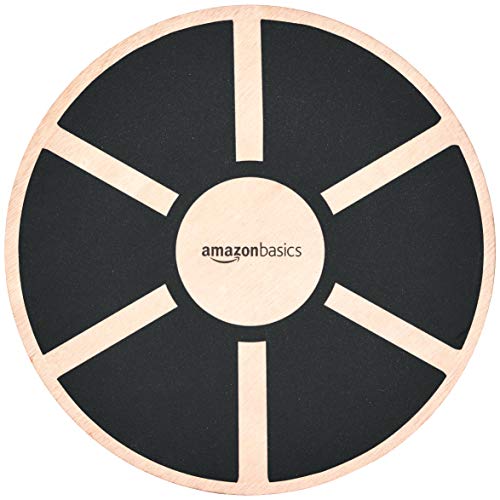
The cheapest board here and the only one that behaves like a specification sheet. It publishes its exact size at 15.75 by 15.75 by 3.15 inches, rates itself at 265 pounds, which is the lowest and therefore the most believable figure on this page, and carries a one-year warranty. It is also the only listing that warns you about the floor: use it on dry non-slip surfaces, not on anything wet or smooth. Solid wood top, non-slip surface, and no claims beyond core strength, coordination, posture and balance.
Pros:
- Publishes exact dimensions to the hundredth
- 265 lbs; the lowest and most plausible rating here
- The only floor-surface warning on this page
- One-year warranty; no exaggerated claims
Cons:
- Does not state its tilt angle
- Does not describe its base shape
- No difficulty guidance at all
Best for: a plain board with the numbers printed on it.
Wooden Wobble (no brand)
Plywood rated at 350 pounds with double reinforcement bands underneath, arriving fully assembled, with anti-slip pads across the top and anti-scratch pads on the bottom and edges that also cut the noise, which matters if you use it at a desk above someone. That desk use is the real pitch here: something to shift your weight on while you work rather than a training tool. It aims at beginners, children and the elderly, and its text is close to word for word with another listing in this search.
Pros:
- Fully assembled; nothing to build
- Double reinforcement bands underneath
- Edge and base pads cut floor noise as well as scratches
- Real about being a standing-desk board
Cons:
- Shares most of its text with a rival listing
- No dimensions, tilt angle or base shape given
- 350 lbs on a board you stand still on
Best for: moving about under a standing desk.
Yes4All Wooden
One of only two boards here that publishes its tilt angle, and that single number tells you more than every capacity figure on this page combined: 15 degrees, with full 360 degree rotation on a 15.75 inch round base. Round base and a stated diameter means you know exactly what you are getting, which is the harder end of the category rather than a rocker. 300 pounds, an anti-skid pad, comfortable barefoot or in shoes, and it moves side to side, front to back and in circles.
Pros:
- Publishes its 15 degree tilt angle
- Round base and stated diameter; you know the movement
- Full 360 rotation, not a one-plane rocker
- Works barefoot or in shoes
Cons:
- Round base is the hard end; not a beginner’s board
- 300 lbs, below the 350 claims here
- No handles; awkward to carry
Best for: real 360 wobble, with the angle on the label.
3-in-1 Slant Board
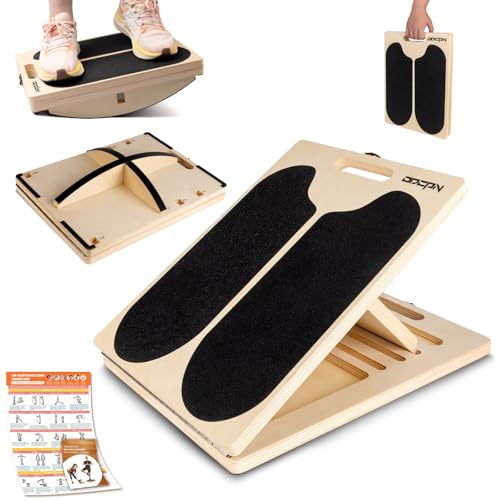
The only board here that lets you change difficulty rather than just buy it. Three arc-shaped side panels attach magnetically, and with them on you get 180 degree directional balance, and off you get 360 degree rotation, switching in seconds. That is the ladder every other listing pretends does not exist, sold as one object. It is also a six-angle calf stretcher at 20, 23, 30, 35, 40 and 45 degrees, folds flat, and it publishes what it is made of: an 11-ply AA-grade poplar core, 4.5 pounds, 300 pound capacity. A training poster comes with it.
Pros:
- Magnetic panels switch 180 degrees to 360 degrees in seconds
- Publishes 11-ply poplar, 4.5 lbs and 300 lbs capacity
- Six stretch angles from 20 to 45 degrees
- Folds flat; training poster included
Cons:
- Three loose panels to keep track of
- Primarily a slant board; balance is the second job
- Does not state the tilt angle in balance mode
Best for: starting easy and making it harder later.
Yes4All Plastic
The largest deck in this search at 16.3 inches across, which sounds trivial and is not: a wider board means your feet sit further apart and the leverage changes. Heavy-duty TPE rather than wood, textured with massage spikes that grip barefoot and press into your soles while you work, 300 pound capacity, full 360 rotation. It has handles, which nothing else here does, so carrying it and storing it is a one-hand job rather than a hug.
Pros:
- 16.3 inches; the widest deck here
- Handles; the only board you can carry properly
- TPE spikes grip barefoot and massage as you shift
- Full 360 rotation; published diameter
Cons:
- Plastic where the rest are wood
- No tilt angle published
- Spikes are not to everyone’s taste under bare feet
Best for: barefoot use, and moving it around the house.
StrongTek Advanced
The only listing in this search that takes balance as a skill with levels. It explains that basic rockers move in one plane, that round-base boards are the demanding end, and that its cross base sits deliberately between them: 360 degree movement, but with more floor contact so the board is controllable while you learn. It calls itself a middle step and means it. Textured wooden top, solid build, and it is aimed at people who have outgrown a rocker and are not ready for a dome.
Pros:
- The only board that grades its own difficulty
- Cross base gives 360 movement with more control
- Explains what a rocker and a round base each do
- Real that harder boards exist above it
Cons:
- Publishes no dimensions, weight limit or tilt angle
- Among the higher prices here
- A middle step, so you may outgrow it
Best for: the step between a rocker and a round base.
360 degrees Rotating (no brand)
The most demanding board here on the one number that counts: a 25 degree tilt, against the 15 degrees the other board publishing an angle offers. That is a serious range of movement on a half-ball base under a 17.5 by 13.4 inch deck, with oval carry holes cut into each end and a gray silicone surface. It is rated at 500 pounds. Its rehabilitation bullet claims the board effectively snacks fractures, sprains, tendinitis and knee pain, and helps insomnia after an hour or more of use.
Pros:
- Publishes a 25 degree tilt; the most movement here
- Oval carry holes cut into both ends
- Publishes full dimensions and a half-ball base
- 30-day full refund offered
Cons:
- Claims to effectively handle fractures and help insomnia
- 500 lbs; a number nothing here needs
- 25 degrees is too much for a beginner
Best for: experienced users who want a real tilt range.
The verdict
Balance boards come in difficulty levels, and almost nothing here admits that. Three listings use rocker and wobble as synonyms in one title, three describe themselves as being for beginners and advanced users in adjacent bullets, and only two publish the tilt angle that actually sets the challenge. The capacity race up to 500 pounds is noise.
Best overall: 3-in-1 Slant Board. It is the only board here you can make harder as you improve: three arc-shaped panels click on magnetically for 180 degree directional balance and come off for full 360 rotation, in seconds. That is a progression path in one object rather than two purchases. It publishes its 11-ply poplar core, its 4.5 pound weight and its 300 pound limit, throws in six calf-stretch angles and a training poster, and folds flat.
Best value: Amazon Basics. The cheapest board on this page and the only one that reads like it was written by someone measuring things: exact dimensions to the hundredth of an inch, a 265 pound rating that is the lowest here and therefore the one worth believing, and a one-year warranty. It is also the only listing that mentions the floor, warning you to use it on dry non-slip surfaces. No claims about fractures, fat or sleep.
Best premium: StrongTek Advanced. Buy it for the clarity. It is the only listing in this search that explains the difference between a rocker and a round base, positions itself deliberately between them, and tells you outright that harder boards exist above it. The cross base is a real engineering answer: full 360 movement with more floor contact, so you can control it while your ankles catch up.
FAQ
What is the difference between a rocker and a wobble board?
A rocker tips along one axis like a see-saw. A wobble board sits on a round or domed base and tips in every direction, so your ankles correct continuously. They are different difficulty levels, and three listings here use both words for the same board.
Which board should a beginner start on?
Not a round base. One listing here lays out the ladder: rocker first, then a wider cross base, then a round base. Ignore the boards that claim to suit beginners and advanced users in adjacent bullets, because those describe opposite products.
Does the weight capacity matter?
No. Capacities here run from 265 to 500 pounds on a board you stand still on. Nothing is close to breaking. The lowest figure here comes from the most careful listing, which tells you something about the other numbers.
What number actually shows difficulty?
The tilt angle, and only two boards publish it: one at 15 degrees, one at 25. That is how far you can lean before the deck stops you, and it is a large gap. Everything else asks you to judge from a photo.
Can a balance board work on an injury?
They are genuinely useful for balance, ankle control and coordination, which is why physiotherapists use them. One listing here goes considerably further, claiming it effectively snacks fractures and helps insomnia after an hour of use. It is a piece of plywood on a curved base.
This article may contain affiliate links; see our Affiliate Disclosure.