Nine of these ten chargers tell you how many miles per hour they add. One of them tells you what car it measured. That is not a small omission, because miles per hour is not something a charger has. It is something a charger and a car have together, and a figure quoted without a vehicle attached is a number with the important half deleted.


At a glance
| Product | Plug and amps | Price tier | Link |
|---|---|---|---|
| VEVOR 16A | NEMA 6-20, 16A. ETL listed. Cheapest here | Budget | |
| J1772 16A (no brand) | NEMA 6-20, 16A. ETL, and names real cars | Budget | |
| Raylix 16A | NEMA 6-20, 16A. FCC and CE, not ETL or UL | Mid-range | |
| Junsun 32A | NEMA 14-50, 32A. Offers 16A on a wall socket | Mid-range | |
| 16A Home Station (no brand) | NEMA 6-20, 16A. Ten layers in the header, six in the text | Mid-range | |
| bokman 32A | NEMA 14-50, 32A. The only one naming its test car | Premium | |
| Webasto Go | NEMA 14-50. UL listed. Amperage never stated | Premium | |
How to choose
Miles per hour belongs to the car, not the charger
A charger delivers kilowatts. How far those kilowatts go depends on how heavy your car is and how efficiently it uses them, so the same charger will add more range to a small hatchback than to a big electric truck. Nine listings here print a miles-per-hour figure with no vehicle beside it. One names its car, gives its battery size, publishes 25.2 miles per hour on the big plug and 4.7 on the wall socket, and adds that actual speed depends on your vehicle and circuit. That is the only figure on this page you can check.
The outlet decides the speed, and the outlet is not in the box
Six of these chargers end in a NEMA 6-20 plug and top out at 16 amps, around 3.7 kilowatts. Three end in a NEMA 14-50, the big dryer and caravan socket, and reach 32 amps, around 7 kilowatts. That is the whole performance story on this page, and it is decided by the socket on your wall rather than the box in your boot. The chargers cost within a modest range of each other. The wiring behind them does not. Work out which outlet you have, or are willing to have installed, before comparing anything else.
A normal wall socket caps you at 12 amps, whatever you paid
Two listings here disclose it plainly: plug into an ordinary household socket and the charger automatically limits itself to 12 amps, and both cite the North American safety standard as the reason. That figure is 80 percent of a 15 amp circuit, which is the arithmetic those two are following. It means a 32 amp charger on a kitchen wall socket is a 12 amp charger. The amps above that are real, and you cannot reach them without an outlet to reach them through.
One charger offers 16 amps on that same socket
Against those two, a third listing here offers Level 1 charging at up to 16 amps through the standard wall adapter, and lists 16 among its selectable Level 1 currents. Two of its rivals say the standard does not allow more than 12 there. This is worth a slow read rather than a shrug: the conservative figure is the one that matches 80 percent of a 15 amp circuit, and it is the one two separate sellers went out of their way to explain. If you buy that charger, there is no obligation to use its top Level 1 setting.
Four times faster and six times faster are measured from the same floor
Two listings shout a multiplier. One says four times faster, one says six times faster, and both are comparing themselves to an 8 amp Level 1 charger rather than to each other. Run it: 16 amps at 240 volts is roughly four times an 8 amp trickle, and 32 amps is roughly double that again. So the six-times charger is about one and a half times the four-times charger. The multipliers make the gap sound enormous because they share a very slow starting point.
Check which certification is on the box
Four chargers here are ETL listed and one is UL and cUL listed, which are the North American electrical safety marks. One names only FCC and CE. FCC covers radio interference and CE is a European conformity mark, and neither is the North American safety listing its rivals hold. It is a charger with NEMA plugs, sold for North American sockets, carrying a European mark instead of an American one. That may be an oversight in the listing. It is still what the listing says.
Read the safety bullets for arithmetic
One listing here titles a bullet “Ten-Layer Safety Protection” and then, in the body of the same bullet, describes six-layer protection and lists six. Its timer bullet is stranger: it says the delay timer means paying for 12 hours of electricity while getting the equivalent of 18 hours of charging, which is not a thing a timer can do. A delay timer moves when you charge. It does not manufacture hours. When the words and the numbers in a bullet disagree, believe neither until something else confirms it.
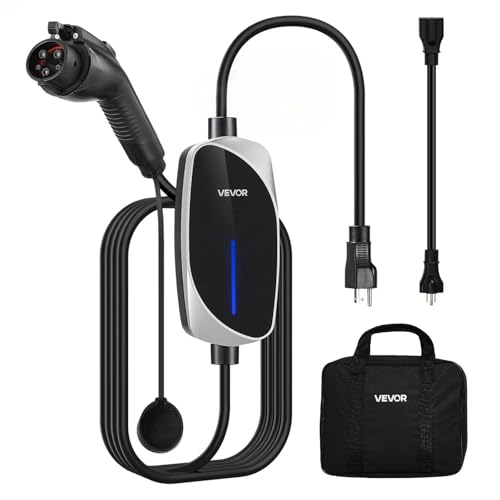
VEVOR 16A
The cheapest charger here and it gives up very little to get there. ETL and FCC certified, 12 or 16 amps to match your breaker with no electrician required, NEMA 6-20 for Level 2 at 3.84kW and a 5-15 adapter for Level 1. Protection covers surge, leakage, ground fault, over and under voltage, overcurrent, overheating and over-charging, with auto shutoff at full. The control box is IP66 and rated from -22 to 122 degrees F, which is a real range plainly stated, and a 25 foot cable, bag and wall mount are included.
Pros:
- ETL and FCC certified at the lowest price here
- IP66 and rated -22 degrees F to 122 degrees F; a published range
- 25 ft cable, carry bag and wall mount included
- 1-12 hour delay timer on an LCD screen
Cons:
- 16 amps; half the ceiling of the 14-50 chargers
- Quotes no miles-per-hour figure at all
- Needs a 6-20 outlet for Level 2 speeds
Best for: a 6-20 outlet, certified, for the least money.
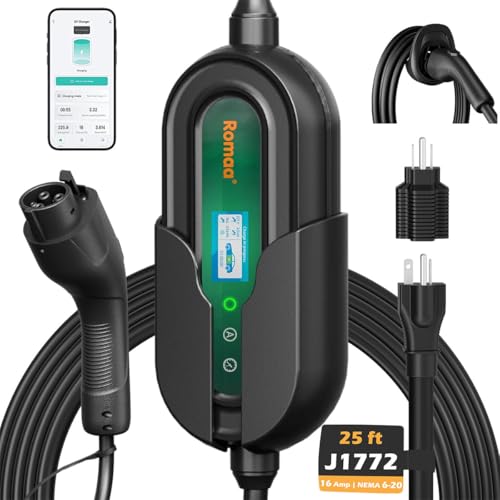
J1772 16A (no brand)
The most careful of the budget listings. It names actual vehicles rather than brands, listing the Wrangler 4xe, RAV4 Prime, Prius Prime, X5 45e and XC90 Recharge as its priority, then adds that it works with a Leaf, Bolt or Kona up to each vehicle’s own onboard charger limit and tells you to check your specifications. That last clause is the real one nobody else writes. ETL listed, FCC Part 15, CCID20 leakage protection, a NEMA Type 4 enclosure, 8 to 16 amps adjustable, and Wi-Fi that keeps charging when it drops.
Pros:
- Names specific vehicles, and their own charger limits
- ETL listed with a NEMA Type 4 enclosure
- Keeps charging offline when Wi-Fi drops
- App scheduling plus a fixed daily start time
Cons:
- 16 amps via 6-20; the lower ceiling
- Its miles-per-hour range names no car
- Listing carries several typos
Best for: plug-in hybrids, from a listing that reads like an engineer wrote it.
Raylix 16A
The best screen here by some distance: a TFT color display showing voltage, current, power load and charging temperature on the unit rather than making you go and look at the car. Four current levels at 8, 10, 12 and 16 amps, a 1-12 hour delay timer, a 21 foot cable, IP65, UL94V-0 flame rating and a two-year warranty. It is also the listing that discloses the 12 amp wall-socket limit properly. Its certifications are FCC and CE, which are radio and European marks, where four rivals here hold ETL. And it uses the figure 100K twice, for a customer survey and for safety tests.
Pros:
- TFT color display with live temperature on the unit
- Discloses the 12 amp wall-socket limit, and why
- Four current steps; 1-12 hour delay timer
- IP65, UL94V-0 flame rating, two-year warranty
Cons:
- FCC and CE only; no ETL or UL listing named
- The same 100K figure covers surveys and safety tests
- 21 foot cable is the shortest on this page
Best for: seeing what is happening without opening the car.
Junsun 32A
A 32 amp charger on a NEMA 14-50 at 7kW, with eight selectable Level 2 currents from 6 up to 32, an LCD showing live current, voltage, energy and time, a 20 foot cable, a storage bag and a one-year warranty that replaces rather than repairs. It claims 24 miles in an hour at 240 volts, with no car named. The point to weigh is its Level 1 mode: it offers up to 16 amps through the standard wall adapter, where two other listings here cite the safety standard and cap themselves at 12 on that same socket.
Pros:
- 32 amps and 7kW via NEMA 14-50
- Eight current steps from 6A to 32A
- LCD shows current, voltage, energy and time
- Warranty replaces rather than repairs
Cons:
- Offers 16A on a wall socket where rivals cap at 12A
- Names no certification body at all
- 20 foot cable; the shortest of the 32 amp group
Best for: 32 amps cheaply, using the lower Level 1 settings.
16A Home Station (no brand)
Five current steps from 6 to 16 amps, a 25 foot flame-retardant cable built to NEMA Type 4, an IP66 control box, a plug rated for over 20,000 charges, and it does disclose the 12 amp wall-socket limit and explain why. Then the bullets stop adding up. One is headed Ten-Layer Safety Protection and describes six layers in its own text. Another says the delay timer means paying for 12 hours of electricity while getting 18 hours of charging, which a timer cannot do, and names an off-peak window of nine hours while it does it.
Pros:
- Five current steps from 6A to 16A
- Discloses and explains the 12 amp wall-socket cap
- 25 ft cable to NEMA Type 4; IP66 box
- Plug rated for more than 20,000 charges
Cons:
- Header says ten safety layers; the text says six
- Claims 12 hours paid for 18 hours charged
- Names no certification body
Best for: little the cheaper certified chargers do not already do.
bokman 32A
The only listing in this search that shows its working. Its final bullet is headed Before You Buy, names the car, gives the battery size, and publishes 25.2 miles per hour on the 14-50 and 4.7 on the wall socket, then says actual speed depends on your vehicle and circuit. Everything else follows suit: seven current steps to 32 amps, a 25 foot cable long enough to cross two bays, ETL certified, IP65, and physical buttons chosen deliberately over a touchscreen because touchscreens fail in rain and cold. No app and no Wi-Fi anywhere.
Pros:
- Names the car and battery behind its range figures
- 32 amps via NEMA 14-50; seven current steps
- Physical buttons; no app, no Wi-Fi, works in the cold
- ETL certified, IP65, 25 ft cable
Cons:
- Needs a 14-50 outlet, which most homes lack
- Its listing states it does not work with Tesla
- No app scheduling if you want remote control
Best for: 32 amps, from the one seller who tells you what that means.
Webasto Go
The only UL and cUL listed charger here, from an established automotive supplier, with thermal detection, ground fault detection, auto-restart and recovery, an IP67 rating that beats everything else on the page, and a NEMA 14-50. Its pitch is subtraction: no app, no notifications, no extra buttons, just plug it in. That is a defensible position and it costs you the adjustable current and the delay timer every rival has. It also runs to four bullets total, and never states its amperage, its kilowatts or its cable length anywhere in them.
Pros:
- UL and cUL listed; the strongest safety mark here
- IP67; better sealed than anything else on the page
- Thermal, ground fault and auto-recovery protection
- Plug and play; nothing to configure or update
Cons:
- Never states amps, kilowatts or cable length
- No adjustable current and no delay timer
- More than twice the price of the 32 amp chargers
Best for: buying the safety listing and nothing else.
The verdict
The plug on the end decides almost everything here: six chargers stop at 16 amps through a 6-20, three reach 32 through a 14-50, and the boxes cost within reach of each other while the wiring behind them does not. Then nine of ten quote a miles-per-hour figure without naming a car, which is the specification equivalent of showing you half a fraction.
Best overall: bokman 32A. The only listing that names its test vehicle and battery size, publishes both the 14-50 and wall-socket figures, and adds that your car and circuit will change them. That candour runs through the product: seven current steps to 32 amps, ETL, IP65, a 25 foot cable, and physical buttons picked over a touchscreen because touchscreens fail in rain and cold. You need a 14-50 outlet, and it says so before you buy.
Best value: VEVOR 16A. The cheapest charger here, ETL and FCC certified, IP66, and rated from -22 to 122 degrees F, which is a published figure rather than a claim about all weather. 12 or 16 amps to match your breaker, a 1-12 hour delay timer, and a 25 foot cable with a bag and wall mount thrown in. If your outlet is a 6-20, 16 amps is the ceiling anyway, and nothing on this page will beat it through that socket.
Best premium: Webasto Go. The only UL and cUL listed charger in the search, IP67, with thermal and ground fault detection from a supplier that builds for carmakers. It deliberately has no app, no timer and no adjustable current, which is either the point or a dealbreaker depending on you. Know going in that its four bullets never state its amperage, its kilowatts or its cable length.
FAQ
Why do miles-per-hour claims vary so much?
Because they depend on the car as much as the charger, and only one listing here names one. The same kilowatts add more range to a light efficient car than a heavy one. A miles-per-hour figure with no vehicle attached cannot be checked or compared.
What outlet do I need?
Six chargers here use a NEMA 6-20 and stop at 16 amps. Three use a NEMA 14-50, the big dryer socket, and reach 32. That single choice roughly doubles your charging speed, and it is decided by your wall, not the charger.
Can I just use a normal wall socket?
Yes, slowly. Two listings here disclose that the charger automatically limits to 12 amps on a standard socket, citing the safety standard, which is 80 percent of a 15 amp circuit. A 32 amp charger plugged into your kitchen wall is a 12 amp charger.
Is “6x faster” better than “4x faster”?
Only by about half. Both multipliers are measured against a slow 8 amp trickle charger, not against each other. 16 amps at 240 volts is roughly four times that floor; 32 amps is roughly double the 16.
Which certification matters?
ETL and UL are the North American electrical safety listings, and five chargers here hold one or the other. One names only FCC, which covers radio interference, and CE, which is a European mark, despite being sold with NEMA plugs for North American sockets.
This article may contain affiliate links; see our Affiliate Disclosure.