The single reason bumper plates exist is that every one of them is the same diameter, so a bar loaded with 10s sits at exactly the same height as a bar loaded with 45s and you can deadlift from the floor properly. Iron plates shrink as they get lighter, which drops the bar and wrecks your setup. Not one listing on this page publishes a diameter. The answer to the question in the title is a number none of them will print.


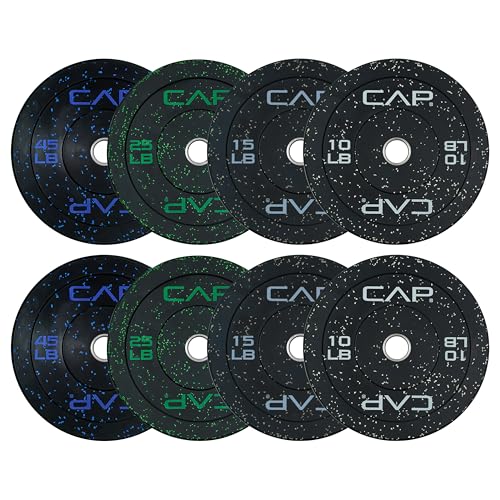

At a glance
| Product | Hub, rubber, and cost per pound | Price tier | Link |
|---|---|---|---|
| CAP Elite 10lb Pair | Anchored stainless hub, virgin rubber, kg and lb marked | Budget | |
| CAP 100lb Set | Floating hub, rubber blend, about a dollar a pound | Budget | |
| Fitvids 120lb Set | The only listing that explains why virgin rubber matters | Mid-range | |
| CAP 190lb Set | Floating hub and a blend, with the 45s you want | Mid-range | |
| Fitvids 390lb Set | The cheapest per pound here. One bullet describes it | Premium | |
How to choose
Same diameter is the entire point, and nobody says so
Bumper plates are all made to one outside diameter regardless of weight. That is not decoration, it is the reason to own them: a bar loaded with two 10s sits at the correct pulling height, and with iron it would be sitting almost on the floor because a 10 pound iron plate is a fraction of the size of a 45. If you deadlift, clean or drop anything, that consistent height is the whole purchase. Every listing here sells you rubber, hubs and color flecks. None gives you the number that answers the question.
Floating hub or anchored hub
One brand uses both terms across its own range and the difference is the product. Its economy plates have a floating steel hub. Its elite plates have an anchored stainless steel one. Anchored means the metal collar is bonded into the rubber; floating means it is not. The hub working loose from the rubber is precisely how bumper plates die, usually after a year of drops, and the word in the bullet tells you which failure you have bought. The same brand tells you, in one word, what the extra money is for.
Virgin rubber, or a proprietary blend
Read the noun. Two listings say 100% virgin rubber and one of them says why it matters, in the only technical bullet on this page: no recycled content means low to no odor, real durability, and a low dead bounce for safety. Two other listings offer a proprietary rubber blend, which is a phrase that exists to avoid the word recycled. The odor point is not trivial. Recycled crumb rubber in a closed garage smells for months, and it is the most common complaint about cheap bumper plates.
Bounce is a safety spec pointing two ways
One brand sells medium bounce as control. The other sells dead bounce as safety. They cannot both be the better answer and the physics favors dead: a 45 pound plate that bounces comes back toward your shins. Medium bounce is what you get from a harder, cheaper rubber compound, and describing it as control is a way of making a property sound like a decision. If you drop weight in a garage with a low ceiling and a car in it, less bounce is what you want.
The set arithmetic checks, which is worth saying
Three sets here list their contents and all three add up exactly. Ten, fifteen and twenty-five in pairs is a hundred. Add a pair of forty-fives and it is a hundred and ninety. Ten, fifteen and thirty-five in pairs is a hundred and twenty. After enough listings that count storage bags among the pieces, a category where the numbers simply work deserves the credit.
Work out the price per pound
This is a commodity and the real comparison is cost per pound, which no listing does for you. Run it and the answers are close but not equal: around a dollar four a pound for the economy sets, about a dollar twenty for the elite pair, a dollar twenty-four for the small virgin set, and ninety-nine cents for the biggest set here. The cheapest per pound is the largest box, which is how bulk usually works, and it is also the listing that tells you the least about what is in it.
Check which plates you are actually getting
A set is a number and a shape. One hundred and twenty pounds sounds fine until you notice it is tens, fifteens and thirty-fives, and thirty-five is an unusual size that will not pair neatly with the forty-fives you buy later. The hundred and ninety set gives you tens, fifteens, twenty-fives and forty-fives, which is the standard ladder and the one every program you follow is written around. The total is the headline; the denominations are what you lift.
Dual markings save arguments
One listing prints both kilograms and pounds on the plate. If you ever follow a program written in kilos, or lift with anyone who does, that saves a conversion every single set. It is a small thing that costs nothing at manufacture and it appears exactly once here.
CAP Elite 10lb Pair
This is where the brand fixes the two things its economy line compromises, and it tells you in the bullets: an anchored stainless steel hub rather than a floating one, and virgin rubber rather than a proprietary blend. Anchored means the collar is bonded into the rubber and cannot work its way loose, which is how bumper plates fail. Stainless means it will not rust in a garage. It also prints both kilogram and pound markings, which nothing else here does. It is a pair of tens, so it is a top-up rather than a start.
Pros:
- Anchored hub, where the same brand’s economy line floats
- Stainless steel; corrosion resistant in a damp garage
- Virgin rubber, named, rather than a blend
- Dual kilogram and pound markings; the only ones here
Cons:
- A pair of tens; not a starting set
- About a dollar twenty a pound; dearer than the economy sets
- Medium bounce, like the rest of the brand’s range
Best for: the hub that will not come loose.
CAP 100lb Set
Tens, fifteens and twenty-fives in pairs, which adds to exactly a hundred and is a sensible first set for someone learning to lift rather than someone already pulling four hundred. About a dollar four a pound puts it among the cheapest here. The speckled flecks are a real convenience, since identifying a plate at a glance mid-session beats squinting at a number. Read the two words the elite line changes: this hub floats, and this rubber is a proprietary blend rather than virgin.
Pros:
- The set adds up exactly; tens, fifteens and twenty-fives
- About a dollar four a pound; among the cheapest here
- Speckled flecks make weights identifiable at a glance
- Two-inch center; fits any Olympic bar
Cons:
- Floating hub, where the brand’s elite line anchors
- A proprietary rubber blend, not virgin
- No forty-fives; you will buy them separately
Best for: a first hundred pounds, cheaply.
Fitvids 120lb Set
The only listing on this page that explains a material rather than naming it. One hundred per cent virgin rubber with no recycled content, and then the three consequences: low to no odor, real durability, and a low dead bounce for safety. Every one of those is true and the odor one is the complaint that ruins cheap plates in a closed garage. Dead bounce is also the safer answer, since a plate that comes back at you is a plate you have to watch. Its denominations are tens, fifteens and thirty-fives, which is an unusual ladder.
Pros:
- Explains why virgin rubber matters; the only technical bullet here
- No recycled content, stated plainly; low odor
- Low dead bounce, described as safety rather than control
- The set adds up exactly; protects bar and floor
Cons:
- Thirty-fives are an odd size against a standard ladder
- About a dollar twenty-four a pound; the dearest here
- Its hub is called steel, with no floating or anchored stated
Best for: the only listing that argues its own material.
CAP 190lb Set
The standard ladder, which matters more than the total: tens, fifteens, twenty-fives and forty-fives, in pairs, adding to exactly a hundred and ninety. That is the set every program is written around, and the forty-fives are the ones you will actually use once the novice phase ends. About a dollar four a pound, the same rate as the smaller set, so the extra ninety pounds costs you no premium. Same caveats as its sibling: the hub floats and the rubber is a blend.
Pros:
- The standard ladder including forty-fives; adds up exactly
- About a dollar four a pound; no premium for the bigger set
- Speckled identification; steel hub; two-inch center
- Enough plate to train seriously without a second purchase
Cons:
- Floating hub, where the brand’s elite line anchors
- A proprietary rubber blend; expect some odor
- Medium bounce sold as control
Best for: the ladder your program assumes you have.
Fitvids 390lb Set
Ninety-nine cents a pound, which is the cheapest rate on this page and the reason to consider it. Three hundred and ninety pounds is a genuine garage gym rather than a starter set, and buying it in one box saves the shipping and the incremental top-ups. It is virgin rubber, which its sibling’s listing explains properly. Everything else about it is unknown, because the entire listing is a single sentence saying it is virgin rubber with a two-inch hole that fits two-inch bars. No denominations, no hub, no bounce.
Pros:
- Ninety-nine cents a pound; the best rate here
- 390 pounds; a real gym in one purchase
- Virgin rubber, which its sibling’s listing explains
- Two-inch center; fits any Olympic bar
Cons:
- The entire listing is one sentence, at nearly four hundred dollars
- No denominations published; you do not know which plates arrive
- No hub type, no bounce, no markings described
Best for: the best price per pound, and nothing else disclosed.
The verdict
Bumper against iron comes down to one number and no listing here prints it: bumpers share a diameter so the bar sits right at any weight. Past that, two words decide everything. Whether the hub is anchored or floating, and whether the rubber is virgin or a blend. One brand uses both pairs across its own range and tells you exactly what the money buys.
Best overall: Fitvids 120lb Set. It is the only listing on this page that explains a material instead of asserting it, and the explanation is correct on all three counts: virgin rubber means no odor, real durability, and a dead bounce that keeps the plate on the floor rather than coming back at your shins. Odor is the complaint that quietly ruins cheap plates in a closed garage, and a dead bounce is the safer property being sold plainly as safety rather than dressed up as control. Its thirty-fives are the compromise.
Best value: CAP 100lb Set. Around a dollar four a pound with a set that adds up exactly and a ladder of tens, fifteens and twenty-fives that suits someone learning the lifts. The speckled flecks genuinely help mid-session. Buy it knowing the two words the brand’s own elite line changes: this hub floats rather than anchors, and this rubber is a proprietary blend rather than virgin, which is the polite way of not saying recycled.
Best premium: CAP Elite 10lb Pair. An anchored stainless hub is the fix for the failure that ends bumper plates, which is the collar working loose from the rubber after a year of drops, and the same brand’s economy line floats. Stainless also survives a damp garage. Add virgin rubber and dual kilogram and pound markings, which nothing else here offers, and this is a pair of tens that tells you precisely what the upgrade money bought.
FAQ
Why bumper plates rather than iron?
Because they share one diameter, so a bar loaded with tens sits at the same height as one loaded with forty-fives and you can pull from the floor correctly. Iron shrinks as it lightens. No listing here publishes a diameter.
What is a floating hub?
A metal collar that is not bonded into the rubber. An anchored one is. The hub working loose is how bumper plates die, and one brand uses both words across its own economy and elite lines.
Does virgin rubber matter?
Yes, and one listing says why: no recycled content means low odor, real durability and a dead bounce. Recycled crumb rubber in a closed garage smells for months. Two listings here offer a proprietary blend instead.
Is medium bounce good?
It is what a harder cheaper compound gives you, sold as control. A rival sells dead bounce as safety, which is the more accurate framing: a plate that bounces comes back toward you.
How do I compare prices?
Per pound, which nobody does for you. It runs from ninety-nine cents to about a dollar twenty-four here, and the cheapest rate belongs to the biggest set, whose listing is one sentence long.
This article may contain affiliate links; see our Affiliate Disclosure.