One listing here promises 360-degree RFID protection in its fifth bullet and then, in its sixth, explains that the blocking is not universal because RFID runs at different frequencies, and that it works only when your cards are in the zipped pocket with the zip fully closed. A shield with a gap is not a shield, and the gap is the zip. That belt is describing every belt on this page. It is the only one that says so.


At a glance
| Product | What it admits, and what it publishes | Price tier | Link |
|---|---|---|---|
| LANNY | Ten RFID sleeves, the most here. Cheapest by a margin | Budget | |
| DAITET | All three dimensions, and do not overstuff it | Budget | |
| Hidden Money Belt 3rd Gen | Says it shows through tight clothes, and RFID needs the zip shut | Budget | |
| VENTURE 4TH | The only one naming the frequency it blocks | Mid-range | |
| Alpha Keeper | 0.2 inches, no visible bulge, and shielding all the way round | Premium | |
How to choose
RFID blocking is not one thing
RFID covers a range of frequencies, and a shield built for one does not stop another. That is why one listing here warns that its blocking is not universal, and why exactly one names the frequency it actually addresses: 13.56 megahertz, which is what contactless cards and electronic passports use. Every other listing on this page offers RFID blocking as though it were a single property, like waterproofing. Ask which frequency, and four of these five have no answer printed anywhere.
The zip is the hole in the shield
This is the sentence that reorganizes the page. One belt states plainly that its RFID protection is effective only when items are in the zippered pocket with the zip fully closed. Of course it is. Shielding works by surrounding the thing, and a half-open zip is a slot in the surround. That is true of every belt here and only one of them wrote it down, in a bullet immediately after the one promising 360-degree protection. Both bullets are on the same listing, and the second one is the true one.
Hidden has a thickness
The entire promise is that nobody can see it. So the number is how thick it is when loaded, and two listings give it: 0.2 inches. A third does something better and rarer, saying outright that it is not ultra slim and may leave a slight outline under tight-fitting clothes. That is a company arguing against its own title. Its rivals promise no visible bulge and say pickpockets will struggle to find it even under thin clothes, and none of them mentions what happens once you put two passports and a phone in.
Measure your waist against the small number
The ranges here start at 23, 24, 25 and 29 inches. That last one is a considerable exclusion for a product sold to everyone, and it belongs to one of the pricier belts. At the other end, watch for two numbers: one belt quotes 23 to 43 inches and then a maximum stretch of 55. Stretching elastic to its limit around your waist for a fourteen-hour flight is not the same as fitting.
Will your phone go in
Three listings answer and two of them name a specific handset, which is the useful version: up to 6.9 inches, or up to a named Pro Max model. A fourth says a phone within 7 inches. A fifth says it fits phones. If putting your phone in the belt is the plan, that number decides everything, because a belt that will not close is a belt whose zip is open, and you have just read what an open zip does to the shielding.
One brand names its fabric
Ripstop nylon at 210 denier, published, which tells you both the weave and the weight and is the only material specification on this page. Everyone else offers reinforced nylon, water resistant, or nothing at all. It is a small thing on a small product, and it is the difference between knowing what you bought and reading an adjective.
The sleeves are the actual product
Two belts here include RFID sleeves, seven and ten of them, and they are worth more than the belt’s own lining. A sleeve wraps a single card completely with no zip and no gap, and it works in your normal wallet on the days you are not wearing a money belt around your waist. If the shielding is the reason you are here, the sleeves do that job better than the pouch does, and one of them costs under ten dollars with ten included.
Do not overfill it
One listing ends its capacity bullet with five words nobody else would print: do not stuff the sack too full or it will burst. That is fair, it is the correct advice, and it points at the real failure of this whole category. Every belt here promises to hold passports, a phone, cards, cash and boarding passes. Put all of that in and you no longer have a hidden belt; you have a bulge under your shirt with a strained zip on it.
LANNY
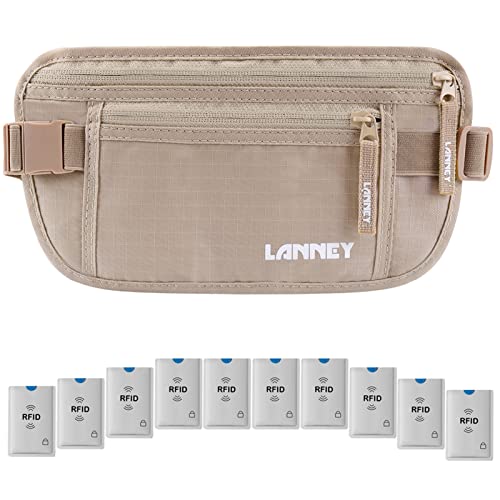
Under ten dollars, with ten RFID sleeves in the box, which is the most on this page and arguably the whole reason to buy it: a sleeve wraps a card completely with no zip to leave open, and ten of them outlive the belt. Three layers of blocking lining, two zipped pockets with the larger one divided into three, waterproof reinforced nylon, double stitching, a breathable mesh back and a front buckle. The waistband runs 24 to 50 inches. It publishes no thickness, and it promises to be invisible.
Pros:
- Ten RFID sleeves included; the most here, and the better shield
- The lowest price on this page by a clear margin
- Three blocking layers; two zipped pockets, one divided in three
- Waistband 24 to 50 inches; breathable mesh back
Cons:
- No thickness published, on a product sold as invisible
- Names no frequency and no fabric weight
- Claims it will never break
Best for: ten sleeves for under ten dollars.
DAITET
It publishes all three dimensions, including the one that matters: 11.2 by 5.5 by 0.2 inches. Two tenths of an inch is what hidden actually means, and only one other belt here gives you that figure. It also ends its capacity bullet by telling you not to stuff it too full or it will burst, which is blunt, correct and completely absent from every rival. A widened belt, a padded breathable cushion and a soft mesh back that pulls sweat off your skin. Its waist range is 23 to 43 inches, with a maximum stretch to 55.
Pros:
- All three dimensions published, including 0.2 inches thick
- Tells you not to overfill it, in plain words
- Widened belt; padded cushion; soft mesh back for sweat
- Fits from 23 inches; among the cheapest here
Cons:
- Its comfortable range ends at 43 inches; 55 is a stretch figure
- Names no frequency, no fabric, no sleeves included
- Its own bullets contain several typos
Best for: the thickness figure, and plain advice about filling it.
Hidden Money Belt 3rd Gen
Its first bullet and its last bullet are both admissions, which is unheard of. The first says it is not ultra slim and may leave a slight outline under tight clothes, on a product called a hidden money belt. The last says RFID blocking is not universal because frequencies differ, and works only with the zip fully closed. Both are true of every belt on this page. In between: a 1.18-inch widened waistband from 24 to 42 inches, two zipped pockets plus a hidden rear one, a waterproof back panel, and room for two passports and a seven-inch phone.
Pros:
- Admits it may show under tight clothes, in its first bullet
- Admits RFID blocking is not universal and needs the zip shut
- Fits two passports and a 7-inch phone; a hidden rear pocket
- A 1.18-inch widened waistband that does not dig in
- Waterproof back panel with breathable mesh
Cons:
- Not ultra slim, by its own account, and it publishes no thickness
- Its fifth bullet claims 360-degree protection its sixth walks back
- Waistband to 42 inches; 55 is the stretch figure
Best for: the only listing that tells you what it cannot do. Twice.
VENTURE 4TH
It names the frequency, at 13.56 megahertz, which is what contactless cards and electronic passports actually use, and it is the only listing on this page that says which of the several RFID bands it addresses. It also names its fabric properly as 210 denier ripstop nylon, the only material spec here, and names the phone it fits at 6.9 inches including the Pro Max. Seven RFID sleeves are included and it points out they work in a normal wallet too. Its waistband starts at 29 inches, which is the highest floor on this page.
Pros:
- Names the frequency it blocks; the only listing that does
- 210D ripstop nylon; the only fabric spec here
- Seven RFID sleeves, usable outside the belt
- Names the phone size it takes, at 6.9 inches
- Moisture-wicking mesh back; two zipped compartments
Cons:
- Its waistband starts at 29 inches; the highest floor here
- No thickness published
- Does not mention the zip’s effect on its shielding
Best for: the only belt that says what its shield is for.
Alpha Keeper
Two tenths of an inch, published, with the widest waist range here at 25 to 55 inches and a quick-release buckle, which together make it the belt most likely to actually fit and actually hide. It names the phone it takes by model, up to a current Pro Max, and quantifies its card capacity at six, which nobody else does. Its shielding claim is the boldest on the page, wrapping the entire belt, and it is the claim that the accurate listing three rows up says depends on your zip being shut.
Pros:
- 0.2 inches published; genuinely flat against the body
- The widest waist range here: 25 to 55 inches
- Names the phone by model and the card count at six
- Quick-release buckle; moisture-wicking mesh back
Cons:
- Claims shielding wraps the entire belt; a rival explains the zip
- Names no frequency and no fabric
- No RFID sleeves included, at the highest price here
Best for: the flattest belt with the widest fit.
The verdict
Everything here blocks RFID and one listing explains that blocking is frequency-specific and depends on a closed zip. Everything here is hidden and one listing admits it shows through tight clothes. Those two bullets are on the same product, and they describe the entire page.
Best overall: Hidden Money Belt 3rd Gen. It opens by telling you it is not ultra slim and may outline under tight clothes, and closes by telling you its RFID blocking is not universal and only works with the zip fully shut. Both facts are true of every belt on this page and only this one printed them. What is left is a well-made pouch: a widened waistband that does not dig in, a waterproof back panel, a hidden rear pocket, and room for two passports and a phone. You will know exactly what you have bought.
Best value: DAITET. It publishes all three dimensions, and the one that matters is 0.2 inches thick, because hidden is a measurement rather than an adjective. It also tells you plainly not to overfill it or it will burst, which is the correct advice and the thing that actually ruins these. A widened belt, a padded cushion and a mesh back that moves sweat off you, from 23 inches up, for under thirteen dollars.
Best premium: VENTURE 4TH. It is the only listing on this page that says which RFID frequency its shielding is for, at 13.56 megahertz, which is the band your cards and passport actually use, and naming it is the difference between a specification and a sticker. It names its fabric as 210 denier ripstop and the phone it fits at 6.9 inches. Seven sleeves come with it, and it points out they work in an ordinary wallet, which is the plain version of what RFID protection is good for. Check your waist first: this one starts at 29 inches.
FAQ
Does RFID blocking actually work?
Within limits one listing here spells out: it is not universal, because RFID runs at several frequencies, and it is effective only when the item is zipped fully inside. A gap in a shield is not a shield.
Which frequency should it block?
13.56 megahertz is what contactless cards and electronic passports use, and exactly one listing on this page names it. The rest offer RFID blocking as if it described one thing.
Will it show under my clothes?
Look for a thickness. Two belts publish 0.2 inches. One says outright it is not ultra slim and may outline under tight-fitting clothes, which is fair and probably true of all of them once loaded.
Are the sleeves better than the belt?
For shielding, yes. A sleeve wraps one card completely with no zip to leave open, and it works in your everyday wallet. Two belts here include seven and ten of them.
How much can I put in?
Less than they list. One listing ends its capacity bullet by telling you not to stuff it too full or it will burst, which is the only realistic sentence about capacity on this page.
This article may contain affiliate links; see our Affiliate Disclosure.