Plug an ordinary USB cable into a camera 50 feet away and the feed stutters, drops, or simply never appears, because copper USB was never meant to run that far. Active optical cables fix it by turning the signal into light inside the jacket, so a webcam across a conference room or a sensor on the far side of a workshop reports back as cleanly as one sitting on the desk.




A long-distance cable earns its place three ways: it holds its rated speed over the whole run instead of fading with every extra meter, it shrugs off the electromagnetic noise that fills racks and busy rooms, and it is flexible enough to actually route through the conduit, ceiling, or wall where it has to go. That holds whether you are wiring a hybrid meeting room, feeding a 4K camera into an editing rig, extending a VR headset, or linking a machine-vision sensor to a controller. The picks below lead with the best sellers, so the most-bought cables come first.
| Cable | Standout features | Price | Link |
|---|---|---|---|
| GeoHN.G Right-Angle USB-C (50 ft) | 10Gbps USB 3.2 Gen2, German SiliconLine chip, 90° right-angle connector, Kevlar core | Mid-range | |
| phoossno USB-C to C (100 ft) | 10Gbps over the longest run here, 4.8 mm slim jacket, data only | Premium | |
| phoossno USB-C to C (33 ft) | 10Gbps USB 3.2, 4.8 mm flexible jacket, broad camera compatibility | Mid-range | |
| phoossno USB-A to C (50 ft) | 10Gbps USB 3.2 Gen2, A-to-C orientation, backward compatible to USB 2.0 | Mid-range | |
| DavVision Extension, A M-to-F (33 ft) | 10Gbps male-to-female extension, zinc-alloy shells, 2-year support | Mid-range | |
| phoossno Extension, A M-to-F (33 ft) | 10Gbps male-to-female with swappable end adapters, slim jacket | Mid-range | |
| DWLCWY USB-A to C (33 ft) | 10Gbps USB 3.2 Gen2, German SiliconLine chip, conduit-friendly jacket | Mid-range | |
| DavVision Extension, A M-to-F (50 ft) | 10Gbps male-to-female extension, EMI-shielded zinc-alloy shells | Mid-range | |
| DavVision USB-C (50 ft) | 10Gbps USB 3.2 Gen2, German SiliconLine chip, ultra-slim jacket | Mid-range | |
| BlueRigger Active USB 3.0 (25 ft) | 5Gbps copper active extension, also carries 5V/1A charging, lifetime warranty | Budget | |
The price column shows a general tier only. Prices move often, so tap a link for the live figure on Amazon.
How to choose an active optical USB cable for long runs
Length is only the start. Two cables of the same rated speed can behave very differently at the far end depending on how the signal travels, which way it flows, and how the jacket routes. Here is what separates a long cable that just works from one that frustrates.
Active optical versus passive copper
Passive copper USB is reliable only for short distances; push it much past a few meters at high speed and the signal weakens until devices disconnect. Active optical cables (AOCs) carry the data as light through a fiber core, with tiny converters in each connector translating electrical to optical and back. Light does not fade over these lengths the way current does, which is why every fiber cable here holds its rated speed across 33, 50, even 100 feet. The trade-off is that an AOC needs a powered host and is usually one cable for one job.
Speed: 10Gbps versus 5Gbps
Most cables here are USB 3.2 Gen2 rated at 10Gbps, enough for uncompressed 4K camera feeds, fast external drives, and machine-vision streams. The budget copper pick runs at 5Gbps, still ten times USB 2.0 and plenty for webcams, keyboards, and general peripherals. The cable only reaches a speed both host and device support, so confirm both ends before expecting the full figure.
Direction and the data-only catch
This is the detail that trips people up. Almost every optical cable here is directional: one end is marked for the host (the PC or laptop) and the other for the device (the camera, drive, or headset), and reversing them means nothing works. They are also data-only, so they will not send video from a laptop to a monitor and most carry little or no charging power. The copper BlueRigger is the exception, working either direction and passing 5V/1A.
Connector type: C-to-C, A-to-C, and male-to-female
Pick the ends to match your gear. USB-C to USB-C suits modern laptops and cameras; USB-A to USB-C meets desktops and capture cards that still use USB-A; and a male-to-female extension simply adds reach to a device you already own, sometimes with swappable adapters so one cable serves many. If a host is USB-A and the cable is C-to-C, you will need an adapter, so plan the chain end to end.
Build, routing, and interference
For a permanent install the jacket matters as much as the chip. A slim, flexible cable, several here are around 4.8 mm, pulls through conduit and hides along trim; a stiff one fights you the whole way. Fiber cables emit no electromagnetic noise and resist it, keeping feeds clean inside racks and near motors. The shell and connectors matter too: zinc-alloy housings aid heat and EMI shielding, gold or nickel plating resists corrosion, and a Kevlar-reinforced core survives the bends a long run takes. A right-angle plug, like the GeoHN.G’s, also spares a port from sideways strain in tight mounts.
GeoHN.G Right-Angle USB-C Fiber Optic Cable (50 ft, 10Gbps)
The best seller in this group solves a problem most long cables ignore: the connector that snaps off because someone caught the cord with a foot. Its 90° right-angle USB-C plug routes the cable flat against the device, taking the strain off a webcam or camera port instead of levering it sideways. Inside, a German SiliconLine conversion chip carries 10Gbps over the full 50 feet as light rather than copper current, so the signal does not fade the way it does on a long passive cable. The Kevlar-reinforced fiber core is rated for over 35,000 bend cycles, the shell is zinc alloy for heat and interference, and the plugs are 24K gold-plated against corrosion. Note that it runs one direction only, host to device.
Pros
- Right-angle connector protects ports in tight mounts
- German SiliconLine chip drives a clean 10Gbps at 50 ft
- Kevlar fiber core rated past 35,000 bend cycles
- Zinc-alloy shell and 24K gold plating for durability
- 5-year warranty with lifetime technical support
Cons
- Directional only: host end and device end are fixed
- USB-C to USB-C, so USB-A hosts need an adapter
- Data and the cable’s stated speed, not a charging cable
Best for: flush-mounted webcams, studio cameras, or any device where a straight plug would strain the port.
Mid-range tier. Check price on Amazon
phoossno USB-C to USB-C Fiber Optical Cable (100 ft, 10Gbps)
When the camera and the computer sit on opposite sides of a large room, this is the cable that bridges the gap. At 100 feet it is the longest run in the comparison, and it still holds 10Gbps because the optical core converts the signal to light end to end, sidestepping the distance limits that stop ordinary USB at a few meters. Despite the length the jacket is only 4.8 mm thick, slim and flexible enough to thread through tight conduit, and because it is fiber it emits no electromagnetic noise and shrugs off interference from nearby equipment. The plugs are 24K gold-plated, the housing is zinc alloy, and the Kevlar-wrapped core is rated for at least 10,000 bend cycles. It carries data only, not video to a monitor.
Pros
- Longest reach here at 100 ft with no signal loss
- Slim 4.8 mm jacket pulls through tight conduit
- Immune to and emits no electromagnetic interference
- 24K gold plugs, zinc-alloy housing, Kevlar core
- Plug-and-play across Windows, Mac, and Unix
Cons
- Premium tier, the priciest in this group
- Directional, data-only; not for laptop-to-monitor video
- Check recessed USB-C sockets fit the plug head
Best for: the longest hauls, such as a ceiling or far-wall camera feeding a PC across a big room.
Premium tier. Check price on Amazon
phoossno USB-C to USB-C Fiber Optical Cable (33 ft, 10Gbps)
This is the shorter, more affordable sibling of the 100-foot model, sharing the same optical design in a 33-foot length that suits a single room. It moves USB 3.2, 3.1, 3.0, and 2.0 signals at up to 10Gbps without the fade a passive copper cable suffers past a few meters, and the same 4.8 mm jacket keeps it flexible and easy to route along a wall or under a desk. Build quality matches the family: 24K gold-plated plugs, a zinc-alloy housing, and a Kevlar-covered fiber core rated for at least 10,000 bend cycles. Compatibility is broad, from MacBooks to conference cameras and touch screens, and it needs no driver. Like its siblings it is data only.
Pros
- Full 10Gbps over a practical 33-foot run
- Slim 4.8 mm jacket is easy to route and hide
- Wide device support: cameras, touch screens, scanners
- 24K gold plugs and zinc-alloy housing
- No driver or adapter required to use
Cons
- Directional, data-only; not for video to a display
- USB-C both ends, so USB-A hosts need an adapter
- Confirm fit with deeply recessed USB-C ports
Best for: a single-room USB-C link to a conference camera or touch display at a sensible price.
Mid-range tier. Check price on Amazon
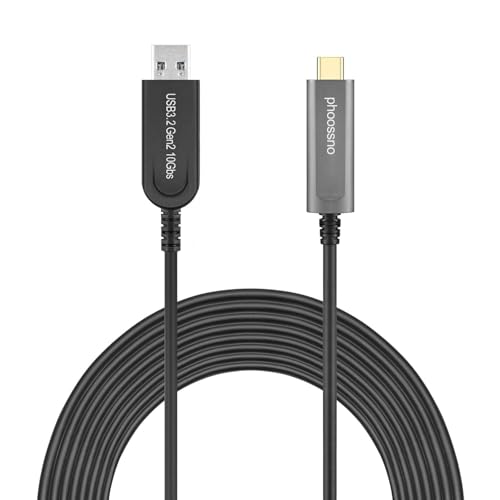
phoossno USB-A to USB-C Fiber Optical Extension (50 ft, 10Gbps)
Most desktops and many capture cards still expose USB-A, and this cable meets them where they are: a USB-A plug at the host end and USB-C at the device. Over its 50-foot (15 m) length the optical core sustains 10Gbps USB 3.2 Gen2 while staying lighter and more flexible than the equivalent copper cable, and it falls back gracefully to 5Gbps and USB 2.0 speeds for older gear. The USB-C device end opens it to a wide field of peripherals, from machine-vision cameras and KVM extenders to VR headsets and digital signage. It is plug-and-play on Windows, Mac, and Unix, and as with the optical cables here it carries data, not video to a monitor.
Pros
- USB-A host plug fits desktops and capture cards
- 10Gbps USB 3.2 Gen2 across the full 50 ft
- Backward compatible to USB 3.0 and USB 2.0
- Lighter and more flexible than copper at this length
- No driver needed on Windows, Mac, or Unix
Cons
- Directional, data-only; no laptop-to-monitor video
- Device end is USB-C, so USB-A peripherals need an adapter
- Confirm both devices support the speed you expect
Best for: extending a USB-C camera or sensor back to a desktop or capture rig with a USB-A port.
Mid-range tier. Check price on Amazon
DavVision USB 3.2 Fiber Optic Extension, Male to Female (33 ft, 10Gbps)
An extension that ends in a USB-A female port is the flexible choice when you do not yet know what will plug in. This 33-foot DavVision adds 10Gbps of reach to whatever USB-A device you already own, from a webcam to a flash drive to a gaming peripheral, by carrying the signal optically rather than over copper that would fade at this distance. The connectors are nickel-plated against oxidation, the shell is recyclable zinc alloy for heat dissipation and EMI shielding, and dual acrylic-resin coatings plus an optical lens coupling are built for years of service. It is directional, host to device, and should not be over-bent. It backs up to USB 3.0 and 2.0 speeds and carries a 2-year warranty.
Pros
- Female end accepts any USB-A device you plug in
- 10Gbps optical signal across the full 33 ft
- Nickel-plated connectors resist oxidation
- Zinc-alloy shell for heat and EMI shielding
- 2-year warranty with lifetime technical support
Cons
- Directional: keep to the host-to-device orientation
- Avoid sharp over-bending of the optical core
- Data-only; not a video or charging extension
Best for: adding length to an existing USB-A device without committing to a fixed connector type.
Mid-range tier. Check price on Amazon
phoossno USB 3.1 Active Optical Extension, Male to Female (33 ft, 10Gbps)
This phoossno extension takes the same male-to-female idea and leans into versatility. The USB-A female end lets you swap in different adapters, A-to-A, A-to-B, A-to-C, A-to-Micro-B, A-to-Mini-B, so one cable can serve a hard drive today and a camera tomorrow. Over 33 feet (10 m) it carries up to 10Gbps optically, with graceful fallback to USB 3.0, 2.0, and 1.1 for older devices, and the fiber build keeps it slimmer and more flexible than a copper run of the same length. It is plug-and-play on Windows, Mac, and Unix with no driver to install, suiting industrial control, digital signage, KVM extension, and conferencing alike. Like the others it handles data, not video to a display.
Pros
- Female end takes interchangeable USB adapters
- 10Gbps over 33 ft with fallback to older USB
- Slim, flexible fiber build versus copper
- Broad use: control systems, signage, KVM, cameras
- Driver-free on Windows, Mac, and Unix
Cons
- Directional, data-only; not for monitor video
- Adapters for non-A devices may be needed separately
- Avoid over-bending the optical core
Best for: a do-anything extension whose end connector you can change as your devices change.
Mid-range tier. Check price on Amazon
DWLCWY USB-A to USB-C Fiber Optic Cable (33 ft, 10Gbps)
Built with installers in mind, this DWLCWY cable pairs a USB-A host plug with a USB-C device end and a German SiliconLine conversion chip driving a stable 10Gbps USB 3.2 Gen2 over 33 feet. The hybrid active-optical design strongly resists electromagnetic interference and curbs the signal degradation that copper suffers in racks, cable trays, and noisy industrial spaces. The jacket is slim, light, and flexible, which is the point: it pulls through conduit, routes in ceilings and walls, and manages tidily inside a rack for clean professional runs. Durability comes from a zinc-alloy shell, 24K gold-plated connectors, a reinforced fiber core, and dual protective coatings. It is backed by 2-year business after-sales service.
Pros
- German SiliconLine chip for stable 10Gbps at 33 ft
- USB-A to USB-C fits common host and device pairings
- Strong EMI resistance for racks and noisy spaces
- Slim, flexible jacket pulls through conduit easily
- Zinc-alloy shell, 24K gold plugs, dual coatings
Cons
- Directional, data-only; not laptop-to-monitor video
- Device end is USB-C, so USB-A peripherals need an adapter
- Confirm both devices support 10Gbps for full speed
Best for: in-wall and in-rack installs where conduit routing and interference resistance matter most.
Mid-range tier. Check price on Amazon
DavVision USB 3.2 Fiber Optic Extension, Male to Female (50 ft, 10Gbps)
This is the 50-foot version of DavVision’s male-to-female extension, for the times when 33 feet falls short. It carries 10Gbps optically over the longer run, ending in a USB-A female port that accepts whatever device you bring, a surveillance camera, a scanner, a hard drive, while backing down to USB 3.0 and 2.0 for older gear. The build mirrors its shorter sibling: nickel-plated connectors against oxidation, a recyclable zinc-alloy shell for heat and EMI shielding, and dual acrylic-resin coatings with optical lens coupling for long service. It is directional, host to device, should not be over-bent, and ships with a 2-year warranty and lifetime technical support.
Pros
- Female end accepts any USB-A device
- Full 10Gbps over a long 50-foot run
- Nickel-plated connectors resist corrosion
- Zinc-alloy shell for heat and EMI shielding
- 2-year warranty with lifetime support
Cons
- Directional: keep host-to-device orientation
- Avoid over-bending the optical core
- Data-only; not a video or charging extension
Best for: a long male-to-female extension for surveillance, machine vision, or far-placed peripherals.
Mid-range tier. Check price on Amazon
DavVision USB-C Fiber Optic Cable (50 ft, 10Gbps)
DavVision’s USB-C to USB-C entry covers the 50-foot run with a German SiliconLine conversion chip behind its 10Gbps USB 3.2 Gen2 throughput. The selling point alongside the speed is the ultra-slim jacket, which makes a half-room cable far easier to route and conceal than a stiff copper equivalent. As fiber it brings zero electromagnetic interference and no signal loss across the distance. Durability is handled by 24K gold-plated connectors, a recyclable zinc-alloy shell for heat and EMI, and dual acrylic-resin plus heat-setting coatings rated for long use. It runs one direction, host to device, suiting a 4K webcam, VR headset, or industrial control system on the far end, and includes a 2-year warranty.
Pros
- German SiliconLine chip for steady 10Gbps at 50 ft
- Ultra-slim jacket routes and hides easily
- Zero EMI and no signal loss over the run
- 24K gold plugs and zinc-alloy shell
- 2-year warranty with lifetime technical support
Cons
- Directional only: host and device ends are fixed
- USB-C both ends, so USB-A hosts need an adapter
- Data-only; not for laptop-to-monitor video
Best for: a slim, easy-to-route USB-C run to a 4K camera, VR headset, or control system across a room.
Mid-range tier. Check price on Amazon
BlueRigger Active USB 3.0 Extension Cable (25 ft, 5Gbps)
Not every long run needs fiber or 10Gbps, and the BlueRigger is the practical, budget answer for those. It is an active copper extension, USB-A male to female, with a signal booster built in so it reaches 25 feet where a plain passive cable would drop out. It moves data at up to 5Gbps, ten times USB 2.0, and unlike the optical cables here it also carries power at 5V/1A, so it can both extend and charge a device, and it works in either direction. Nickel-plated connectors and multiple shielding layers reduce interference, and an aluminum-alloy casing aids heat dissipation. It is broadly compatible across Windows, Mac, Linux, and Chrome OS, and is backed by a lifetime warranty.
Pros
- Budget tier and the most affordable here
- Carries 5V/1A power as well as data
- 5Gbps, ten times USB 2.0 speed
- Works in either direction, not host-locked
- Lifetime warranty with US-based support
Cons
- 5Gbps and 25 ft, below the optical cables on both
- Copper, so not immune to electromagnetic interference
- Less reach than the 50- and 100-foot fiber picks
Best for: shorter runs that need both data and a little charging, or anyone wanting the lowest price.
Budget tier. Check price on Amazon
The verdict
Best overall
The GeoHN.G Right-Angle USB-C Fiber Optic Cable takes the top spot. It is the best seller here, and it pairs a clean 10Gbps over 50 feet, driven by a German SiliconLine chip, with the port-saving right-angle connector and a Kevlar core rated past 35,000 bends. For the most common long-distance job, feeding a camera or sensor back to a PC, it is the most complete and most trusted answer. Check price on Amazon
Best value
The BlueRigger Active USB 3.0 Extension wins on value. At the budget tier it delivers a dependable 25-foot active run at 5Gbps, and unlike the optical cables it also passes charging power and works in either direction. For shorter distances and everyday peripherals it covers the need for the least money. Check price on Amazon
Best premium
The phoossno USB-C to USB-C 100-Foot Fiber Optical Cable is the premium pick. When the distance is genuinely long, it holds the full 10Gbps across 100 feet in a jacket slim enough to thread through conduit, with the interference immunity only fiber provides. Nothing else here reaches as far without compromise. Check price on Amazon
Frequently asked questions
Why can’t I just use a normal long USB cable?
Standard passive copper USB is only rated for short distances at high speed, often just a few meters, because the electrical signal weakens with length until the device disconnects. Active optical cables convert the signal to light inside the jacket, and light does not fade the same way, so they hold their rated speed across 33, 50, or even 100 feet where a passive cable would fail.
What does “directional” mean and why does it matter?
Most active optical cables here send data one way only: one end is labeled for the host (your PC or laptop) and the other for the device (the camera, drive, or headset). Plug them in reversed and nothing works. Always check the labels and connect the host end to the computer. The copper BlueRigger is the exception and works in either direction.
Will these cables carry video to a monitor or charge my device?
The optical cables here are data-only: they will not send video from a laptop to a display, and most carry little or no charging power. They are made to extend cameras, drives, sensors, and similar peripherals over distance. If you need charging along with data, the copper BlueRigger passes 5V/1A; for monitor video you would need a dedicated display cable instead.
Do I get 10Gbps just by buying a 10Gbps cable?
Only if both your host and your device also support that speed. The cable cannot exceed the slowest link in the chain, so a 10Gbps cable between a 5Gbps port and a 5Gbps camera runs at 5Gbps. Check the USB generation of both ends, and if a host is USB-A while the cable is USB-C, plan for an adapter.
Are active optical cables fragile?
They are more bend-sensitive than copper, so avoid sharp kinks and very tight loops around the fiber core. That said, the cables here are built for it: Kevlar-reinforced cores rated for thousands of bend cycles, zinc-alloy shells, and protective coatings. Routed with gentle curves through conduit or along trim, they are made to last for years of fixed installation.
This article may contain affiliate links; see our Affiliate Disclosure.