Thirty seconds of hard waves and your forearms are on fire, your lungs are screaming, and you have not moved a single step. That is the strange magic of a battle rope: it turns a length of woven cord into one of the most punishing pieces of conditioning gear you can own. But two ropes that look identical on a shelf can feel like different tools entirely once you pick them up, and almost all of that difference comes down to two numbers: how thick the rope is and how long it runs.





A great battle rope matches its thickness and length to your grip, your space, and how hard you want to work, then survives years of slams without shedding fibers. That balance lands differently for a beginner in a small apartment, a parent squeezing in a garage circuit, a coach kitting out a class, and an athlete chasing raw power. The lineup below leads with the proven best sellers, then covers thicker ropes, longer ropes, and the ropeless designs that skip the anchor entirely.
| Battle rope | Standout feature(s) | Price tier | Link |
|---|---|---|---|
| Amazon Basics 1.5″ x 30 ft | Poly Dacron, waterproof sleeve, heat-shrink caps, tracking line | Budget | |
| COCTN Ropeless (Weighted) | Cordless, ~1.61 lb each, silent, no anchor, rubber grips | Budget | |
| Triberion 1.5″ x 30 ft (Black) | Heavy 3-strand polyester, nylon sleeve, anchor strap kit | Mid-range | |
| Triberion 1.5″ x 40 ft (Black) | Longer 40 ft span, sleeve and anchor kit, fuller waves | Mid-range | |
| Triberion 1.5″ x 30 ft (Red) | Same 30 ft heavy build in a high-visibility red sleeve | Mid-range | |
| Poonoo Ropeless (Weighted) | Cordless pair ~3 lb, ~17 in long, quiet, spring resistance | Budget | |
| Max4out 1.5″ x 30 ft | Polyester-covered 3-strand twist, straightforward build | Mid-range | |
| REP 1.5″ x 50 ft (with Sleeve) | Long 50 ft Poly Dacron, full nylon sleeve, 1-year warranty | Premium | |
| SPRI 1.5″ x 18 ft | Short 18 ft length, compact, low-ceiling and small-space friendly | Mid-range | |
| Meister 2.0″ x 30 ft | Thick 2-inch sheathed rope, molded 7.5″ handles, high resistance | Premium | |
The price column shows a general tier only. Prices move often, so tap a link for the live figure on Amazon.
How to choose a battle rope
Every rope here will leave you breathless if you swing it hard enough. What changes from one to the next is how much grip strength it demands, how big the waves feel, where you can actually use it, and how long it lasts. Four decisions do most of the work.
Diameter: 1.26″, 1.5″, or 2″
Thickness sets the difficulty floor. A 1.5-inch rope is the all-rounder almost everyone reaches for first: heavy enough to build real power, thin enough that most hands can wrap it comfortably and keep the waves moving for a full interval. A thinner 1.26-inch rope is lighter and easier to control, a friendly starting point for newcomers or for high-rep, cardio-leaning sessions. Step up to a 2-inch rope and everything intensifies, the rope weighs more, your grip works overtime just to hold on, and each wave carries more force. Bigger diameters build grip and forearm strength fast, but they punish sloppy form and tire untrained hands quickly.
Length: 30, 40, or 50 feet (and shorter)
Length determines the size and feel of your waves, and how much room you need. Because a battle rope folds in half around an anchor, a 30-foot rope gives you roughly 15 feet of working space per side, a 40-foot rope about 20, and a 50-foot rope about 25. Longer ropes weigh more, produce larger, slower, more powerful waves, and demand more floor, which is why gyms favor 50-footers. A 30-foot rope is the home and garage sweet spot, intense but manageable in a single-car bay or backyard. Shorter ropes around 18 feet trade some weight and wave size for a compact footprint that fits low-ceiling basements and tight rooms.
Sleeve, construction, and durability
Battle ropes live a rough life, dragged across concrete, slammed into the floor, and yanked against an anchor. A three-strand twisted Poly Dacron or polyester core resists stretching and holds its shape, and heat-shrink end caps keep the strands from unraveling. The bigger durability upgrade is a protective sleeve: a nylon or Oxford cover that takes the abrasion so the rope underneath does not fray, shed fibers, or chew up your floor. If you train on concrete or rough ground, a sleeved rope is worth the premium.
Anchored rope vs ropeless
A traditional rope needs a solid anchor, a post, a heavy rack, a tree, or a wall ring, and enough room to lay it out. Ropeless or cordless designs skip all of that: short weighted or spring-loaded handles mimic the wave motion in place, run quietly, and store in a drawer. They will not perfectly replicate the inertia and unpredictability of a real rope, but for apartments, travel, shared walls, and tiny spaces, they deliver a similar burn without an anchor or 15 feet of clearance. Choosing between them is mostly a question of space and noise.
Handles and grip
Your hands are the weak link in any rope session. Heat-shrink ends on a traditional rope double as no-slip grips and are the most common setup; thicker molded handles with finger channels, like the ones on wider ropes, give more to hold onto and help when palms get sweaty. Ropeless models lean on rubber or foam grips, often ergonomically shaped, since you hold them for the entire workout. Whatever the style, a secure grip is what lets you finish the last brutal interval instead of dropping the rope early.
Amazon Basics Battle Rope (1.5″ x 30 ft)
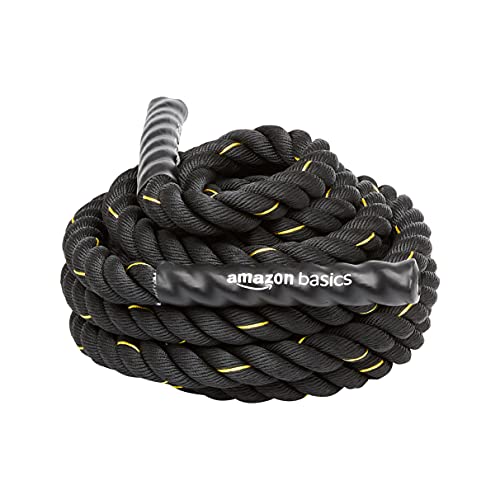
The best seller in this group hits the dimensions most people actually want: a 1.5-inch diameter and a 30-foot length, the configuration that suits the widest range of homes, garages, and skill levels. It is built from 100% Poly Dacron in a durable three-strand twisted design, wrapped in a 600D Oxford waterproof sleeve, and finished with heat-shrink end caps so the strands stay put. A bright orange-yellow tracking line runs the length, a small touch that makes wear and twist easy to spot. For a do-everything first rope at a budget price, it is hard to argue with.
Pros
- Versatile 1.5-inch by 30-foot size suits most users and spaces
- 100% Poly Dacron, three-strand twisted for durability
- 600D Oxford waterproof sleeve resists abrasion and fraying
- Heat-shrink end caps double as no-slip grips
- High-visibility tracking line for easy maintenance
Cons
- No anchor strap included in the box
- 1.5-inch diameter is moderate, not the heaviest option here
Best for: anyone who wants a proven, no-fuss first rope in the most universal size.
Budget tier. Check price on Amazon
COCTN Weighted Ropeless Battle Ropes
If you do not have a spare 15 feet or a solid anchor, the COCTN reinvents the rope as a pair of short weighted handles. Each one is built around precision steel and weighs about 1.61 pounds, enough heft to feel the load and protect your wrists while you drive the wave motion in place. The upgraded rubber handles are sweat-absorbing and non-slip, ergonomically shaped, and screw on with a threaded connection so they will not work loose mid-set. It runs silently, packs into a bag, and comes with a training poster, making it a genuine option for apartments, offices, and travel.
Pros
- Cordless design needs no anchor and almost no space
- Steel-weighted handles, about 1.61 lb each, for real resistance
- Silent operation suits apartments and shared walls
- Non-slip ergonomic rubber grips with secure threaded fit
- Portable, with a training poster included
Cons
- Cannot fully replicate the inertia of a long anchored rope
- Fixed weight, so resistance is not adjustable
Best for: small-space and quiet-workout users who want a rope-style burn without an anchor.
Budget tier. Check price on Amazon
Triberion Battle Rope (1.5″ x 30 ft, Black)
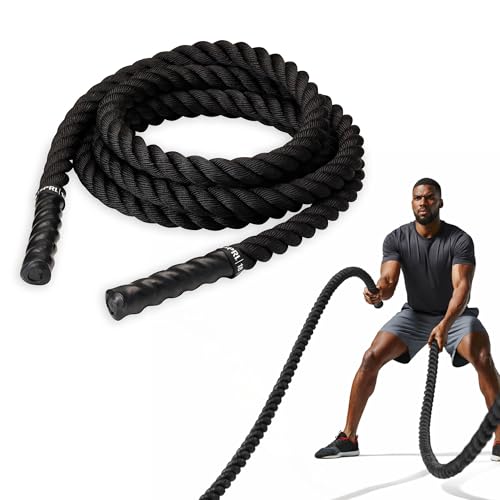
The Triberion takes the popular 1.5-inch, 30-foot format and leans into heavy-duty use. The core is a tough three-strand 100% polyester filament, and the headline upgrade over the basic ropes is a full ultra-durable nylon sleeve that absorbs the friction of slams, tire pulls, and sled drags while sparing your hands and floor. It ships with a rust-resistant anchor strap kit, so you can secure it to a post, tree, or rack out of the box, and thick heat-shrink handles keep your grip locked in when your palms are slick. It is a noticeably more rugged rope than the entry-level options.
Pros
- Heavy three-strand polyester built for intense, abusive training
- Full-length ultra-durable nylon sleeve protects rope, hands, and floor
- Rust-resistant anchor strap kit included
- Thick heat-shrink non-slip handles
- Popular 1.5-inch by 30-foot size for home and garage
Cons
- Heavier build is more rope than casual users need
- Costs more than unsleeved budget ropes
Best for: home and garage athletes who want a sleeved, anchor-ready rope in the standard size.
Mid-range tier. Check price on Amazon
Triberion Battle Rope (1.5″ x 40 ft, Black)
This is the same rugged Triberion build stretched to 40 feet, the middle ground between a home 30-footer and a full gym 50-footer. The extra length adds weight and lets the waves run bigger and more powerful, while still folding down to about 20 feet of working space per side, which a roomy garage or backyard can usually accommodate. You get the identical three-strand polyester core, the protective nylon sleeve, the heat-shrink handles, and the anchor strap kit. If your 30-foot rope started to feel easy, this is the natural step up without committing to gym-sized real estate.
Pros
- 40-foot length delivers bigger, heavier, more powerful waves
- Same durable polyester core and protective nylon sleeve
- Anchor strap kit and thick heat-shrink handles included
- Step-up challenge over a standard 30-foot rope
- Still fits a larger garage or backyard setup
Cons
- Needs more clearance than a 30-foot rope
- Heavier and pricier, more than beginners require
Best for: intermediate users who have outgrown 30 feet but lack room for a 50-footer.
Mid-range tier. Check price on Amazon
Triberion Battle Rope (1.5″ x 30 ft, Red)
Mechanically this is the black 30-foot Triberion in a different coat: the same heavy three-strand polyester core, the same abrasion-fighting nylon sleeve, the same anchor strap kit and thick heat-shrink handles, finished in a high-visibility red. The bright cover is more than cosmetic, it makes the rope easy to track at a glance during fast waves and easy to spot if you train outdoors or in a busy garage. Pick it over the black version purely on looks or visibility; the workout is identical.
Pros
- Identical heavy 1.5-inch by 30-foot build to the black version
- High-visibility red sleeve is easy to track during fast waves
- Abrasion-resistant nylon sleeve protects rope and floor
- Anchor strap kit and heat-shrink handles included
- Rugged enough for slams, pulls, and drags
Cons
- No performance difference from the black model
- Same higher price as the sleeved black rope
Best for: buyers who want the sleeved Triberion in a brighter, easier-to-see color.
Mid-range tier. Check price on Amazon
Poonoo Upgraded Ropeless Battle Ropes
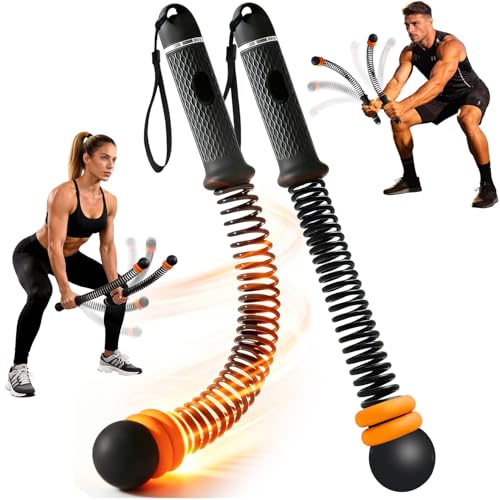
The Poonoo is the other cordless contender, and it solves the space problem in the most literal way: each handle is about 17 inches long, the pair weighs roughly 3 pounds, and there is no rope to lay out and no anchor to find. Instead of dead weight alone, it uses a reinforced spring resistance system that simulates the smooth, consistent tension of real rope waves, and it does so quietly enough not to bother neighbors or mark up floors. Anti-slip ergonomic handles keep it stable through intense intervals, and the whole kit tucks away when you are done. For apartments, hotel rooms, and offices, it turns almost any spot into a conditioning station.
Pros
- Fully cordless, no anchor or open floor needed
- Spring resistance simulates real rope wave tension
- Very quiet and floor-friendly for shared spaces
- Light and compact, about 3 lb per pair, easy to travel with
- Anti-slip ergonomic handles for intense sessions
Cons
- Spring feel differs from a heavy rope’s raw inertia
- Lighter overall, so less absolute resistance than a thick rope
Best for: apartment and travel users who want the quietest, most compact rope-style cardio.
Budget tier. Check price on Amazon
Max4out Battle Ropes (1.5″ x 30 ft)
The Max4out keeps things simple and sticks to the proven 1.5-inch, 30-foot recipe. It is a heavy-duty three-strand twisted rope with a polyester cover that shields the core from friction so it holds up over years of use. There is no anchor kit or tracking line here, just a straightforward, durable rope that tones the arms, chest, shoulders, and core, and works for men and women across fitness levels. As the brand notes, longer ropes carry more weight and hit harder, so this 30-foot version sits in the accessible, everyday-training zone.
Pros
- Standard versatile 1.5-inch by 30-foot dimensions
- Three-strand twisted build with protective polyester cover
- Durable enough for years of regular use
- Full-body conditioning for all fitness levels
- Simple, no-frills design
Cons
- No anchor strap or tracking line included
- Fewer extras than sleeved, kitted competitors
Best for: buyers who want a plain, dependable 30-foot rope without paying for accessories.
Mid-range tier. Check price on Amazon
REP Battle Ropes (1.5″ x 50 ft, with Sleeve)
This is the rope for people who want full gym-scale waves at home. At 50 feet, it folds to roughly 25 feet of working space per side, the length that produces the biggest, most powerful waves and the most demanding intervals. The poly Dacron, three-twist braided construction is tuned for flexibility, feel, and clean wave action, and a full-length nylon sleeve protects it from fraying and wear so it survives serious training. Heat-shrink ends keep it wound tight and give a non-slip grip, and it is backed by a one-year warranty against breakage in normal use from an established Colorado fitness company. The trade-off is the space and the premium price.
Pros
- Long 50-foot length for the biggest, gym-scale waves
- Poly Dacron three-twist braid tuned for feel and wave action
- Full-length nylon sleeve resists fraying and wear
- Heat-shrink non-slip grips
- One-year warranty from an established fitness brand
Cons
- Needs a large space, roughly 25 feet per side
- Highest price in the lineup
Best for: serious trainers and coaches who want long, full-power waves and a warranty.
Premium tier. Check price on Amazon
SPRI Battle Rope (1.5″ x 18 ft)
At 18 feet, the SPRI is the compact specialist of the group, the answer when you want rope training but do not have room to anchor a 30-footer. The shorter length means a smaller footprint and lighter overall weight, which makes it manageable in a basement, a low-ceiling room, or a tight corner of the gym, while still delivering the high-intensity, core-targeting work battle ropes are known for. It is a 1.5-inch durable conditioning rope from a well-known fitness brand, built for repeated vigorous use, with simple care: towel it dry and store it somewhere cool and dry.
Pros
- Short 18-foot length fits small and low-ceiling spaces
- Lighter and easier to handle than longer ropes
- 1.5-inch durable build for repeated high-intensity use
- Targets core, arms, grip, and stamina
- From an established fitness brand
Cons
- Less weight and smaller waves than 30-foot-plus ropes
- No anchor kit or protective sleeve
Best for: small-space and low-ceiling setups that still want a real anchored rope.
Mid-range tier. Check price on Amazon
Meister Professional Sheathed Battle Rope (2.0″ x 30 ft)
This is the thick-rope option, and the jump from 1.5 to 2 inches changes the whole feel. The 2-inch diameter is heavier and offers intermediate-to-high resistance, so your grip and forearms work much harder just to keep the waves moving. It is built from superior triple-strand twisted Poly-Dacron and wrapped in a rugged nylon sleeve that avoids abrasion and stops the rope shedding fibers during heavy use, equally at home in a commercial or home gym. The standout detail is the handles: thick 7.5-inch molded grips with deep finger channels that stay locked in no matter how much you sweat. At 30 feet it keeps a manageable footprint while delivering serious resistance.
Pros
- Thick 2-inch diameter builds grip and forearm strength fast
- Triple-strand twisted Poly-Dacron with rugged nylon sleeve
- Thick 7.5-inch molded handles with deep finger channels
- Commercial-grade durability, no fiber shedding
- 30-foot length keeps a manageable footprint for the resistance
Cons
- 2-inch grip is demanding, tough for untrained or smaller hands
- Premium price and no anchor kit included
Best for: stronger athletes who want maximum grip and resistance from a thick rope.
Premium tier. Check price on Amazon
The verdict
Best overall
The Amazon Basics 1.5″ x 30 ft takes the top spot, and the sales make the case: it pairs the most universal diameter and length with genuinely useful build details, the Poly Dacron core, the 600D Oxford waterproof sleeve, heat-shrink caps, and a tracking line, all at a budget price. It is the size that fits the most homes and the most skill levels, which is exactly why it outsells the rest. Start here unless you have a specific reason to go thicker, longer, or ropeless. Check price on Amazon
Best value
The Triberion 1.5″ x 30 ft wins on value once you want more than the basics. For a mid-range price it adds a full protective nylon sleeve and a rust-resistant anchor strap kit, the two upgrades that matter most for durability and for actually setting the rope up, on top of a heavier three-strand polyester build. If you train on concrete or want a rope ready to anchor out of the box without paying premium money, this is the smart buy. Check price on Amazon
Best premium
The REP 1.5″ x 50 ft is the premium pick for anyone who wants true gym-scale training at home: a long, sleeved Poly Dacron rope tuned for clean wave action and backed by a one-year warranty, provided you have the space for it. If your priority is thickness over length, the Meister 2.0″ x 30 ft is the standout alternative, a sheathed 2-inch rope with molded finger-channel handles that builds grip strength like nothing else here. Check price on Amazon
Frequently asked questions
Is a 1.5-inch or 2-inch battle rope better?
It depends on your strength and goals. A 1.5-inch rope is the all-rounder: heavy enough to build power yet easy enough to grip for full intervals, which suits most people and most hands. A 2-inch rope is heavier and far more demanding on the grip and forearms, so it builds those areas quickly but tires untrained or smaller hands fast. Many people start at 1.5 inches and move to 2 inches once their grip strength catches up.
What length battle rope should I get, 30, 40, or 50 feet?
Match the length to your space and intensity. A rope folds in half around its anchor, so a 30-foot rope needs about 15 feet of working room per side and is the home and garage sweet spot. A 40-foot rope gives bigger waves and needs roughly 20 feet per side. A 50-foot rope produces the largest, most powerful waves but requires about 25 feet per side, which is why gyms favor it. If space is tight, an 18-foot rope still delivers a solid workout in a small footprint.
How much space do I need to use a battle rope?
Plan for slightly more than half the rope’s total length, plus room for your stance, because the rope doubles back from the anchor. That means roughly 15 feet of clearance for a 30-foot rope and about 25 feet for a 50-foot rope. You also need a solid anchor point, a post, rack, tree, or wall ring. If you cannot meet those requirements, a ropeless or cordless design gives a similar burn in just a few square feet.
Do ropeless battle ropes actually work?
For conditioning, grip, and cardio in a small or quiet space, yes. Ropeless models use weighted or spring-loaded handles to mimic the wave motion without an anchor or open floor, and they keep your shoulders, arms, and core working through high-intensity intervals. They will not perfectly reproduce the heavy inertia and unpredictability of a long anchored rope, so dedicated power athletes may prefer the real thing, but for apartments, travel, and shared walls they are a practical, effective alternative.
Does a battle rope need a protective sleeve?
If you train on concrete, asphalt, or rough ground, a sleeve is well worth it. The nylon or Oxford cover takes the abrasion from slams and drags so the rope underneath does not fray or shed fibers, and it also protects your floor. On soft turf or rubber matting an unsleeved rope can last a long time, but the sleeve is the single best durability upgrade for hard surfaces.
This article may contain affiliate links; see our Affiliate Disclosure.