A 10-inch blade spins faster and leaves a cleaner edge on trim, while a 12-inch blade reaches deeper to swallow a fat 4×4 or wide crown in a single pass. Pick the wrong diameter and you are either fighting a saw that bogs in thick stock or paying for capacity that gathers dust over your baseboards.





Blade diameter is the headline number on any miter saw, but it sets off a chain of trade-offs in cut capacity, weight, blade cost, and price. The lineup below runs from compact 7-1/4 and 8-inch saws through the popular 10-inch field to a heavy-duty 12-inch slider, plus the angle finders and miter boxes that round out a trim kit. Best sellers lead, so the most-bought tools come first.
| Tool | Standout features | Price | Link |
|---|---|---|---|
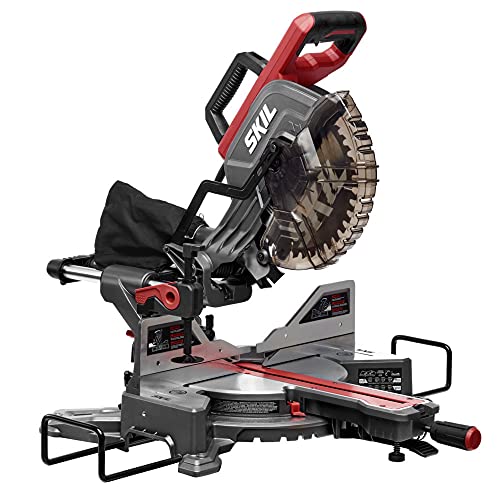
| SKIL 10″ Dual Bevel Sliding (MS6305) | 15-amp 4,800 RPM, dual bevel, LED shadow line, 2×12 crosscut | Mid-range | |
| SKIL 7-1/4″ Compact Rail (MS6306) | Under 25 lbs, compact rail, LED shadow line, 2×10 crosscut | Mid-range | |
| Metabo HPT 10″ Single Bevel (C10FCG2) | 15-amp 5,000 RPM, 24 lbs, Xact Cut shadow line, 5-year warranty | Budget | |
| DEWALT 12″ Double Bevel Sliding (DWS780) | 15-amp 3,800 RPM, XPS shadow line, 2×14 crosscut, 75%+ dust capture | Premium | |
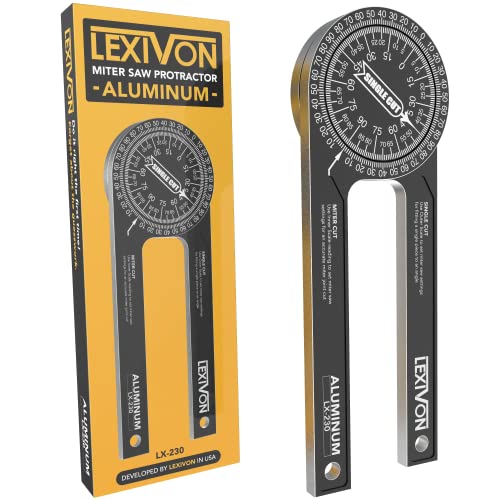
| LEXIVON 7″ Aluminum Protractor (LX-230) | CNC aluminum, laser-engraved scales, transfers angles to the saw | Budget | |
| Marvtool 10″ Compound | 15-amp 5,000 RPM, 20.5 lbs, two extension tables, 36T blade | Budget | |
| Mini Metal Miter Box & Saw Set | Aluminum box, 45/90/135 slots, 6-inch fine-cut saw, three blades | Budget | |
| SEESII 8″ Compact Compound | 4,900 RPM, laser guide, dual safety switches, full accessory kit | Mid-range | |
| Miter Box & Japanese Pull Saw Set | Japanese pull saw, fine and coarse blades, light-duty miter box | Budget | |
The price column shows a general tier only. Prices move often, so tap a link for the live figure on Amazon.
How to choose between a 10-inch and a 12-inch miter saw
Blade diameter is the first fork in the road, and it ripples through almost every other spec on the saw. Once you know which size matches the stock you cut most, the rest, sliding versus fixed, single versus dual bevel, motor power, and cut-line tech, falls into place. Here is what actually separates a saw that earns its bench space from one that frustrates.
What blade size really changes
A 10-inch blade has a smaller radius, so a fixed (non-sliding) 10-inch saw typically crosscuts boards up to about a 2×6, and a sliding 10-inch model reaches a 2×12 flat, like the SKIL slider here. The smaller blade is lighter, spins faster (often 4,800 to 5,000 RPM), and tends to leave a cleaner edge on trim, plus replacement blades cost less and the whole saw is easier to lift. A 12-inch blade trades some speed (the DEWALT runs 3,800 RPM) for reach: it powers through 4×4 posts upright and crosscuts wider boards, up to a 2×14 at 90 degrees on the DEWALT, and it holds tall crown and base molding against the fence with room to spare. The catch is more weight, pricier blades, and a higher sticker.
Match the size to your actual cuts
For baseboards, casing, picture frames, shelving, and the bulk of interior trim, a 10-inch saw covers nearly everything and is friendlier to move and store. Step up to 12 inches when you regularly cut deck framing, 4×4 posts, wide crown nested against the fence, or thick hardwood slabs, where the extra capacity saves you from flipping stock and re-aligning a cut. If your work lives at the small and portable end, picture framing, model work, or quick trim touch-ups, a compact 7-1/4 or 8-inch saw, or even a hand miter box, may be all you need. None of those choices is wrong; they simply target different jobs.
Sliding or fixed, single or dual bevel
A sliding saw puts the head on rails so the blade travels forward through the cut, multiplying crosscut width far beyond the blade’s diameter, which is how a 10-inch slider matches a much larger fixed saw on wide boards. A fixed compound saw chops straight down: simpler, lighter, cheaper, and plenty for narrower stock. Bevel refers to tilting the head for sloped cuts. A single-bevel saw tilts one way, so you flip the workpiece for the opposite angle; a dual (double) bevel tilts both directions, letting you cut matching miters on crown and base without flipping, a real time-saver on long trim runs.
Power, speed, and cut-line accuracy
Most full-size saws here use a 15-amp motor, the practical ceiling on a standard household circuit, with no-load speeds from 3,800 to 5,000 RPM. Higher RPM helps clean cuts in softwood and trim; bigger blades run slower but carry more torque through thick stock. For accuracy, an LED shadow line casts the blade’s own shadow onto the workpiece so the cut tracks the actual kerf, an approach several saws here favor over a laser because it never needs recalibration. A laser guide, as on the SEESII, projects a bright line that some find easier to spot in daylight. Either beats eyeballing it.
Weight, portability, and the supporting cast
If the saw travels between job sites or lives in a small shop, weight matters: the compact saws here run 20 to 25 pounds, while a 12-inch slider is a two-hand lift. Look for built-in dust collection (the DEWALT captures over 75 percent), extension tables to support long boards, and a work clamp to hold stock steady. Two tools round out any miter kit at almost no cost: an angle protractor that reads an inside or outside corner and transfers the exact setting to your saw, and a hand miter box for delicate or cordless-free cuts where firing up a power saw is overkill.
SKIL 10″ Dual Bevel Sliding Compound Miter Saw (MS6305-00)
The best seller in this group makes the strongest case that a 10-inch saw can do almost everything a bigger one can. A 15-amp motor spins the blade at 4,800 RPM, and the sliding rails stretch its reach to a 2×12 crosscut at 90 degrees (2×8 at 45), so it handles wide boards a fixed 10-inch saw cannot touch. Dual bevel means it tilts both left and right with positive stops at 48 and 45 degrees left, 0, and 45 right, so you cut matching crown and base miters without flipping the workpiece. The LED shadow line projects the blade’s real shadow for precise tracking, and 11 positive miter stops out to 50 degrees each way cover the common angles fast.
Pros
- Sliding action delivers a wide 2×12 crosscut at 90 degrees
- Dual bevel cuts both directions without flipping stock
- 15-amp, 4,800 RPM motor for quick, clean cuts
- LED shadow line tracks the actual kerf, no laser to calibrate
- 11 positive miter stops out to 50 degrees left and right
Cons
- Mid-range price, above the basic fixed saws here
- Sliding rails need clearance behind the saw
- 10-inch blade still trails a 12-inch on 4×4 posts
Best for: trim carpenters and serious DIYers who want wide-board capacity and dual-bevel speed in a manageable 10-inch saw.
Mid-range tier. Check price on Amazon
SKIL 7-1/4″ Single Bevel Miter Saw with Compact Rail System (MS6306-00)
This compact SKIL proves a smaller blade need not mean small capacity. A fixed compact rail system lets the 7-1/4-inch blade crosscut up to a 2×10 at 0 degrees and nest crown molding up to 3-1/2 inches, while keeping the saw’s benchtop-to-wall footprint tight enough to work flush against a wall, a genuine help in a cramped shop or garage. At under 25 pounds it is easy to carry to the work, and the 10-amp motor still reaches 4,800 RPM. The LED shadow line guides each cut, a quick miter lock sets angles fast, and miter detents run from 0 to 47 degrees left and 0 to 50 degrees right. Note the stand (SRS0001) sells separately.
Pros
- Compact rail system rolls back the bench footprint, works flush to a wall
- Crosscuts up to 2×10 and nests 3-1/2-inch crown despite the small blade
- Under 25 lbs for easy transport and storage
- LED shadow line and quick miter lock for fast, accurate setup
- Wide miter range, up to 47 left and 50 right
Cons
- Single bevel, so the workpiece must be flipped for opposite angles
- Stand sold separately
- 7-1/4-inch blades are less common than 10- or 12-inch sizes
Best for: tight workspaces and anyone who values a light, wall-hugging saw that still tackles wide trim.
Mid-range tier. Check price on Amazon
Metabo HPT 10″ Single Bevel Compound Miter Saw (C10FCG2)
The Metabo HPT is the value entry into a full 10-inch saw, pairing a strong 15-amp motor that hits 5,000 RPM with a 24-pound, second-generation body that is easy to carry and store. It is a single-bevel compound saw tilting 0 to 45 degrees left, with a wide 0 to 52 degree miter range on both sides for flexible angle work. An Xact Cut shadow line marks the kerf for accurate alignment, an improved miter scale and controls speed up adjustments, a large table supports the workpiece, and a vise clamping system locks stock for safe, precise cuts. A 5-year warranty backs the whole package, unusual at this price.
Pros
- 15-amp motor reaches 5,000 RPM, the fastest here
- Lightweight 24-lb body for easy maneuvering and storage
- Xact Cut shadow line for accurate cut alignment
- Wide 0 to 52 degree miter range left and right
- Vise clamp included, plus a long 5-year warranty
Cons
- Single bevel, requires flipping for opposite angles
- Non-sliding, so crosscut width is limited versus a slider
- Bevels only to the left
Best for: budget-minded buyers who want a powerful, light 10-inch saw with a long warranty for general trim and framing.
Budget tier. Check price on Amazon
DEWALT 12″ Double Bevel Sliding Compound Miter Saw (DWS780)
This is the 12-inch heavyweight that defines the upper end of the size question. A 1,100-watt, 15-amp motor turning at 3,800 RPM is built for heavy-duty, repeated cuts, and the combination of a 12-inch blade and sliding rails crosscuts dimensional lumber up to a 2×14 at 90 degrees and a 2×10 at 45, with miters 60 degrees right and 50 degrees left for unusually wide angle reach. Tall sliding fences support crown molding up to 7-1/2 inches nested and base molding up to 6-3/4 inches vertically, then slide out of the way for bevel cuts. The XPS LED shadow line marks the kerf without batteries, dust collection captures over 75 percent of debris, and a stainless detent plate with 10 positive stops keeps angles repeatable.
Pros
- 12-inch slider crosscuts up to 2×14, the most capacity here
- Double bevel with wide 60 right / 50 left miter range
- Tall fences handle 7-1/2-inch nested crown and 6-3/4-inch base
- XPS shadow line plus dust collection capturing 75%+ of debris
- Heavy-duty 15-amp motor and stainless detent plate
Cons
- Premium tier, the highest price in this lineup
- Heavier and bulkier than every 10-inch option
- 12-inch replacement blades cost more than 10-inch
Best for: remodelers, deck builders, and pros who routinely cut wide boards, 4×4 posts, and tall crown.
Premium tier. Check price on Amazon
LEXIVON 7″ Aluminum Miter Saw Protractor (LX-230)
No miter saw cuts a clean corner if you guess the angle, and this protractor removes the guesswork for a few dollars. CNC-machined from anodized aluminum alloy with laser-engraved scales, it reads an inside or outside corner directly, then transfers that work angle straight to your saw setting, which is exactly the help you want when the walls in a real room are never quite square. An internal Teflon O-ring lets it swivel smoothly and hold a precise reading, the quarter-inch-thick aluminum body resists the bending that plagues plastic finders, and a lifetime limited warranty backs it. It pairs with any saw on this list.
Pros
- Reads inside and outside corners, transfers the angle to your saw
- CNC aluminum with precise laser-engraved scales
- Teflon O-ring swivel for smooth, repeatable readings
- Quarter-inch-thick body resists bending
- Lifetime limited warranty
Cons
- An accessory, not a saw on its own
- Reading still has to be transferred by hand
- Overkill for simple 45-degree picture frames
Best for: anyone fitting crown or trim into out-of-square corners who wants exact angles the first time.
Budget tier. Check price on Amazon
Marvtool 10″ Compound Miter Saw with Extension Table
The Marvtool is the lightest full-size 10-inch saw here and one of the most loaded out of the box. A 15-amp motor reaches 5,000 RPM to cut soft metal, plastic, wood, and laminates, and at just 20.5 pounds with a head that locks to the base via a release knob, it stores and travels easily. It is a single-bevel compound saw covering 0 to 45 degrees left miter and 0 to 45 degree bevels on both sides for compound cuts. A transparent blade guard keeps the cut visible, a vise clamp secures stock, and a dust bag keeps the bench clean. The kit ships with a 36-tooth TCT blade, two extension tables to support long boards, and an Allen key, backed by a 2-year warranty.
Pros
- Very light at 20.5 lbs, with a lock-down head for storage
- 15-amp, 5,000 RPM motor cuts wood, laminate, plastic, soft metal
- Two extension tables and a 36T blade included
- Transparent guard, vise clamp, and dust bag in the box
- 2-year warranty and 24/7 support
Cons
- Single bevel, so flipping is needed for opposite angles
- Non-sliding, limiting crosscut width
- Lesser-known brand than the established names here
Best for: value buyers who want a feather-light, fully kitted 10-inch saw for mixed-material DIY work.
Budget tier. Check price on Amazon
Mini Metal Miter Box and Saw Set
When a power saw is more tool than the job needs, this little kit delivers clean angled cuts by hand. The aluminum-alloy miter box guides a 6-inch fine-cut hand saw through slots set for 45, 90, and 135 degrees, ideal for small molding, trim, model parts, and jewelry where a powered blade would be loud, dusty, or simply too aggressive. The aluminum frame is more durable than the plastic boxes it competes with, the handle is plastic-wrapped for grip, and three replacement hacksaw blades are included so it keeps cutting wood, plastic, rubber, bamboo, soft metal, and gypsum board. It ships in a gift box.
Pros
- Cuts accurate 45, 90, and 135 degree angles by hand
- Durable aluminum-alloy box outlasts plastic versions
- Three replacement blades included
- Quiet, dust-light, and safe for fine craft work
- Handles wood, plastic, bamboo, soft metal, and more
Cons
- Hand-powered, far slower than any electric saw
- Small capacity, not for dimensional lumber
- Limited to its three preset angles
Best for: hobbyists, model makers, and anyone making precise small cuts without the noise of a power saw.
Budget tier. Check price on Amazon
SEESII 8″ Compact Compound Miter Saw with Laser Guide
The SEESII slots between the hand boxes and the full 10-inch saws: a compact 8-inch single-bevel compound saw built around portability and safety. Its 4,900 RPM motor cuts hardwoods, lumber, decking, and thick stock, while an integrated laser marker projects a clear cutline and a scaled fence speeds length measurements. Cutting capacities run 115 by 60 mm at a 0-degree miter and tighten predictably through 45-degree miters and bevels for crown, picture frames, and trim. Safety is a focus here: tilt protection guards against tip-overs on angled cuts, and dual handle switches require two-handed activation. A full kit, dust bag, clamps, wrenches, extension tables, rubber base pad, and spare carbon brushes, comes in the box.
Pros
- Compact 8-inch size bridges hand tools and full saws
- Laser guide and scaled fence for quick, clear cuts
- 4,900 RPM handles hardwood, decking, and thick stock
- Tilt protection and dual safety switches
- Generous accessory kit, including extension tables and spare brushes
Cons
- Single bevel, requires flipping for opposite angles
- 8-inch blade limits capacity versus 10- and 12-inch saws
- Laser may need occasional realignment for fine work
Best for: beginners and homeowners wanting a safe, portable powered saw for trim and lighter projects.
Mid-range tier. Check price on Amazon
Miter Box and Saw Set with Japanese Pull Saw
This 4-in-1 hand kit pairs a precise miter box with a Japanese pull saw, which cuts on the pull stroke for a thinner kerf and cleaner finish than a typical push saw. It includes a coarse-tooth blade for hardwood plus the pull saw, handle, and mounting screw, suiting flooring, baseboards, wall frames, chair legs, and door or window trim. The pull saw’s triple-ground teeth cut smoothly, with one side tuned for hardwoods like oak and maple and the reverse for softwoods such as pine, while the fine blade also handles aluminum, copper, and thin pipe. Built from manganese steel and ABS, the box is compact and clearly meant for light-duty tasks, not thick lumber or heavy work.
Pros
- Japanese pull saw gives a thin kerf and clean finish
- Fine and coarse blades cover hardwood, softwood, and thin metal
- Reversible teeth tuned for both oak/maple and pine/spruce
- Compact manganese-steel and ABS construction
- Versatile for trim, flooring, and DIY carpentry
Cons
- Light-duty only, not for thick lumber or heavy work
- Hand-powered, slower than an electric saw
- Narrow box width limits stock size
Best for: trim and flooring DIYers who want clean, quiet hand cuts and a finer finish than a power saw leaves.
Budget tier. Check price on Amazon
The verdict
Best overall
The SKIL 10″ Dual Bevel Sliding Compound Miter Saw (MS6305-00) takes the top spot, and it answers the size question neatly: a 10-inch slider that crosscuts a 2×12, dual-bevels both directions without flipping stock, runs a 15-amp motor at 4,800 RPM, and tracks the cut with an LED shadow line. As the best seller here, it gives most trim, framing, and DIY work a saw that is easier to lift and store than a 12-inch yet rarely runs short on capacity. Check price on Amazon
Best value
The Metabo HPT 10″ Single Bevel Compound Miter Saw (C10FCG2) wins on value. A Budget-tier saw with a 15-amp, 5,000 RPM motor, a light 24-pound body, a shadow-line guide, an included vise clamp, and a standout 5-year warranty covers everyday trim and framing for less. If you want the lightest fully kitted alternative, the Marvtool 10″ adds two extension tables and a blade at a similar price. Check price on Amazon
Best premium
The DEWALT 12″ Double Bevel Sliding Compound Miter Saw (DWS780) is the premium pick and the reason to choose 12 inches at all. It crosscuts up to a 2×14, double-bevels with a 60-right/50-left miter range, holds 7-1/2-inch nested crown against tall fences, marks the kerf with XPS, and captures over 75 percent of dust. For remodelers and pros cutting wide boards, posts, and tall molding all day, the capacity and durability justify the spend. Check price on Amazon
Frequently asked questions
Is a 10-inch or 12-inch miter saw better?
Neither is better in the abstract; they target different work. A 10-inch saw is lighter, spins faster, leaves clean trim cuts, and uses cheaper blades, covering baseboards, casing, shelving, and most interior work. A 12-inch saw trades some speed for reach, cutting wider boards, 4×4 posts upright, and tall crown nested against the fence. Choose 10 inches for trim and portability, 12 inches if you regularly cut thick or wide stock.
Do I need a sliding miter saw or a fixed one?
A sliding saw puts the head on rails so the blade travels forward, multiplying crosscut width well beyond the blade’s diameter, which is how a 10-inch slider can match a larger fixed saw on wide boards. A fixed compound saw chops straight down: it is lighter, cheaper, and needs no rear clearance, and it is plenty for narrower trim. If you cut boards wider than a 2×6 often, a slider is worth it; otherwise a fixed saw saves money and space.
What is the difference between single bevel and double bevel?
Bevel is the head tilt for sloped cuts. A single-bevel saw tilts only one direction, so you flip the workpiece to cut the matching opposite angle. A double (dual) bevel tilts both ways, letting you cut left and right miters on crown and base molding without flipping the stock, which speeds up long trim runs and reduces alignment errors. Single bevel costs less and suits occasional projects; double bevel pays off on heavy trim work.
Can a 10-inch miter saw cut a 4×4 post?
A standard fixed 10-inch saw usually cannot cut through a 4×4 in one pass; you would cut partway, flip the post, and finish the second side, which risks a slightly misaligned cut. A 12-inch saw clears a 4×4 in a single pass thanks to its larger blade radius. If cutting posts is a regular part of your work, the 12-inch size, or a sliding saw with enough vertical capacity, saves time and gives cleaner results.
Do I need an angle finder or a hand miter box too?
They solve problems a power saw alone does not. An angle protractor reads the real angle of an inside or outside corner (rarely a perfect 90 degrees in an actual room) and transfers it to your saw, so crown and trim fit tightly the first time. A hand miter box handles small, quiet, dust-light cuts on molding, model parts, or craft stock where a powered saw is overkill. Both are inexpensive additions to a saw of any size.
This article may contain affiliate links; see our Affiliate Disclosure.