Nearly every casserole, lasagna, tray bake, and sheet cake recipe ever written assumes one dish. Nobody tells you that the 9×13 you own might be two inches deep or three, glass or steel, and that those differences decide whether the top browns, the middle sets, and the whole thing survives the trip from freezer to oven.



The 9×13 is the most-used piece of bakeware in most kitchens, which is exactly why the choice deserves five minutes of thought rather than a grab off the shelf. Material sets how it browns, depth sets how much it holds, and a lid decides whether leftovers go straight into the fridge. The five here cover a batch cook feeding a crowd, a baker who wants clean square edges on a sheet cake, and anyone who wants the dish to go from oven to table without a trivet apology.
At a glance
| Product | Standout features | Price tier | Link |
|---|---|---|---|
| Pyrex Deep Glass Baking Dish with Lid | 2.75 in deep, up to 50% more than standard; snug BPA-free lid; oven, microwave, freezer | Mid-range | |
| Farberware Nonstick 9×13 Baking Pan | Warp-resistant steel; oven safe to 450F; no PFAS or PFOA; dishwasher safe | Budget | |
| USA Pan Aluminized Steel Baking Pan | Corrugated surface for airflow; silicone nonstick; made in the USA; 450F | Premium | |
| OXO Good Grips Glass Baking Dish with Lid | Borosilicate, freezer to oven; big handles; slosh-proof stacking lid; 3 qt | Mid-range | |
| DOWAN Ceramic Casserole Dish | 4.2 qt and 3.1 in deep; lead-free glazed ceramic; double handles; oven to table | Premium | |
How to choose a 9×13 baking dish
The material decides what the dish is good at
Metal heats fast and hard, and it browns. That is why cakes, brownies, cornbread, and roasted vegetables belong in a metal pan: the edges crisp and the base colors properly. Metal also cools fast, which stops a bake carrying on after it leaves the oven.
Glass and ceramic heat slowly, hold that heat, and keep radiating it long after the oven is off. For a lasagna or a gratin, that is exactly right, since the middle keeps bubbling while it rests. For a cake it can mean overbaked edges before the center sets. Glass has one advantage nothing else matches, which is that you can see the base browning through it. Ceramic gives up that view in exchange for looking like serveware.
9×13 is a footprint, not a capacity
Every dish here shares the same rectangle and none of them hold the same amount, because depth is the variable nobody puts in the headline. The pans in this group run from 2.25 inches to 3.1, and the ceramics carry over 4 quarts against 3 for the glass.
That range matters in both directions. A deep dish stops a full lasagna weeping over the edge onto the oven floor, and it holds enough to feed a crowd or leave a second meal behind. It also bakes more slowly, because the heat has further to travel, so a recipe written for a shallow pan will need longer and a check in the middle.
Thermal shock is how glass dishes die
Glass bakeware does not usually fail from being dropped. It fails from a sudden temperature change: a frozen dish into a hot oven, a hot dish onto a wet counter, cold water into a pan straight from the grill. The listings here differ in what they promise about this, and the difference is worth reading closely.
OXO states borosilicate construction and freezer-to-oven use that withstands extreme temperature changes without cracking. Pyrex specifies a pre-heated oven and does not make an equivalent claim. Take each at its word: a dish that advertises freezer-to-oven is built for it, and one that does not should be thawed on the counter first. Ceramic deserves the same caution.
Lids are for the fridge, not the oven
A lid turns a baking dish into a storage container, and it is the feature people underrate until they own one. Bake, cool, snap the lid on, and the leftovers go into the fridge in the same dish. It saves a container, a wash, and a decanting job.
The catch is universal: plastic lids do not go in the oven. They handle the freezer, the microwave, and usually a dishwasher’s top rack, and that is the extent of it.
Pyrex Deep Glass Baking Dish with Lid
The best seller here, and the one most kitchens should probably own. The trick is the depth: at 9x13x2.75 inches it runs up to 50% deeper than the standard Pyrex dish, which is the difference between a lasagna that fits and one that overflows onto the oven floor. Glass means you can watch the base brown, it will not take on stains, flavors, or odors, and it goes from oven to microwave to freezer. The BPA-free lid snaps on for the fridge and is safe in the freezer, the microwave, and the dishwasher’s top rack.
Read the fine print on temperature. This dish is specified for a pre-heated oven, and it does not carry the freezer-to-oven promise the OXO does, so thaw before baking rather than moving it straight across. It is also glass, which means heavy when full and slower to brown a cake than metal. For casseroles, bakes, and anything that wants gentle steady heat, none of that is a real objection.
- Pros: Best-selling 9×13 here; 2.75 in depth stops overflow and feeds more people; see-through base; will not stain or hold odors; lid included for fridge and freezer; microwave and dishwasher safe; a design that has been trusted for generations.
- Cons: Specified for a pre-heated oven, with no freezer-to-oven claim, so plan a thaw; heavy when loaded; glass browns cakes less sharply than metal; the lid must never go in the oven.
Best for: Everyday casseroles and lasagna, and anyone who wants one dish that bakes, stores, and reheats.
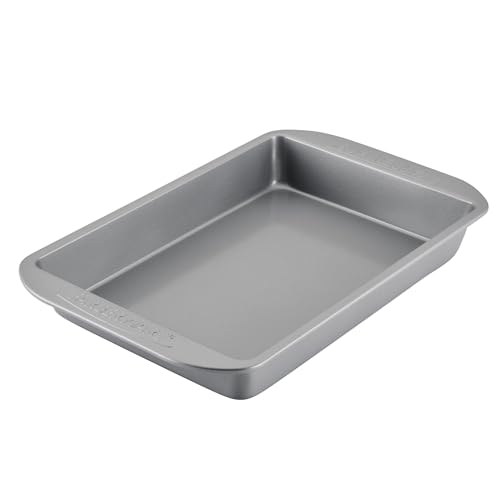
Farberware Nonstick 9×13 Baking Pan
The cheap one that keeps turning up in real kitchens rather than just in carts. Heavy-duty steel construction resists warping, which is the failure that ruins budget pans: a thin sheet buckles with a bang at temperature and then bakes unevenly forever after. It heats evenly to brown properly and reduce hot spots, and it is oven safe to 450F, high enough to roast chicken and vegetables rather than just bake cakes.
Farberware is also specific about the coating, stating it is made without PFAS, PFOA, lead, or cadmium, and that none of those are intentionally added to the interior nonstick. That is a clearer statement than most pans at any price offer. It is dishwasher safe, though hand washing is recommended, which is fair shorthand for what is true of every nonstick pan: the dishwasher will shorten the coating’s life. Nonstick is a consumable surface, and at this price replacing it eventually is not painful.
- Pros: Lowest cost of the picks here; warp-resistant heavy-duty steel; browns well and evenly; oven safe to 450F for roasting; explicitly made without PFAS, PFOA, lead, or cadmium; dishwasher safe.
- Cons: No lid on this version; nonstick wears out eventually, especially in a dishwasher; a plain gray pan is not a serving dish; metal reacts with long-stored acidic leftovers, so move them to a container.
Best for: Box-mix cakes, brownies, tray bakes, and roasting, at the lowest sensible spend.
USA Pan Aluminized Steel Baking Pan
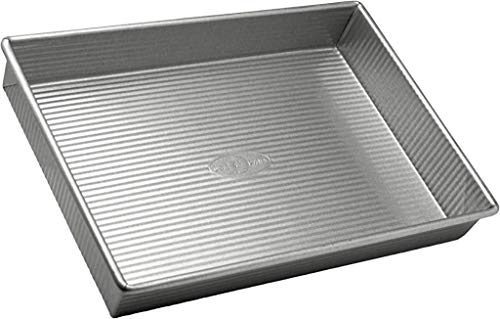
The baker’s pan, and the one with an actual engineering idea behind it. The surface is corrugated rather than flat, a pattern of fine ridges that lets air move under whatever is baking. The result is faster release and more even color, and it is the reason a cake lifts out of this pan cleanly when it would fight a smooth one. The body is aluminized steel, combining steel’s rigidity with aluminum’s heat conduction, and it is rated to 450F.
The nonstick is a proprietary silicone coating rather than a conventional one, which releases well and cleans easily. At 9x13x2.25 inches this is the shallowest dish here, and that is a deliberate choice for cakes and bars rather than an oversight; deep lasagna is not the job. It is made in the USA by a family company that has built bakeware for over 60 years, part of why it costs what it does.
- Pros: Corrugated surface genuinely improves airflow, release, and evenness; aluminized steel is rigid and conducts well; silicone nonstick coating; oven safe to 450F; made in the USA by a long-established manufacturer; the best cake and bar pan here.
- Cons: Shallowest at 2.25 in, so it is not a deep-casserole pan; leaves a light ridge pattern on the base of bakes; no lid; a workshop tool rather than a serving dish.
Best for: Sheet cakes, brownies, cornbread, and bars, where clean release and even browning are the whole job.
OXO Good Grips Glass Baking Dish with Lid
The one to buy if the freezer is part of the plan. OXO builds this from borosilicate glass and says plainly what that buys: freezer-to-oven use that withstands extreme temperature changes without cracking or shattering. For anyone who batch cooks, that single sentence is the whole argument. Assemble on a Sunday, freeze, and bake it straight from frozen without the thaw the other glass dish needs.
The details around it are the usual OXO fussiness in the good sense. The handles are generously sized, which matters when three quarts of hot food needs moving with gloves on. The lid is slosh-proof for carrying to a potluck and lets dishes stack in a full fridge. There are dimension markings molded in, so you know what you are baking in. At 3 quarts it holds less than the ceramics here, and like all glass it is heavy and takes longer to brown than steel.
- Pros: Borosilicate glass explicitly rated freezer to oven; large secure handles; slosh-proof lid that also stacks; molded dimension markings; will not stain or absorb odors; microwave, dishwasher, and freezer safe.
- Cons: 3 qt is the smallest capacity of the lidded and ceramic picks; heavy; browns more gently than metal; the lid is fridge and freezer only, never the oven.
Best for: Batch cooking and make-ahead meals that go from freezer to oven without a thaw.
DOWAN Ceramic Casserole Dish
The biggest and the handsomest, and the only one here that goes to the table without apology. 4.2 quarts and 3.1 inches of depth make it the deepest dish in this group, enough for a five-layer lasagna, a full roast chicken with vegetables around it, or bread. The lead-free glazed ceramic holds heat so the food is still bubbling when it reaches the table, and the smooth glaze wipes clean rather than gripping baked-on cheese.
Double handles make a heavy dish manageable in oven gloves, which is not a luxury at this capacity. The trade-offs are physical. Including handles it measures 15.6 inches long, so check the oven, the fridge shelf, and the dishwasher before buying. Ceramic is slow to heat, which is ideal for casseroles and wrong for cakes, and it is heavy before any food goes in. There is no lid, so leftovers need covering another way. In soft white it looks like serveware because that is half the point.
- Pros: Largest capacity here at 4.2 qt and 3.1 in deep; lead-free pro-grade ceramic; double handles for safe lifting; holds heat at the table; smooth glaze cleans easily; genuinely attractive oven-to-table piece.
- Cons: 15.6 in with handles, so measure the oven and fridge first; no lid; heavy empty and heavier full; slow to heat, and a poor choice for cakes; sudden temperature swings are best avoided.
Best for: Feeding a crowd, and any meal that gets carried to the table in the dish it cooked in.
The verdict
Best Overall: Pyrex Deep Glass Baking Dish with Lid. The best seller of this group, and the most useful single dish for most kitchens. The extra depth solves the overflow problem, glass suits the casseroles a 9×13 mostly gets used for, and the lid means leftovers stay put. Thaw before baking and it will outlast most of the kitchen.
Best Value: Farberware Nonstick 9×13 Baking Pan. Warp-resistant steel, 450F, a clearly specified coating, and a price that makes the eventual replacement painless. For cakes and roasting, spending more is optional.
Best Premium: DOWAN Ceramic Casserole Dish. 4.2 quarts, 3.1 inches deep, double handles, and a glaze that earns a place on the table. When the dish is part of the meal and the crowd is large, this is what the money is for.
Bakers should step sideways to the USA Pan. Its corrugated aluminized steel releases cakes and bars more cleanly than anything else here, and no casserole dish will match it on browning.
FAQ
Do I need to change the temperature when a recipe says glass?
The common advice is to drop the oven around 25F when swapping a metal pan for glass, and it exists for a real reason. Glass holds heat and keeps radiating it, so edges can overbake while the center catches up. It matters most for cakes and brownies and barely at all for a casserole. Start checking earlier than the recipe says and trust the dish rather than the clock.
Can I take a dish straight from the freezer to the oven?
Only if it says so. The OXO dish is borosilicate and is sold specifically for freezer-to-oven use without cracking. The Pyrex dish is specified for a pre-heated oven and makes no such claim, so thaw it first. Ceramic deserves the same caution. Thermal shock, not clumsiness, is what breaks most glass bakeware.
Why does my lasagna overflow in one dish and not another?
Depth, almost always. These dishes share a 9×13 footprint but run from 2.25 inches to 3.1, and the ceramics hold over 4 quarts against 3 for the glass. A recipe developed in a deep dish will spill from a shallow one. If overflow is a recurring theme, the dish is the problem rather than the recipe.
Is nonstick worth having on a 9×13?
For cakes, bars, and anything sticky, yes, and it saves a lining job. Take it as a wearing surface: skip the dishwasher despite what the label allows, avoid sharp metal unless the pan is rated for it, and expect to replace it in time. Glass and ceramic never lose their release properties, which is part of why they cost more up front and last longer.
Which one goes to a potluck?
A lidded dish, and preferably one with real handles. The OXO lid is designed to be slosh-proof for exactly this, and the Pyrex lid seals a full dish for the car. Ceramic travels beautifully and stays hot, but with no lid it needs foil and both hands.
This article may contain affiliate links; see our Affiliate Disclosure.