Turn a filter cutoff knob on a real analog synth and the sound opens up under your hand, immediately, with no menu and no mouse. That physical cause and effect is why people who learn on hardware understand synthesis, while people who learn in a plugin often just learn presets.



A good first analog synth has one job: make the signal path visible. Oscillator, filter, envelope, LFO – one knob each, laid out so you can see how they connect. What separates the options below is how much of that chain they expose, whether they can play chords or only single notes, and how far they will still be useful once you know what you are doing. They suit a curious beginner, a producer wanting hands-on hardware, and anyone who has read about subtractive synthesis and wants to hear it.
| Product | Standout feature | Price tier | Link |
|---|---|---|---|
| Korg Volca Keys | Three-voice polyphony, 16-step sequencer, self-tuning | Mid-range | |
| Korg Volca Bass | Three oscillators, acid-style slide, Electribe sequencer | Mid-range | |
| Korg Monotron Delay | Genuine MS-10/MS-20 filter circuit, ribbon keyboard, space delay | Budget | |
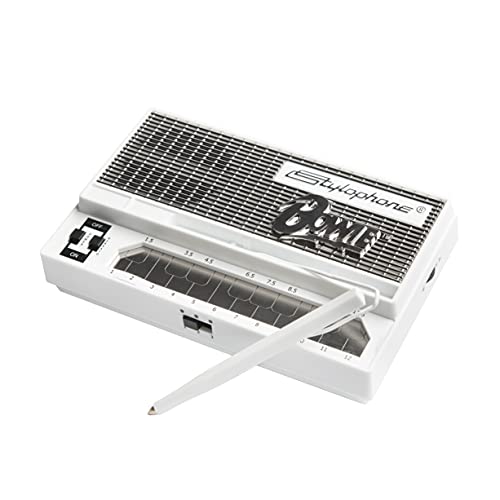
| Bowie Stylophone | Stylus-played pocket synth with three analog modes | Budget | |
| MOOG Mavis | Semi-modular patchbay, ladder filter, wavefolder, Eurorack-ready | Premium | |
How to choose a first analog synthesizer
What “analog” buys you, and what it costs
An analog synth generates sound with actual voltage moving through circuits rather than maths running on a chip. The practical payoff is a knob-per-function layout and a slightly unpredictable character that many people find more alive. The costs are real too: analog oscillators drift with temperature, which is why the Volca Keys advertises self-tuning as a feature, and patches usually cannot be saved – you write the knob positions down or you lose the sound. For learning, that last limitation is secretly a benefit. It forces you to build a sound from scratch every time, which is exactly the skill you want.
Monophonic or polyphonic
Most affordable analog synths play one note at a time. That is not a defect – bass lines, leads, and acid sequences are monophonic by nature, and the Volca Bass, Monotron Delay, and Stylophone all work this way. Polyphony means chords, and it is expensive to build in analog because each voice needs its own circuitry. The Volca Keys manages three voices, which is enough for triads and is unusual at its price. The Mavis is monophonic despite its cost, because its money goes into depth rather than voices.
Look for a visible signal path
The whole reason to learn on hardware is to see the chain. Classic subtractive synthesis runs: oscillator makes a raw waveform, filter removes harmonics from it, envelope shapes it over time, LFO wobbles something automatically. The Volca Bass states its structure outright – single VCF, VCA, LFO, and EG – and that simplicity is a teaching aid, not a shortcoming. Anything that hides these behind menus will teach you less.
A sequencer changes what you can do alone
Without one, you play with one hand and turn knobs with the other, and never hear what your changes do to a repeating part. A built-in step sequencer loops a pattern so both hands are free for the filter. Both Volcas include a 16-step sequencer, and the Volca Keys adds motion sequencing, which records your knob movements into the loop. For learning by ear, this feature is worth more than an extra oscillator.
Where it goes next
Ask whether the synth grows with you. The Volcas sync together and to other gear, so a second one slots into the same setup. The Mavis is the outlier: it lifts out of its case as a 44HP Eurorack module, so it can become the first piece of a modular system rather than a thing you outgrow. The Monotron Delay has an audio input, which means it can filter other sounds – a synth that doubles as an effects box.
Battery power and a built-in speaker
Underrated, and the reason some of these get played daily while expensive gear gathers dust. The Monotron Delay and Stylophone have speakers and run on batteries; the Volca Keys runs on batteries or an adapter. A synth you can pick up on a sofa gets more hours than one that needs an audio interface booted up first.
Korg Volca Keys – the best-selling starting point
This shares the top sales spot in the group, and for someone learning synthesis it is the better of the two leaders. Three-voice analog polyphony means you can play a chord and hear a filter sweep move across all of it – the single most instructive thing a beginner can do. Twenty-seven touch-sensitive keys, a 16-step sequencer, and motion sequencing that records knob movements into the loop let you set a pattern running and spend an hour just listening to what each control does. Self-tuning handles the analog drift problem quietly in the background. Delay is built in, and it runs on batteries or an adapter.
The keys are touch strips rather than real piano keys, so this is not the synth for someone who wants to play in a traditional sense – it is for sequencing and sound design. Everything is knob-per-function, which is the point.
- Pros: Joint best seller here; three-voice polyphony for chords, rare at this price; 16-step sequencer with motion recording of knob moves; self-tuning tames analog drift; built-in delay; battery or adapter power; genuinely intuitive knob-per-function layout.
- Cons: Touch-strip keys are not playable like a real keyboard; no patch memory for sounds; three voices is polyphony but only just; small controls.
Best for: Learning subtractive synthesis properly, with chords and a sequencer to experiment against.
Korg Volca Bass – three oscillators and an acid streak
The other joint best seller, and a more focused instrument. Three analog oscillators can be detuned against each other for a thick, moving bass, or stacked in intervals – one of those things that teaches you more about tuning and beating in ten minutes than an hour of reading. The Electribe-inspired 16-step sequencer is built for basslines and grooves, and the slide function is the detail that matters: slide is what makes an acid line sound like acid rather than a series of notes, and having it on a knob rather than buried in software is the difference between using it and forgetting it.
Korg is upfront that the structure is deliberately simple – a single VCF, VCA, LFO, and EG. That is the teaching layout. It is monophonic, and the sound is aimed squarely at bass and acid rather than pads or leads, so it is a strong second synth alongside something polyphonic and a narrower first one on its own.
- Pros: Joint best seller; three oscillators for detuning and interval stacking; Electribe-inspired 16-step sequencer built for grooves; slide function for authentic acid lines; deliberately simple VCF, VCA, LFO, EG structure that is easy to learn; syncs with other Volcas.
- Cons: Monophonic, so no chords; the voice is specialized toward bass and acid; touch-strip keys; no patch saving.
Best for: Anyone drawn to acid house, techno, and bass, or wanting a dedicated bass machine that syncs to other gear.
Korg Monotron Delay – a legendary filter for pocket money
The remarkable thing here is the filter. Korg put the original analog VCF circuit from the classic MS-10 and MS-20 into a device that costs less than a cheap microphone. Those filters are famous for a reason – aggressive, resonant, and full of character – and turning that cutoff knob is the cheapest possible introduction to why analog filters are talked about the way they are. Around it: a space delay with rate and intensity, a pitch LFO with selectable waveshape, a wide-range ribbon keyboard, a built-in speaker, and battery power.
The ribbon strip is played with a fingertip and is not precise, so this is an instrument for sweeps, squeals, and dub-style noise rather than melodies. The trick that makes it more than a toy: it has an audio input, so it will filter and delay anything you feed it, from a drum machine to a phone. As a first taste of analog, or as a filter box next to a laptop setup, it is very hard to beat for the money.
- Pros: Genuine MS-10/MS-20 analog filter circuit at a budget price; space delay with rate and intensity control; pitch LFO with selectable waveshape; audio input lets it filter external sound; built-in speaker and battery power; endlessly fun and pocket-sized.
- Cons: Ribbon controller is imprecise for playing melodies; monophonic and very simple; no sequencer; tiny controls; more sound-effects box than songwriting instrument.
Best for: Hearing what an analog filter really does, and adding character to other gear, for almost nothing.
Bowie Stylophone – the one people actually pick up
The stylophone is played by touching a metal keyboard with a stylus, which sounds like a novelty and is, a bit – but it is also a real analog noise-maker with three modes covering classic analog synth and bass sounds, and this limited edition carries a white finish with an embossed Bowie logo, nodding to the instrument’s most famous user. It is compact, battery-powered, and needs nothing else to make sound.
Set expectations plainly. There is no filter to sweep, no envelope to shape, no sequencer, and no signal path to study – this will not teach you subtractive synthesis the way the Volcas or the Mavis will. What it does is get played, by anyone who walks past it, including people who would never touch a synth with knobs on. As a gift, a desk object, or a first spark of interest for a curious kid, it earns its place; as a study tool, it does not.
- Pros: Lowest price here; genuinely fun and immediate with no learning curve; three analog synth and bass modes; compact and battery-powered; distinctive limited-edition finish; a good gift and a good conversation piece.
- Cons: Teaches little about synthesis – no filter, envelope, or LFO to explore; stylus playing is imprecise; no sequencer or sync; closer to a novelty instrument than a studio tool.
Best for: A gift, a first spark of curiosity, or anyone who wants analog noise without a manual.
MOOG Mavis – the one you will not outgrow
Mavis arrives as a build-it-yourself kit, and that is the first lesson – assembling it puts the signal path in your hands before you play a note. Inside is a fully analog Moog design: two oscillators, a full ADSR envelope, the ladder filter the company is known for, sample and hold, a diode wavefolder, attenuators, a mixer, mults, and a built-in keyboard with glide and keyboard scaling. The wavefolder is the unusual one, adding harmonics in a way that sounds unlike the classic Moog palette.
Semi-modular is the key word. It works standalone with sensible internal connections, so a beginner is not staring at an empty patchbay – but every one of those connections can be overridden with a patch cable, which is how you learn what modulation actually is. And when 44HP of Moog stops being enough, it lifts out of its case into a Eurorack system rather than into a cupboard. It is monophonic and by far the most expensive option here, which is the real trade for depth.
- Pros: 100% analog Moog design with the ladder filter and two oscillators; full ADSR, sample and hold, wavefolder, attenuators, mixer, and mults; semi-modular patchbay teaches modulation properly; build-it-yourself kit is itself a lesson; lifts out as a 44HP Eurorack module; built-in keyboard with glide and scaling; dust cover included.
- Cons: Premium price, several times the Volcas; monophonic; assembly required; no sequencer or patch memory; the patchbay is more depth than some beginners want on day one.
Best for: Learning synthesis seriously, and anyone who suspects a modular system is in their future.
The verdict
Best Overall – Korg Volca Keys. It shares the top sales position here, and for a beginner it is the more instructive of the two leaders. Three-voice polyphony lets you hear a filter move across a chord, the sequencer frees both hands to turn knobs, motion recording captures what you did, and self-tuning removes the one genuine annoyance of cheap analog. It is a real instrument, not a trainer.
Best Value – Korg Monotron Delay. The actual MS-10 and MS-20 filter circuit, in your pocket, for a budget price, with an audio input so it can filter anything else you own. It will not write songs, but as a first encounter with analog character it costs almost nothing and teaches the most per unit spent.
Best Premium – MOOG Mavis. Semi-modular, so it works out of the box and still rewards patch cables; a genuine Moog ladder filter and wavefolder; and a Eurorack future when 44HP stops being enough. The one here that a beginner can grow into rather than out of.
Two more for specific readers. The Volca Bass is the pick if acid basslines are the draw – the slide function alone justifies it. The Bowie Stylophone is a gift and a spark rather than a study tool, and it is clear about that.
FAQ
Do I need to read music or play keyboard to start?
No. Synthesis is about shaping sound, not performing. A sequencer plays the notes while you learn the controls, which is exactly why the Volcas suit beginners – set a 16-step pattern looping and spend your time on the filter and envelope. Playing skill can come later, or never.
Why can’t these save my sounds?
Because on an analog synth the sound is the physical position of the knobs, and storing that needs extra digital circuitry that adds cost. None of these save patches. Take a photo of the panel when you find something good – it is the standard trick, and it also makes you learn the layout.
What else do I need to buy?
Less than you think. The Monotron Delay and Stylophone have built-in speakers and run on batteries, so they need nothing. The Volcas have headphone outputs and run on batteries or an adapter. The Mavis needs an amp, headphones, or an interface to be heard, and patch cables if you want to go beyond its internal routing.
Is analog actually better than a plugin?
For learning, usually yes – not because it sounds better, but because one knob does one thing and your hands remember it. Plugins are cheaper, save patches, and stay in tune. Many people end up using both. If the goal is to understand synthesis rather than browse presets, hardware gets you there faster.
This article may contain affiliate links; see our Affiliate Disclosure.