A big freshwater tank is only as healthy as the water moving through it, and on a 75 to 125 gallon setup that job falls to the canister filter humming away in the cabinet below. Get the flow and media right and the water turns glass-clear; get it wrong and you fight cloudiness and algae for months.


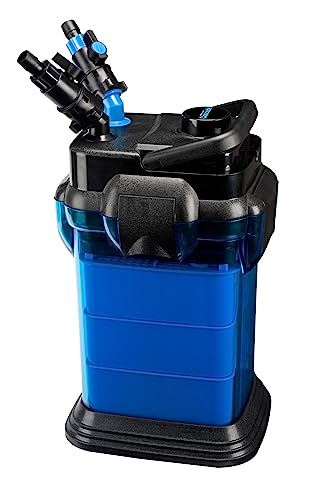

The best canister filter for a large freshwater tank pushes enough water each hour, holds enough media to keep the biology stable, and seals reliably so you never mop a cabinet. That serves the hobbyist stocking a busy community tank, the keeper of messy cichlids, and anyone building a planted showpiece. The five picks below run from a quiet budget unit to a high-flow flagship, so you can match the filter to your stocking and your patience for maintenance.
| Product | Standout feature | Price tier | Link |
|---|---|---|---|
| PONDFORSE Canister Filter | Quiet brushless motor, adjustable flow | Budget | |
| Fluval FX2 | High flow, self-priming, built-in water-change drain | Premium | |
| VEVOR 396GPH 4-Stage | Four media stages rated to 125 gallons | Mid-range | |
| Penn-Plax Cascade 1000 | Three stackable baskets, push-button primer | Mid-range | |
| Aquatop 4-Stage with UV | Built-in clarifier for crystal-clear water | Premium | |
How to choose a canister filter for a large freshwater tank
Flow rate and turnover come first
The single most important number is flow, measured in gallons per hour. A common guideline is to turn over your tank’s volume roughly four to five times every hour, so a 125 gallon tank generally wants a filter rated well above five hundred gallons per hour, or two filters sharing the load. Remember that the printed rating is a best case: real flow drops once you add media and account for the height the water must climb, so it pays to size up rather than run a filter at its absolute limit.
Media stages: mechanical, biological, chemical
A canister earns its keep by stacking baskets of media the water passes through in sequence. Mechanical media, coarse foam and floss, traps visible debris. Biological media, ceramic rings or bio-balls, houses the beneficial bacteria that quietly convert fish waste into safer compounds, and it is the heart of a stable tank. Chemical media such as activated carbon polishes the water and removes discoloration. More basket volume means more room to tune this mix for your stocking.
Priming, sealing, and quiet running
Self-priming or push-button priming saves you the old trick of sucking a hose to start a siphon, and it makes restarts after cleaning painless. Sealing is not glamorous, but a good silicone gasket and secure clamps are what stand between you and a wet cabinet floor, so look for a design that emphasizes leak protection. Since the filter often sits near a living room, a brushless motor and rubber feet that keep noise and vibration down are worth seeking out.
Handy extras that earn their place
A couple of features genuinely reduce your workload. A built-in drain or water-change valve lets you empty and refill through the canister, cutting the fuss of large water changes on a big tank. A built-in ultraviolet clarifier helps knock back the free-floating microbes that turn water green, which is a real bonus on a bright, planted display. Neither is essential, but both are nice on a tank you want to keep pristine with less effort.
Head height and where the canister actually lives
A canister sits below the tank and pushes water back up, so the height it must lift against, often called head height, directly reduces real flow. A filter in a low cabinet works harder than one on a stand right beneath the rim, and that is part of why printed ratings and reality diverge. Measure your cabinet before ordering, since the tallest units do not fit every stand, and leave room to lift the lid clear for cleaning. Hose length matters too: too short and you cannot route it tidily, too long and you add friction that costs you yet more flow.
Cycling, and why biological media matters most
The most important thing in the canister is invisible. Beneficial bacteria colonize your biological media over several weeks and convert fish waste through ammonia and nitrite into far less harmful nitrate. That colony is your tank’s life support, and it is fragile in one specific way: it lives on those ceramic rings, not in the water. Rinse biological media under a tap and chlorine kills much of it, which is how a spotless cleaning session ends in a dangerous ammonia spike days later. Rinse it gently in old tank water instead, never replace all of it at once, and be patient when setting up a new filter.
PONDFORSE Canister Filter
PONDFORSE is the most popular pick in this roundup, and its appeal is easy to see: a quiet copper brushless motor, an adjustable flow valve, and a full media kit at a budget price. The multiple media layers keep water clear, the noise-damping rubber feet keep it discreet, and the flow control lets you tune output to your setup. On the larger end of this range, confirm the flow turns your volume over enough, or lean on it toward the seventy-five gallon side where it is most comfortable.
The quiet running is not an accident. A brushless motor removes the brushes that wear and buzz in cheaper pumps, and four noise-damping rubber feet stop vibration transmitting into the cabinet, which is where most filter noise actually comes from. The kit is generous for the money, bundling the media, sponges, and bio-balls you need to start, plus a spare bulb. Combined with an energy-efficient motor that keeps running costs low on a filter that never switches off, it makes a strong case as a first canister.
- Pros: Very quiet brushless motor; adjustable flow; complete media kit included; wallet-friendly.
- Cons: Best suited to the lower end of this tank range; flow figures modest next to the flagships.
Best for: Keepers of 75 gallon community tanks who want quiet, affordable filtration.
Fluval FX2
The FX2 is the powerhouse of the group, moving a large volume of water each hour and backing it with smart, self-managing electronics. Its pump monitors performance and purges trapped air automatically, four generous baskets let you stack mechanical, chemical, and biological media exactly as you like, and a base drain valve turns water changes into a simple task. It is the priciest option, but for a heavily stocked or messy 125 gallon tank it delivers the flow and headroom that keep water pristine.
The engineering choices show their worth in the details. A basket-in-basket tray design eliminates the water bypass that lets dirty water sneak around media instead of through it, which is a common weakness in cheaper canisters. The unidirectional impeller uses fewer mechanical joints, so it runs quieter, and rubber feet damp the rest. It is also more cabinet-friendly than its reputation suggests, standing noticeably shorter than the larger model in the family and fitting under most aquariums, and the lid-mounted hose clips keep the tubing tidy when it is not in use.
- Pros: High flow with strong turnover; self-priming and self-purging; big four-basket capacity; built-in water-change drain.
- Cons: Highest price here; larger footprint under the tank.
Best for: Busy, heavily stocked large tanks that need serious, low-fuss filtration.
VEVOR 396GPH 4-Stage
VEVOR’s four-stage canister is the value sweet spot, rated for tanks up to 125 gallons and stacking coarse foam, ceramic rings, and fine cotton to handle particles large and small. A full-copper brushless motor with a hardened bearing keeps it running quietly and efficiently, and a multi-lock lid with a thick rubber seal targets leak-free operation. For a straightforward large freshwater tank, it covers the essentials without stretching the budget.
VEVOR is usefully direct about maintenance, and the advice is worth following. On a planted tank, clear floating leaves before they reach the inlet, because a clogged intake is the most common cause of a filter that seems to have died. If flow weakens, check the inlet and outlet for blockages first, then cut the power and clean the rotor. There is also a smaller model in the same family aimed at tanks up to seventy-five gallons, so if your tank sits at the lower end of this range you can step down and save rather than run an oversized unit throttled back.
- Pros: Rated to 125 gallons; four media stages; quiet, efficient motor; strong sealing design.
- Cons: Consumable media beyond the basics is not included; flow dips somewhat once fully loaded.
Best for: Value-focused keepers who want proper four-stage filtration on a large tank.
Penn-Plax Cascade 1000
The Cascade 1000 is a long-standing favorite that suits tanks up to about a hundred gallons, so it fits neatly into the lower and middle of this range. Three large stackable baskets with handles let you customize the media, a push-button primer gets it started quickly, and dual rotating valve taps make it easy to maneuver inside a tight cabinet. It arrives as a complete kit with floss pads, bio-sponge, and carbon, which is a friendly start for newcomers.
Two small things make it pleasant to live with. The dual rotating valve taps turn a full circle, so you can angle the hoses whichever way a cramped cabinet demands rather than fighting the tubing into an awkward bend. A tip-proof base keeps the canister upright when you are wrestling hoses, which is exactly when filters get knocked over. It also includes a spray bar for gentle surface movement, useful on a planted tank where you want circulation without a jet, and it comes from a maker with decades in the hobby behind it.
- Pros: Proven, dependable design; three roomy baskets; quick push-button priming; complete media kit included.
- Cons: Rated to around a hundred gallons, so it favors the lower end here; flow is moderate rather than high.
Best for: Hobbyists wanting a trusted, customizable filter for a 75 to 100 gallon tank.
Aquatop 4-Stage with UV
Aquatop’s standout trick is the built-in ultraviolet clarifier, which helps clear the free-floating microbes that cloud or green the water on a bright tank. It is rated for tanks up to 125 gallons, runs a multi-stage media path, and includes the filtration media to get started. If you keep a planted or well-lit display and want that extra insurance against green water, the integrated clarifier is a genuine reason to choose it over a plain canister.
It is worth being precise about what a clarifier does. It snacks water passing through the unit, knocking back free-floating algae and microbes that cloud the water column, which is why green water clears. It does not remove the algae growing on your glass and decorations, so it is not a substitute for scraping or for fixing the underlying cause, usually too much light or too many nutrients. Used as intended it is a strong tool, and the filter delivers a solid flow rate with a multi-stage media path and a design that is straightforward to open and service.
- Pros: Built-in UV clarifier; rated to 125 gallons; multi-stage media included; works for fresh and saltwater.
- Cons: Premium price; UV bulb is a part you will eventually replace.
Best for: Planted and brightly lit tanks that battle cloudy or green water.
The verdict
Best overall: the PONDFORSE Canister Filter. As the most popular pick, it blends quiet running, adjustable flow, and a complete media kit at a budget price, a sensible default for tanks toward the seventy-five gallon end of this range.
Best value: the VEVOR 396GPH 4-Stage, which is rated to 125 gallons and delivers real four-stage filtration without a premium price.
Best premium: the Fluval FX2, whose high flow, self-priming smarts, and built-in water-change drain make short work of a big, busy tank. For green-water insurance, the Aquatop’s built-in clarifier is the one to beat.
Frequently asked questions
How much flow do I need for a 125 gallon tank? Aim to turn the water over about four to five times an hour, which points to a filter rated well above five hundred gallons per hour, or two filters working together. Size up, since real flow drops once the baskets are full of media.
Can one canister filter handle a 125 gallon tank? A high-flow flagship can, but many keepers of large or heavily stocked tanks run two filters. Splitting the load improves circulation, adds redundancy if one needs cleaning, and keeps water clearer.
How often should I clean a canister filter? Rinse mechanical media every few weeks as flow starts to drop, but go gently on biological media and only rinse it in old tank water so you protect the beneficial bacteria. A steady drop in flow is your cue that it is time.
Do I need the built-in UV clarifier? Not for basic filtration, but it helps a lot if you fight green or cloudy water on a bright, planted tank. If your water already runs clear, a standard canister with good media is plenty.
Why choose a canister over a hang-on-back filter? Capacity and quiet. A canister holds far more media, which matters enormously on a large tank, hides in the cabinet instead of on the rim, and lets you tailor the media stack. Hang-on filters are simpler but run out of room on tanks this size.
My filter lost flow, what happened? Usually a clogged intake or dirty mechanical media, sometimes trapped air or a fouled rotor. Check the inlet and outlet first, rinse the foam and floss, and if it is still weak, unplug it and clean the impeller before assuming anything has failed.
Are these suitable for planted tanks? Yes, and adjustable flow helps you avoid blasting the plants. Use a spray bar for gentler circulation, and stay on top of floating leaves, which are the usual cause of a blocked inlet in a planted setup.
This article may contain affiliate links; see our Affiliate Disclosure.