The 6 a.m. paw to the face is not affection; it is an alarm clock with claws. An automatic feeder breaks that cycle by making a machine, not you, the source of breakfast — and the good ones keep doing it through power cuts, jammed kibble, and a cat actively trying to burgle the tank.


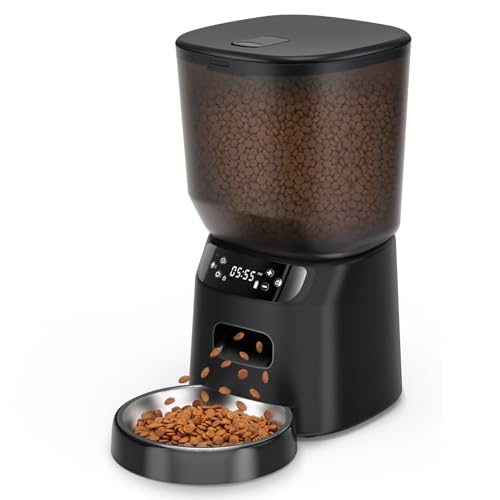

A great automatic feeder does three things without drama: it dispenses the exact portion you set, it keeps the rest of the kibble fresh and locked away, and it fails gracefully when the power or WiFi does not cooperate. Whether you are smoothing out a workday, planning a weekend away, or putting a food-obsessed cat on a stricter routine, the machines below are the proven sellers in this category, compared plainly.
| Feeder | Standout features | Price | Link |
|---|---|---|---|
| PETLIBRO 5L WiFi | App scheduling, 10 meals/day, low-food sensor, twist-lock lid | Premium | |
| ANDOLL HOME 4L | Anti-jam swing device, 10s voice call, 8 meals/day, dual power | Budget | |
| oneisall 5L Two-Cat | Twin bowls 16" apart, dial setup, 10-day capacity for two cats | Mid-range | |
| oneisall 5L WiFi Two-Cat | 5G/2.4G WiFi, twin bowls, app sharing, feeding log | Mid-range | |
| PETLIBRO 3L | Infrared anti-jam stop, 1–50 portions/meal, USB-C + battery backup | Mid-range | |
| PETLIBRO Camera | 1080P camera, night vision, two-way audio, motion alerts | Premium | |
| IMIPAW 3L | Simple LCD programming, 6 meals/day, manual-dispense shortcut | Budget | |
| VOLUAS 4L | LCD setup, 0–40 portions, removable washable parts | Mid-range | |
| 5L Stainless-Bowl | Rust-resistant steel bowl, 6 meals/day, detachable tank | Budget | |
| PETULTRA 4L | Double-rotor anti-clog, 40° sloped chute, fully detachable | Budget | |
How to choose an automatic cat feeder
Every feeder here stores dry food and releases it on a schedule. The differences that matter show up in portion precision, jam resistance, what happens when the power dies, and whether you want a phone involved at all.
Portion size is the real precision spec
Cats eat small, frequent meals, so the smallest dispensable unit decides how finely you can tune a diet. Most machines here meter roughly a twelfth of a cup per portion; PETLIBRO’s 3L model goes finer at about 2.5 teaspoons. If your vet has put a chunky cat on a strict gram count, smaller portions and more meals per day let you match the target closely. Ten small meals dribbled across a day also blunts the wolf-it-then-vomit habit some cats never outgrow.
Jam resistance separates the reliable from the frustrating
A feeder that clogs on odd-shaped kibble is worse than no feeder, because you stop checking it. Look for designs that attack the problem mechanically: PETULTRA uses a double rotor and a 40-degree sloped chute, ANDOLL adds a swinging agitator above the outlet, and PETLIBRO’s 3L unit goes further with an infrared sensor that cuts power the moment something obstructs the mechanism. Whatever you buy, keep kibble under roughly half an inch across — every maker quotes a size ceiling for a reason.
Power cuts happen; batteries are the insurance
Nearly every unit in this group runs on a 5V adapter with a battery bay as backup, usually three D-cells. The batteries sit idle until the cord fails, then carry feeding for weeks. If you travel often, load the batteries and think of them as part of the purchase, not an accessory. It is the difference between a hungry cat and a non-event when a storm knocks the power out mid-trip.
WiFi, camera, or plain dial
App-connected models let you reschedule from anywhere, trigger an extra meal remotely, and read feeding logs — genuinely useful for irregular shifts or shared households where the app can be shared between family members. The camera step-up adds a live view, night vision, and two-way audio, which earns its keep for anxious first-time absences or monitoring a cat on medication. If you would rather never pair another gadget, the dial and LCD models set up in minutes and have fewer ways to go wrong. A 10-second voice recorder is standard on most: it plays your call before each meal, so the machine, not the hallway, becomes where dinner announcements happen.
Freshness and the burglar problem
Kibble grows stale fast in an open hopper, and a determined cat takes a loose lid as an invitation. Twist-lock lids, sealing strips, and desiccant compartments are the standard defenses; PETLIBRO adds a rotor at the tank base designed to stop paws fishing food out of the chute. Stainless bowls resist the chin-acne problem that plastic bowls can aggravate and shrug off dishwasher cycles.
PETLIBRO 5L WiFi Feeder
This is the category’s benchmark for a reason: a 5-liter tank, scheduling up to ten meals a day at one to forty-eight portions each, and an app that works over both 5GHz and 2.4GHz WiFi — a small spec that saves real pairing headaches on modern routers. A low-food sensor pings your phone before the tank runs dry, and the twist-lock lid plus base rotor keep both staleness and burglary at bay.
Pros:
- Dual-band WiFi pairs reliably where 2.4GHz-only feeders struggle
- Up to 10 meals a day with fine portion steps suits strict diets
- Low-food, jam, and low-battery alerts arrive as phone notifications
- Voice meal call plays a 10-second recording at feeding time
Cons:
- Costs more than dial-operated feeders of the same capacity
- Full app features require a stable home network
Best for: anyone who wants remote control and alerts from a proven, widely-owned feeder.
ANDOLL HOME 4L Feeder
ANDOLL’s pitch is mechanical: a swinging agitator above the outlet keeps kibble moving so the chute does not bridge and starve the bowl, a complaint that dogs cheaper feeders. You get eight meals a day, a 10-second voice call that plays three times per feeding, a desiccant box under the lid, and dual power with three alkaline batteries as backup, all at a price that undercuts most of the group.
Pros:
- Anti-jam swing device targets the most common failure point
- Eight daily meals gives more schedule freedom than most budget rivals
- Voice call played three times helps summon slow responders
- Low price for a 4L tank
Cons:
- No WiFi — schedule changes happen at the machine
- Batteries for backup power are not included
Best for: a dependable single-cat setup at the lowest sensible spend.
oneisall 5L Two-Cat Feeder
Two cats, one feeder, no wrestling: oneisall splits each meal into two stainless bowls set sixteen inches apart, far enough that the dominant cat cannot guard both. A physical dial handles programming — no app, no pairing — and the 5-liter tank feeds two adults for around ten days. Portions meter at roughly ten grams each, up to six meals a day, with multi-layer sealing and desiccant keeping the kibble crisp.
Pros:
- Twin spaced bowls solve two-cat mealtime conflict outright
- Dial setup is quick and survives router changes and app updates
- Stainless bowls are hygienic and dishwasher-friendly
- Ten-day capacity for two cats covers most trips
Cons:
- Both bowls always receive the same amount — no per-cat portions
- No remote control or feeding log
Best for: two-cat households that want to end bowl-guarding without adding another gadget to the network.
oneisall 5L WiFi Two-Cat Feeder
The connected version of the twin-bowl design adds 5G-capable WiFi, remote manual feeds, a feeding log, and app sharing so everyone in the house works from the same schedule. The bones are unchanged — same 5L tank, same spaced double bowls, same ten-gram portions — so you are paying the step-up purely for control from anywhere, which matters most when travel plans change mid-trip.
Pros:
- Remote feeding and schedule changes from anywhere
- App sharing keeps multi-person households coordinated
- Feeding log confirms every meal actually dispensed
- Stable 5G WiFi pairing avoids the classic 2.4GHz-only dance
Cons:
- Same-amount-per-bowl limitation carries over from the dial model
- Costs meaningfully more than its non-WiFi twin
Best for: two-cat homes that also want the remote-control safety net.
PETLIBRO 3L Feeder
The smaller PETLIBRO trades tank size for the finest portion control in the group — one to fifty portions per meal at about 2.5 teaspoons each — and a safety feature the others lack: infrared detection that cuts the motor the instant an obstruction appears. USB-C power with three D-cell backup covers outages for a month or more. For a single cat on a measured diet, this is the precision pick.
Pros:
- 2.5-teaspoon portion steps allow near-gram-level diet control
- Infrared anti-jam stop protects both feeder and curious paws
- USB-C plus long-lived battery backup
- Twist-lock lid, sealing strip, and desiccant keep food fresh
Cons:
- 3L tank needs refilling sooner than the 5L machines
- Six meals a day, fewer than the WiFi flagship’s ten
Best for: precise portioning on vet-directed diets, without an app.
PETLIBRO Camera Feeder
This is the feeder for people who want proof, not promises. A 1080P camera with a 145-degree lens and infrared night vision watches the bowl, records activity clips, and sends motion alerts; two-way audio lets you talk to the cat mid-meal. Add the standard PETLIBRO scheduling stack and stainless tray and you have a feeding station that doubles as a pet monitor — one gadget where many homes would otherwise buy two.
Pros:
- 1080P live view with night vision confirms every meal was eaten
- Two-way audio and recorded meal calls ease separation anxiety — yours and the cat’s
- Motion alerts and activity clips double as basic pet monitoring
- Dual-band WiFi and the full PETLIBRO app feature set
Cons:
- The priciest unit here
- Camera features depend on solid WiFi and app permissions
Best for: monitoring eating habits remotely — medication schedules, senior cats, or first long absences.
IMIPAW 3L Feeder
IMIPAW keeps it deliberately simple: a 12-hour LCD clock, up to six meals and twenty portions a day, and a two-button shortcut that dispenses a single portion manually when you want to hand out a bonus. The outlet angle is cut so food does not pile up and bridge, the 3-liter tank feeds a typical cat for days, and dual power covers outages the usual way.
Pros:
- Fast, familiar LCD programming with no app dependency
- Manual-dispense shortcut for snacks or catch-up meals
- Angled outlet resists kibble pile-ups
- Consistently one of the cheapest ways into automatic feeding
Cons:
- 12-hour clock format makes AM/PM mistakes easier to set
- No voice recorder on a segment where most rivals include one
Best for: a no-frills, set-it-once feeder at minimum cost.
VOLUAS 4L Feeder
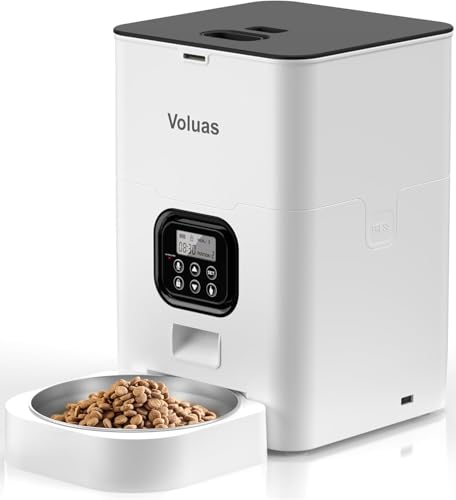
VOLUAS lands squarely in the sensible middle: a 4-liter hopper, one to four meals a day with a wide zero-to-forty portion range, a 10-second meal call, and an LCD that walks you through setup in a couple of minutes. The parts that touch food come apart for washing, which sounds minor until the first time a feeder that does not disassemble starts smelling of old kibble.
Pros:
- Wide portion range in an easy LCD workflow
- Removable, washable food-path parts
- Voice meal call builds a reliable dinner-bell habit
- 4L capacity comfortably covers long weekends
Cons:
- Four meals a day maximum, fewest in this group
- No connectivity or feeding log
Best for: routine feeders who value easy cleaning over meal-count flexibility.
5L Stainless-Bowl Feeder
The value play of the group pairs the largest common tank size — five liters — with a rust-resistant stainless bowl at the lowest price here. Six meals and twenty portions a day, a 10-second voice recorder, dual power, and an anti-clog outlet cover the fundamentals; the detachable tank and bowl keep cleaning true. It skips the brand-name polish, not the feature list.
Pros:
- 5L capacity at a budget price is the best volume-per-dollar in this lineup
- Stainless bowl is hygienic and easy to keep clean
- Voice recorder and dual power despite the low cost
- Detachable tank simplifies deep cleaning
Cons:
- Lesser-known brand with a shorter track record
- No connectivity, alerts, or feeding log
Best for: maximum hopper for minimum money, fundamentals intact.
PETULTRA 4L Feeder
PETULTRA engineered its way at the clog problem: a double rotor spreads kibble evenly while a wide-angle chute on a 40-degree slope keeps it sliding, rated for kibble from tiny 0.07-inch pieces up to 0.4 inches. Up to six meals and twenty portions per meal, dual power, a desiccant bag, and a fully detachable, washable build round out a quietly complete budget machine.
Pros:
- Double-rotor and sloped-chute design attacks jams mechanically
- Handles a wide range of kibble sizes and shapes
- Fully detachable parts make washing straightforward
- Secure locking lid keeps determined paws out
Cons:
- Batteries for the backup bay are not included
- Onboard-only programming, no remote access
Best for: mixed or odd-shaped kibble that has jammed feeders before.
Verdict
Best Overall: PETLIBRO 5L WiFi Feeder. The most-bought feeder in this comparison earns its position: dual-band WiFi that actually pairs, ten meals a day with fine portion steps, and alerts that tell you about low food or a jam before the cat does. It is the one to buy when you want the decision made.
Best Value: ANDOLL HOME 4L Feeder. A strong seller at a budget price, it spends its money where it counts — an anti-jam agitator and eight daily meals — and skips the WiFi most people set once and never touch again.
Best Premium: PETLIBRO Camera Feeder. If you want to watch meals happen, talk to the cat, and get motion alerts from one device, the camera model replaces a feeder and a pet cam in a single footprint.
FAQ
Do automatic feeders work with wet food?
The gravity-and-rotor machines in this guide are built for dry kibble only; moisture clogs the mechanism and spoils in the hopper. Wet-food feeding needs a different design with sealed, often chilled compartments.
What happens during a power outage?
Every feeder here accepts backup batteries, typically three D-cells. The unit switches over automatically and keeps the schedule running for weeks. Load the batteries when you set the feeder up, not when the forecast turns.
Can one feeder handle two cats?
Only with a twin-bowl design like the oneisall models, which split each meal into two bowls set sixteen inches apart. A single-bowl feeder invites the pushier cat to eat both shares.
How small can portions go for a diet cat?
Most machines here meter about a twelfth of a cup per portion. PETLIBRO’s 3L model steps at roughly 2.5 teaspoons, the finest control in this group, which makes hitting a vet-prescribed daily amount much easier.
Will the feeder keep kibble fresh?
Sealed lids, gasket strips, and desiccant compartments are standard across this lineup and keep kibble crisp for a week or two of normal use. Whole-bag storage still belongs in an airtight container; refill the hopper in sensible batches.
This article may contain affiliate links; see our Affiliate Disclosure.