Every ounce you shave from your shelter is an ounce your knees do not carry over the pass. That is why solo hikers obsess over tent weight, and why the gap between a four-pound tent and a 26-ounce trekking-pole shelter feels enormous by mile fifteen. The catch is that the lightest shelter is not automatically the best one for the trip you are actually taking.


A worthwhile solo shelter balances four things: packed weight, how much weather it can take, how livable it is once you are inside, and how quickly it goes up when you arrive at camp in the dark. The five below run from a budget freestanding tent to a 26-ounce trekking-pole shelter favored by thru-hikers, taking in a compact bivy-style tent along the way. Weekend hikers, bikepackers, and long-distance walkers watching every gram will all find something that fits.
At a glance
| Shelter | Standout feature | Price tier | Link |
|---|---|---|---|
| Clostnature 1-Person | Freestanding, high waterproof rating | Budget | |
| Naturehike Cloud-Up | 20D nylon, 7075 poles, storm-ready | Mid-range | |
| Naturehike Star Trail | 2.3 lb total, sit-up headroom | Mid-range | |
| GEERTOP Bivy Tent | Compact bivy-style with two vestibules | Mid-range | |
| Six Moon Designs Lunar Solo | 26 oz trekking-pole shelter, no-sag fabric | Premium | |
How to choose an ultralight solo shelter
Understanding the weight figures
Makers quote weight in two ways, and the difference matters. Total or packed weight includes everything in the bag: tent, fly, poles, stakes, guylines, and the stuff sack. Minimum trail weight counts only the essentials you truly need to pitch it, usually fly, inner, and poles, which is why the same tent can be listed at 4 pounds and 2.97 pounds. Compare like with like. Among the shelters here, the range runs from about 4 pounds packed down to 26 ounces, and where you land on that scale changes the day far more than any other spec.
Freestanding or trekking-pole
A freestanding tent uses its own poles and stands up on its own, which lets you pitch on rock, wooden platforms, or hard ground where stakes will not bite, and lets you lift and reposition it once it is up. That convenience costs weight, because you carry poles just for the tent. A trekking-pole shelter uses hiking poles you already carry as the structure, which cuts serious weight, but it must be staked out properly and needs a bit more practice to pitch drum-tight. If you already hike with poles and want the lightest pack, the trade is worth it.
Single wall, double wall, and condensation
Double-wall tents pair a mesh inner with a separate fly, which manages condensation well: moisture collects on the fly rather than dripping on your sleeping bag. Single-wall shelters cut the inner to save weight, so you rely on good venting and site choice to keep the inside dry. Either way, look for mesh panels, vents above the door, and enough clearance under the fly to keep air moving. Condensation is the most common complaint about solo shelters and the easiest one to design around.
Waterproofing and weather
Waterproofing is quoted as a hydrostatic head in millimeters. Roughly speaking, 1500mm handles ordinary rain, 3000mm copes with sustained downpours, and 5000mm and up is genuinely storm-resistant. Floors usually carry a higher rating than flies because you kneel and press on them. Also look for factory-taped seams, a bathtub floor that lifts the edge above pooling water, and aluminum poles, which flex in wind rather than snapping the way cheaper fiberglass can.
Space and livability
One-person tents differ enormously inside. Peak height decides whether you can sit up to change or cook in the doorway, floor length matters if you are tall or want gear beside you, and a vestibule gives your pack and boots a dry home outside the sleeping area. A slightly heavier tent you can actually live in during a rainy afternoon may beat a lighter one you can only lie down in.
Clostnature 1-Person Backpacking Tent
The Clostnature is the best-seller here, and it is the sensible entry point into solo backpacking. It is freestanding on two aluminum poles, so it goes up fast, even for a first-timer, and stands on ground where stakes struggle. The polyester fly and bathtub floor carry a PU 5000 coating with factory-sealed seams, which is a genuinely strong waterproof rating for the money, and reinforced poles with adjustable guylines hold it steady when the wind picks up. It weighs 4 pounds packed with a minimum trail weight of 2.97 pounds, packs to about 15 by 5 by 5 inches, and still offers a roomy 7-foot-3 interior plus a side vestibule for your pack. It even ships with a pole repair kit.
Pros
- Freestanding and quick to pitch solo
- Strong PU 5000 waterproof rating with sealed seams
- Roomy interior and a side vestibule for gear
- Lowest price here, with stakes and a repair kit included
Cons
- Heaviest packed weight of this group
- Polyester build is bulkier than premium nylon tents
Best for: newer backpackers and weekend hikers who want a weatherproof, easy-pitching tent without spending much.
Naturehike Cloud-Up 1-Person Tent
The Cloud-Up is the sturdy middle ground, and it is a long-standing favorite for good reason. It uses lightweight 20D nylon with a silicone coating rated beyond PU4000mm and 7075 aluminum alloy poles, a combination that handles heavy rain, wind, and hail better than most tents at this weight. At 3.57 pounds it packs to roughly 15.3 by 5.1 by 5.1 inches, and a ventilation window above the front door cuts the condensation that plagues small tents. The double-layer build pairs a high-density mesh inner with a fly that can pitch alone as a sun shelter, and a footprint, poles, ropes, and stakes are all in the box. It is the pick when you want serious weather protection without a big weight penalty.
Pros
- Strong 20D nylon and 7075 alloy poles for hard weather
- Ventilation window reduces condensation
- Double-layer design with a fly that pitches standalone
- Footprint and full accessory kit included
Cons
- Heavier than the lightest options here
- Costs noticeably more than the budget tent
Best for: hikers who want dependable storm protection and a well-vented tent for shoulder-season trips.
Naturehike Star Trail 1-Person Tent
The Star Trail is where the weight really drops. At 2.3 pounds total, roughly the weight of two water bottles, it takes a serious bite out of your pack while still pitching in about three minutes even for a beginner. It packs down to 17.7 by 5.1 inches and uses a 10D nylon outer rated PU1500mm+ with a 20D floor and footprint at PU3000mm, so it is squarely a three-season tent rather than a storm fortress. A full-coverage mesh inner and elevated clearance keep air moving and bugs out, which makes it excellent for warm summer nights, and an elevated center peak gives enough headroom to sit up comfortably.
Pros
- Very light 2.3 pound total weight
- Pitches in about three minutes
- Full mesh inner for airflow and bug protection
- Raised center peak gives real sit-up headroom
Cons
- Lower fly waterproof rating than the Cloud-Up
- Thin 10D fabric asks for careful site selection
Best for: summer and three-season hikers who want a genuinely light tent that still feels roomy.
GEERTOP Ultralight Bivy Tent
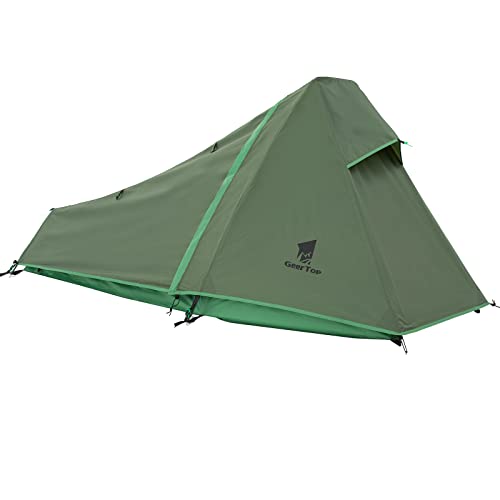
The GEERTOP sits between a tent and a bivy, and that is its appeal: a very compact, low-profile shelter for minimalist trips. It weighs under 4 pounds and packs to a tiny 17 by 4 by 4 inches, which slides into a pack without eating the space your food and water need. A full-coverage rain fly rated to PU 2500mm with tape-sealed seams and double stitching handles spring through fall and mild winter weather, while two large mesh doors and vents keep condensation down, a real concern in a shelter this snug. An intuitive two-pole design pitches fast with no tools, and rugged 210T ripstop polyester with aluminum poles holds up to hard use.
Pros
- Very compact packed size for a tight pack
- Two mesh doors and vents fight condensation
- Simple two-pole setup with no tools
- Durable ripstop fabric and aluminum poles
Cons
- Low bivy profile means little room to sit up
- PU 2500mm fly is not for sustained storms
Best for: minimalist hikers and bikepackers who value a tiny packed size over interior room.
Six Moon Designs Lunar Solo
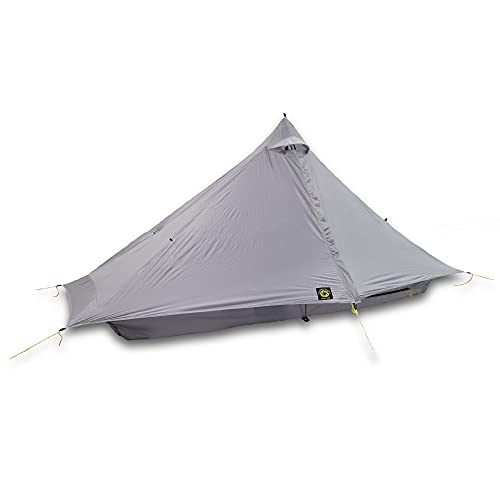
The Lunar Solo is the true ultralight shelter here and a long-time thru-hiker favorite. At 26 ounces it uses a trekking pole you already carry instead of dedicated tent poles, which is how it gets so light without feeling flimsy. Its 20D silicone polyester canopy will not sag or stretch when wet, so the pitch stays drum-tight through rain and overnight dew, a real weakness of cheaper single-wall fabrics. Despite the weight it is genuinely spacious, with 26 square feet of floor, a 48-inch peak height, and a 90-inch floor that fits tall hikers and gear. A 6-inch bathtub floor blocks groundwater while a full mesh perimeter maximizes airflow, and it pitches in under two minutes with six stakes.
Pros
- Just 26 ounces using a trekking pole for support
- No-sag silicone polyester holds a tight pitch when wet
- Generous floor area, length, and 48-inch peak height
- Deep bathtub floor with a full mesh perimeter
Cons
- By far the highest price here
- Not freestanding, so it needs stakeable ground and practice
Best for: thru-hikers and gram-counters who already carry trekking poles and want maximum space per ounce.
The verdict
Best overall: the Clostnature 1-Person. It is the most popular shelter here, and the reason holds up: a freestanding pitch, a PU 5000 waterproof rating that beats far pricier tents, a roomy interior with a vestibule, and the lowest price. For most solo hikers, it delivers the essentials without drama.
Best value: the Naturehike Star Trail. Dropping to 2.3 pounds usually costs a great deal more, yet this one keeps sit-up headroom, a full mesh inner, and a three-minute pitch at a mid-range price.
Best premium: the Six Moon Designs Lunar Solo. At 26 ounces with 26 square feet of floor and a 48-inch peak, it offers the best space-to-weight ratio of anything here, and the no-sag fabric makes it a shelter that holds its pitch night after night.
Frequently asked questions
What counts as an ultralight solo shelter?
There is no official line, but solo shelters around two pounds and under are generally taken as ultralight, while three to four pounds is considered lightweight. Trekking-pole shelters like the Lunar Solo reach the lowest figures by using poles you already carry. Always check whether a quoted weight is packed weight or minimum trail weight before comparing.
Is a trekking-pole tent worth it over a freestanding one?
If you already hike with poles, it saves real weight, since the tent no longer carries its own poles. The trade-off is that it must be staked out, so it needs ground that takes stakes and a bit of practice to pitch tight. A freestanding tent is more forgiving on rock, platforms, and hard-packed sites and can be moved once pitched.
How do I stop condensation in a one-person tent?
Ventilate and site well. Choose a shelter with mesh panels, door vents, and clearance under the fly, pitch away from low, damp hollows and right beside water, and leave vents open even in rain. Double-wall tents help by keeping moisture on the fly rather than on your bag. Wiping the inside of the fly in the morning also helps.
What waterproof rating do I need?
For typical three-season use, a fly rated around 2,000 to 3,000mm is fine, while 5,000mm handles heavy, sustained rain. Floors benefit from higher numbers because your weight presses water through. Taped seams and a bathtub floor matter as much as the rating, since most leaks start at seams and ground-level edges.
Can one of these work as a bikepacking shelter?
Yes. The compact ones are well suited to it. The GEERTOP packs down very small, and the Lunar Solo is a favorite for bikepacking because of its tiny packed size and quick pitch. Look for the shortest packed length so the shelter fits handlebar rolls and frame bags.
This article may contain affiliate links; see our Affiliate Disclosure.