A hot shower fogs the mirror, beads the walls, and, left unchecked, feeds the black mildew creeping along the grout. The fan overhead is the cheapest insurance your bathroom has against moisture damage, and a good one clears the steam without droning like a jet engine.




Two numbers do most of the work when choosing: CFM, how much air the fan moves, and sones, how loud it is doing it. Match the airflow to your room size and the noise to your patience, and the rest is features and fitment. The five fans below cover a small powder room, a standard family bath, and a large spa-style bathroom, with quiet operation and easy retrofit installation across the board.
| Fan | Standout feature | Price tier | Link |
|---|---|---|---|
| Panasonic WhisperFit | Selectable 50/80/110 CFM, efficient DC motor | Premium | |
| Broan-NuTone 50 CFM | Budget, easy no-cut install | Budget | |
| Amico 80 CFM With Light | Whisper-quiet 0.9 sones, adjustable LED | Mid-range | |
| Gopper 12″ 120 CFM | High airflow with bright LED, for large baths | Mid-range | |
| Broan-NuTone 110 CFM | Strong airflow, sealed damper, tub-rated | Premium | |
How to choose a bathroom exhaust fan
Get the airflow and noise right first, then weigh installation and extras. Here is what each spec actually means for your room.
CFM: matching airflow to room size
CFM measures how many cubic feet of air the fan moves per minute, and a rough guide is one CFM per square foot of bathroom, with a bit extra for a room with a shower. A small powder room up to about 45 square feet is happy with 50 CFM, a standard bath wants 80 to 110 CFM, and a large or high-ceiling bathroom benefits from 110 CFM or more. The Broan 50 suits small spaces, the Amico 80 a typical bath, and the Gopper 120 and Broan 110 handle larger rooms. The Panasonic is the clever one: its Pick-A-Flow switch lets you set 50, 80, or 110 CFM, so a single fan fits nearly any room.
Sones: how loud it will be
Sones rate perceived loudness, and lower is quieter. Anything at or below 1.0 sone is genuinely quiet, close to a soft hum you barely notice; 2.0 sones is clearly audible, like background chatter. The Amico’s 0.9 sones is the quietest here, the Gopper and both premium fans sit at a hushed 1.0, and the budget Broan runs a louder but still reasonable 2.0. If a peaceful bathroom matters, prioritize a sub-1.0 rating.
Humidity sensing and controls
Some fans and wall switches include a humidity sensor that switches the fan on automatically when moisture rises and off once the air clears, so the room ventilates even when nobody remembers to flip the switch. The fans here are controlled by a standard wall switch, and any of them can be paired with a separate humidity-sensing or timer switch for hands-off operation. A simple timer switch is an inexpensive upgrade that runs the fan for a set spell after a shower, which is often all a bathroom needs.
Motor type and efficiency
An efficient motor runs quieter and costs less over years of use. The Panasonic’s DC/ECM motor with SmartFlow technology is the standout for efficiency and steady airflow, and Energy Star certification, carried by the Panasonic and both Broan fans, signals lower energy draw. A quality motor also tends to last longer and hold its rated performance, so it is worth paying a little more if the fan runs daily.
Installation and retrofit
The dread of fan replacement is attic access, but most modern fans avoid it. Look for a room-side or no-cut retrofit design that installs from below without cutting extra drywall. The Broan fans, both Amico models, and the Gopper all support retrofit installation with no attic access, and the Panasonic’s Flex-Z Fast bracket and slim housing simplify tight spaces. Check the duct diameter, usually 3 or 4 inches, matches your existing ductwork before buying.
Light and extras
A combined fan-and-light unit tidies up your ceiling and simplifies wiring in a smaller bathroom. The Amico adds a bright, dimmable LED with five selectable color temperatures, and the Gopper includes a large 1500-lumen LED panel. If you already have separate lighting, a light-free fan like the Panasonic or Broan 110 keeps things simple. Sealed backdraft dampers, like Broan’s TrueSeal, also stop cold outside air and odors flowing back in when the fan is off.
Panasonic WhisperFit Retrofit Fan
The WhisperFit is the best-selling and most versatile fan here, built around a quiet, efficient DC motor with SmartFlow technology. Its headline trick is Pick-A-Flow: a switch that sets the airflow to 50, 80, or 110 CFM, so one fan suits a powder room or a full bath and gives you room to adjust for your space. Energy Star certification keeps running costs down, and the ultra-slim housing with a Flex-Z Fast bracket makes retrofitting straightforward, fitting into a shallow ceiling and installing from a single hinge point. For a do-everything fan that runs quietly for years, it is the confident pick.
Pros:
- Selectable 50, 80, or 110 CFM airflow
- Efficient, quiet DC/ECM motor
- Energy Star certified for low running cost
- Slim housing and easy retrofit bracket
Cons:
- Premium price
- No integrated light on this model
Best for: most bathrooms, especially anyone wanting one adaptable, efficient, long-lasting fan.
Broan-NuTone 50 CFM Fan
The Broan 50 is the value entry, and for a small bathroom it is all you need. Its 50 CFM airflow clears moisture, odor, and pollutants from a powder room or bath up to about 45 square feet, and Energy Star certification keeps it efficient. It runs at 2.0 sones, the loudest here but still unobtrusive, and its real strength is easy installation: compact housing with foldable mounting brackets allows a no-cut, versatile fit with no attic access required. A brighter modern white grille blends into most ceilings. Made in the USA and priced low, it is the sensible choice for a compact space on a budget.
Pros:
- Lowest price in the group
- Easy no-cut install, no attic access needed
- Energy Star certified
- Compact, unobtrusive modern grille
Cons:
- 50 CFM suits only small rooms
- 2.0 sones is the loudest here
Best for: small powder rooms and budget-minded replacements.
Amico 80 CFM Fan With Light
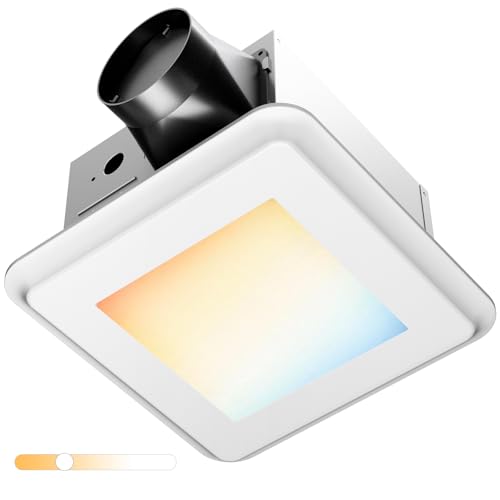
The Amico combines strong ventilation with lighting and the quietest operation here. Its 80 CFM airflow clears steam from a standard bath up to about 80 square feet, and at just 0.9 sones it runs quieter than a whisper. The integrated 1000-lumen LED offers five color temperatures, from warm 2700K to crisp 5000K, with smooth 0 to 100 percent dimming, so one fixture handles both a soft nighttime glow and bright morning light. It fits a standard ceiling opening for new builds or replacements and is ETL and FCC certified. For a typical family bathroom that wants fan and light in one tidy unit, it is a strong value.
Pros:
- Quietest in the group at 0.9 sones
- Bright LED with five color temperatures and dimming
- Solid 80 CFM for a standard bath
- Fits standard openings, easy install
Cons:
- 80 CFM is not enough for a very large bathroom
- Combined light means planning your ceiling wiring
Best for: standard bathrooms wanting a quiet fan and adjustable light in one.
Gopper 12″ 120 CFM Fan
The Gopper is the airflow champion for larger rooms. Its 120 CFM output, driven by an upgraded motor with centrifugal impellers to keep noise down, clears steam from spaces up to 100 square feet, and it manages that at a quiet 1.0 sone. A large 12-inch panel houses a bright 1500-lumen 6500K LED that floods the room with clean cool-white light and keeps mirrors fog-free after a shower. The sleek white grille suits most decor. The trade-off is size: the wide 12-inch panel needs a larger 9.8-inch mounting cutout, so confirm the dimensions before you buy. For a big bathroom, the extra power pays off.
Pros:
- High 120 CFM for large bathrooms
- Quiet 1.0 sone operation
- Bright 1500-lumen LED panel
- Clears fog and steam quickly
Cons:
- Large panel needs a bigger cutout
- Cool-white LED color is not adjustable
Best for: large or high-ceiling bathrooms that need maximum airflow and light.
Broan-NuTone 110 CFM Fan
The Broan 110 is the quiet powerhouse of the pair from a trusted air-quality name. It moves a strong 110 CFM at a hushed 1.0 sone, enough for a room up to about 105 square feet, and its TrueSeal damper technology cuts air leakage by up to half compared with typical models, blocking cold backdrafts and odors when the fan is off. Retrofit installation is done entirely from the room side, so no attic access is needed, and it is UL listed for use over a tub or shower on a protected circuit, letting you place it exactly where the steam gathers. Energy Star certified and dependable, it is a reliable upgrade for a busy bathroom.
Pros:
- Strong 110 CFM at a quiet 1.0 sone
- TrueSeal damper reduces backdrafts and leakage
- Room-side retrofit, no attic access needed
- Rated for use over a tub or shower
Cons:
- No integrated light
- Mid-to-premium price
Best for: standard-to-large baths wanting strong, quiet, sealed ventilation.
The verdict
Best overall: the Panasonic WhisperFit takes the top spot as the proven best-seller. Its selectable airflow, efficient DC motor, quiet operation, and easy retrofit make it the fan that fits almost any bathroom well.
Best value: the Broan-NuTone 50 CFM ventilates a small bath for the least money, and the Amico 80 CFM With Light adds a quiet fan and adjustable LED at a fair mid-range price.
Best for big bathrooms: the Gopper 120 CFM moves the most air with a bright light, while the Broan 110 CFM pairs strong airflow with a sealed damper.
Frequently asked questions
What CFM do I need for my bathroom?
A common rule is one CFM per square foot, so a 60-square-foot bath wants at least 60 to 80 CFM, and a larger room 110 or more. Add extra for a room with a shower or high ceilings. The Panasonic’s selectable airflow makes matching your room simple.
How quiet is quiet?
Look at the sone rating: 1.0 sone or less is genuinely quiet, close to a soft hum, while 2.0 sones is clearly audible. The Amico at 0.9 sones is the quietest here, ideal if the fan runs while you relax in the bath.
Can I install one without attic access?
Yes. Most fans here, including both Broan models, the Amico, and the Gopper, are designed for room-side retrofit installation with no attic access and often no extra drywall cutting. Always confirm the duct size matches your existing ductwork first.
Do any turn on automatically with humidity?
These models use a standard wall switch, but you can pair any of them with a separate humidity-sensing or timer switch. That upgrade runs the fan automatically when moisture rises or for a set time after a shower, which is often the most effective way to keep a bathroom dry.
How long should I run the fan after a shower?
Aim for about 15 to 20 minutes after you finish to clear lingering moisture from the walls and air. A timer switch handles this automatically, and it is a small, worthwhile addition that helps prevent mildew and protects paint and grout.
This article may contain affiliate links; see our Affiliate Disclosure.