Nothing strips paint, flattens a glued-up panel, or knocks down a proud edge faster than a belt sander biting into wood. It is the brute of the sanding world, and used well it turns hours of hand-sanding into minutes.


A belt sander drives a continuous loop of abrasive over a surface to remove material fast and level it flat, the heavy-lifting step before finer sanders take over. This guide compares five machines across the main types, a detail file sander, a benchtop station, a cordless handheld, and corded workhorses, so woodworkers, DIYers, and restorers can match the tool to the job. Choosing the right style of belt sander matters as much as choosing the brand.
| Product | Standout | Price tier | Link |
|---|---|---|---|
| WEN 6307 Detail File Sander | Best-selling, narrow belt for tight spots | Budget | |
| WEN Benchtop Belt & Disc Sander | Stationary belt plus disc, cast iron base | Mid-range | |
| DEWALT 20V Cordless Belt Sander | Brushless, cordless, strong dust collection | Premium | |
| Skil 3×18 Belt Sander | Pressure control, micro-filtration | Mid-range | |
| CRAFTSMAN 3×21 Belt Sander | Fast removal, sands close to edges | Mid-range | |
How to choose a belt sander
The best belt sander depends entirely on what you are sanding. Sort out the type first, then the details.
Match the type to the job
Belt sanders come in several forms for different work. A standard handheld model, typically with a 3-inch-wide belt, is the classic choice for fast material removal and leveling large flat surfaces like tabletops, decks, and doors. A narrow detail or file sander uses a small belt to reach tight spaces, curves, and slots a big sander cannot touch. A benchtop belt-and-disc station holds the abrasive still while you bring the workpiece to it, ideal for shaping smaller parts precisely. Decide whether you mostly flatten big surfaces, detail tight areas, or shape small pieces, and the right type follows.
Belt size and power
For handheld sanders, belt width and length set the pace. Wider, longer belts cover more surface per pass and remove material faster, which is what you want for leveling, while narrower belts fit tighter spots. Motor power, rated in amps for corded tools, determines how well the sander holds speed under pressure, and more amps mean it bogs down less when you lean into a stubborn spot. Belt speed, measured in feet per minute, affects removal rate too. For heavy leveling, favor a wider belt and a stronger motor; for finesse, a smaller, more controllable machine wins.
Corded or cordless
Corded belt sanders deliver constant, uninterrupted power for long, demanding jobs and never need recharging, which makes them the traditional choice for shop work near an outlet. Cordless models, powered by modern brushless motors, now come close to corded performance and free you to sand anywhere, on a ladder, out in the yard, or across a job site, without hunting for power. The trade is battery runtime and the cost of batteries. If you work mostly at a bench, corded is simple and economical; if you value portability and already own a battery platform, cordless is liberating.
Dust collection and belt tracking
Belt sanders make a lot of dust fast, so collection matters for your lungs and your workspace. Look for an onboard dust bag or, better, a port that connects to a shop vacuum, and note that some tools advertise very high dust-capture efficiency. Belt tracking is the other quiet essential: a good sander keeps the belt centered automatically, and auto-tracking designs save you from constant fiddling. Tool-free belt changes speed up swapping grits. These conveniences separate a pleasant machine from a frustrating one, so weigh them alongside raw power.
Control and comfort
A belt sander removes material so quickly that control is a safety and quality feature, not a luxury. Variable speed lets you dial the pace down for delicate work and up for fast removal, and features like pressure-control warnings help avoid gouging by alerting you when you push too hard. A comfortable grip and manageable weight reduce fatigue on long sessions and improve your accuracy. An angled or low-profile front helps sand close to adjoining surfaces. Consider how the tool feels in the hand, since a controllable sander produces flatter, cleaner results with fewer mistakes.
WEN 6307 Detail File Sander: the best-selling tight-space specialist
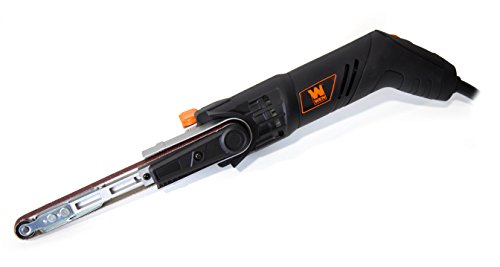
The top seller here is not a big surface sander at all, but a nimble detail file sander, and its popularity reflects how often woodworkers need to reach where a full-size machine cannot. A slim 1/2-by-18-inch belt gets into slots, curves, and cramped corners for controlled material removal in tight spots, and a variable-speed dial runs the belt from 1080 to 1800 feet per minute to suit the task. The belt arm pivots up to 55 degrees to meet awkward angles, the auto-tracking system needs no tensioning fuss, and tool-free belt changes keep you working. It will not level a tabletop like a 3-inch sander, but for detailed sanding, deburring, and finishing intricate pieces, it is an affordable, genuinely handy specialist.
Pros
- Reaches tight spots and curves
- Variable-speed belt control
- Pivoting arm for awkward angles
- Auto-tracking, tool-free belt changes
- Affordable best-seller
Cons
- Narrow belt, not for large surfaces
- Modest removal rate on big jobs
- Specialist rather than general-purpose
Best for: detailed sanding, deburring, and tight spaces a full-size sander cannot reach.
WEN Benchtop Belt & Disc Sander: the shaping station
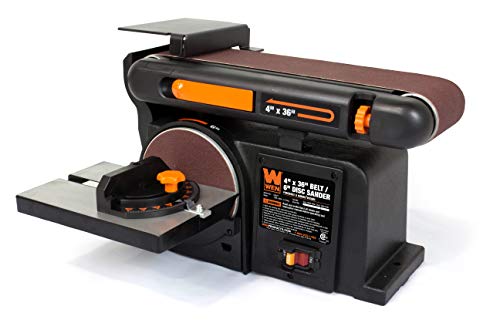
This stationary two-in-one brings the workpiece to the abrasive, which is exactly what you want for shaping and squaring smaller parts with precision. It pairs a 4-by-36-inch belt with a 6-inch sanding disc, so you can flatten, round, and true edges without chasing the tool across the bench. The belt tilts anywhere from 0 to 90 degrees for angled and vertical sanding, a sturdy cast iron base soaks up vibration for steadier work, and a 4.3-amp motor spins up to 3600 RPM. For a home shop that builds small projects, sharpens, or needs consistent, controlled edges, a benchtop station complements a handheld sander beautifully and often becomes the most-used tool for detail shaping.
Pros
- Belt and disc in one machine
- Belt tilts 0 to 90 degrees
- Sturdy cast iron base
- Great for shaping small parts
- Steady, controlled sanding
Cons
- Stationary, not for large in-place surfaces
- Takes up bench space
- Smaller motor than heavy handhelds
Best for: shaping, squaring, and truing smaller workpieces at the bench.
DEWALT 20V Cordless Belt Sander: the go-anywhere workhorse
DEWALT’s cordless belt sander proves battery tools can handle serious sanding. A brushless motor delivers up to 22 percent more power than comparable tools for efficiency and long runtime, letting you complete traditionally corded jobs without a cable, whether up a ladder, out in the yard, or across a site. It tackles large jobs quickly with a generous sanding surface area, and a variable-speed trigger with a 25-speed selection lets you tune the pace precisely to the material. Dust collection is a strong point, capturing up to 95 percent of dust through a tool-free bag to keep your workspace and lungs cleaner. For anyone invested in a cordless platform who wants freedom without giving up removal power, it is the premium pick.
Pros
- Cordless freedom, strong brushless power
- Up to 95 percent dust collection
- 25-speed variable control
- Large sanding surface for big jobs
- Long runtime for a battery tool
Cons
- Highest price, battery may be extra
- Runtime limited by battery
- Heavier with a large battery fitted
Best for: pros and DIYers who want corded-like power with cordless freedom.
Skil 3×18 Belt Sander: the controllable value pick
Skil’s 3-by-18-inch handheld hits a sweet spot of capability, control, and price for everyday sanding and leveling. Its standout is pressure-control technology that warns you when you are pushing too hard, a genuinely useful guard against the gouges and uneven spots that trip up newcomers to belt sanders. A 6-amp motor sands any type of wood surface with authority, auto-track belt alignment keeps the belt centered without fuss, and micro-filtration captures fine dust to keep the air cleaner. The slightly shorter 18-inch belt makes it a touch more maneuverable than a 21-inch machine. For a first serious belt sander or a controllable everyday workhorse, it offers reassuring performance at a sensible cost.
Pros
- Pressure-control warns against gouging
- Capable 6-amp motor
- Auto-track belt alignment
- Micro-filtration for fine dust
- Maneuverable and well-priced
Cons
- Corded, needs an outlet
- Narrower belt than 21-inch models
- Bag fills quickly on big jobs
Best for: first-time buyers and anyone wanting controllable, everyday leveling.
CRAFTSMAN 3×21 Belt Sander: the fast-removal handheld
The CRAFTSMAN 3-by-21-inch is the classic surface sander built for exactly what this article is about: fast material removal and leveling. A 7-amp motor drives the belt up to 800 feet per minute for quick stock removal on tabletops, doors, decks, and rough lumber, and an angled belt design lets you sand closer to adjoining surfaces than many rivals, reducing hand-finishing in corners. Tool-free belt release makes grit changes quick, and an onboard dust bag provides solid collection to keep the work area clearer. The larger 21-inch belt covers ground efficiently on big flat jobs. For a dependable, no-nonsense handheld that flattens surfaces fast from a trusted name, it is a strong mid-range choice.
Pros
- Fast removal at up to 800 fpm
- Sands close to adjoining surfaces
- Tool-free belt changes
- Onboard dust collection
- Larger 21-inch belt covers more
Cons
- Corded operation
- Can remove material quickly if careless
- Heavier than smaller sanders
Best for: leveling and fast material removal on large flat surfaces.
The verdict
These span very different jobs, from detail work to whole-surface leveling. Match the pick to what you actually sand most.
Best Overall: WEN 6307 Detail File Sander – the best-selling detail file sander, a versatile, affordable specialist for the tight spots and intricate work that stump larger machines.
Best Value: Skil 3×18 Belt Sander – a controllable 3×18 handheld with pressure control and solid power at a sensible price, ideal for everyday leveling.
Best Premium: DEWALT 20V Cordless Belt Sander – cordless freedom with brushless power and excellent dust collection, for sanding anywhere without sacrificing removal speed.
Frequently asked questions
Which belt sander is best for leveling a large flat surface?
A standard handheld model with a wide belt, typically 3 inches, is the right tool for leveling tabletops, doors, and decks. Its width covers ground quickly and removes material fast to flatten a surface. Detail file sanders are too narrow for this, and benchtop stations are made for bringing small parts to the tool. For big flat jobs, choose a corded or cordless 3-inch handheld with a strong motor.
How do I avoid gouging the wood?
Keep the sander moving in long, even strokes along the grain, let the tool’s weight do the work rather than pressing down hard, and never let it sit in one spot while running. Start and lift the sander while it is moving. Models with pressure-control warnings help by alerting you when you push too hard. Using a slightly finer grit and lighter touch as you approach your target depth also avoids over-sanding and uneven dips.
What grit should I start with?
For fast material removal, paint stripping, or heavy leveling, start with a coarse grit around 40 to 60, then step up through medium grits to refine the surface. Do not jump straight to fine grit for heavy work, as it clogs and removes little. After the belt sander has flattened and shaped the surface, switch to an orbital or finishing sander with finer grits for a smooth, ready-to-finish result. Working through grits in order gives the cleanest outcome.
Do I really need dust collection?
Yes, it matters for both health and results. Belt sanders produce a large volume of fine dust quickly, which is unpleasant and unhealthy to breathe and can settle over your whole workspace. An onboard dust bag helps, and connecting to a shop vacuum captures far more. Some tools advertise very high collection efficiency. Wearing a dust mask is still wise. Good dust management also lets you see your work clearly, improving accuracy.
Is a cordless belt sander powerful enough for real work?
Modern cordless belt sanders with brushless motors have closed much of the gap and can handle demanding sanding that once required a cord. They offer the freedom to work anywhere, which is a real advantage on ladders, outdoors, or away from outlets. The trade-offs are limited battery runtime and the cost of batteries. For occasional portable jobs or if you already own a battery platform, cordless is excellent; for constant all-day bench work, corded remains simple and economical.
This article may contain affiliate links; see our Affiliate Disclosure.