Your phone is at nine percent, the laptop needs a top-up before the meeting you are driving to, and there is exactly one power socket in the dash. A good multi-port car charger turns that single cigarette-lighter port into a small charging station, so the driver’s phone, a passenger’s tablet, and a work laptop can all drink at once.



The catch with “100W” car chargers is that the headline number is usually a total, shared across ports. What actually matters for charging a laptop and phone together is how much a single port can deliver on its own. The picks below cover both angles: the crowd favorite that fast-charges phones and lighter laptops, true dual-100W units that run a laptop and a phone at full speed, and a compact premium option for the heaviest laptops. Whether you commute alone or pack the car with family devices, there is a match here.
At a glance
| Charger | Standout feature | Price tier | Link |
|---|---|---|---|
| JUNVANG 90W 4-Port | Four ports, best-selling value | Budget | |
| ROADRESS Dual 100W | Two full 100W USB-C ports | Mid-range | |
| UYUXIO 6-in-1 | Six ports plus voltage display | Budget | |
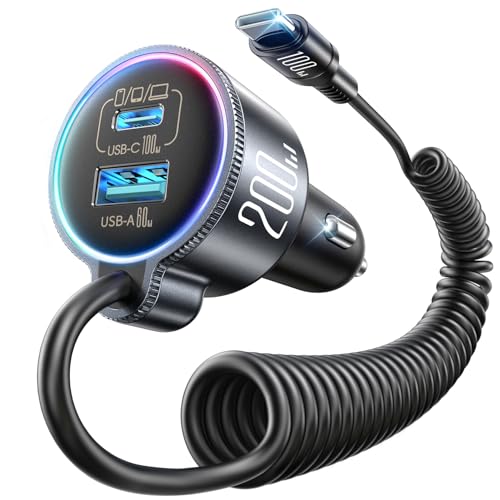
| FLYLEAD Coiled Cable | Built-in cable, dual 100W | Mid-range | |
| UGREEN 150W GaN | 140W single port, compact GaN | Premium | |
How to choose a multi-port car charger
The right charger depends less on the big number on the box and more on how you actually load it up. A weekday commuter charging one phone has very different needs from a family filling six ports on a long drive, and the specs that matter shift with them. Here is what separates a great pick from a frustrating one.
Total watts versus per-port watts
This is the single most important thing to understand. A charger advertised at 200W or 250W is stating a combined ceiling, not what one device receives. A laptop that needs 100W will only charge at full speed if a single port can supply 100W on its own. Read the per-port breakdown, not just the headline, and you will avoid the classic disappointment of a “200W” charger that only trickles into your laptop because the wattage is spread thin.
Running a laptop and a phone at the same time
To keep a laptop at full speed while a phone charges alongside, you want at least one port rated near 100W and a second port with useful output left over. The dual-100W chargers here are built for exactly that, holding 100W on each of two ports. A phone, by contrast, rarely draws more than 20 to 45W, so once the laptop’s port is covered, the rest of the ports are plenty for phones, tablets, and earbuds.
Ports, protocols, and device mix
USB-C with Power Delivery (PD) is what modern laptops and phones want, and PPS support helps fast-charge recent Samsung phones. USB-A ports are handy for older cables and accessories like dash cams. Count your devices plainly: a solo commuter may only need two ports, while a family road trip can fill six. More ports is convenient, but remember the total-watts rule still applies when every port is busy.
GaN and heat
Chargers built with gallium nitride, or GaN, run cooler and pack more power into a smaller body. That matters in a hot car, where a cheap plastic adapter can throttle back once it heats up. The UGREEN unit uses GaN to deliver 140W from a compact shell, which is why it stays composed under a heavy laptop load on a warm day.
Cable: built in or bring your own
Most of these are pure adapters, so you supply your own cables. The FLYLEAD includes a coiled cable that stretches to a dashboard mount and retracts out of the way, which keeps the cabin tidy. If you go the adapter route and want full 100W or 140W speeds, make sure your cable is rated for it, because a thin charge-only cable will quietly cap your speed.
Fuse and vehicle compatibility
High-output chargers can ask a lot of your car’s accessory circuit. The UGREEN, for instance, needs a 20-amp fuse to reach its full 150W. Most modern cars and trucks handle these fine, but if you drive an older vehicle it is worth checking the fuse rating for the accessory socket before buying the highest-wattage option. All of these are rated for the common 12 to 24 volt range, so they work in cars, SUVs, and trucks alike.
Size, placement, and back-seat reach
A charger that sticks far out of the socket can catch a knee or a bag, so a low-profile body is worth having in a cramped console. If passengers in the back need power, look for a longer lead or a rear clip that anchors the unit in a seat pocket, as the Rocoren-style six-port designs and the UGREEN’s rear clip do. Match the port layout to where people actually sit, and nobody has to stretch a short cable across the cabin.
What a real drive actually gives you
It helps to set expectations against the length of your trips. A twenty-minute school run or commute is enough to put a meaningful dent in a phone on a 45W port, but it will not do much for a laptop no matter what the box claims. A two-hour drive is where a 100W or 140W port earns its money, taking a large laptop from nearly flat to comfortably usable by the time you arrive. Phones also taper: they pull peak power in the first stretch and slow down as they fill, so the headline “80 percent in 30 minutes” figures describe the fast early phase, not the whole charge.
Safety and protection
Every charger here uses a smart control chip that identifies each device and feeds it the right power, along with layered protection against overcurrent, overvoltage, overheating, and short circuits. Metal or flame-retardant housings help shed heat during long sessions. These are standard features now, but they are the reason a good charger can sit in a hot car for hours without drama, and a reason to be wary of no-name units that skip them.
JUNVANG 90W 4-Port USB-C Car Charger
This is the runaway crowd favorite, and it is easy to see why: four ports, two USB-C and two USB-A, in a compact metal body at a friendly price. It delivers up to 90W total, with each USB-C port topping out around 45W, so it is a superb match for phones, tablets, and lighter USB-C laptops that charge in the 45 to 65W range. It is fair to say it is not the pick for a power-hungry laptop that wants a full 100W to one port, but as an everyday four-device charger for a busy car, its popularity is well deserved.
Pros
- Four ports charge up to four devices at once
- Compact all-metal housing that dissipates heat
- Fast PD and PPS charging for phones and tablets
- Excellent value and a top seller
Cons
- 90W total, so no single port hits a full 100W
- Best for phones and lighter laptops, not heavy laptop loads
Best for: families and commuters who want to fast-charge several phones and tablets on a budget.
ROADRESS Dual 100W USB-C Car Charger
If the whole point is charging a laptop and a phone at full speed together, this is the straightforward answer. It carries two USB-C ports that each hold 100W, plus a 60W USB-A port, and supports the major fast-charge protocols including PD and PPS. That means a MacBook or Windows laptop on one port and a phone on the other, both moving quickly, with a third device still welcome. A soft blue ring light makes the ports easy to find at night. For the money, getting two genuine 100W outputs is the headline here.
Pros
- Two true 100W USB-C ports for full-speed laptop plus phone
- Extra 60W USB-A port for a third device
- Wide protocol support for phones and laptops
- Night-friendly ring light around the ports
Cons
- You supply your own high-rated cables
- Bright ring light may be too much for some drivers
Best for: anyone who regularly charges a laptop and a phone at the same time.
UYUXIO 6-in-1 Car Charger with Voltage Display
When the goal is charging a lot of phones rather than a laptop, this six-port unit shines. It adds a small voltage display that shows your car battery’s status at a glance, which road-trippers and older-car owners appreciate. It fast-charges phones across the major brands, though it is fair to note that per-phone speeds are modest, in the range you would expect for a multi-phone hub rather than a laptop charger. Think of it as the family-and-friends option: six devices topping up while a screen keeps an eye on the battery.
Pros
- Six ports for charging many phones at once
- Built-in voltage display for battery monitoring
- Broad phone fast-charge support
- Metal build resists heat during long use
Cons
- Per-device speeds are modest, not a laptop charger
- The headline wattage is a combined figure
Best for: group trips where several phones need charging and battery status is nice to see.
FLYLEAD Car Charger with Coiled Cable
The FLYLEAD’s clever touch is a built-in coiled cable, so one of your two 100W outputs is always ready without digging for a cord. It pairs that fixed cable with a second USB-C port, each capable of 100W, plus a 60W USB-A port. Smart power sharing keeps two devices at full speed, or splits sensibly across three. The coiled cable stretches to a dash mount or the back seat and retracts to stay tidy. If cable clutter drives you up the wall, this is the pick that reads your mind.
Pros
- Integrated coiled cable keeps the cabin tidy
- Dual 100W outputs for laptop plus phone
- Extra USB-A port for a third device
- Smart power allocation across ports
Cons
- Fixed cable can wear over years of use
- Full 140W to a large laptop needs the laptop’s own cable
Best for: drivers who want a full-speed port ready to grab without carrying a cable.
UGREEN 150W USB-C Car Charger (GaN)
For the heaviest laptops, the UGREEN is the composed premium pick. GaN internals let it push up to 140W from a single USB-C port and 150W total across four ports, all from a small, cool-running body. That is enough to charge a large laptop from empty toward half in about half an hour while phones and a tablet fill the other ports. It includes a rear clip for the seat pocket and a charging cable. Just remember it wants a 20-amp fuse to hit full power, so it suits modern vehicles best.
Pros
- Up to 140W on one port for demanding laptops
- GaN design stays cool and compact
- Four ports plus a handy rear clip
- Trusted brand with strong build quality
Cons
- Needs a 20-amp fuse for full 150W output
- Priced above the value picks
Best for: owners of power-hungry laptops who want the fastest, coolest-running option.
The verdict
Best overall: the JUNVANG 90W 4-Port. It is the most popular for good reason, charging four devices quickly at a low price. Just match it to phones, tablets, and lighter laptops rather than a power-hungry workstation.
Best value: the ROADRESS Dual 100W. Two genuine 100W ports for laptop-plus-phone charging, at a mid-range price, is the smartest balance of speed and cost in the group.
Best premium: the UGREEN 150W GaN. Its 140W single port and cool-running GaN build make it the one to grab if you charge a large laptop in the car regularly.
Frequently asked questions
Can a car charger really charge a laptop? Yes, if a single port supplies enough wattage. Many USB-C laptops charge at 45 to 100W, so a charger with a 100W or 140W port keeps them moving at full speed, even while a phone charges beside it.
What is the difference between total and per-port wattage? Total wattage is the combined ceiling across all ports. Per-port wattage is what one device actually receives. For a laptop, the per-port number is the one that counts.
Do I need a special cable for 100W or 140W? Yes. Use a USB-C cable rated for the wattage you want, ideally one with an E-mark chip for the highest speeds. A thin charge-only cable will cap the current no matter how strong the charger is.
Will a high-wattage charger drain my car battery? While the engine runs, the alternator easily covers it. With the engine off, any charger draws from the battery, so avoid long high-power sessions on a parked car, just as you would with any accessory.
Are these safe for my phone? Yes. Each of these uses smart chips that match output to the device and add protections against overcurrent, overheating, and short circuits, so your phone only takes the power it is designed to accept.
What happens when I use every port at once? The charger shares its total budget across the ports, so per-device speeds drop as you add devices. A charger that gives one port 100W might split to 100W plus 24W across three. That is normal and safe, and it is exactly why the total-versus-per-port distinction matters when you shop.
This article may contain affiliate links; see our Affiliate Disclosure.