Five lever presses here promise effortless juicing. A lever’s entire job is mechanical advantage, and mechanical advantage is set by one measurement: the length of the arm. Not one of the five publishes it. You get extra-long, extended, long, dependable, and serious. Meanwhile the cheapest result in this manual juicer search has a 40-watt motor and a plug.


At a glance
| Product | What sets it apart | Price tier | Link |
|---|---|---|---|
| ChefVille 4-in-1 | Cheapest. Also grinds potatoes and separates egg yolks | Budget | |
| Elite Gourmet ETS623 | A 40-watt motor, in a manual juicer search | Budget |  |
| Etinslant Reamer | Only listing explaining why slits beat round holes | Budget | |
| OXO Good Grips 2-in-1 | Five bullets, five checkable facts, nothing else | Budget | |
| Sopito Press | The only listing that says how big an orange is | Mid-range | |
| CO-Z Cast Iron | 15 lbs, published. Its own twin costs more in gray | Mid-range | |
| Eurolux Cast Iron | Ships a backup for its own suction cups | Premium | |
| Zulay Cast Iron | The dearest here. Its headline feature is 20+ colors | Premium | |
How to choose
Weight is the feature, and one brand says so out loud
A lever press works by you pulling down hard. Newton’s third law means the fruit pushes back just as hard, and something has to stop the whole machine coming up off the counter with the lever. On a 15 lb cast iron press, that something is the 15 lbs. The lightest press here made a different choice, and then wrote the most accurate bullet in this entire category: it says its lightweight design means you must hold it down with one hand and press with the other, and adds, in brackets, that other manual juicers require two hands as well. That is a company pre-emptively apologizing for a trade-off nobody else on this page admits exists.
Everything that isn’t heavy is stuck down instead
Once you see it, you cannot unsee it. One press suctions to the counter. Another has suction cups. Another has rubberized feet and promises no tipping, ever. A fourth just says its construction is weighted. Four products, four answers to the same problem, and the problem is that a lever press wants to lift. The most revealing one ships suction cups and a small rubber piece to replace them with. Nobody includes a backup for a part that works. Suction fails on textured stone, tile grout and anything but smooth laminate, and exactly one brand here has quietly planned for that.
2300 psi is not the pressure on your orange
One brand gives the only number attached to any cast iron press here, and it is worth reading closely. The claim is that reinforced cast iron withstands over 2300 psi. Withstands. That is what the frame survives, not what the fruit receives. It is a material strength figure wearing a performance figure’s clothes, and cast iron’s compressive strength comfortably exceeds it regardless. Useful to know the frame will not crack. It tells you nothing about yield.
Bowl size only means something next to a fruit
Presses here quote 5-inch bowls, 5-inch funnels, 4.3-inch bowls, and fits fruits of all sizes. All of that is unreadable until somebody tells you how big an orange is, and exactly one listing does: most commercial oranges run 2.6 to 3.5 inches across. That single sentence turns every bowl figure on this page into information. It also means the smallest bowl here still clears the biggest common orange with an inch to spare, and the brand publishing the smallest number is the only one that proved its number is enough.
Reamer or press
Two different tools sharing one search. A reamer is a ridged cone you push half a fruit onto and twist, doing the work with your wrist; it is cheap, small, and fine for a lemon or two. A press is a lever and a cone, doing the work with your shoulder through a mechanical advantage; it costs three to six times more and it is the only thing worth owning if you are juicing a bag of oranges every week. Buy the reamer for the salad dressing. Buy the press for breakfast.
Slits, not holes
One budget listing explains its own strainer geometry, saying slits filter seeds and pulp while letting juice drain fast, unlike round holes which jam. That is correct and it is a real design decision: pulp bridges across a circular hole and seals it, where a slot keeps draining along its length. It is the only listing on this page that explains why any part of it is shaped the way it is, and it costs under twenty dollars.
When the bullets stop being about juice
The dearest product here leads its final bullet with availability in 20 or more colors. It publishes a bowl diameter and nothing else: no weight, no lever length, no pressure. At the other end, one listing claims to juice watermelons and pineapples, separate egg yolks, and grind garlic, carrots, potatoes and ginger, from a tool it calls a 4-in-1 while listing at least eight jobs. Both are telling you the same thing in opposite directions: when a listing runs out of things to measure, it starts counting other things.
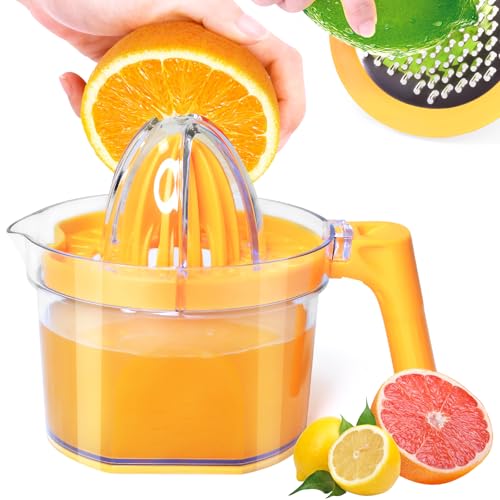
ChefVille 4-in-1
The cheapest thing here, and it does the one piece of arithmetic on this page correctly: it claims 16.9oz is 40% more than the usual 12oz, and 16.9 divided by 12 really is about 1.4. Credit where it is due. Two heads is a genuinely good idea, a 12-tooth cone for lemons and limes and a three-claw head for oranges, and the detachable handle plus side grooves gives you two ways to hold it. Then it claims to grind potatoes and separate egg yolks, in a 4-in-1 that lists eight jobs, and you remember what you paid.
Pros:
- The lowest price here by a wide margin
- Two heads sized for small and large citrus
- 16.9oz with milliliter markings; the capacity maths checks out
- Detachable handle, plus side grooves as a second grip
Cons:
- Claims to grind potatoes and separate egg yolks
- Called a 4-in-1 while listing eight jobs
- Plastic, where rivals a few dollars up are 304 steel
Best for: two reamer heads for under ten dollars.
Elite Gourmet ETS623
It is electric. In a search for manual juicers, this arrives second-cheapest with a 40-watt motor, and it is included here so you notice before it arrives. On its own terms it is decent: the motor is stronger than the 25W typical of the category, the reamer auto-reverses to work the fruit both ways, and the 24oz jug with a built-in pulp and seed filter holds three cups. If a plug was never the objection, this is a lot of juicer for the money. If a plug was the objection, this is not a juicer for you.
Pros:
- 40W motor against the category’s usual 25W
- Auto-reversing reamer works the fruit both directions
- 24oz jug with built-in pulp and seed filter
- Top rack dishwasher safe; ETL listed
Cons:
- It plugs in; this is a manual juicer page
- Needs an outlet and counter space near one
- Motor and reamer speed are its ceiling; you cannot lean on it
Best for: people who did not actually want manual.
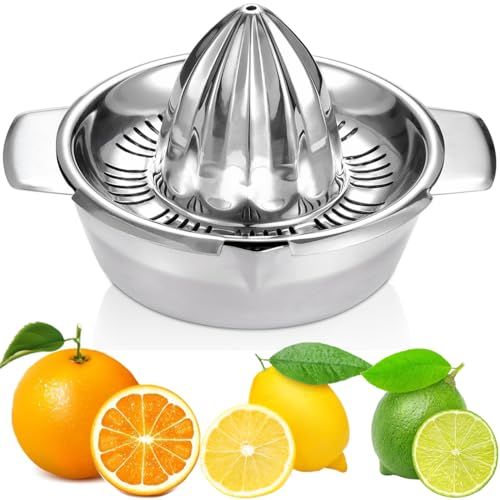
Etinslant Reamer
The only listing here that explains why any part of it is shaped as it is, noting that slit strainers drain fast where round holes jam with pulp. That is true, and it is the kind of thing you learn by using the product. It is 304 stainless throughout, resists citric acid, and publishes real dimensions: a 2.75 inch cone, a 5.43 inch sieve, an 11-tooth reamer, two pour spouts and two-sided handles. It is also the only product on this entire page with a warranty, at 12 months, plus a 60-day unconditional return.
Pros:
- Explains its strainer geometry, and is right about it
- Publishes cone height, sieve diameter and tooth count
- 304 stainless steel; acid and rust resistant
- The only warranty here: 12 months, plus 60-day returns
Cons:
- A 10oz bowl; the smallest capacity on the page
- Wrist work, not lever work; hard going on a bag of oranges
- One reamer size for every fruit
Best for: a metal reamer that tells you its own dimensions.
OXO Good Grips 2-in-1
Five bullets, and every one of them is a fact you could confirm in the kitchen. Small reamer for lemons and limes, large for oranges and grapefruit. Markings to 1.5 cups. Drip-free spout. BPA-free body shaped to grip. Reamers snap off to wash and nest to store. No maximum extraction, no lifetime, no pressure rating, no vitamins. On a page where the dearest product’s standout feature is a color count, a listing that simply describes the object is doing something the rest are not.
Pros:
- Two reamer sizes, snapping off to wash and nesting to store
- Measurement markings to 1.5 cups, printed on the body
- Drip-free spout; shaped for grip
- Every claim in the listing is checkable
Cons:
- 1.5 cups is modest for a family batch
- Plastic body at nearly the price of a steel rival
- Still wrist work, not leverage
Best for: a listing that claims exactly what it can show.
Sopito Press
Its first bullet is headed “Friendly Reminder” and it is a confession: the press is light, so you will need one hand holding it and one hand pressing, and by the way so does everyone else’s. Nobody makes you read that before you buy unless they would rather lose the sale than the review. Its second gift is telling you most commercial oranges are 2.6 to 3.5 inches across, which is the fact that makes its 4.3 inch bowl legible and every rival’s bowl figure legible too. Stainless frame with aluminum alloy, all fruit-contact parts dishwasher safe, cleaning brush included, and a handle designed to stay put rather than fall.
Pros:
- Warns you it needs two hands, before you buy
- The only listing publishing how big an orange actually is
- Light enough to carry; stainless and aluminum alloy
- Dishwasher-safe fruit contact parts; brush included
Cons:
- Light means you hold it down every single press
- No lever length or weight published
- The smallest press bowl here at 4.3 inches
Best for: clarity about the trade-off it made.
CO-Z Cast Iron
The most specified cast iron press here, publishing 15 lbs of frame, 304 stainless on every fruit-contact part, a 5-inch funnel and that 2300 psi rating. Fifteen pounds is the number that matters, because that is the weight arguing with your lever instead of you having to. It also appears on this page twice, in black and in gray, with the same bullets and the same 2300 psi, sixteen dollars apart. Same juicer. The gray one costs more and is the only one of the pair that bothers to tell you the weight.
Pros:
- 15 lbs published; heavy enough to stay put on its own
- 304 stainless on all fruit-contact parts
- 5 inch funnel clears any common orange
- Detachable strainer and funnel; dishwasher safe
Cons:
- 2300 psi is what the frame survives, not what the fruit gets
- Listed twice in two colors, sixteen dollars apart
- No lever length published
- 15 lbs is a permanent counter resident
Best for: weight and steel, at the cheaper of its two colors.
Eurolux Cast Iron
It ships suction cups and a small rubber piece to swap them out for, and that is the single most useful thing any press on this page does. Suction only grips smooth surfaces; on textured granite, tile or a seamed worktop it lets go halfway through a grapefruit. Every rival sells you suction and stops talking. This one packs the fallback in the box, which means someone there has actually put a juicer on a real kitchen counter. It also includes a stainless steel cup, so you are not hunting for a glass short enough to fit under the spout.
Pros:
- Ships a rubber alternative to its own suction cups
- Stainless cup included; no hunting for a glass that fits
- Fruit-contact parts detach for the dishwasher
- Heavy cast iron built for continuous use
Cons:
- No weight, lever length or pressure figure published
- Premium price for a listing with five short bullets
- Extra-large body, permanently on the counter
Best for: the only brand that planned for a real countertop.
Zulay Cast Iron
The most expensive product on this page, and its final bullet sells you 20 or more colors. It publishes one measurement, a 5-inch bowl, and beyond that: cast iron, a lever arm, rubberized feet, no slipping or tipping ever, and built to last a lifetime. No weight, no lever length, no pressure, no steel grade on the parts that touch your juice. It is very likely a good press. There is simply nothing here to check, at twice the price of a rival that publishes its weight and its steel grade.
Pros:
- Cast iron with rubberized feet rather than suction
- 5-inch bowl handles limes through grapefruit
- Detachable strainers for cleaning
- More color choice than anything else here
Cons:
- The dearest here, and its headline bullet is color count
- No weight, lever length, pressure or steel grade published
- Its rivals at half the price publish more
Best for: matching your kitchen, if that is the brief.
The verdict
Five lever presses, no lever lengths. Four answers to the problem of a press lifting off the counter, and only one brand admitting the problem exists. The useful listings here are the ones that gave you a number you could argue with.
Best overall: Sopito Press. It is the only listing on this page that tells you how big an orange is, which is the fact that makes its bowl figure and everyone else’s mean something, and its own 4.3 inches clears the biggest common orange comfortably. It then opens with a warning that its lightness costs you a hand, and volunteers that its rivals need two hands as well. A brand that leads with its own trade-off has usually got the rest right too, and the stainless contact parts, the included brush and the handle designed not to drop all point the same way.
Best value: Etinslant Reamer. Under twenty dollars buys 304 stainless, an 11-tooth cone, a published cone height and sieve diameter, two spouts, and the only warranty on this page at 12 months with 60 days of unconditional returns. It is also the only listing anywhere here that explains why a part is shaped the way it is, telling you slits drain where round holes jam. It is wrist work and a small bowl, so it is a lemon tool, not a breakfast tool. For that job nothing here beats it.
Best premium: Eurolux Cast Iron. Buy it for the small rubber piece in the box. Suction cups fail on textured stone and tile, every press here sells you suction anyway, and this is the only brand that packed the alternative. That one part is evidence somebody tested this on a real counter rather than a photo studio. The included stainless cup saves the usual hunt for a glass that fits, and the listing is short because it is not padding.
FAQ
Reamer or lever press?
Reamer for a lemon or two, using your wrist, at under twenty dollars. Lever press for a jug of orange juice, using your shoulder through mechanical advantage, at three to six times the price. They are different tools sharing one search term.
Why does the juicer lift off the counter?
Because the fruit pushes back as hard as you push down. Heavy cast iron solves it with mass. Everything lighter solves it with suction, rubber feet, or asking you to hold it. One brand here says that last part out loud.
Do suction cups work?
On smooth laminate, yes. On textured granite, tile or a seamed worktop, often not. Tellingly, one product here ships a rubber piece to replace its own suction cups. Nobody includes a spare for a part that works.
What does 2300 psi mean here?
It is what the cast iron frame withstands, not the pressure reaching your fruit. Read the verb. It tells you the frame will not crack, which is worth knowing, and nothing about how much juice you get.
Will my oranges fit?
Almost certainly. Most commercial oranges run 2.6 to 3.5 inches across, and the smallest bowl on this page is 4.3. Only one listing tells you that first number, which is the only reason any of the others can be read.
This article may contain affiliate links; see our Affiliate Disclosure.