The diapers were never the problem. Somewhere around the four-month mark the nights start leaking, and the fix is not a new stash of covers: it is what goes inside them. Inserts are the part of a pocket diaper that does the actual work, and they are the part you can change.
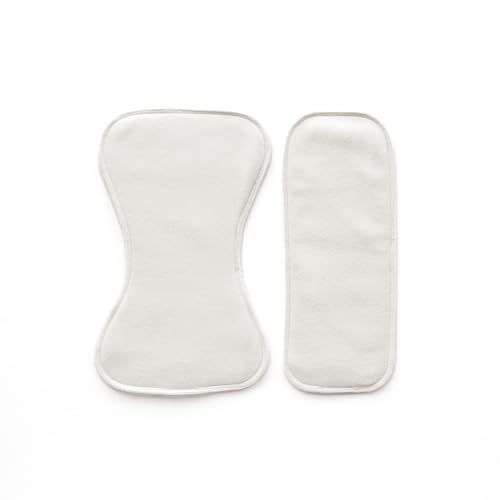


A pocket diaper is two things: a waterproof shell with a stay-dry lining, and a stuffable pocket. Absorbency is entirely down to what you put in that pocket, which is the whole appeal, because you can dial it up for a nap, a night, or a car journey without buying different diapers. What separates a good insert from a frustrating one is the fiber it is made from, how many layers it stacks, and how fast it drinks. The five here cover a first top-up pack, a heavy wetter sleeping through, and a stash rebuild on a budget.
At a glance
| Product | Standout features | Price tier | Link |
|---|---|---|---|
| Esembly Overnight Hemp Booster Set (1 contour + 1 booster) | 55% hemp, 45% organic cotton; stay-dry fleece top; use singly or stacked; two sizes | Premium | |
| Babygoal Microfiber Inserts (12 pack) | 3-layer microfiber; fits 8-33 lbs; stack two for nights; lowest cost per insert | Budget | |
| Mama Koala 6-Layer Inserts (6 pack) | 4 layers bamboo plus 2 layers hemp cotton; absorbs fast and holds; fits any diaper | Premium | |
| Wegreeco Charcoal Inserts (12 pack) | Slim 5-layer build; 13.4 x 5 in; dark charcoal face hides staining; fits most pockets | Mid-range | |
| Reginary Microfiber Inserts (24 pack) | 24 inserts plus a bag; 13.78 x 5.31 in; quick drying; most inserts per order | Budget | |
How to choose cloth diaper inserts
Three fibers, three different jobs
Microfiber is the one that comes in the box with most pocket diapers. It is cheap, it drinks fast, and it dries fast, which matters when laundry turnaround is the real constraint. Its weakness is compression: sit a baby down on a soaked microfiber insert and it gives the liquid back. It also holds less per layer than the natural fibers.
Bamboo is the middle ground, soft and thirsty, absorbing quickly and holding more than microfiber for the same bulk. Hemp is the heavyweight. It holds more liquid than anything else here and holds onto it under pressure, which is exactly the overnight problem. The trade is speed: hemp drinks slowly, so a hemp-only insert can leak from a sudden flood while still being half empty. This is why the good overnight inserts blend hemp with cotton or bamboo, using the faster fiber to catch and the hemp to hold.
Stacking is what “adjustable” actually means
There is no dial. Adjustable absorbency means putting more material in the pocket, and every listing here says so in its own way: two microfiber inserts instead of one for overnight, or a contour plus a booster used together rather than singly.
Build a routine rather than buying one insert for everything. One insert covers a daytime change. Two, or one plus a booster, covers a nap or a long outing. Overnight is where the hemp goes. The limit is the shell: stuff too much in and the diaper stops fitting round the legs, which produces exactly the leaks you were trying to stop. Bulk is the budget you are spending.
Keep microfiber off the skin
Microfiber pulls moisture aggressively, and against skin it pulls too much, which is uncomfortable and can leave a baby red. In a pocket diaper this never comes up, because the insert lives inside the pocket with the stay-dry lining between it and the baby. It matters if you are tempted to lay a spare insert straight into a cover, which is fine for bamboo, hemp, or cotton, and not fine for microfiber.
Inserts topped with a fleece layer, like the Esembly, are designed to sit against skin with the fleece side up, and that layer is doing a real job rather than decorating.
Natural fibers need prepping, and everyone forgets
Hemp, bamboo, and cotton arrive with natural oils that repel water. Straight out of the packet they can shed liquid rather than take it, and a parent reasonably concludes the expensive inserts are faulty. They need several hot wash cycles before they reach full absorbency, and they keep improving for a while after that. Microfiber has no such wait, and several listings note their inserts get more absorbent once washed. Plan for it: wash new natural inserts a few times before the night they are meant to save.
Check the width, not just the layer count
Layers are the number every listing shouts, and they are not comparable across fibers: three layers of hemp will beat five of microfiber. The dimension that quietly decides fit is width. These run from about 3.15 inches to 5.31, and a narrow insert in a wide pocket leaves channels down each side for liquid to run out. Match the insert roughly to the pocket, and check whether the listing is sized for one brand’s diapers or for most.
Esembly Overnight Hemp Booster Set
The best-selling insert of this group, and the one built for the night that everything else is judged against. The blend is 55% hemp and 45% organic cotton, which is the combination that works: cotton catches a sudden flood, hemp holds the volume under a sleeping baby’s weight. A layer of moisture-wicking fleece sits on top so the surface against skin stays dry. Esembly rates it as three times more absorbent than the insert it replaced.
The set is one contour insert and one booster, and they are meant to be used individually or stacked, which is the adjustability in physical form: booster alone for a nap, both together for eleven hours. Two sizes cover 7 to 17 lbs and 18 lbs upward, so this is fitted rather than one-size. Two things to know before buying. It is designed to sit inside an Esembly Inner, sold separately, so it assumes their system. And per piece it is easily the most expensive thing here, which is the price of solving the hardest problem rather than the everyday one.
- Pros: Best-selling insert here; 55% hemp and 45% organic cotton blend catches fast and holds under compression; stay-dry fleece top layer; contour and booster usable alone or stacked; sized for a proper fit; available as a set or a three-set bundle.
- Cons: Most expensive per insert by a distance; designed around the Esembly Inner, which is sold separately; sized rather than one-size, so it is outgrown; hemp needs several washes before it performs.
Best for: Overnight and heavy wetters, where nothing cheaper has held and sleep is the thing being bought.
Babygoal Microfiber Inserts (12 Pack)
The workhorse restock. Twelve 3-layer microfiber inserts at the lowest cost per piece here, sized 12.2 by 3.15 inches and rated for babies from 8 to 33 lbs. Babygoal is direct about how to get more out of them: use two in the pocket for overnight. That is the plain answer for microfiber, and it works, up to the point where bulk starts fighting the fit.
These are pitched at Babygoal’s own medium diapers and other brands’ medium pocket diapers, and at 3.15 inches they are the narrowest inserts in this comparison, so check them against a wide pocket before committing to twelve. Microfiber’s virtues are real and undersold: it drinks immediately, it dries in a fraction of the time hemp takes, and when a stash is in constant rotation, drying time is often the binding constraint. A three-month warranty backs them.
- Pros: Lowest cost per insert here; twelve in a pack keeps a rotation going; microfiber absorbs instantly and dries fastest; covers 8-33 lbs; two can be stacked for overnight; three-month warranty.
- Cons: Narrowest at 3.15 in, so it can leave gaps in a wide pocket; microfiber releases liquid under compression; holds less per layer than bamboo or hemp; must stay inside the pocket, never against skin.
Best for: Restocking a daytime rotation cheaply, and anyone whose real problem is laundry turnaround.
Mama Koala 6-Layer Bamboo and Hemp Inserts
The best-engineered stack here for the money. Six layers split four of bamboo over two of hemp cotton, which is the right order for the physics: bamboo on top absorbs quickly, hemp underneath holds the volume and does not surrender it when compressed. Mama Koala describes it as absorbing quickly and retaining well, and that pairing is precisely why. It is sold as suitable for any baby cloth diaper rather than only their own.
Against the Esembly this is a general-purpose insert that happens to handle nights, rather than a night specialist with a fleece top and a fitted size. For most stashes that is the more useful shape, and six of them cost less than two Esembly sets. Expect real bulk from six layers, so check the fit round the legs before assuming it will work in a slim pocket, and prep them properly, since bamboo and hemp both need several hot washes before they perform. The listing spells bamboo oddly throughout, which is a proofreading matter rather than a product one.
- Pros: Six layers combining fast-absorbing bamboo with retentive hemp cotton; genuinely suited to overnight and heavy wetters; fits any brand of cloth diaper; better value per insert than the Esembly; natural fibers hold up under compression.
- Cons: Bulky, and can fight the fit in a slim pocket; needs several hot washes before it reaches full absorbency; slower to dry than microfiber; second most expensive per insert; only six per pack.
Best for: One insert that covers days and nights across any pocket diaper, without a brand-specific system.
Wegreeco Charcoal Inserts (12 Pack)
The slim one, and the fix for a diaper that has become too fat to fit under trousers. Wegreeco builds these to be extremely slim while keeping usable absorbency, measuring 13.4 by 5 inches, which makes them the widest here and a better match for a full-size pocket than the narrow microfiber strips. The dark charcoal face is genuinely practical: staining that would be a permanent yellow shadow on a white insert simply does not show.
Two caveats, both from the listing itself. The title says five layers while the description details two layers of fiber and two of microfiber, so the construction is not stated consistently and is best taken as a mid-weight rather than a heavyweight. More importantly, the wash guidance specifies warm water under 30C, roughly 86F, with no additives or softeners. That is notably cooler than the hot washes most cloth diaper routines rely on to keep a stash properly clean, and it is worth reconciling with your own laundry routine before buying twelve.
- Pros: Slimmest profile here, so diapers stay trim under clothes; widest at 5 in, filling a full-size pocket properly; charcoal face hides staining permanently; twelve per pack; fits most pocket or cover diapers; covers newborn to toddler.
- Cons: Listing contradicts itself on layer count, so absorbency is hard to pin down; wash instructions call for under 86F and no additives, cooler than typical cloth diaper laundering; mid-weight rather than an overnight solution.
Best for: Keeping a pocket diaper slim, and anyone tired of stained inserts.
Reginary Microfiber Inserts (24 Pack)
Twenty-four inserts in one order, which is a different kind of answer. Anyone running cloth full time learns that the stash size is set by laundry frequency, not by how many diapers are owned: run out of clean inserts on a Tuesday and the whole system collapses back to disposables. This is the pack that makes that unlikely, and it includes a bag for the used ones.
The inserts themselves are conventional 3-layer microfiber at 13.78 by 5.31 inches, the largest dimensions in this comparison, which suits full-size pockets well. Reginary gives the same overnight advice as everyone else in this fiber, which is to stack two. They dry quickly, they get more absorbent after the first few washes, and they are unremarkable in every other way. That is the point. At this price per insert, the calculation is about never running out rather than about performance.
- Pros: 24 inserts in one order, enough to survive a missed laundry day; largest at 13.78 x 5.31 in, filling full-size pockets; includes a bag; quick drying; cheapest per insert alongside the Babygoal; suits newborn through toddler.
- Cons: Basic 3-layer microfiber, so not an overnight answer on its own; compresses and releases liquid under a sitting baby; generic brand with little track record; twenty-four inserts is a lot to store.
Best for: Full-time cloth with a real laundry rhythm, where running out is the failure that matters.
The verdict
Best Overall: Esembly Overnight Hemp Booster Set. The best seller here, and it earns that by solving the reason people buy inserts separately in the first place. Hemp and organic cotton with a stay-dry fleece top, a contour and a booster that stack or work alone, and enough capacity for a full night. It costs the most per piece, and a night that holds is what it is being bought for.
Best Value: Babygoal Microfiber Inserts. Twelve inserts at the lowest cost per piece, drinking fast and drying faster. Stack two for nights, keep them in the pocket, and a daytime rotation is handled for very little.
Best Premium: Mama Koala 6-Layer Bamboo and Hemp Inserts. The smartest construction here: bamboo to catch, hemp to hold, six per pack, and no brand-specific system required. If one insert has to do days and nights in any diaper you own, buy these.
For a stash that keeps failing on laundry day rather than on absorbency, the Reginary 24-pack fixes the actual problem.
FAQ
How many inserts do I actually need?
Count from laundry, not from diapers. Washing every second day, most families run through eight to twelve changes a day with a newborn and fewer as the baby grows, so somewhere around twenty-four inserts covers two days with a margin for the ones still drying. Nights need their own, since those are the thick ones. Owning more inserts than shells is normal, because the insert is the part that gets soaked every time.
Why do my brand-new hemp inserts leak?
They are almost certainly not faulty. Hemp, bamboo, and cotton carry natural oils that repel water until they are washed out, so a new natural insert can shed liquid instead of absorbing it. Several hot wash cycles fix it, and absorbency keeps improving over the first several washes. Microfiber does not have this problem, which is one reason it is what most diapers ship with.
Can I put an insert straight against my baby’s skin?
Bamboo, cotton, and hemp are fine, and inserts with a fleece top layer are designed for it, fleece side up. Microfiber should not touch skin: it pulls moisture hard enough to leave a baby dry and sore. In a pocket diaper the question is moot, since the insert goes in the pocket behind the stay-dry lining, which is exactly what that lining is for.
Will more inserts always mean fewer leaks?
Only up to a point, and past it the opposite happens. Every insert added makes the diaper thicker, and a shell stuffed too full stops sealing round the legs, which is where the leak then appears. If two inserts leak where one did not, suspect the fit rather than the absorbency. A thinner, thirstier fiber like hemp is the way out of that trap.
Do inserts from one brand fit another brand’s pockets?
Usually, with attention to width. Most are sold as fitting most pocket or cover diapers, but the widths here range from about 3.15 to 5.31 inches. A narrow insert in a wide pocket leaves channels for liquid to escape down the sides. Some listings are explicitly sized for one brand’s diapers, so read that line before buying a big pack.
This article may contain affiliate links; see our Affiliate Disclosure.